
Getting the late-night call that someone you love is sitting in a Colorado jail changes the whole room. Suddenly, everybody wants the same answer, how do we get them home, and what does the court really want from us?
The purpose of a bail bond is simpler than most paperwork makes it look. It gives an accused person a way to leave custody before trial while creating a legal and financial promise that they'll come back to court, and that promise sits inside the larger idea that a person is presumed innocent until proven guilty, not punished first and explained later. Federal data shows that pretrial release is part of a bigger system, not a single lever, and that's why families often need to sort out what the judge ordered before they can make the right decision about payment and release conditions. What pretrial release means in plain English can help with that first layer of confusion.
A serious charge can make that confusion worse, especially when the stakes feel personal and immediate. If you're trying to understand the pressure of a major case, serious felony assault consequences gives useful context for why courts treat release decisions carefully. The point of a bond is not to decide guilt, it's to create conditional liberty while the case is still pending.
Why a Bail Bond Exists in the First Place
At 2 a.m., nobody is thinking about legal theory. They are thinking about a jail phone call, a missed shift at work, and whether someone they love will sleep on a bunk that night or come home by morning.
That is where the purpose of a bail bond starts. Colorado judges can use several release tools, including cash, personal recognizance, unsecured bond, property bond, or a surety bond. A surety bond matters when the court wants a financial promise tied to a licensed agency, while still allowing release before trial. Federal Bureau of Justice Statistics data shows that pretrial release is part of a broader system, not a single punishment device. Federal pretrial release data shows that courts use different release paths, many of them with no money at all. For a simple overview of that first layer, what pretrial release means in plain English helps explain the basics.
A bail bond works like a promise backed by money. It gives the defendant a way out of custody before trial, and it gives the court a financial reason to expect a return to every required hearing. That is also why it fits inside the presumption of innocence. The person has not been convicted yet, so the system uses release conditions to manage attendance, not to hand down punishment.
Plain rule: if the court wants appearance assurance, the bond gives it. If the court wants punishment, that comes later, after conviction.
Families also need to know that release choices depend on the case, not just the paperwork. Courts can order detention, supervision, or other conditions, and the charge itself can make the decision stricter. If the case involves a major violent-felony issue, serious felony assault consequences can help explain why release decisions get serious so quickly.
How Courts Decide Who Gets Released and How
A judge doesn't pick a release option at random. The court weighs the charge, the person's history, the chance they'll return, and whether release would put anyone else at risk, then picks the least restrictive set of conditions that still does the job. That approach fits the federal view that courts should secure appearance and protect the community without using more restraint than necessary. Court risk-assessment guidance describes those connected goals clearly.
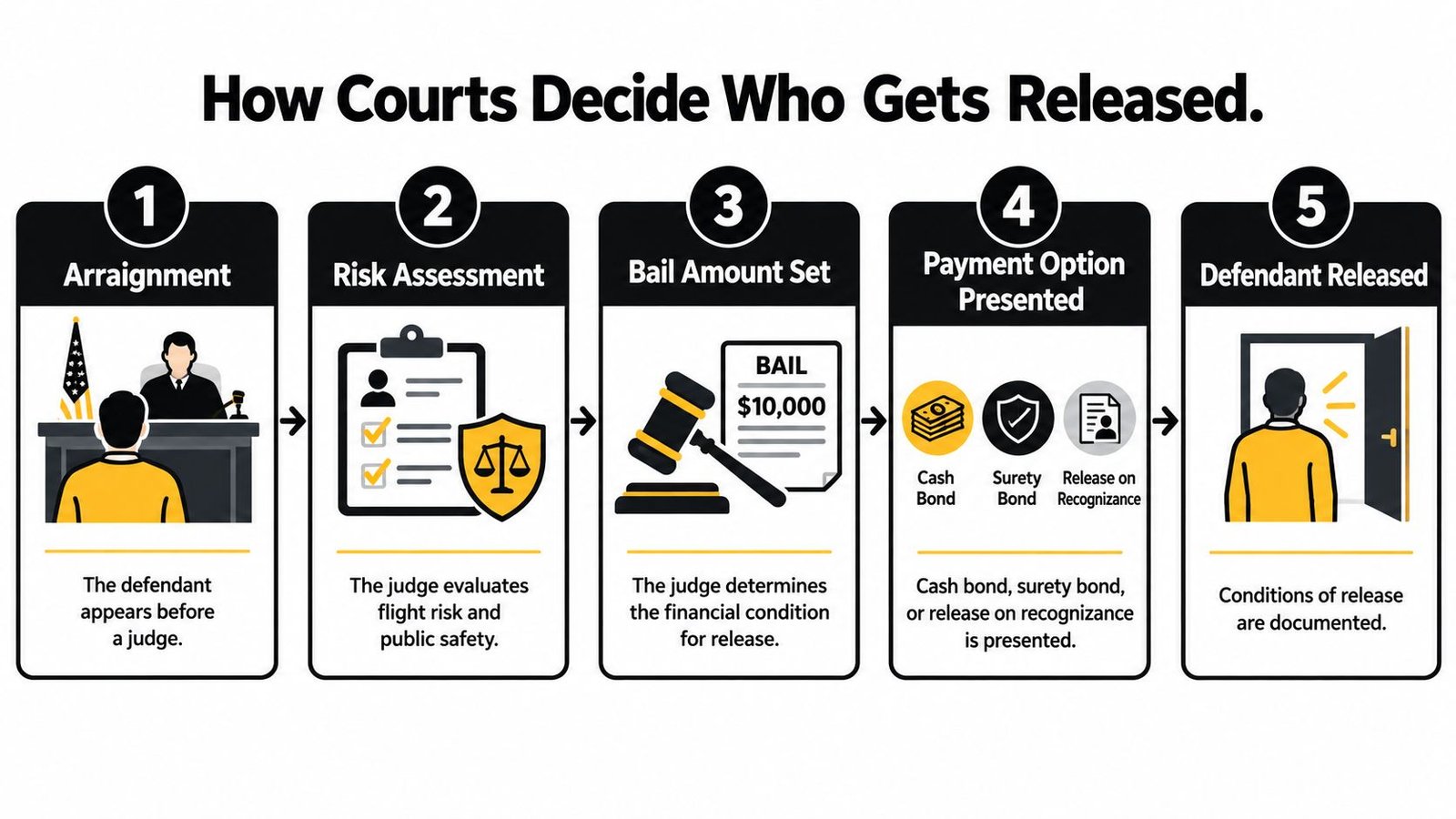
What the judge is really balancing
The federal legislative analysis is direct about the two core judicial concerns, later court appearance and protecting society. It also describes a compensated surety as a party that guarantees appearance by promising to pay the bond amount after a judicial finding of violation. Federal legislative analysis on surety bonds shows why the surety system exists at all, it gives the court a financial backstop when release is allowed.
That matters because money is only one tool in the box. A court can combine release with travel limits, reporting requirements, no-contact orders, treatment, or monitoring. The bond becomes one piece of a larger release plan, not the whole plan.
When families are trying to get paperwork moving, the practical side matters too. If documents need to be filed, e-filing, mail or fax options can reduce delays that add stress to an already hard day. And if you're comparing what release conditions may be in play, pretrial risk assessment is a useful reference point for the kinds of issues courts look at.
Cash Bonds vs Surety Bonds vs Personal Recognizance
Most families hear “bail” and assume there's only one path. There isn't. The judge may order a cash bond, a surety bond, personal recognizance, an unsecured appearance bond, or a property bond, and each one shifts the financial burden differently.
| Comparing Common Bail Release Options | Who Pays Upfront | If Defendant Fails to Appear | Typical Use in Colorado |
|---|---|---|---|
| Cash bond | The full amount is paid directly to the court | The court can keep the money and pursue forfeiture | Used when the court wants direct financial security |
| Surety bond | A bail bond company fronts the court amount, and the family pays a premium | The surety may owe the court, and the cosigner can be pursued under the contract | Common when a family can't post the full amount in cash |
| Personal recognizance | No money upfront | The court can issue a warrant and impose consequences for nonappearance | Used when the court trusts the person to return without money |
| Unsecured appearance bond | No money upfront unless there's a violation | Money becomes due only if the bond is breached | Often used when risk is managed without cash deposit |
| Property bond | Property is pledged instead of cash | The court may look to the pledged property if there's a violation | Used less often because it takes more paperwork and valuation |
The cleanest way to think about this is simple. Cash bond means the court wants the money held directly. Surety bond means the court accepts a licensed company's promise backed by a contract. Personal recognizance means the court trusts the defendant enough to release them on a promise alone.
A property bond is different again, because real estate or another asset stands behind the promise. An unsecured appearance bond is the lightest financial option, but it still carries a court obligation if the person misses required dates. Cash bond versus surety bond is useful if the paperwork doesn't make the difference obvious at first glance.
Practical rule: don't pay anything until you know which release type the court actually ordered. The wrong assumption is expensive.
What a Cosigner and Defendant Are Actually Signing
After a surety bond is ordered, the defendant and cosigner are not just helping with bail. They are entering a contract with separate duties, and each side carries its own risk.
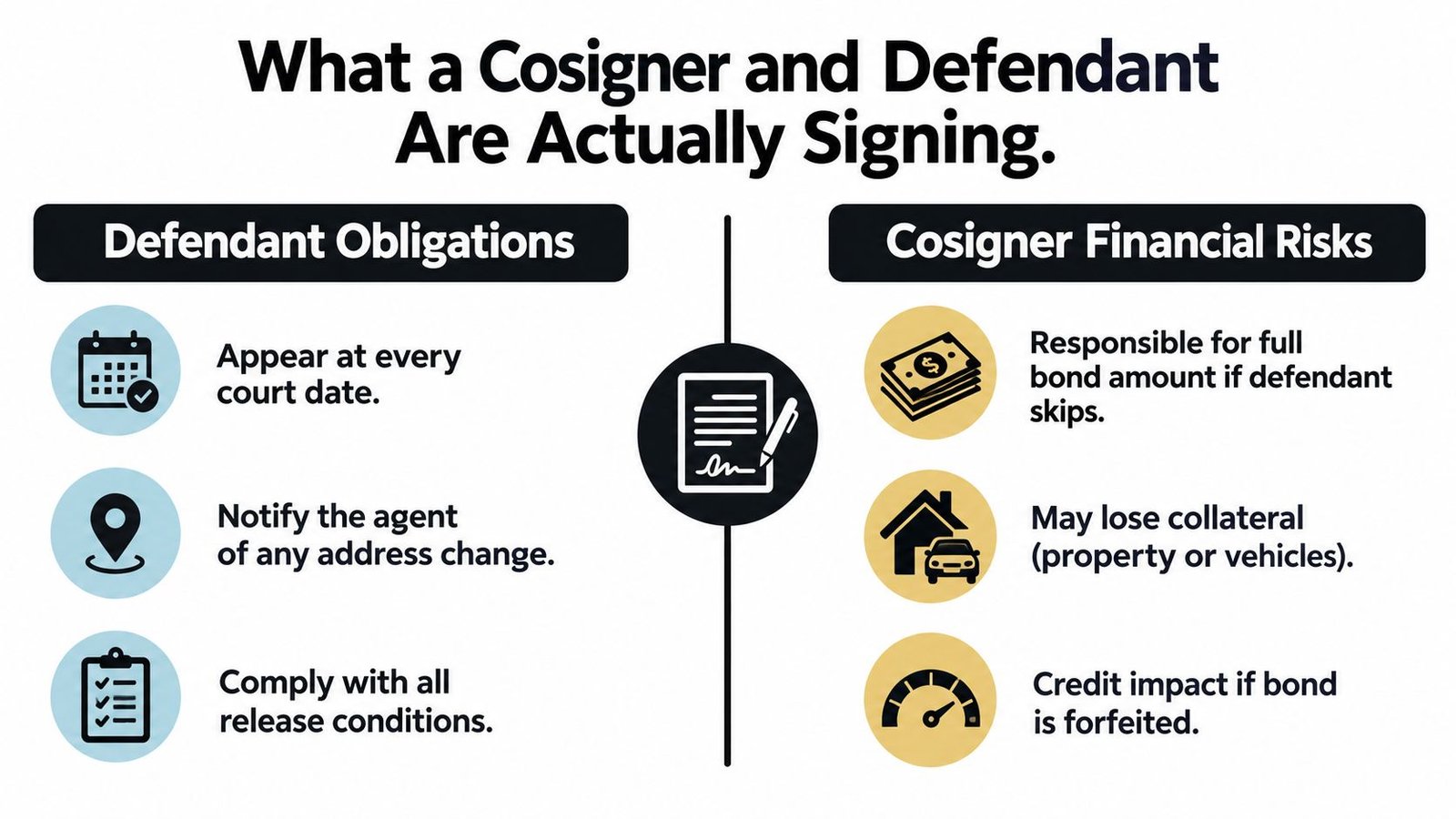
The defendant's side
The defendant has to appear at every court date, follow the release conditions, and stay reachable. If the agent asks for contact details, an updated schedule, or clarification about a condition, the defendant needs to respond quickly. A bond depends on compliance, so silence creates risk fast.
Before signing, review what signing a bond for bail actually involves so both parties understand the obligations they are accepting.
The cosigner's side
The cosigner accepts financial responsibility if the defendant misses court or breaks a bond condition in a way that triggers loss. That can include the full bond amount, collateral, and the pressure of tracking documents and deadlines after the fact. Federal Rule of Criminal Procedure 46 also makes clear that forfeiture is not always final, because the court may set aside all or part of it if the surety later surrenders the defendant or if justice does not require forfeiture. Rule 46 and forfeiture explains why this duty is conditional, not automatic forever.
Read this twice before signing: the bond is not paid to “buy freedom.” It is a contract that makes freedom conditional on compliance.
Families often compare release options before they commit to a surety bond. A cash bond means the court wants money held directly. Personal recognizance means the court is trusting the defendant on a promise alone. An unsecured appearance bond and a property bond each work differently again, so the right choice depends on what the judge ordered and what the family can realistically handle.
How the Premium and Fee Structure Actually Works
The premium is where many families get tripped up, because they assume they'll get the money back later. They won't. The premium is the fee for the surety taking on the risk, and once the bond is posted, that fee is earned.
Colorado's standard premium is 15%, and for bonds over $5,000, agencies often use 10% with an approved cosigner. Approval isn't magic, it usually means the cosigner has verifiable income, valid ID, Colorado ties, and the willingness to accept financial liability if the defendant fails to appear. Surety bond premium details explains the framework families usually see in practice.
Here's the clean math on a $20,000 bond at 10%. The premium would be $2,000, paid at signing. The bail company guarantees the rest to the court, and the family's financial exposure depends on whether the defendant complies, plus any collateral tied to the agreement.
Bottom line: the premium is not a deposit. It's the price of the bond service, and it usually doesn't come back even when the case ends well.
A lot of people also ask whether payment plans exist. Some agencies offer them, but the court's bond amount and the company's underwriting rules still control what's possible. The video below is a helpful visual if you want to see how the numbers work out in a simple bond calculation.
The premium only makes sense if the family understands what's being purchased, which is the surety's promise to the court and the release paperwork that goes with it. It does not erase the case, and it does not replace the duty to appear.
What a Licensed Colorado Bail Agency Does for You
A family calling a licensed Colorado bail agency is usually trying to solve one immediate problem, how to get a loved one released while the court process keeps moving. The agency works with the jail, the court, and the paperwork that has to be accepted before release can happen.

What happens behind the scenes
A licensed agency can take intake by phone or text, prepare electronic contracts, collect payment, and coordinate posting with detention staff. That helps when the cosigner is out of state or when nobody can spend hours in a lobby. It also helps when the case crosses county lines, because each facility still follows its own release steps.
Colorado agencies work across Denver, Jefferson, Arapahoe, Adams, Douglas, Weld, El Paso, and other counties, and they stay involved after the release paperwork is done. Express Bail Bonds' main site says the company focuses on surety solutions and electronic completion of applications, payments, and contract documents.
Why process matters as much as price
A bond posted the wrong way can slow everything down. Families still need hearing reminders, court-date tracking, and clear guidance about release conditions so one missed appearance does not create a larger problem. That kind of support is part of what the agency is providing, steady coordination while the legal clock keeps moving.
Colorado families also need to know when remote paperwork is enough and when someone has to act in person. If the defendant is in a county facility far from home, electronic paperwork can mean the difference between release that night and waiting until morning.
Common Misconceptions and Your Next Steps
The first myth is that paying the premium ends the case. It doesn't. The bond only deals with release conditions, not guilt, sentencing, or dismissal, and the rest of the criminal case keeps moving after the jail door opens.
The second myth is that the bond disappears the second the defendant is found not guilty. The court may end an appearance bond and release the bond and its security when the defendant is found not guilty on all charges or reports to serve a sentence, but that happens through the court's process, not by accident. U.S. Courts bond materials make clear that compliance still matters until the court formally closes the bond.
The third myth is that every agency charges the same thing. Colorado's standard premium is commonly 15%, but a lower 10% bond rate for amounts over $5,000 usually depends on an approved cosigner and the agency's underwriting standards. If a family is comparing options, that's a real difference in cost and responsibility, not a minor detail.
Short version: the right bond is the one the court ordered, priced correctly, and signed by someone who understands the obligation.
If you're in Jefferson County or Golden, start with Jefferson County bail bond help. If the case is in the south metro area, Centennial bail bond support is the faster route. If you need statewide help right now, the safest move is a short call before the paperwork gets any harder.
If your family needs a clear explanation of a surety bond, what it costs, and what the signing means, Express Bail Bonds can walk you through the next step and help you confirm the court's release order. They handle Colorado surety bonds, electronic paperwork, and county coordination, which makes the process easier when everything feels urgent. Call before you guess, because the right advice at 2 a.m. usually saves time, money, and a lot of stress.