At 2 a.m., the call usually sounds the same. Someone you love is in a Colorado detention center, a bond amount has been set, and an agent is asking whether you can sign. You want the person home, but you also need to know what your signature could cost, which documents control the deal, and what happens if the defendant misses court.
Signing a bond for bail isn't just paying a fee and waiting for release. You may be agreeing to three separate obligations: a nonrefundable premium, conditional collateral, and contingent indemnity liability. Read the contract as if your own property and savings are at stake, because they may be.
What Signing a Bond for Bail Actually Means
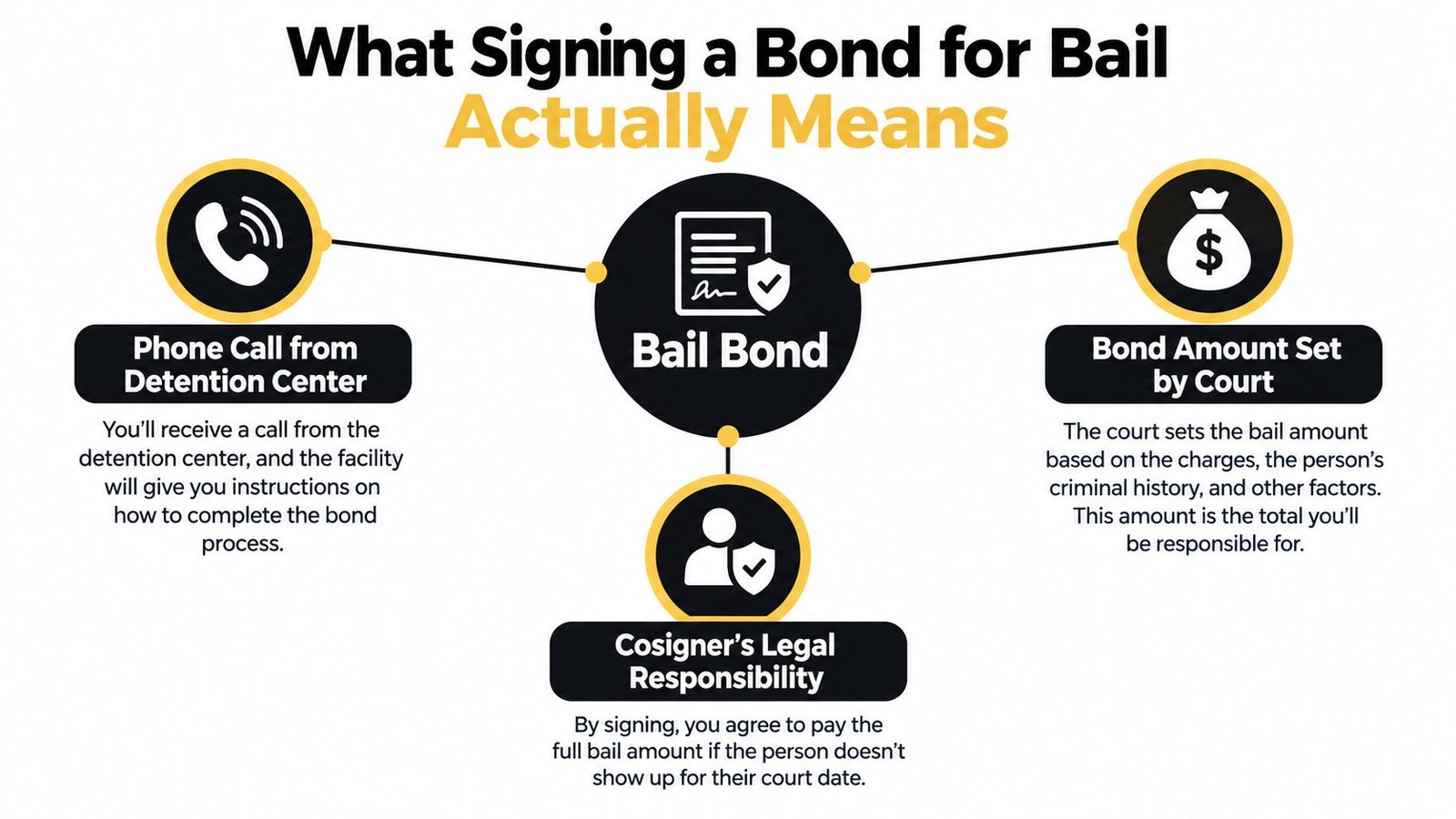
A surety bail bond is a contract involving three parties: the defendant, the court, and a commercial bond company. The bonding company promises the court that the defendant will follow release conditions and generally signs an obligation for the full court-ordered bail amount. You, as the cosigner or indemnitor, help support that promise.
The court's bail amount and the amount you pay the agent are different things. A historical federal study found that defendants released on surety bonds had a median bail amount of $5,000, while the typical amount paid to secure the bond was about 10%, or approximately $710 on average in that study. Those figures are historical federal benchmarks, not current Colorado pricing, so rely on the signed Colorado contract rather than an old example. Federal pretrial release data explains the distinction between the court's full obligation and the upfront surety payment.
The three obligations behind one signature
The premium is the fee paid to the bonding company for providing the surety service. It isn't the same as the bail amount, and it generally isn't refundable once the defendant is released.
Collateral is separate security. The agent may require cash, a vehicle title, property interest, or another asset in addition to the premium. The contract should identify exactly what is pledged and how it will be released.
Indemnity liability is the serious part. If the defendant fails to appear or violates the bond, the surety can become liable for the full amount promised to the court. The cosigner may then owe the company under the indemnity agreement, along with contract-defined expenses.
Federal Bureau of Justice Statistics data show that approximately 70% of defendants in state felony cases had bail set and had to post all or part of it for release, while commercial surety bonds were the most common release method through 2006, accounting for 42% of releases. The federal state felony release data helps explain why these contracts are routine. Routine doesn't mean low-risk.
Practical rule: If you wouldn't accept the possibility of losing the full bond amount, don't sign until the agent explains the exposure in writing.
Documents and Information You Need Before Signing
Don't start with the payment link. Start with identity, court information, and document control. A rushed signing creates confusion later, especially when relatives are coordinating from another state.
Have these details ready:
- Defendant identity: Obtain the full legal name and date of birth exactly as recorded by the jail or court.
- Booking information: Record the booking number or case number and the precise detention facility.
- Court order: Confirm the exact bond amount and every charge as written in the paperwork.
- Cosigner identity: Prepare valid identification and accurate contact information for every indemnitor.
- Collateral records: If property, a vehicle, or cash is pledged, gather the title, deed, account record, or other ownership document.
The agent should provide a written, signed, and dated agreement before taking consideration. That agreement should state the premium, payment schedule, applicable charges, collateral description, surrender provisions, and default consequences. You should also receive a signed, dated receipt for each premium payment, plus a separate collateral receipt when collateral is pledged.
Use the contract as the control document
Colorado law limits a bail-bond producer's premium or commission to the greater of $50 or 15% of the furnished bail, and generally prohibits extra bond-posting fees unless they fit specified categories. Those categories can include a court or law-enforcement filing charge, secure collateral storage, or premium financing. Colorado's bail-bond statute is the right place to check the legal framework, while the signed agreement tells you what this particular transaction requires.
An oral quote, text message, or phone promise isn't enough. Compare the contract against the receipt and the court paperwork before signing. Confirm whether the agent's signature relates to the bond obligation only, because Colorado law distinguishes the producer's bond obligations from a lender debt owed by a consumer.
For families coordinating several calls at once, reliable after-hours communication matters. Law firms handling release work may also benefit from resources that improve law firm call coverage when clients or relatives need a prompt response.
Keep copies of the bond, indemnity agreement, collateral receipt, payment receipts, court order, and every written instruction. The documents needed for a Colorado bail bond should be collected before the defendant leaves custody, not reconstructed months later.
Electronic vs In-Person Signing
Electronic signing is practical when a parent in another state needs to help a defendant in Colorado, especially after normal office hours. In-person signing is better when the agent must inspect collateral, verify original ownership documents, or walk a hesitant cosigner through a complicated agreement face to face.
| Factor | Electronic Signing | In-Person Signing |
|---|---|---|
| Speed | Documents, identification, and payment can be exchanged remotely | Requires travel to the agent's office or another approved location |
| Best fit | Out-of-state relatives and urgent after-hours coordination | Local cosigners with physical collateral or questions requiring discussion |
| Identity verification | Photo identification and an electronic signing platform | Government identification reviewed in person |
| Collateral | Uploads and scanned records may start the review | Titles, deeds, and other records can be examined directly |
| Main risk | Clicking through without reading every attachment | Assuming an in-person meeting replaces careful contract review |
| Before signing | Confirm the agent's Colorado license and authority to bind your assets | Confirm the same points and obtain complete copies before leaving |
Electronic execution doesn't reduce the legal responsibility. It only changes how the documents reach you. Before clicking, verify the bonding company's Colorado license, the exact defendant and bond amount, the identity of each person signing, and whether you have authority to pledge an asset located in another state.
Ask where the completed copies will be stored and how you can retrieve them. Don't rely on a phone screenshot of one page if the agreement includes attachments, payment terms, or collateral schedules. You need the complete signed package.
Remote signing is especially useful when the jail is far away, but it can create pressure to approve documents you haven't reviewed. Take the same approach online that you would take at an office. Read the premium, installment terms, indemnity language, collateral provisions, surrender rules, and default expenses before entering payment information.
For Colorado families who need the process handled remotely, online contract signing for bail bonds can make document exchange more manageable. It doesn't replace the need to understand what you're signing.
Fees, Premiums, and What the Cosigner Actually Pays
The first cost is the premium, not the full court-ordered bail amount. Colorado limits a licensed bail-bond agent's premium or commission to the greater of $50 or 15% of the bail furnished, subject to the statute and the written agreement. The Colorado Division of Professions and Occupations describes that ceiling and minimum in its 2025 Sunset Review of bail bonding.
For example, a $10,000 bond could carry a maximum regulated premium of $1,500. That premium is the charge for the surety service. It isn't collateral, and it isn't the amount the surety promises the court. The contract must show the actual rate and payment terms.
Separate the bill into four lines
Premium: This is the compensation for posting the surety bond. Colorado's statutory ceiling is 15%, with a $50 minimum.
Collateral: This may be required in addition to the premium. It secures the agent against the risk created by the bond and must be documented separately.
Permitted charges: Colorado generally prohibits additional bond-posting fees unless they fit specified categories, such as a court or law-enforcement filing charge, secure collateral storage, or premium financing.
Payment schedule: An installment arrangement doesn't change the underlying obligation. Write down each due date and ask what happens if a payment is late.
The premium is generally earned in full when a compensated surety releases the defendant. That means dismissal, acquittal, or a later change in the case doesn't automatically create a refund. Collateral follows a different rule. It may be returned after the bond is formally exonerated and all contractual conditions are satisfied, but don't assume release is automatic. Ask for the procedure in writing.
Some Colorado agents may offer a rate below the statutory maximum. Express Bail Bonds states that its standard Colorado premium is 15% and that 10% is often available on bonds over $5,000 with an approved cosigner. Any negotiated rate must appear in the signed contract, not just in a phone conversation. Review this surety bond premium guidance before accepting a quote.
Cosigner Liability and What You Can Actually Lose
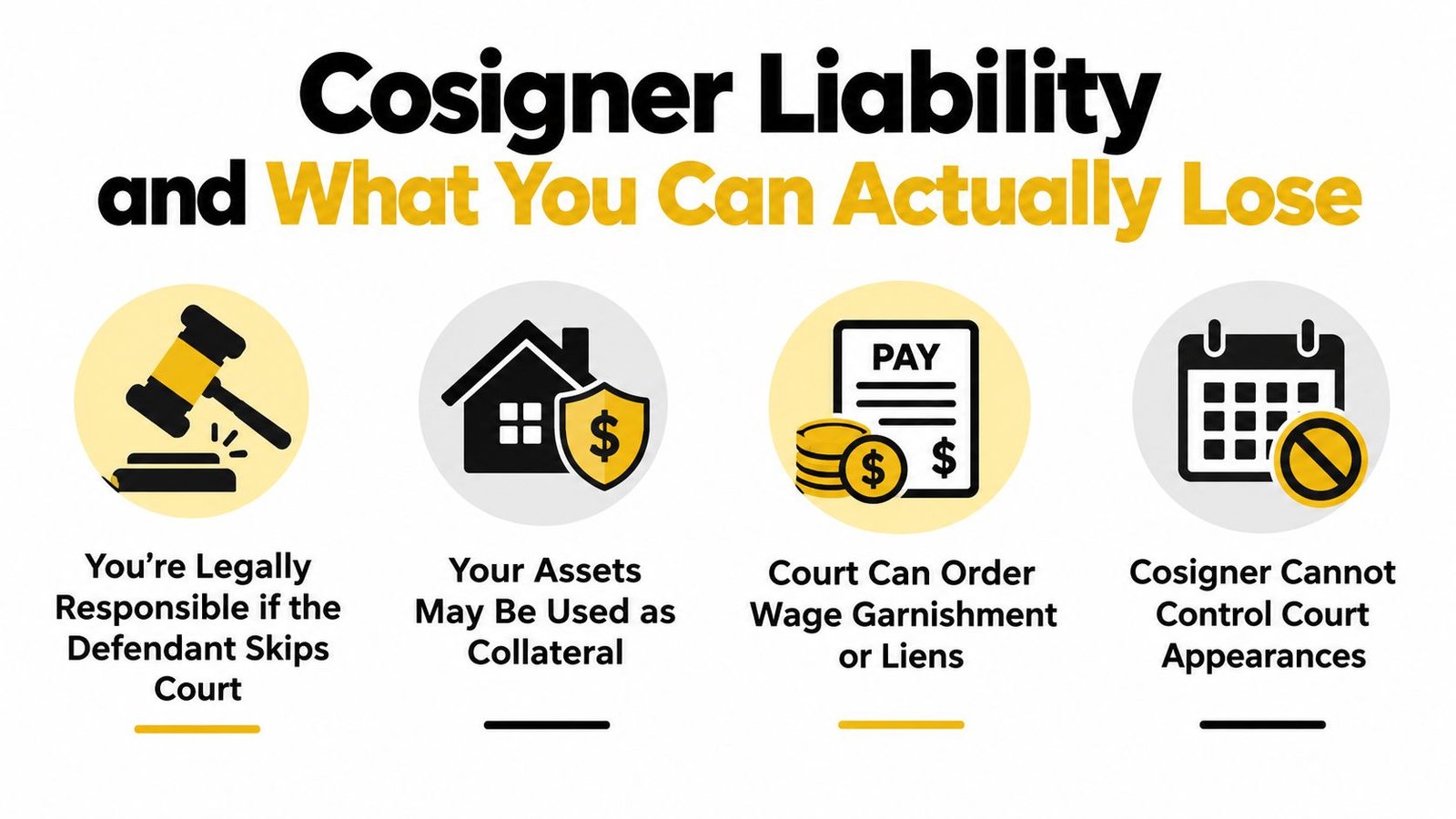
A cosigner is a contingent financial guarantor. The premium may be the amount you pay immediately, but it isn't necessarily the limit of your exposure. Colorado consumer guidance states that a cosigner may be responsible for the bond's full face value, may have to provide collateral, and may owe reasonable apprehension or bounty-hunting costs if the defendant fails to appear.
That risk sits outside the simple question, “How much is the fee?” If the defendant disappears, the agent may pursue the cosigner for amounts due under the agreement. Collateral may be retained or applied according to the contract and applicable law.
The appearance risk is still real
A secured bond doesn't guarantee that the defendant will attend court. Research summarized in Colorado consumer guidance found no statistically significant appearance advantage for secured bonds over unsecured bonds among comparable risk groups. For low-risk defendants in that study, 97% appeared on unsecured bonds compared with 93% on secured bonds. Colorado's consumer bail-bond guide supports the practical conclusion: the contract doesn't remove the need for supervision and communication.
After signing, use a strict control routine:
- Confirm the next court date. Don't rely only on the defendant's memory. Check the paperwork and verify with counsel or the court.
- Record every appearance. Put hearings, check-ins, testing, and reporting obligations on a shared calendar.
- Keep contact information current. Notify the agent immediately about address, phone, custody, or immigration-status changes.
- Collect the complete file. Keep every indemnity, collateral, receipt, court notice, and payment record.
- Act on warning signs. If the defendant stops responding or talks about leaving, contact the agent promptly instead of waiting for a missed appearance.
The cosigner's job doesn't end when the defendant walks out of jail. It changes from arranging release to controlling information, dates, and communication.
Read the cosigner responsibilities for a Colorado bail bond before you sign. If you can't monitor the defendant or absorb the contractual exposure, declining the bond is safer than signing under pressure.
Release Conditions That Still Apply After You Sign
Posting the financial bond may not be the final release requirement. The judge sets release conditions, and the defendant must follow every condition attached to the court's order. A surety bond doesn't cancel supervision, reporting, travel limits, no-contact orders, testing, electronic monitoring, or court-date notices.
Denver Pretrial Services interviews defendants booked on a new pending criminal charge, checks national, state, and local criminal-history databases, and scores pretrial risk assessments. It then gives the court a Bond Advisement Report with recommendations about release conditions and supervision. Denver Pretrial Services illustrates why money is only one part of release.
Federal data for 2025 reported pretrial-services supervision for 86% of defendants released with specified conditions. The federal 2025 pretrial-services report shows how frequently release includes supervision rather than a bond alone.
Ask these questions before assuming release is complete
- Is there a probation or parole detainer?
- Is another warrant active?
- Is there an immigration hold or separate immigration matter?
- Does the judge require electronic monitoring, testing, or pretrial check-ins?
- Is there a no-contact or geographic restriction?
- Who will provide the next court-date notice?
- Could another case keep the defendant in custody after this bond posts?
Denver states that failure to appear on the new court date listed on the bond paperwork can lead to forfeiture and a new arrest warrant. If the defendant follows the conditions, the bond is released when the case reaches final disposition, but a professional bonding-company premium isn't refunded. Denver court services information explains those mechanics.
Remote families sometimes need help verifying a changed address or locating a person who has stopped communicating. That is separate from the bail contract, but a service such as people tracing London may be relevant for a family handling an international location issue.
Next Steps After the Bond Is Signed
The first job after signing is confirmation. Ask the agent whether the bond has been accepted and posted, whether the jail has processed it, and whether another hold or court condition remains. Collect the defendant's property, confirm the release instructions, and keep the complete paperwork in one secure folder.
Then review the agreement line by line. Confirm the next court date, every installment due date, collateral description, surrender terms, and the process for requesting collateral release. Use this Colorado jail release process as a practical reference, but verify the defendant's actual status with the facility and court.
Your obligation generally ends when the case is resolved and the bond is formally exonerated. Don't treat a final hearing, dismissal, or acquittal as proof that the paperwork is complete. Ask the agent for written confirmation of exoneration and collateral release, then retain it with your receipts.
Express Bail Bonds offers statewide Colorado surety-bond service, electronic applications and contract documents, and 24/7 help by call or text at 720-984-2245. The agency has a Denver base, a Jefferson County Golden location, and a Centennial office, with a standard Colorado premium of 15% and 10% often available on bonds over $5,000 with an approved cosigner.
If you're signing tonight, contact Express Bail Bonds to review the bond amount, premium, collateral, indemnity terms, and release conditions before you commit. Their electronic process can help out-of-state cosigners complete documents remotely while agents coordinate posting at Colorado detention facilities.