
In Colorado, a commercial bail surety bond premium is capped at 15% of the bail amount or $50, whichever is greater, and it's non-refundable. On bonds over $5,000, some families may qualify for a 10% rate with an approved cosigner, which can make a real difference when money is tight.
If you're reading this late at night, phone in hand, trying to figure out what it will cost to get someone out of jail, that's the number you usually need first. Most families aren't asking for a lecture on surety law. They want a straight answer, they want to know whether the money comes back, and they want to know what questions to ask before they agree to anything.
The part that trips people up is simple. A surety bond premium is not the same thing as cash bail sitting with the court. You're paying for a licensed company to guarantee the full bail amount to the jail or court. That fee is earned when the bond is written and maintained, so it usually doesn't come back even if the case ends well.
That's why a family can feel shocked after hearing, “The premium is this much,” and then asking, “Wait, we don't get that back?” If that's your situation, you're not confused because you missed something. You're confused because many bond cost pages skip the plain-English explanation.
What a Surety Bond Premium Really Means for Families
It is 11 p.m., someone you love has just been booked, and the jail has finally given you a bail amount. The first question is usually not about court procedure. It is, “How much do we need to pay to get them out?”
A surety bond premium is the fee you pay a bail bond company to stand behind the full bail amount. The company is putting its name, license, and money on the line with the court so your family does not have to bring the entire bail amount in cash.
A simple way to picture it is a co-signer on a very large promise. The premium is the price of that promise.
A surety bond premium is typically non-refundable because it is the earned fee for writing and maintaining the bond, while collateral is separate and must be returned after discharge if it was not applied to a forfeiture.
That is where families often get crossed up. The premium pays for the bond to be written and posted. Collateral is separate. If collateral is required, it is extra protection for the bond company and may come back later if there is no loss on the bond.
People also mix up three different buckets of money:
- Cash bail: money paid directly to the court
- Surety bond premium: the fee paid to the bond company for the guarantee
- Collateral: property, cash, or value held separately in some cases
Those terms sound close when you are stressed, but they work very differently. If you want a plain-English breakdown, this guide on whether bail is refundable clears up the difference between court-held bail money and a bond company's premium.
For Colorado families, the practical meaning is straightforward. If bail is set at a level you cannot pay out of pocket, the premium is the smaller amount that gets the release process started. In many cases, that is the difference between someone waiting in custody and getting home while the case moves forward.
The value is not only the signature on paper. It is also the work that follows: contacting the jail, preparing documents, checking cosigners, and posting the bond correctly so release is not delayed by avoidable mistakes.
How Surety Bond Premiums Are Calculated in Plain English
The math is simpler than the terminology. In most surety settings, the premium is figured as a percentage of the bond amount. The broad formula is direct.
Practical rule: Premium = bond amount × premium rate.
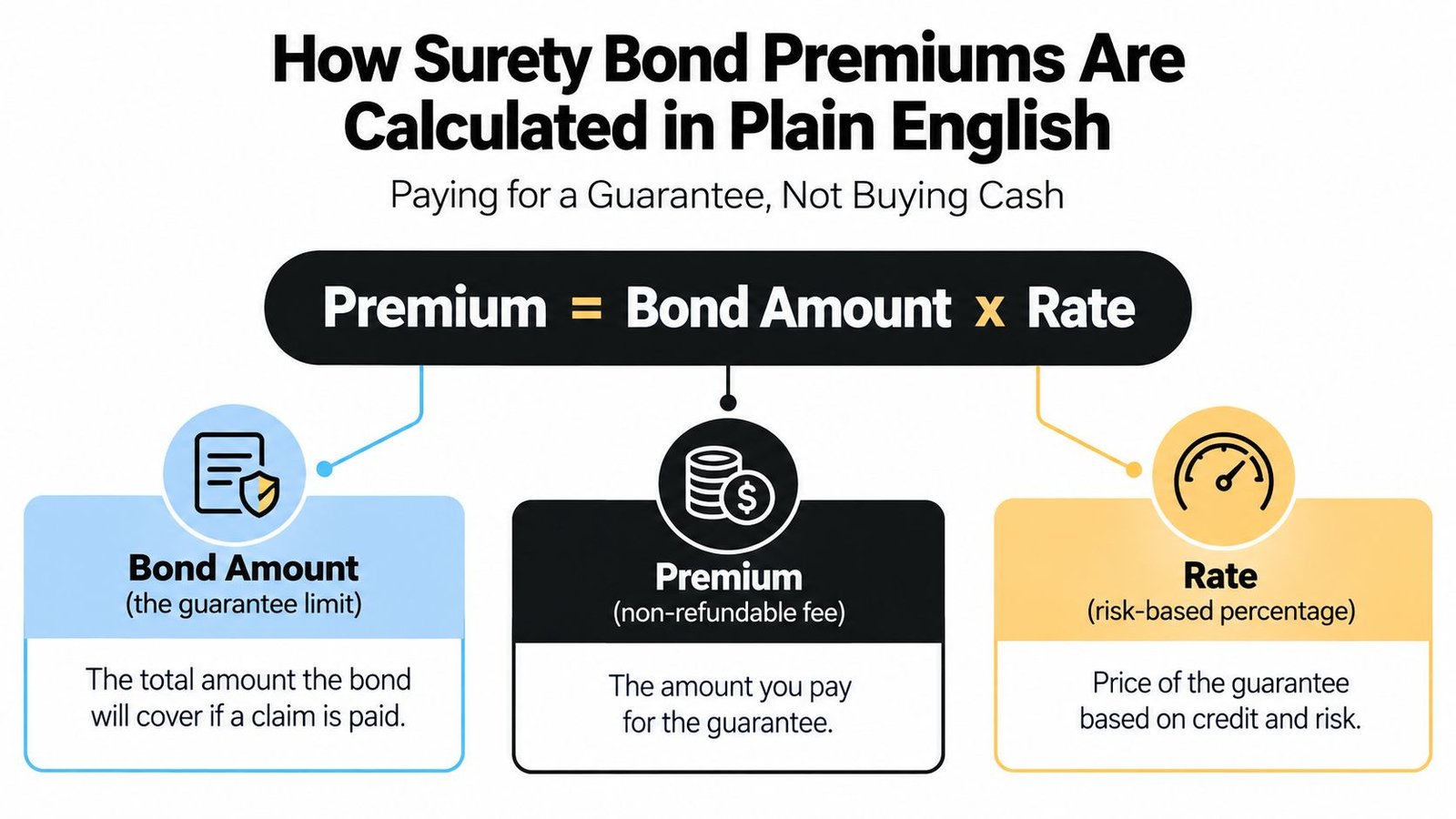
That sounds almost too simple, so where does the confusion come from? It comes from the rate. The rate isn't random, and it isn't always flat across all bond types.
The three parts that matter
Bond amount
This is the total obligation being guaranteed. If the bond amount goes up, the premium usually rises too because the basic calculation is linear.Premium rate
This is the percentage charged against the bond amount. Public and market references show surety bond premiums can run about 1% to 15% of the bond amount per year in broader markets, while some lower-risk public bond schedules are much lower according to this surety market overview.Bond type and underwriting
Surety pricing is driven by the applicant and the obligation, not by a pooled insurance model. A Casualty Actuarial Society paper notes that surety underwriting looks at the principal's risk profile, financial strength, and obligation type, and market ranges often fall around 0.5% to 10% depending on qualification level in this underwriting discussion.
What the premium is really buying
A lot of people hear “premium” and think of insurance. That comparison helps a little, but not all the way. In surety, the company is extending a guarantee based on the specific applicant and the specific obligation.
That's why one bond can price near the low end and another lands much higher. The guarantee is being priced for risk, not sold as a one-size-fits-all product.
Why payment timing matters too
Even when the math is straightforward, the cash flow can still be hard on a family or small business. Some people find it useful to read a plain-language flexible payment timing guide before deciding whether to pay all at once or spread costs out.
If you want a bail-specific version of the same idea, this guide on how bond pricing works shows how the percentage translates into what you pay at signing.
Colorado Bail Bond Premium Rates and Legal Limits
Your sister calls from jail, the bail is set, and the first question out of your mouth is usually, “What will this cost me today?” In Colorado, that answer is not supposed to be a guessing game. State rules put a clear frame around commercial bail bond pricing, so families can ask better questions and catch charges that do not belong.
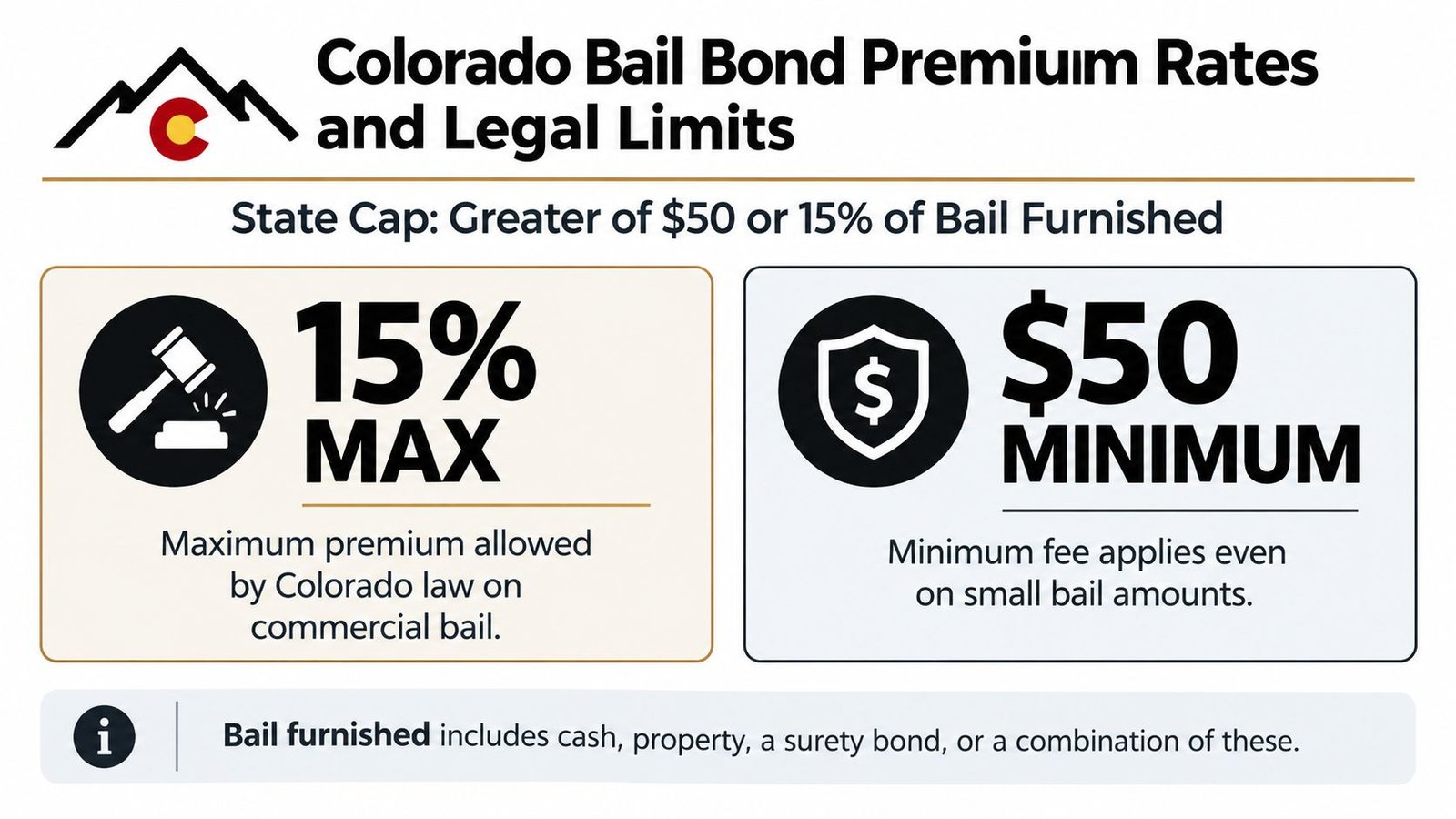
The basic rule is straightforward. For a Colorado commercial bail bond, the premium is capped at the greater of $50 or 15% of the amount of bail furnished. Colorado also limits what can be added beyond that premium to specific permitted items, such as filing fees, actual collateral storage costs, or lawful financing-related charges.
That gives families three guardrails right away. There is a minimum charge on small bonds. There is a maximum percentage on larger bonds. There are also limits on the extra fees an agency can discuss.
Here is what that sounds like in plain English on a real call. If bail is set at $1,000, the percentage math would be lower than the minimum, so the $50 floor matters. If bail is $10,000, the standard ceiling points you to a $1,500 premium at 15%. That is the number many Colorado families hear first.
Some families may qualify for less than that top percentage. A common example is a 10% cosigner option on certain bonds over $5,000 when the cosigner is approved. Using the same $10,000 bail example, that changes the premium from $1,500 to $1,000. It is the same bond amount. The difference is the strength of the file and whether the bond qualifies.
That point trips people up, so it helps to use a simple comparison. The bail amount is the full promise to the court. The premium is the price of having the bond posted for you. A stronger cosigner can sometimes lower that price, but it does not reduce the court's bail amount itself.
What to ask before you agree
A calm, clear quote usually starts with four questions:
- What is the bail amount, and what percentage are you charging? Ask for both numbers.
- Is this quote based on the standard 15% rate or an approved 10% cosigner option? That helps you compare offers fairly.
- Are there any permitted extra charges? If so, ask for each one by name and amount.
- Is this a surety bond or a cash-only bond? Cash-only bonds follow a different path.
If you want to see how an agency explains one of those added charges, this page on the premium processing fee and how it is disclosed gives a more specific example.
The short video below gives a useful visual overview before you sign anything.
Local procedure still affects timing, paperwork, and how fast a cosigner can get documents completed. Those steps can change the experience, even when the premium rules stay the same.
Why Bail Premiums Differ From Other Surety Bond Types
People get confused when they search “surety bond premium” and see rates that look far lower than bail bond premiums. The reason is simple. Not all surety bonds are priced on the same structure or risk profile.
Some general surety references place common market ranges around 0.5% to 10% for stronger to higher-risk applicants, while standardized lower-risk bonds may land near 1% to 3% annually and higher-risk placements may rise to 7.5% to 15% or more as described in this bond cost overview. Bail sits in a different lane from many of those examples.
The cleanest comparison
For Colorado official bonds, the statutory premium is much smaller. The law says the premium “shall not exceed one-half of one percent per annum on the amount or penalty of each bond or obligation” under this Colorado official bond discussion.
That phrase matters because it shows two important differences at once. First, the rate is 0.5% per year, not a commercial bail percentage. Second, it's an annual pricing structure.
| Bond Type | Typical Premium Range | Pricing Basis |
|---|---|---|
| Colorado commercial bail bond | Up to 15% of bail, with a $50 minimum under Colorado law | Based on amount of bail furnished |
| Colorado official bond | Up to 0.5% per annum | Annual premium on bond amount or penalty |
| Other surety bond types in broader markets | Often around 0.5% to 10%, with some lower-risk bonds near 1% to 3% annually and higher-risk placements rising to 7.5% to 15% or more | Risk-based underwriting tied to bond class and applicant strength |
Why bail often looks higher
Bail is tied to immediate release from custody and short-fuse risk. The bond has to be posted fast, the defendant has to comply with court requirements, and the exposure can be very different from an official bond or a routine license-style obligation.
When readers compare a bail quote to a public official bond quote, they're usually comparing two different products that happen to share the word “surety.”
Worked Examples and Simple Calculator You Can Use
Numbers feel less scary when you can work them on paper. For Colorado bail, families usually want to know the premium on the bail amount they were just given and whether a qualified cosigner could lower it.
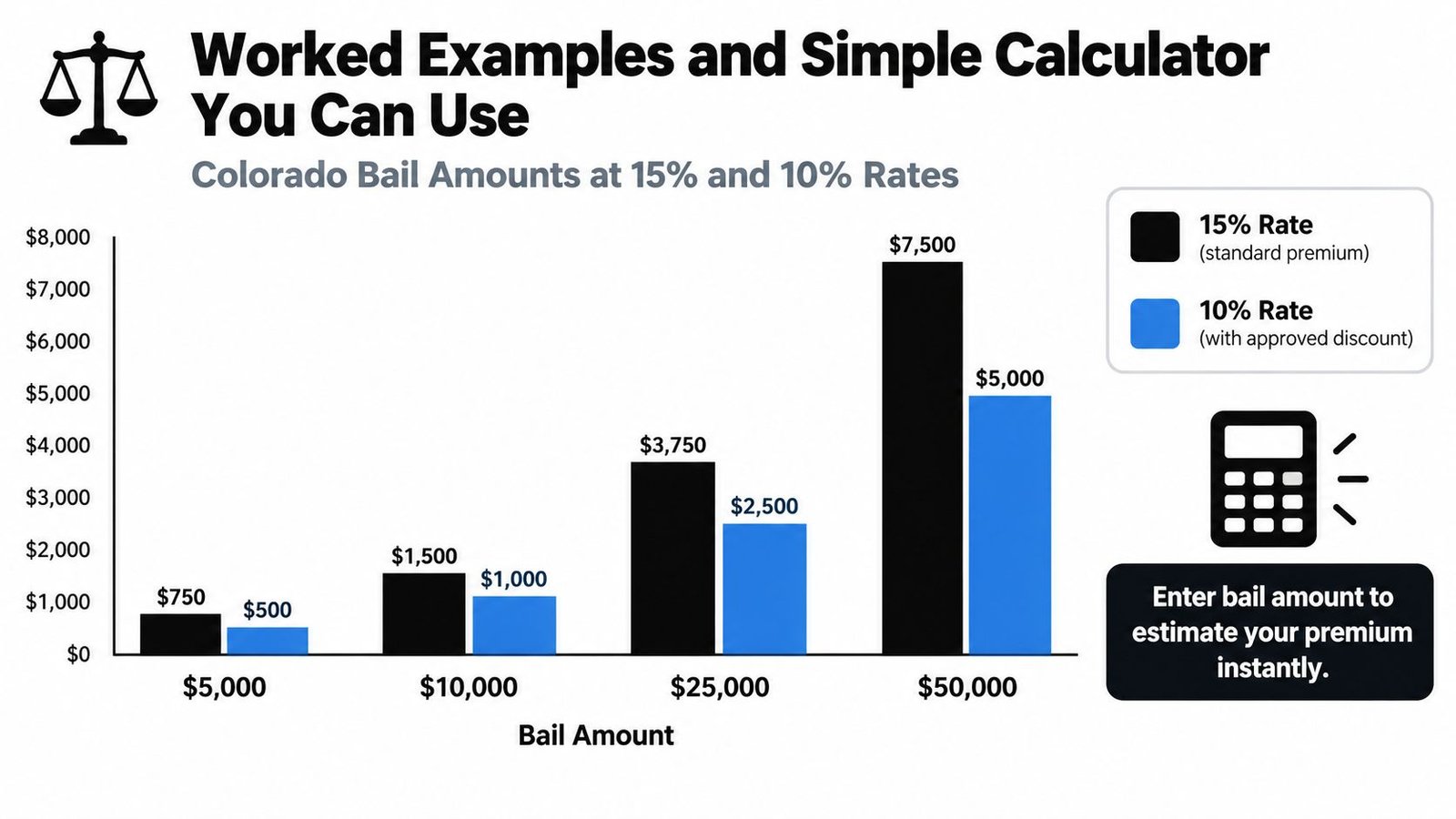
Four Colorado-style examples
Here's what the premium looks like at the standard 15% rate and at a possible 10% cosigner rate on eligible bonds over $5,000:
$5,000 bail
- 15% premium: $750
- 10% premium: $500
$10,000 bail
- 15% premium: $1,500
- 10% premium: $1,000
$25,000 bail
- 15% premium: $3,750
- 10% premium: $2,500
$50,000 bail
- 15% premium: $7,500
- 10% premium: $5,000
On a larger bond, that rate change matters quickly. Moving from 15% to 10% doesn't sound huge until you see the dollar result.
Bond premium = bail amount × premium rate, then add any permitted charges that were clearly disclosed.
A three-step calculator you can reuse
Use this simple method any time you get a quote.
Start with the bail amount
Write down the full bond amount set by the court.Apply the quoted rate
Multiply the bail amount by the premium percentage. If the quote is at the legal maximum, use 15%. If you've been approved for a reduced rate, use that number instead.Ask about permitted extra charges
Add only charges that are allowed and clearly explained, such as permitted filing or financing-related charges where applicable.
Don't forget the small-bond floor
Colorado also has a $50 minimum for commercial bail bond premiums. That means if the percentage calculation on a very small bond would come out lower than $50, the premium still won't drop below that floor.
If you want to compare your estimate against a bail-specific cost page, this breakdown of how much a bail bond costs is a practical next stop.
Payment Options Financing and Fee Transparency
A family may understand the premium and still feel stuck. The next question is usually simple and urgent. How do we come up with the money tonight?
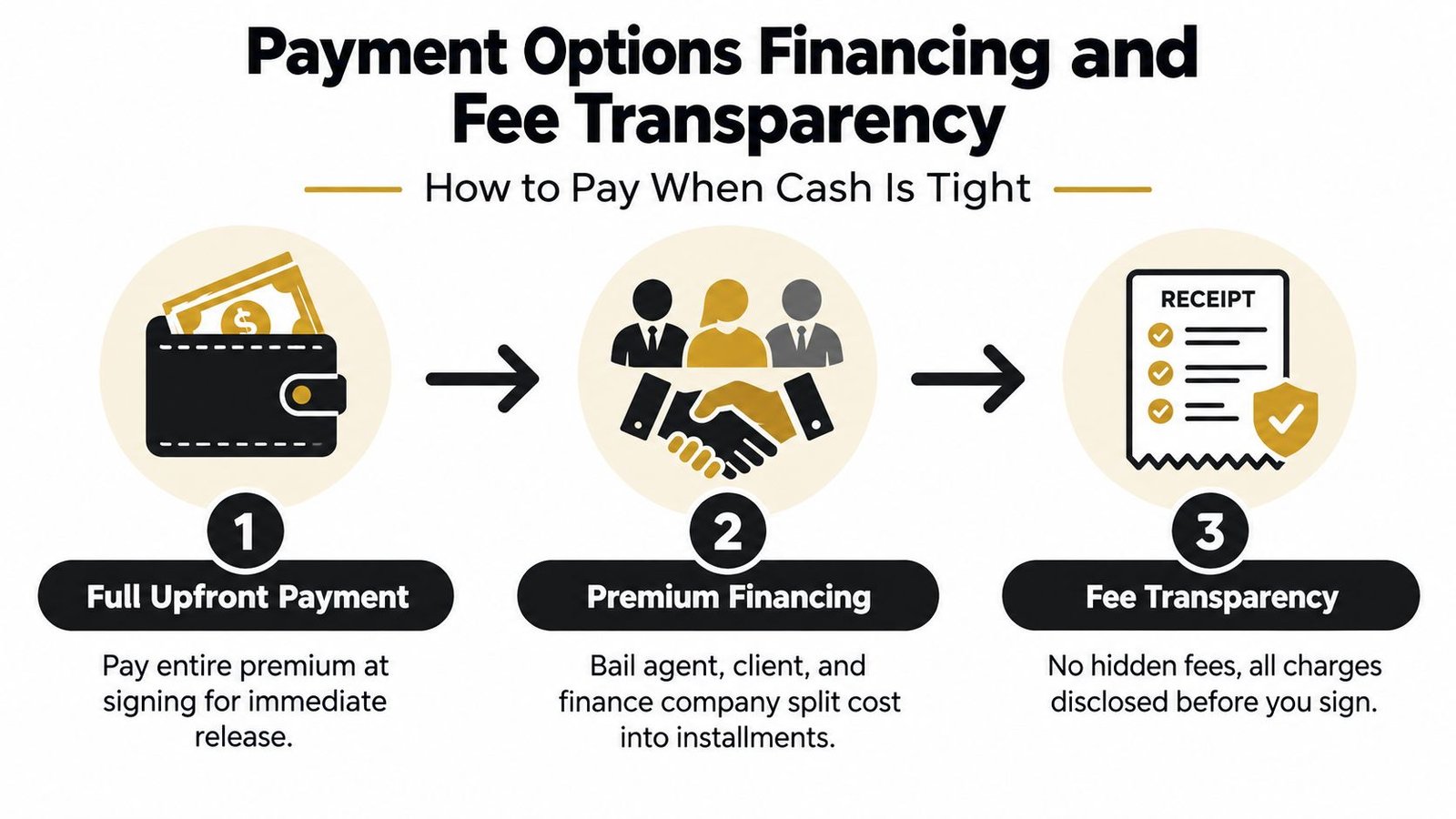
Payment options change the timing of the cost. They do not change what the premium is.
That distinction helps because families often hear "financing" and hope it means the bond got cheaper. A payment plan works more like splitting a large repair bill into smaller monthly pieces. The total obligation is still there. You are changing when you pay, not what the court-approved bond requires.
If you want a plain-language consumer explainer before signing, this payment plan definition for 2026 gives a useful general overview.
What financing usually looks like
For bail families, the practical questions are straightforward. Is there a down payment? How many installments are there? Are there financing-related charges? Who is collecting those payments?
Ask those questions in that order.
A clear answer should tell you whether the agency is offering installments directly or whether a separate finance company is part of the agreement. It should also spell out the first payment due tonight, the amount and timing of later payments, and any allowed charges tied to that arrangement. If any part of that feels fuzzy, pause and ask for it in writing.
What a transparent quote should include
A clean quote should separate each part of the cost so you are not guessing in the middle of a stressful call:
Premium amount
The bond premium itself.Payment schedule
Whether you are paying in full or over time, and when each payment is due.Financing-related charges
Any allowed charge connected to installments should be listed plainly.Other permitted fees
If there are filing or processing charges allowed in your case, they should be named clearly, not folded into one mystery total.
One sentence matters here. The premium is generally non-refundable, even if you use a payment plan.
Remote cosigners and electronic paperwork
Many families are not all in one place when the call comes in. A parent may be in Denver, a cosigner may be in Pueblo, and the person in custody may be in a different county altogether. Electronic paperwork can make that process faster and less chaotic.
Express Bail Bonds is one agency that handles applications, contracts, and payments electronically, which can help an out-of-town cosigner review and sign without a late-night drive across Colorado. For a closer look at flexible payment terms for Colorado bail bonds, review the installment details before you agree to anything.
Good fee transparency should feel boring. That is a compliment. You should be able to read the quote, point to each charge, and explain it back to someone else without guessing.
How to Lower Your Premium and Get Help Fast
Your brother is in jail. The bond is set. Everyone on the call wants the same thing: get him out tonight without agreeing to a cost you do not understand.
That is usually how this part starts for families in Colorado. The good news is that there are a few practical ways to make the process easier, and sometimes less expensive, if you act early and ask the right questions.
Steps that can reduce the strain
A stronger file often leads to better options. In plain terms, the bail agent is deciding how much risk the company is taking on. A qualified cosigner can lower that risk, the same way a second name on a loan application can help the lender feel more comfortable.
Here are the moves that help most:
- Bring in a qualified cosigner as early as possible. On eligible bonds over $5,000, that can open the door to a 10% cosigner rate instead of the standard 15% rate.
- Have documents ready before the call gets deep into paperwork. A photo ID, current contact information, and basic employment or residence details can speed up approval.
- Ask whether collateral is needed. Premium and collateral are two different things. The premium pays for the bond. Collateral is backup security in some cases.
- Raise payment-plan questions early. If financing is available, ask what the down payment is, how long the payments last, and whether any permitted installment charges apply.
- Confirm the bond type. If the court ordered a cash-only bond, a surety company cannot convert that into a surety bond.
One detail causes a lot of confusion, so it helps to say it plainly.
The part families need repeated clearly
The premium is generally non-refundable.
A family may hear, "We paid thousands of dollars, so do we get that back when the case ends?" Usually, no. The premium is the price of the guarantee itself. It works more like an insurance cost than a security deposit. Collateral is different. If collateral was required and not used to cover a forfeiture, it may be returned after the bond is discharged.
If you remember one sentence from the call, make it this one: the premium pays for the guarantee, not for a future refund.
Getting help fast without agreeing blindly
Speed matters, especially if a release can happen tonight. Clear questions matter too.
Start with the four numbers and facts that change the quote fastest: the bail amount, the jail or county, whether a cosigner is available, and whether you need time payments. Then ask for the exact premium in dollars, not just the percentage. On a $10,000 bond, for example, 15% means $1,500, while a 10% cosigner option would mean $1,000 if the bond qualifies. That kind of side-by-side math helps families make a decision under pressure.
Express Bail Bonds offers Colorado families electronic paperwork, remote cosigner options, and phone help around the clock at 720-984-2245. If you already know the bail amount, you can ask for a real quote, ask whether an eligible bond may qualify for the 10% cosigner rate, and ask how any financing would be broken out before you sign.