
Colorado's standard premium is 15% of the bond amount, and for bonds above $5,000 a 10% rate is often available with an approved cosigner. If you're staring at a jail call right now, that's the number that matters, because speed only helps when the paperwork and the signatures are right.
A surety bond isn't a cash bond. It's a three-party promise where the bond company guarantees the court the full bond amount, and you pay a non-refundable premium to get the defendant out. In Colorado, that premium is what families are usually trying to pin down at 2 a.m., while someone sits in a county jail and waits for the release process to move.
When It Makes Sense to Purchase a Surety Bond Online
The right move is usually to go online the minute you know the bond amount and the jail. If the defendant is sitting in a Colorado detention center, driving around town looking for an office wastes time you don't have, especially when family members or out-of-state cosigners can't get to the facility quickly. Online processing lets you start the file where the information lives, on your phone, in your email, and in the booking paperwork.
A surety bail bond is a three-party agreement. The principal is the defendant, the obligee is the court or jail, and the surety guarantees the full bond amount in exchange for the premium. That distinction matters because you're not buying release outright, you're buying the promise that gets the court comfortable enough to release the person while the case moves forward. If you want the cleanest explanation of that difference, this comparison of a surety bond and a cash bond is the right place to start.
Why online makes sense in real life
Online is the smart path when the arrest happens at the worst possible time, because arrests usually do. It also makes sense when the cosigner is in another city or another state and can't physically sit at the jail, wait in line, and sign in person. You still need the bond done correctly, but you don't need to stand in a lobby to get it moving.
Practical rule: if the jail has the defendant, and you have the bond amount, the fastest route is usually to gather the facts, submit them electronically, and let the agent handle posting.
That's where Express Bail Bonds fits into the picture as one local option, because its process is built around electronic paperwork and statewide Colorado posting. For anyone trying to avoid a long night at the detention center, online is usually the practical answer, not the fancy one.
Information You Need Before You Start the Application
A bond application moves faster when you gather the file once and answer the questions once. Have the defendant's full legal name, date of birth, booking number, the exact detention facility, the charges, and the bond amount ready before you start. If the facility name is off, the file can stall, and in Colorado that is one of the fastest ways to slow a release.
The jail name matters more than people expect. A bond tied to Denver County does not belong in Jefferson County, and a simple paperwork mix-up can hold up release when the family is already under pressure. If you are still sorting out what an agency will ask for, the document checklist is the right page to keep open before you call.

Cosigner details and payment readiness
Have the cosigner's identifying information ready, and if they are in Colorado, proof of residency and stable contact details usually keep the process clean. Out-of-state cosigners can still often sign remotely through a licensed agent, which is one reason online applications work well for Colorado bail bonds. Payment should be ready too, since agencies may take cards, ACH, or electronic transfers, and a delay at checkout can slow posting after approval.
The release file moves fastest when the defendant information, the facility name, and the cosigner's details all match the booking sheet exactly.
Keep the court date location in your notes even if the agent does not need it to post the bond. It helps verify the file quickly and keeps everyone aligned on what happens after release. For a broader list of what agencies ask for, refer to the document guide linked above.
Colorado agencies also have to follow state insurance calling rules, so clean contact information matters more than people think. If the cosigner uses a different phone number or email than the one on the booking sheet, expect a delay while the agent confirms the file.
Colorado Premium Rates and Cosigner Requirements
The premium is where Colorado families either save real money or make a bad assumption fast. For surety bail bonds here, the standard premium is 15% of the bond amount, and a 10% option can be available on bonds over $5,000 when an approved cosigner is in place. That 10% rate is not automatic, it depends on the cosigner's credit profile and the agency's underwriting decision.
A cosigner in Colorado is usually a working resident with verifiable income and stable housing. The point is simple, reduce the chance that the bond turns into a loss if the defendant misses court. The cosigner signs because they are taking on real financial responsibility, not because they are just helping out in a casual sense.
The gap between 15% and 10% shows up immediately on larger bonds. A lower premium can make a file workable tonight, but it still brings underwriting, identity review, and indemnity obligations. If you want a plain breakdown of how agencies review backup signers, this cosigner credit-check guide is the relevant read.
| Colorado Surety Bail Bond Premium Tiers | Bond Amount | Standard Premium (15%) | With Approved Cosigner |
|---|---|---|---|
| Example tier 1 | $5,000 | $750 | $500 if approved |
| Example tier 2 | $10,000 | $1,500 | $1,000 if approved |
| Example tier 3 | $25,000 | $3,750 | $2,500 if approved |
Colorado families also run into state-specific calling and compliance rules, especially when more than one person is involved in the file. A useful reference on that front is state insurance calling rules, because once you start coordinating a bond by phone and email, paperwork discipline matters more than the sales pitch.
What the cosigner is actually signing for
The cosigner is backing the bond, period. If the defendant fails to appear, the agency can look to that cosigner for repayment or enforcement under the indemnity agreement. That is why experienced agents screen carefully and why people who rush through the application usually regret it later.
Large bonds can also bring collateral into the conversation, depending on the file and the risk. Do not be blindsided if you hear that term, it is part of how agencies protect themselves when the bond amount or the circumstances call for more security. For a deeper look at how agencies review backup signers, see the cosigner credit-check guide linked above.
Filing the Online Application and E-Signature
A clean online bond file starts with the agency guiding you through each step, rather than pushing you straight to a payment button. You choose a licensed Colorado agent, pick the bond type, enter the obligee details, and submit the application through the site or portal. That sequence matches the standard online workflow used by providers that let buyers select the state, choose the bond type, identify the obligee, enter the bond details, then review and submit the application.
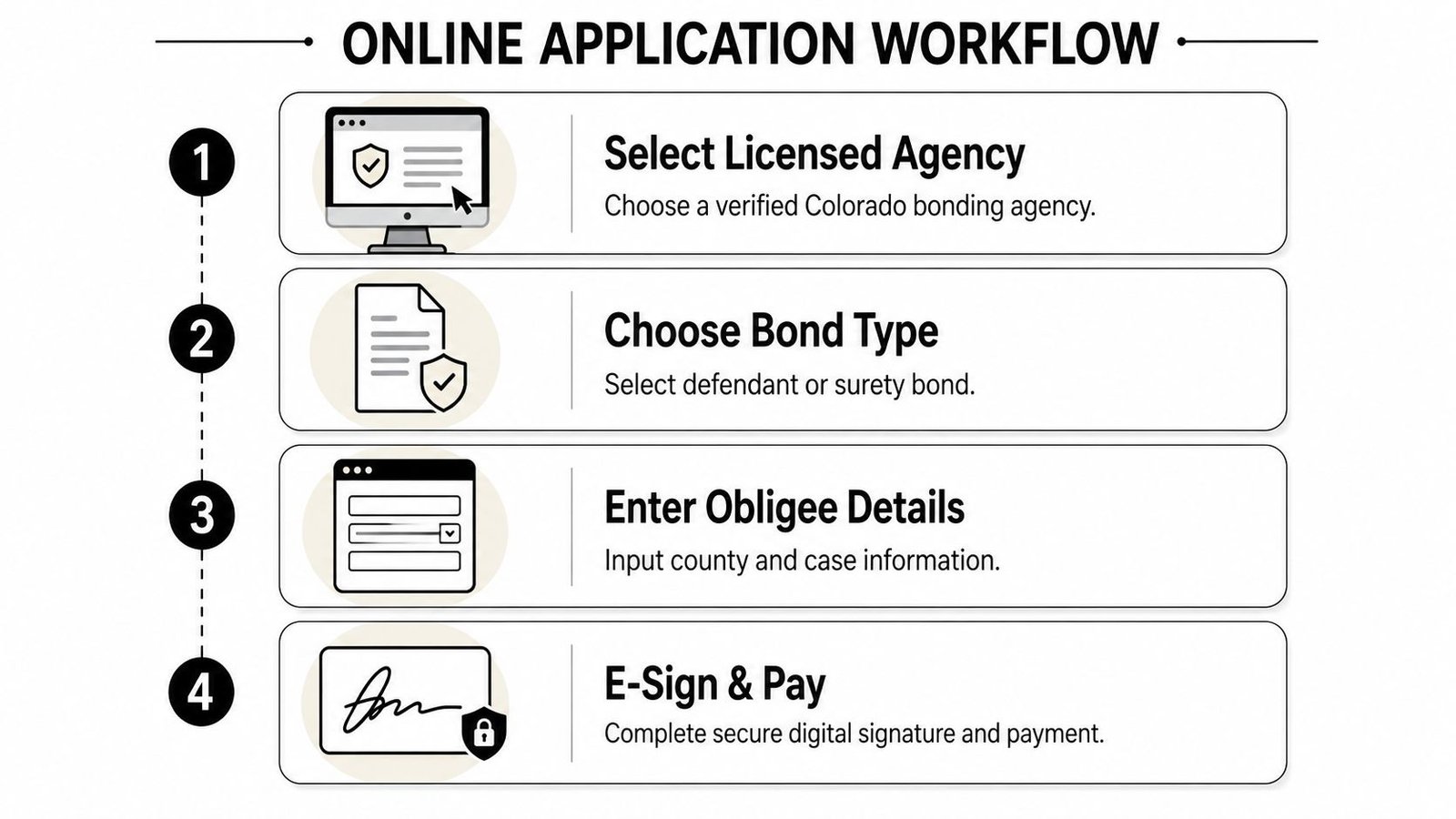
E-signatures are part of the process, and they hold up when the platform is compliant and the agency is licensed to issue the bond. If you want a practical read on how that signature layer is handled, this guide to signature verification for faxes is useful because the same discipline applies, make sure the signature can be trusted before anyone treats the document as final. For a Colorado-specific breakdown of what gets signed electronically and what still needs attention, see Express Bail Bonds' electronic signature requirements.
The underwriting step still happens, even online. The agency checks identity and credit, then decides whether the file qualifies for standard approval, a cosigner-backed rate, or more documentation. That review might move fast, but it is still a review.
What arrives after payment
Once payment clears, the agency sends the bond confirmation or bond power by email. That document is what the jail or court needs to accept the filing, so do not treat it like a receipt you can ignore. If the obligee wants wet signatures or a raised seal, the agency still has to satisfy that requirement before the bond is officially posted, because a digital file alone is not always enough.
The cleanest online file is the one that is signed, paid, and ready to print or transmit without extra chasing. For those who want to pay online and keep the process moving, the payment page helps show where the digital work ends and the posting step begins.
How the Bond Gets Posted at Colorado Jails
Once the agent has the signed file and payment, the bond power goes to the jail or court. That is the legal document the bail agent uses to tell the facility the bond is backed, the premium is paid, and the defendant can be processed for release. In practice, that means the family's job is mostly done, and the agency's job becomes getting the bond in front of the right booking desk fast.
The timeline after acceptance varies by county and staffing, but the release usually moves in a matter of minutes to a few hours once the jail has the paperwork it wants. Denver County, Jefferson County in Golden, Arapahoe County through Centennial, Douglas County, Weld County, El Paso County, and Adams County each run on their own intake rhythm, so one facility may move faster than another even on the same day. That's not mystery, it's jail operations.
Why the posting step matters more than people expect
A lot of families think the online part is the hard part. It isn't. The hard part is making sure the bond gets where the jail will accept it, in the format the jail wants, with the signatures and seal fields in place. If you're looking for a direct way to handle payment and posting without chasing down an office visit, this online pay page is the obvious route.
Practical rule: an out-of-state cosigner does not need to drive to Colorado to make a release happen, but the agent still has to post the bond in person or through the proper facility channel.
That's the whole value of doing this online. The family signs remotely, the agency handles the county process, and the defendant gets out without forcing everyone into the same room. Express Bail Bonds handles that kind of workflow in Colorado, including county jail posting, which is why online processing matters most when the people involved aren't in the same zip code.
Common Pitfalls That Slow Down Online Purchases
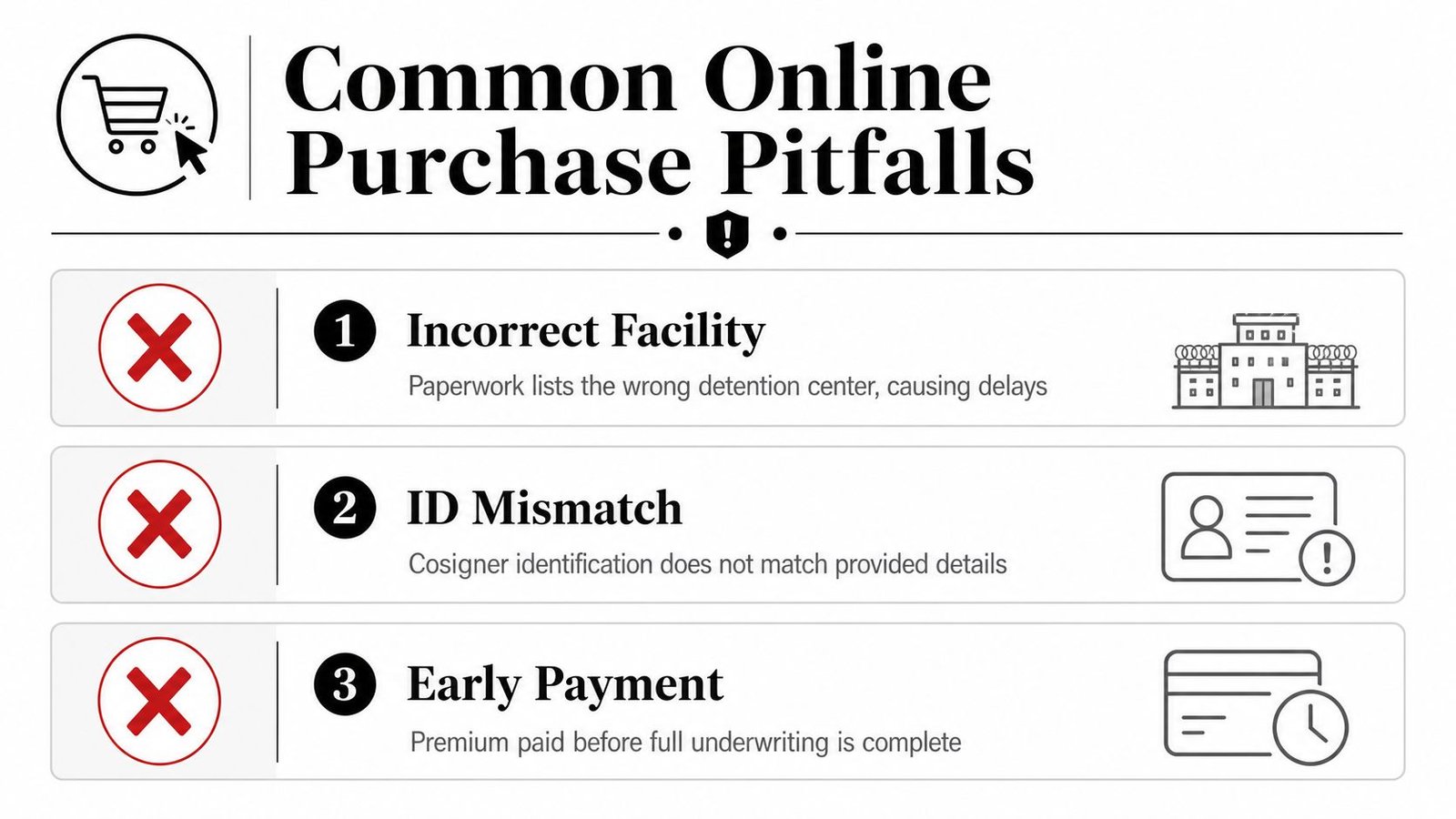
The same mistakes show up over and over, and they're preventable. The wrong detention facility on the paperwork can stall the file immediately, because a bond sent to the wrong jail won't release anyone. A cosigner ID mismatch does the same thing, especially when the application name and the submitted identity document don't line up exactly.
Another common problem is paying too early. If the bond hasn't been fully underwritten, the premium can get tied up while the agency is still checking the file, and that creates confusion nobody needs during an arrest. The premium is also non-refundable once the bond is posted, even if the underlying charges change later, so don't treat the payment like a deposit you can unwind whenever you want.
Independent verification still matters, online or not. The producer or broker should hold an active Colorado license, and the carrier backing the bond should be admitted in the state, with federal or court bonds also checked against the U.S. Treasury's certified list. If that verification step is missing, walk away.
A 60-second pre-submit check
- Facility name: Confirm the jail name matches the booking sheet exactly.
- Cosigner identity: Make sure the ID, address, and application details agree.
- Bond amount: Verify the amount is identical to the court's setting.
- Signatures: Check that every required signature and seal field is complete.
- Payment timing: Don't pay until the file has been accepted for underwriting.
If those five items are clean, you're ahead of most first-time buyers. That's usually enough to keep a midnight release from turning into a next-day headache.
Your Next Steps With Express Bail Bonds
If you need the bond done now, contact a licensed Colorado agent who can take the file, verify the details, and move it to posting. Express Bail Bonds has handled Colorado surety bonds since 1988, works by call or text at 720-984-2245, and supports out-of-state cosigners by email when remote signing makes more sense than a trip to the jail. The point is simple, get the file right once, then let someone who does this every day push it through the county process.
For Denver-metro cases, start with the main site and get the bond moving without wasting time on back-and-forth. If the case is in Jefferson County or Golden, use the county-specific page so the facility information lines up from the start. If the arrest happened near Centennial or elsewhere in Arapahoe County, use the local page and send the right jail details the first time.
- Denver-metro access: Express Bail Bonds
- Jefferson County and Golden: Jefferson County Golden Colorado
- Centennial: Bail Bonds Centennial
If you need to purchase a surety bond online and you want a Colorado agent who already knows how county posting works, start with Express Bail Bonds. They handle the paperwork, the signature flow, and the jail posting so you can focus on getting the person home tonight instead of trying to decode bond language on your own.