You get the call late at night. A son, spouse, sibling, or close friend has been arrested in Colorado. They're in a county jail, they want out fast, and you're trying to help from Denver, another state, or across the country. The first question is usually about cost. The second is almost always this one: can I sign everything remotely, and will it hold up?
That question matters more in bail than it does in most other contracts. A bail bond isn't a casual online form. It's a financial obligation tied to a criminal case, court appearances, and a real risk if the defendant doesn't comply. If you're the cosigner, your signature has to be valid, traceable, and attached to the right paperwork the first time.
Families often assume any emailed signature box solves the problem. It doesn't. What works in a low-stakes consumer transaction may not be enough when a jail release depends on a written indemnity agreement, identity verification, and a clean record of consent. That's where understanding electronic signature requirements can save time and prevent a costly mistake.
The Urgent Need for Remote Bail Bond Signatures
A Colorado jail will not slow down because the cosigner lives in Texas, works night shift, or cannot get to an office before morning. In bail, the delay usually is not the defendant's willingness to leave. It is getting the indemnitor's paperwork signed, verified, and returned in a form the bond agent can use.
That pressure hits out-of-state families the hardest. A mother in Arizona may be ready to help, but if her identity cannot be confirmed or the bond contract comes back incomplete, release stalls. In my experience, that is where remote signing matters most. It is not about convenience. It is about getting valid paperwork in place fast enough to keep the bond moving.
Why bail contracts need a narrower standard
General articles on e-signatures usually cover sales contracts, HR forms, or basic consumer agreements. Bail is different. A cosigner is taking on financial liability tied to a criminal case, missed court risk, and the defendant's compliance with bond conditions.
For that reason, families should stop asking only whether an electronic signature is "allowed." The better question is whether the full process will hold up if the file is reviewed later by the agency, the surety, or the court. If you need a clear breakdown of the paperwork itself, review this guide to understanding a Colorado bail bond contract.
The terminology also trips people up. If you need to compare digital and electronic signatures, do that before you assume every online signing tool creates the same legal record.
What matters in a real remote bail signing
A remote bail signature has to do more than capture a name on a screen. The bond file needs to show who signed, what documents were presented, when consent was given, and how the signer's identity was checked. If the cosigner is in another state, those details matter even more because the agent cannot rely on an in-person meeting to clear up mistakes.
Here is the practical standard families should use:
- Remote signing can work: A cosigner in another city or another state can often sign bond documents electronically if the agency's process is set up correctly.
- Speed only helps if the file is clean: A fast signature means very little if the ID is missing, the agreement is incomplete, or the audit trail is weak.
- Out-of-state cosigners need tighter verification: Distance adds risk, so agencies often need clearer identity checks and more complete records.
- The platform is only part of the answer: A typed name, checkbox, or stylus signature does not prove much by itself. The supporting record gives the signature legal weight.
Families calling about a release usually want one straight answer. Yes, remote signing may be possible. It has to be done in a way that protects the bond, the cosigner, and the release process at the same time.
The Legal Foundation for Electronic Signatures
Electronic signatures are not a shortcut around the law. When they're handled correctly, they are the legal method.
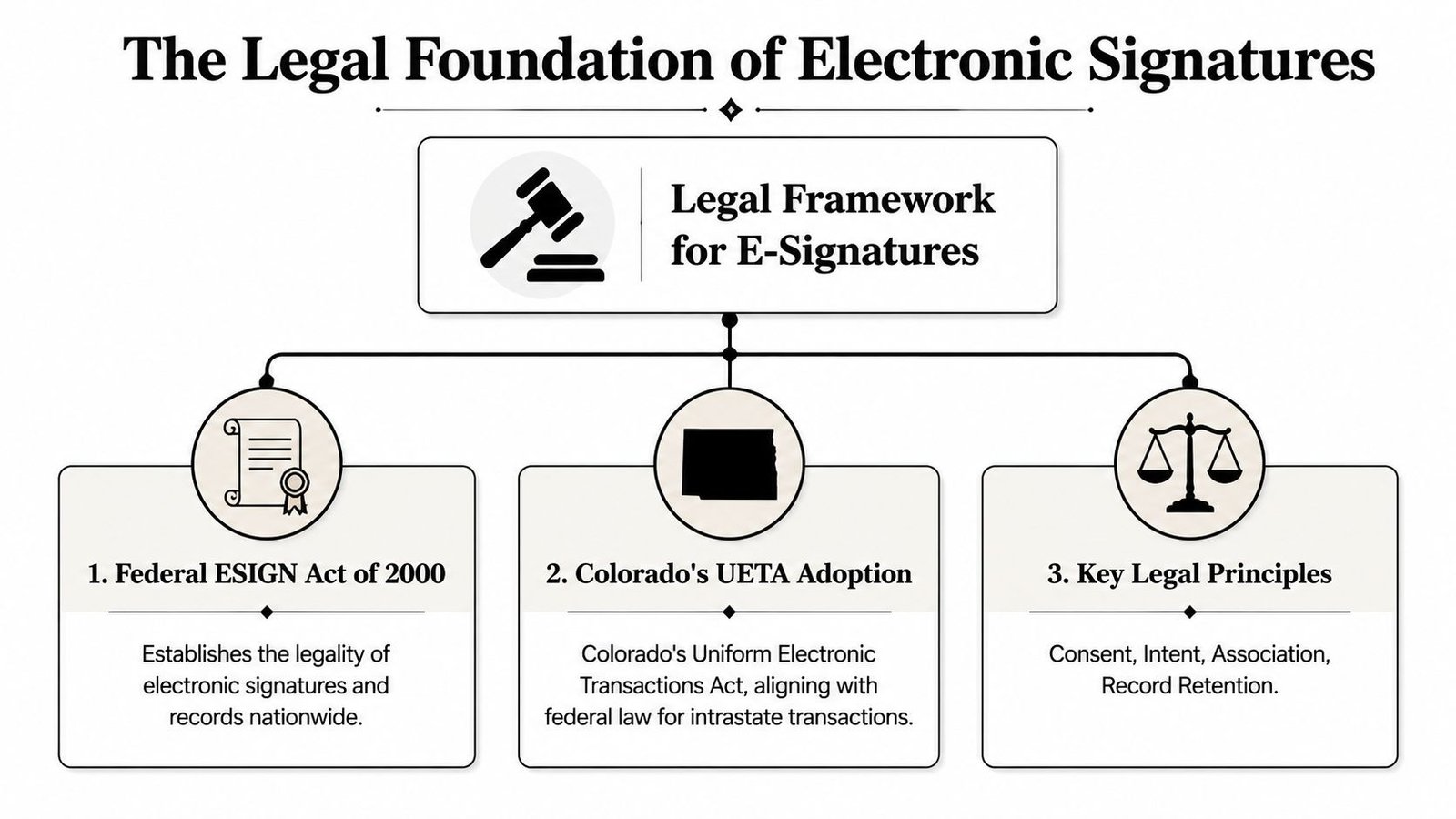
The core federal rule is the ESIGN Act, enacted in 2000, which established that electronic signatures are legally binding in every state and U.S. territory where federal law applies, giving them the same legal status as handwritten wet signatures for most contract types, according to GlobalSign's legality guide. Colorado also follows the same general framework through the Uniform Electronic Transactions Act.
Think of it as a digital handshake
A wet signature shows agreement with ink on paper. A compliant electronic signature shows agreement through a recorded digital action. The law cares less about the shape of the signature and more about whether the system can prove the signer meant to sign and agreed to do it electronically.
That matters in bail because a cosigner is not just acknowledging receipt of a document. The cosigner is taking on responsibility under a written agreement.
If you're sorting out terminology, it also helps to compare digital and electronic signatures because people often use those terms interchangeably even when the signing methods and verification layers differ.
The four pillars that matter
Under the ESIGN framework, a valid electronic process rests on several core requirements. In plain English, those are:
- Intent to sign: The signer has to take a clear action that shows agreement.
- Consent to do business electronically: The signer must agree to use an electronic process.
- An opt-out path: The signer must be informed of the option to withdraw consent and receive paper records.
- Record retention: The completed record has to be stored so it can be reproduced later.
Those points are not paperwork trivia. They are the reason an electronic bail contract can carry the same legal weight as a paper one when handled correctly.
A proper e-signature process doesn't just capture a mark on a screen. It captures intent, consent, delivery, and retention.
Why this matters for your bail paperwork
For families, the takeaway is simple. A valid e-signature process is not risky because it is electronic. It's risky only when someone treats it like a casual email attachment with no real compliance steps.
When a bail agency uses a structured process, the signed documents can be handled remotely and still stand on solid legal ground. If you want to see how those terms fit into the actual paperwork, review this guide to understanding your Colorado bail bond contract.
Validating E-Signatures for Bail Bond Agreements
A bail bond agreement needs more than convenience. It needs proof.
A lot of people hear "electronic signature" and think of the simplest version possible: click a box, type a name, done. That may work for a low-risk acknowledgment. It is not the standard I would want attached to a surety agreement where a cosigner may be responsible if the defendant doesn't appear.
What makes a signature defensible
The strongest part of a compliant e-signature process is the audit trail. Under the ESIGN Act and UETA, a legally valid electronic signature requires reliable association of the signature to the record through an audit trail that captures timestamps, IP addresses, and document hash values to show the signer opened, modified, and signed the document, as explained in MinuteBox's overview of electronic signature regulations and best practices.
That tells you something important. The signature is only one piece. The surrounding record is what makes it credible.
Weak process versus strong process
Here is the practical difference families should understand:
| Process type | What it looks like in real life | Risk level for bail paperwork |
|---|---|---|
| Basic click-to-sign | A link arrives, a name is typed, little else is documented | Higher risk if identity or intent is later questioned |
| Auditable e-sign process | The system records delivery, access, signature events, and document history | Stronger support if the agreement is ever challenged |
A bail cosigner should want the second process every time.
Why identity and intent are separate issues
People often assume that if an email went to the right inbox, the signature must be valid. That's not enough. Email access does not automatically prove who signed. It also doesn't prove the signer understood the obligation.
That is why a careful bail process often includes document review, direct communication with the agent, and identity checks before posting. It also helps to understand related underwriting issues, including whether the cosigner will be approved. This overview of a bail bond cosigner credit check explains part of that side of the process.
If a signature can't be tied back to the actual signer and the actual document, it may create trouble at the worst possible time, after release and during a dispute.
For remote bail agreements, the practical standard is simple. You want a system that proves the signer saw the document, took deliberate action, and signed the exact version the agent sent.
Key Features of a Secure E-Signature Platform
If you're trusting a platform with bail bond paperwork, don't judge it by how slick the screen looks. Judge it by whether it protects you when questions come up later.
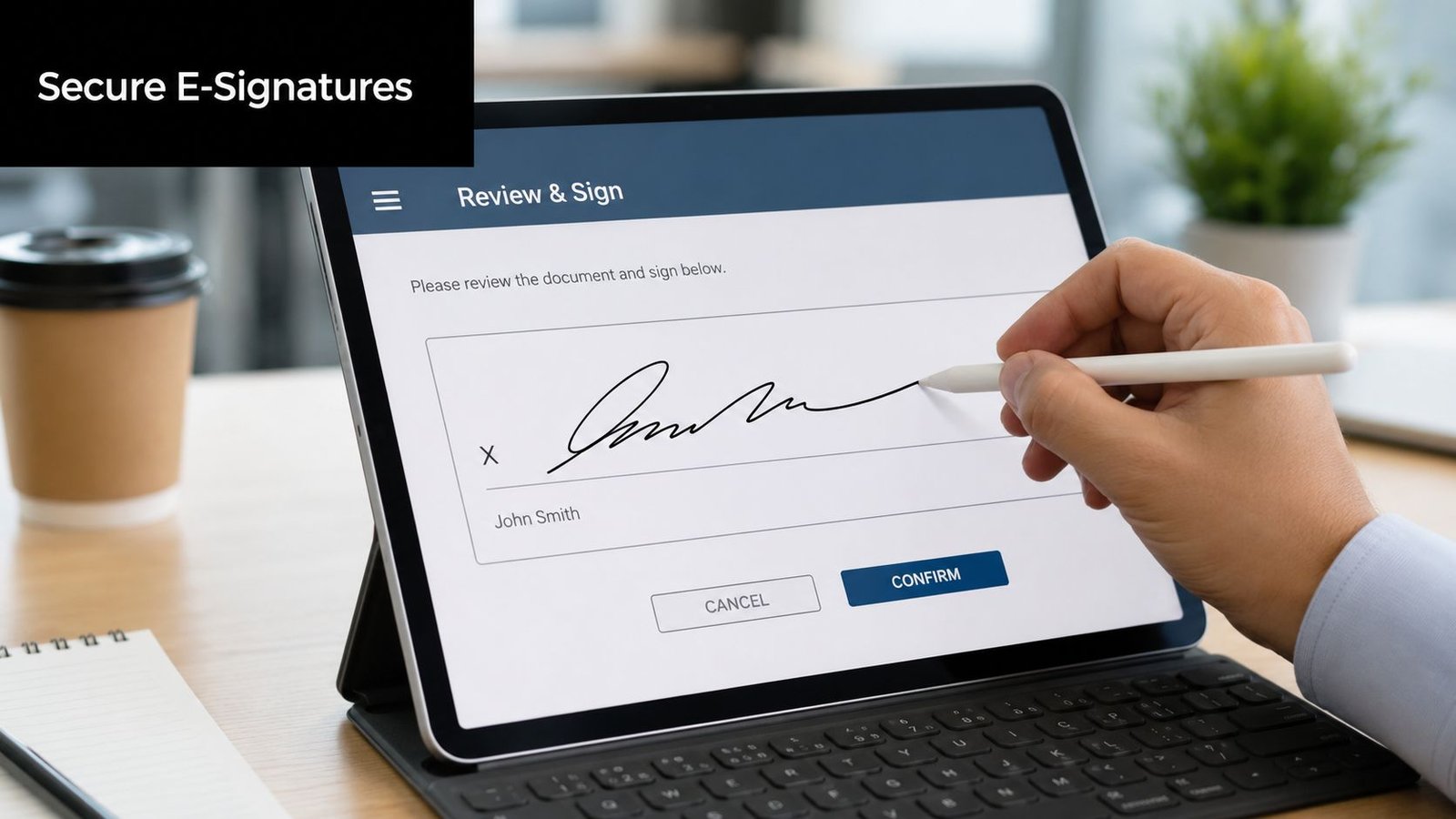
A secure e-signature platform should do more than collect signatures. It should verify identity, secure the document in transit, preserve the final record, and make tampering obvious. In bail work, that protects the agency, the defendant, and the cosigner.
The features worth asking about
Some agencies talk about "online signing" as if every system is the same. It isn't. For high-stakes contracts, the essential features are the ones that support authenticity and record integrity.
| Feature | Why It's Critical for Bail Bonds |
|---|---|
| Multi-factor authentication | Adds another layer before a signer can access or complete the document |
| Government ID review | Helps connect the signer to a real identity, not just an email address |
| Encrypted delivery | Protects sensitive financial and case information during transmission |
| Audit trail logging | Preserves proof of when the document was sent, opened, and signed |
| Tamper-evident controls | Shows whether a document changed after signing |
| Final copy delivery | Gives the cosigner a completed record for later reference |
| Secure retention | Keeps the signed agreement reproducible if a dispute arises |
What works and what doesn't
What works is a structured system with verification built in. What doesn't is a casual back-and-forth of unsigned PDFs, screenshots, or edited attachments where no one can later show which version was final.
One practical example is an agency workflow that combines online documents with remote payment processing, document delivery, and final confirmation. Express Bail Bonds offers electronic payment processing, which is useful because families usually need one connected process rather than separate systems that create delays.
For people who need a simple tool for lower-stakes document tasks outside bail, it can help to simplify contract and report signing with a straightforward PDF signing utility. But for bail agreements, simplicity alone is not enough. The platform must also support identity, timing, and record integrity.
A short walkthrough helps make that difference clearer:
Questions a cosigner should ask before signing
- How do you verify identity: Ask whether the process uses ID review, direct confirmation, or another method before the bond is posted.
- What record do I receive: You should receive a copy of what you signed, not just a payment receipt.
- Can the document be altered after signing: If the answer is vague, that's a warning sign.
- What happens if I need paper instead: A compliant process should explain your options.
The right platform doesn't just make signing easier. It makes the agreement stronger.
Colorado Rules Exceptions and Special Cases
A remote cosigner can do everything right and still hit a delay if the bond package is missing one required detail or the case involves a bond type with extra rules. That is where families lose time. In Colorado bail work, the signature is only one part of what has to be done correctly.
What Colorado specifically requires in bail contracts
For bail bond indemnity agreements, Colorado law is specific. Under Colorado Revised Statutes Section 10-2-705(1)(a), an indemnity agreement for a bail bond must be in writing and must explicitly include details such as the exact bail amount, defendant's name, court case number, and premium charged.
That rule matters most for remote and out-of-state cosigners. If you are signing from another state, you need to confirm the form you receive already contains the case details before you sign it. A valid electronic signature on an incomplete bail contract still leaves a defective contract. The problem is the missing information, not the device used to sign.
One practical way to avoid delays is to gather the case and identification paperwork before the agreement is sent out. Families who are unsure what to pull together can review the documents needed for a bail bond application and have them ready before the agent prepares the contract.
Where families often run into confusion
The bond agreement can often be signed remotely, but related parts of the release process may still follow separate rules. That is the point many general e-signature articles miss. Bail is time-sensitive, and the contract, jail acceptance process, and any extra supporting documents all have to line up at the same time.
Common problem areas include:
- Court-specific filings: Some filings tied to the criminal case are governed by court procedures separate from the bail bond contract.
- Property-backed bonds: A property bond is different from a standard surety bond and usually requires extra review and supporting records.
- Jail release procedures: Even after the bond is accepted, release timing depends on how the detention facility processes holds, booking checks, and discharge steps.
Property-backed bonds are the clearest example. Colorado courts explain that the property must have enough unencumbered equity to support the bond, and they require supporting records such as tax notices, mortgage payoff information, and title evidence in their Colorado Judicial property bond guidance. That kind of file usually takes more than a fast phone signature and payment authorization.
Local handling can still affect release timing
Families often assume statewide e-signature rules mean every county handles release the same way. They do not. Local jail workflow, staffing, cutoff times, and internal review procedures can all affect how quickly a signed bond turns into an actual release.
I tell cosigners to treat local procedure as part of the legal process, especially if they are signing from out of state and cannot walk documents in themselves. A clean electronic signature helps. A complete contract helps. Release still depends on the jail, the court, and the bond paperwork matching up without errors.
Your Step-by-Step E-Signature Checklist for Bail
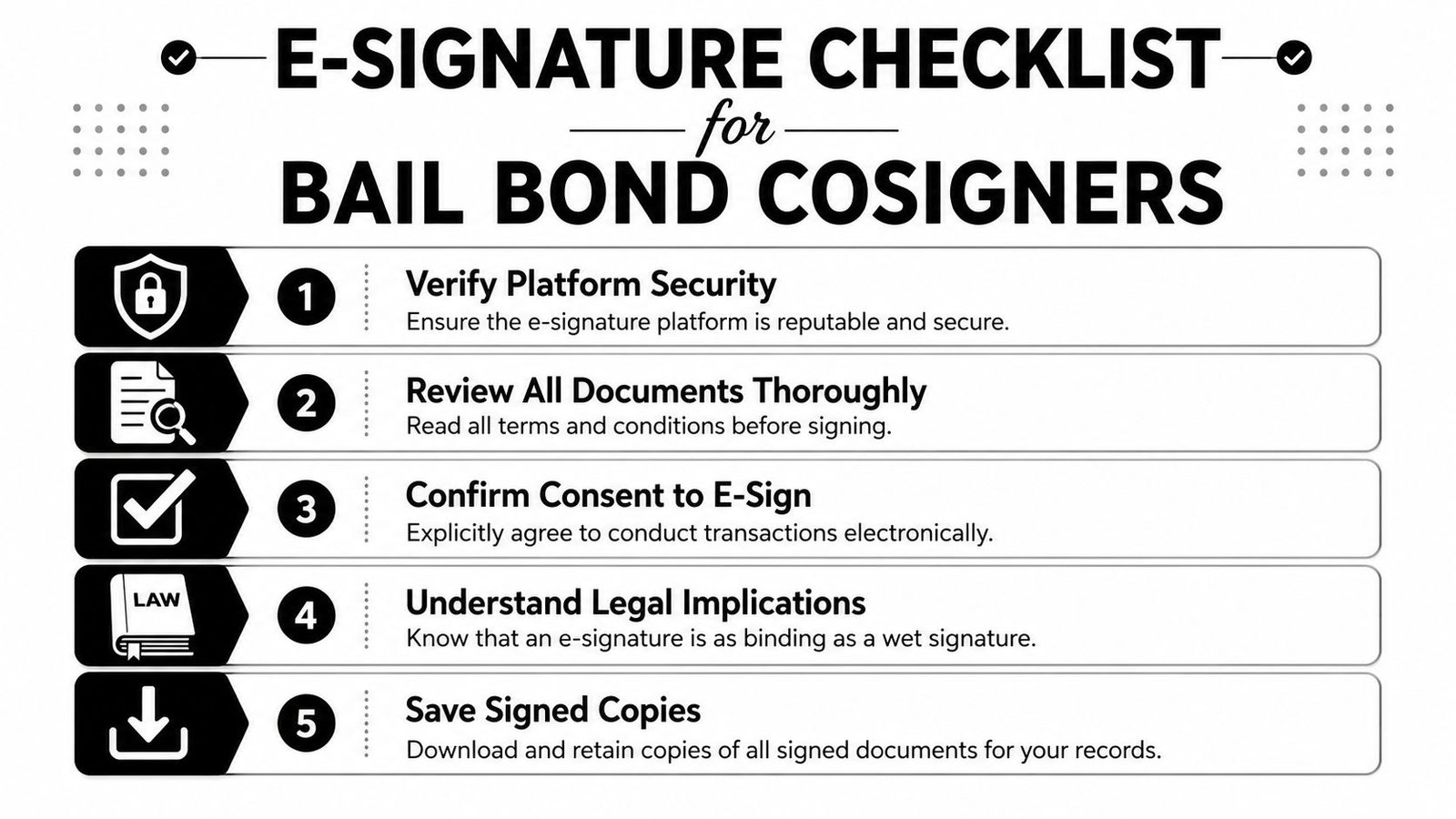
When you're the cosigner, the easiest way to stay calm is to follow the process in order and not skip ahead. Remote bail signing in Colorado usually works best when you handle identity, documents, signature, and payment as one continuous sequence.
For Colorado electronic bail bond processing, the indemnitor first provides photographic documentation of required forms to the bail agent, then the agent prepares the documents for electronic signature, sends them back by email for completion, and follows with a payment call, according to this overview of online bail bonds in Colorado.
The checklist to follow in real time
Confirm who sent the documents
Check that the email, text, or portal invitation came from the licensed bail agent you're working with. If anything looks off, call before clicking.Gather your identification and case details
Keep your ID nearby and have the defendant's full name and booking information ready. That speeds up verification and reduces errors in the contract.Review every page before signing
Read the indemnity terms, the bond amount, and the premium information. If you don't understand a condition, stop and ask.Give clear consent to sign electronically
Don't rush past the consent language. That step matters because your agreement to handle the transaction electronically is part of the legal foundation.Complete any requested verification steps
This may include sending photos of documents, confirming personal information, or responding directly to the agent.Apply your signature and finish all required fields
An incomplete packet can delay posting just as much as no signature at all.Save the final copy
Download or email yourself the executed documents and keep them in one place.
Small mistakes that cause big delays
A lot of release delays come from very ordinary errors. Not fraud. Not legal disputes. Just preventable mistakes.
- Wrong signer: The person filling out the form isn't the approved indemnitor.
- Missed attachments: The agent requested photo documentation and never received it.
- Unchecked details: A name, case number, or financial term was entered incorrectly.
- No saved copy: The cosigner finishes the process but can't later confirm what was signed.
If you're unsure what identification or supporting paperwork you need before the signing link arrives, review what documents you need for a Colorado bail bond.
Sign with Confidence for a Fast Release
A mother in Texas gets the call at 11:30 p.m. Her son is in a Colorado jail, and the bond can move as soon as the paperwork is signed. In that moment, the question is not whether electronic signatures are modern or convenient. The question is whether the signature process will hold up, clear the jail's requirements, and avoid a delay that keeps her son inside until the next shift change.
That is the standard remote bail paperwork has to meet.
For bail bond contracts, especially with out-of-state cosigners, a valid e-signature process needs to do more than capture a name on a screen. It has to connect the right signer to the right agreement, preserve the full record, and give the bond agent enough verified information to post the bond without hesitation. If any part of that chain is weak, release can slow down.
The good news is that remote signing is routine when it is handled correctly. Families often sign from another county, another state, or while coordinating work, childcare, and travel. What gets results is a clean file, a responsive signer, and a secure process that matches the jail and court paperwork involved.
If you are ready for the payment step, review the option to pay a bail bond online. If you still need direction on the bond paperwork itself, contact Express Bail Bonds directly and confirm who must sign, what identification is needed, and whether any county-specific requirements apply before the bond is posted.