
A bail bond cosigner credit check is typically a soft inquiry that does not impact your credit score. Unlike a loan application, bail bond agencies look first at financial stability and identity verification, not a perfect credit history.
That matters because individuals asking about a cosigner credit check aren't doing casual research. They're standing in a kitchen after a late-night call, trying to decide whether helping a son, daughter, spouse, or friend will create a second financial emergency. In Colorado, that fear is common, and it usually comes down to one question: what exactly is the agency checking, and how much risk are you really taking on?
The short version is this. A bail bond cosigner is being screened for reliability, not being underwritten for a mortgage. The details still matter, though, especially if you're the one signing the paperwork and taking legal responsibility.
The Urgent Question About Cosigning a Bail Bond
A lot of families hear the same sequence of events. The phone rings late. Someone has been booked into jail. A bond amount has been set. Then your name comes up as the person who might be able to help get them out.
At that moment, people usually aren't asking legal theory questions. They're asking practical ones. Will they run my credit? Will this hurt my score? If I sign, what am I responsible for?
Those are fair questions. Cosigning any legal obligation deserves a clear answer, especially when you're making the decision under stress. If you're also trying to understand the criminal case itself, outside resources such as criminal law paralegal support can help you organize information and questions before you speak with counsel.
What people are really worried about
Most worried cosigners aren't trying to avoid responsibility. They want to know whether the process is reasonable and whether the risk is being explained truthfully.
In bail work, the fear usually comes from mixing two very different things together:
- Loan cosigning: people think of car loans, student loans, or credit cards.
- Bail bond cosigning: the purpose is making sure a responsible adult can back the defendant's release and court appearance.
- Credit damage: many people assume any check means an automatic score hit.
- Legal liability: the bigger issue is often the contract obligation, not the inquiry itself.
Practical rule: Before you sign anything, separate the credit check question from the liability question. They are not the same thing.
If you're new to the process, it also helps to review a plain-language explanation of what a cosigner is in a bail bond case. That gives you the right frame before you discuss paperwork with any agency.
Why this feels heavier than it sounds
A worried family member often says, "I'm only helping them get out." Legally, it's more than that. You're stepping in as the person the bond company can rely on if the defendant stops cooperating.
That doesn't mean every cosigner situation turns into a problem. It does mean you should expect a real screening process and real questions about your identity, employment, and stability. In Colorado, good agencies treat that process calmly and directly, because anxious people make better decisions when the terms are clear.
What a Bail Bond Cosigner Credit Check Really Is
A cosigner credit check in the bail bond world isn't the same thing as applying for a mortgage, auto loan, or new credit card. That's the first distinction families need to understand.
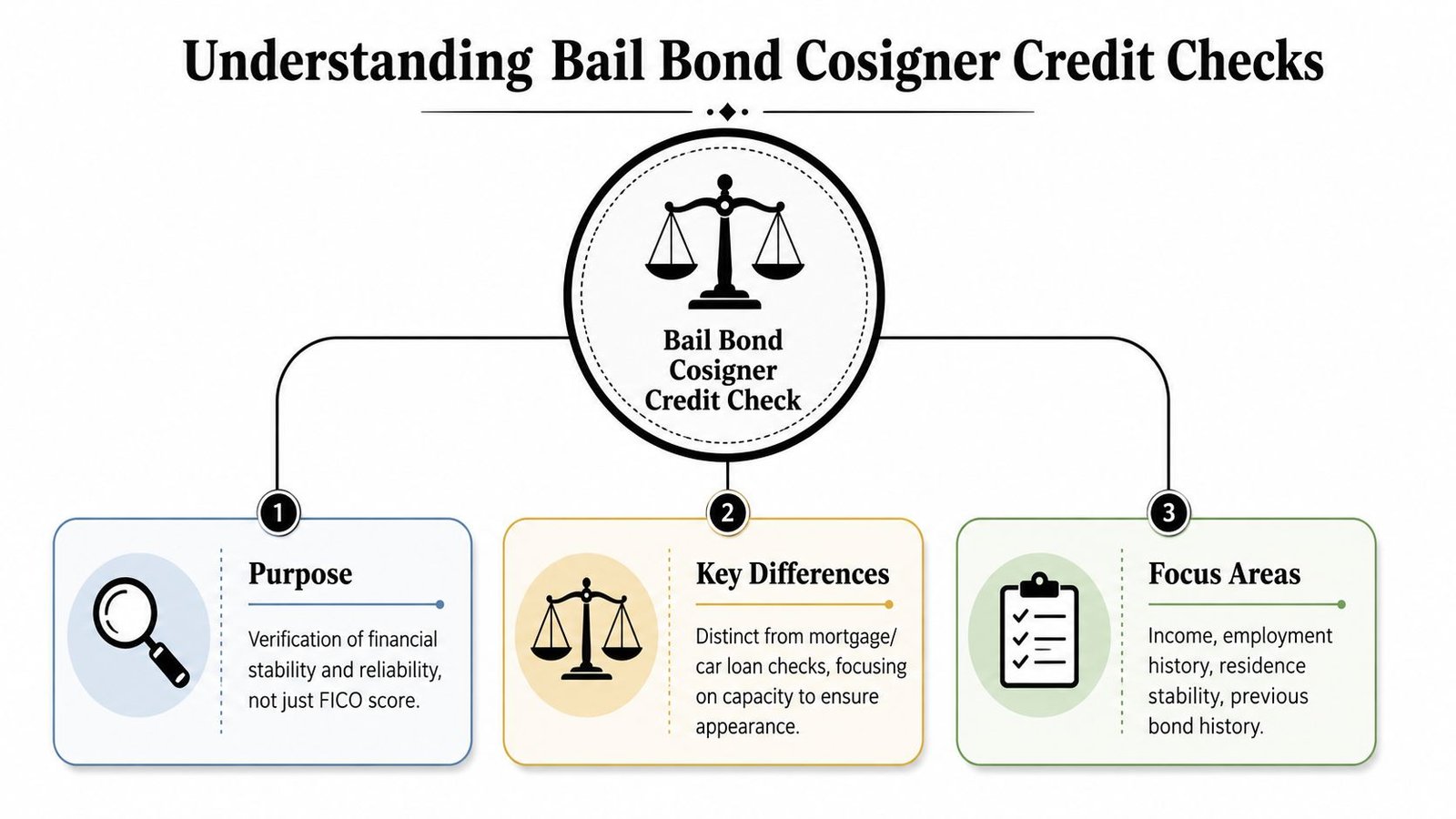
According to Armstrong Bail Bonds' explanation of bail bond credit requirements, a bail bond cosigner credit check is typically a soft inquiry or identity verification rather than a deep FICO-based review. That same explanation notes that agencies commonly focus on employment stability, residence history, and immediate ability to cover the obligation if the defendant disappears, rather than on perfect credit alone.
Think of it as screening, not lending
A lender asks, "Should we extend new debt to this applicant?"
A bail agent asks, "Is this person stable, reachable, and financially capable of backing this defendant's release?"
That difference changes the whole purpose of the review. You're not asking the agency to hand you a line of credit. You're asking the agency to post a surety bond based in part on your willingness and ability to stand behind the defendant.
A simple comparison helps:
| Situation | Main concern |
|---|---|
| Car loan application | Ability to repay borrowed money over time |
| Mortgage application | Long-term debt qualification and credit profile |
| Bail bond cosigner review | Identity, stability, and ability to back the bond obligation |
What agencies tend to focus on
In practice, the review usually centers on facts that show whether you're a dependable cosigner.
- Identity: government-issued identification helps confirm you are who you say you are.
- Employment: steady work suggests ongoing income and accountability.
- Residence history: a stable address helps show community ties.
- Resources: the agency may look at whether you have income, assets, or collateral available if needed.
- Bond history: prior bail situations can matter if they show a pattern of cooperation or problems.
If you want to understand the paperwork side before signing, review a sample overview of a bail bond contract. Many misunderstandings disappear once people see the contract as a legal guarantee, not a casual favor.
The cleanest way to view a bail bond cosigner check is this: the agency is trying to verify that the person signing is real, reachable, and financially grounded.
Hard Inquiries vs Soft Inquiries and Your Credit Score
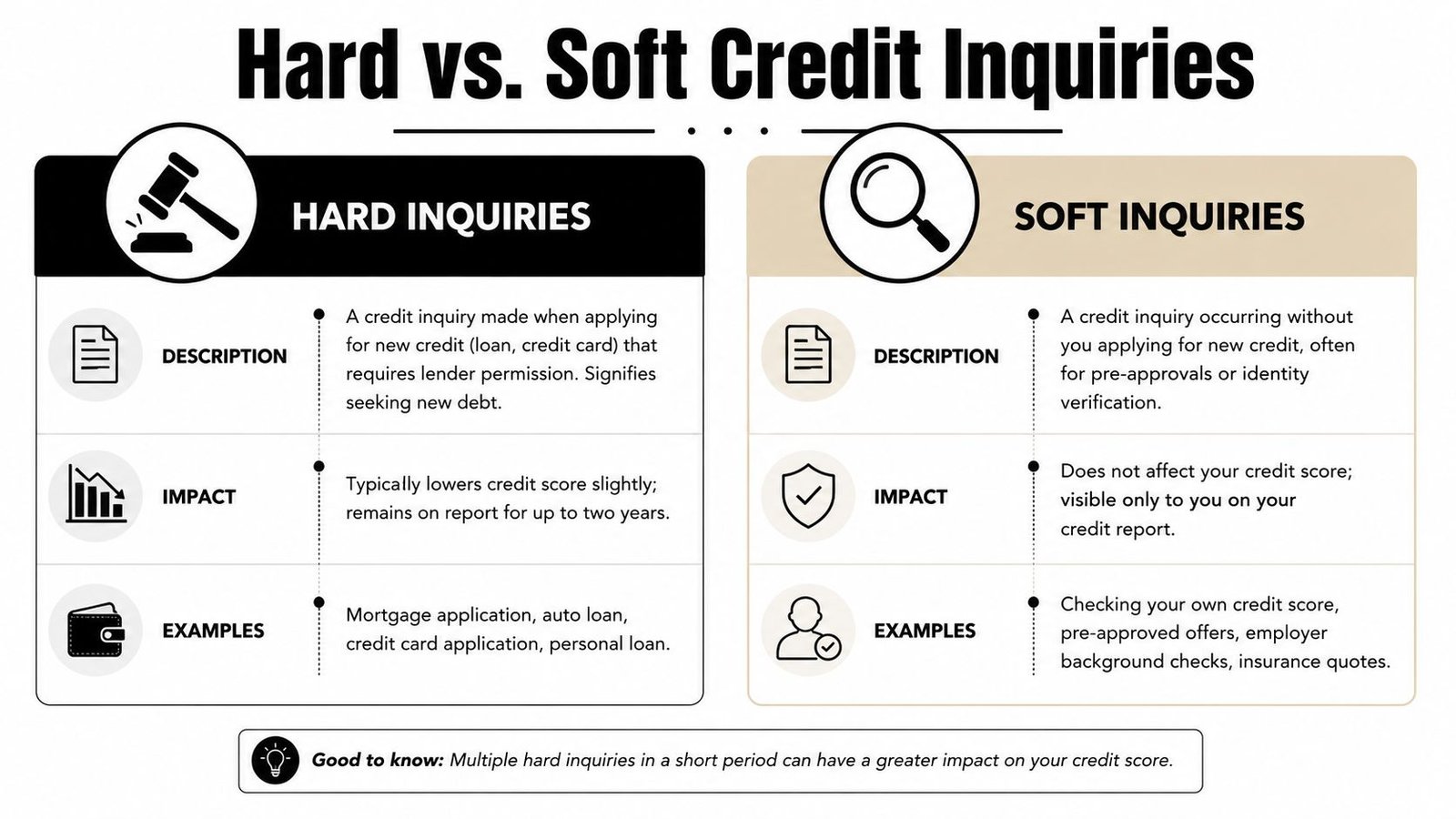
The phrase "credit check" makes people nervous because they picture a hard pull attached to a loan application. In the bail bond setting, that usually isn't what happens.
The difference that matters
A hard inquiry is associated with applying for new credit. A soft inquiry is generally tied to review, verification, or background-style screening. For worried cosigners, the practical point is simple: the initial bail bond screening is generally a soft inquiry, so the act of being checked usually doesn't affect your score.
That distinction is one reason bail bond cosigning feels so different from loan cosigning. The front-end check is lighter. The back-end legal responsibility is what deserves your full attention.
Here's a useful video primer on credit inquiries and score impact:
Where people get confused
People often borrow advice from the lending world and apply it to bail bonds. That's understandable, but it creates panic where there doesn't need to be any.
For example, when a traditional loan is cosigned, the debt appears on both parties' credit reports, and Sofi's summary of cosigner reporting notes that 90 percent of private student loan borrowers who applied for co-signer release were rejected by lenders. That's a long-term credit burden tied to lending. It is not the same thing as the initial soft inquiry used in many bail bond screenings.
If you're comparing bail bond cosigning to student loan cosigning, you're comparing two different systems with two different risk structures.
Why this matters in real life
A family under pressure doesn't need jargon. They need a usable answer.
- If your concern is the inquiry itself: the initial bail bond check is usually the less threatening part.
- If your concern is legal exposure: that's where you need to slow down and ask questions.
- If you're used to tenant or applicant screening rules: reading about understanding FCRA for independent landlords can help clarify how different kinds of consumer checks serve different purposes.
So yes, ask whether the agency uses a soft inquiry. You should. Just don't stop there. The bigger question is what you're agreeing to if the defendant misses court or stops cooperating.
How Colorado Bail Agencies Screen Cosigners
Colorado families usually expect a number-driven lending process. What they see instead is something more practical. Agencies are trying to determine whether the cosigner is a stable adult who can stand behind the bond and stay involved until the case moves forward.

What agents usually ask for
The exact list can vary, but Colorado cosigners are commonly asked for documents that show identity, income, and stability.
- Valid identification: a driver's license or other government-issued ID
- Proof of income: recent pay stubs, direct deposit history, or similar records
- Proof of residence: a utility bill, lease, or another document tying you to your address
- Basic personal history: employment details, how long you've lived where you live, and your relationship to the defendant
- Possible collateral information: if the bond or risk profile requires it
This isn't busywork. It gives the agent a basis for deciding whether you're in a position to take on responsibility. If you want a plain overview of how the process works from start to finish, it helps to review how to use a bail bondsman.
Why the screening can feel personal
Bail agents aren't just collecting forms. They're trying to judge reliability under pressure. That means they'll notice whether answers line up, whether documents are current, and whether the cosigner understands what they're signing.
Apex Bail Bond explains this clearly in its discussion of the cosigner's role. The Apex overview of bail bond cosigner responsibility states that the review functions as a risk-mitigation tool and that the cosigner is legally bound to the full bond amount plus associated court costs, effectively acting as the "bank" for the defendant's release.
A strong cosigner file is usually simple. Clear ID, steady income, stable residence, honest answers.
What this looks like in Colorado counties
Local logistics matter. A cosigner helping with a release in Jefferson County and Golden may face a different timing issue than someone handling a case in Centennial and the Arapahoe area. The screening questions are similar, but detention center procedures, booking times, and document coordination can vary.
That local variation is one reason organized paperwork helps so much. If you're trying to gather details on a defendant or verify identifying information quickly, guides on performing an online background check can help you understand what public-record style searches can and can't confirm before you call an agency.
What tends to help and what doesn't
A few patterns show up again and again.
| Helps the process | Slows the process down |
|---|---|
| Current ID and readable documents | Missing or expired identification |
| Verifiable income | Vague answers about work |
| Stable address history | Inconsistent address information |
| Honest discussion of the defendant | Minimizing obvious risks |
People sometimes think they need a perfect profile. They don't. They need a credible one.
Preparing to Cosign and Protecting Your Finances
Before signing, take ten calm minutes and review your own position. That small pause saves people more grief than any last-minute promise from the defendant.
Check your own financial footing
Traditional lenders usually want a cosigner with good to excellent credit, often defined as a credit score of 670 or higher, and they often look for a debt-to-income ratio below 50%, as described in Experian's overview of cosigner qualification benchmarks. Bail agencies aren't running the same kind of underwriting, but those benchmarks still give you a useful way to judge whether your finances look stable on paper.
That doesn't mean you need to meet a rigid banking formula for every bond situation. It means you should know whether your own finances are already stretched before you take on another legal obligation.
Questions worth asking before you sign
Bring these questions into the conversation:
- If the defendant misses court: ask what happens next and what your obligations become.
- If collateral is involved: review the terms carefully and read up on how bail bond collateral works.
- If you're worried about communication: ask who contacts you, when they contact you, and what updates you should expect.
- If the defendant has a shaky history: ask yourself whether you're prepared to stay involved until the case is resolved.
Don't cosign based on emotion alone. Cosign because you've looked at the risk, asked direct questions, and can live with the obligation if things go badly.
A practical checklist
Some people do better with a short checklist than a long explanation.
- Pull together your documents. Have ID, proof of income, and proof of residence ready.
- Be honest about the defendant. If there are reliability concerns, say so early.
- Review your own monthly obligations. If your budget is already tight, acknowledge that.
- Read the contract before the rush starts. Pressure leads people to miss the terms that matter most.
- Decide your limit in advance. If you won't pledge collateral or accept certain conditions, know that before the call.
Some families also need to hear this plainly: you are allowed to say no. Helping someone doesn't always mean cosigning. Sometimes the most responsible answer is refusing an obligation you can't safely carry.
Your Next Steps with Express Bail Bonds
If you've made it this far, the biggest point is probably clear. The initial cosigner credit check in a bail bond case is usually about verification and stability, not a damaging loan-style inquiry. The part that deserves close attention is the contract responsibility that comes after approval.
That is why transparency matters. The FTC notes in its cosigning guidance for consumers that co-signed loans are included in the cosigner's debt-to-income ratio, which can make it harder to obtain new credit. Even though a bail bond isn't the same as a consumer installment loan, the lesson carries over cleanly: don't sign anything you don't fully understand.
What to do right now
If you're ready to move forward, keep the process simple.
- Gather documents first: valid ID and recent proof of income are the usual starting point.
- Handle the details remotely if possible: electronic applications and signatures reduce delay.
- Ask direct questions: if a term isn't clear, stop and get it clarified.
- Use a clear contact path: if you need immediate answers, start with the Express Bail Bonds contact page.
A dependable agency should be able to explain the screening process in plain English, tell you what documents are needed, and move quickly without making you feel rushed into the wrong decision. For families in Colorado, that's the standard to expect.
If you need fast, professional help from a Colorado agency that handles bail bond applications, documents, and payments electronically, contact Express Bail Bonds. Their team serves detention facilities statewide and can walk you through cosigner requirements, timing, and next steps clearly when the situation can't wait.