A booking is not a conviction. Individuals held in local jails have not been found guilty of anything: they are awaiting court action or being held for other reasons, according to the Bureau of Justice Statistics jail inmates report. That fact shapes everything else. Getting someone released from jail starts with confirming what the court authorized, not with paying anyone. A judge sets the release conditions first, and a premium only becomes relevant after that decision exists. Payment alone never equals release; the jail still controls its own processing timeline.
Release Options and Who Decides Each One
Before anyone discusses price, one question controls everything: which release instrument did the judge authorize? Colorado splits release into several types, and the judge picks both the kind and the amount. A licensed agent enters the picture only after that decision exists, and only if the decision calls for a surety bond. The court is supposed to match the condition to the risk, which is why some defendants leave with a signature and no payment at all.
The Colorado General Assembly summary of HB19-1225 describes a 2019 law that generally requires courts to release defendants charged with a class 3 misdemeanor, a petty offense, or an unclassified offense on a personal-recognizance bond unless specified exceptions apply. The law also prohibits monetary bond conditions for many traffic, petty, and comparable municipal offenses. Those exceptions cover traffic offenses involving death or bodily injury, eluding police, circumventing an ignition-interlock device, and substantially similar municipal offenses. A later failure to appear, or a violation of release conditions, can still bring a monetary condition back.
| Release type | Who decides | Money involved | Often fits |
|---|---|---|---|
| Personal recognizance bond | Judge | None | Many low-level charges where the law favors release without money |
| Non-monetary conditions | Judge, using pretrial risk review | None | Lower-risk cases where check-ins or reminders address court appearance |
| Supervised release | Judge, with pretrial services | Typically none upfront | Cases where supervision or monitoring addresses the risk |
| Cash bond | Judge sets the amount, paid to the court | Full bail amount | Defendants who can pay the full amount to the court |
| Surety bond | Judge sets the amount, licensed agent posts it | Premium up to 15% of bail, $50 minimum | Families who cannot pay the full amount in cash |
Match the row to the paperwork before comparing costs. A recognizance release, explained on our page about release on your own recognizance, involves no bonding agent at all. For family handling this from out of state, the instrument matters most because it decides whether payment is even part of the plan. Calling a bondsman on a case the judge already cleared without money adds a step the court did not order.
Confirm the instrument first. Ask the jail or clerk which row applies, then compare costs. A posted surety bond cannot substitute for a release type the judge never chose, and the posting alone does not release anyone. The jail still completes its own release process before the defendant walks out.
What a Surety Bond Costs Before You Pay
The premium is a ceiling you can calculate, not a number someone invents on the phone. Colorado law limits a bail-bond insurance producer to the greater of $50 or 15% of the bail amount furnished. The Colorado Court of Appeals opinion in 25CA0631 works through a $10,000 bond, which produces a maximum premium of $1,500.
That cap works like a speed limit. It sets the most an agent may charge, and a written quote either stays under it or it is not a lawful quote.
| Bail amount | Maximum premium | How it is calculated |
|---|---|---|
| $300 | $50 | 15% is $45, so the $50 minimum applies |
| $1,000 | $150 | 15% of $1,000 |
| $5,000 | $750 | 15% of $5,000 |
| $10,000 | $1,500 | 15% of $10,000 |
Charges that sit outside the premium
The percentage is the premium. Anything beyond it, such as collateral pledged against the bond, belongs on its own line in the written quote, so ask for that full breakdown before anyone signs. Name who is financially responsible, including any cosigner, while the terms are still on paper. Our premium is non-refundable and is fully earned the moment the defendant walks out, even if the case is later resolved or the charges are dropped. That is why the refund, collateral, and forfeiture language has to be settled before money moves, and why paying faster does not change the jail's side of the process.
Say the court set $5,000. The cap is $750, not the full $5,000 the court would hold on a cash bond. A relative who can cover an unexpected bill without draining rent is in a stronger spot to cosign. Building a financial cushion for unexpected bills is separate from the bond, and it keeps a cosigner from promising money they can't replace.
Before you sign, get these five items in writing:
- Bond amount and form: secured surety, not a cash-only order we don't post.
- Premium: the dollar figure under the 15% cap or the $50 floor.
- Each separate charge: collateral and anything else owed, each on its own line.
- Who pays: defendant, cosigner, or both, with names spelled as on the ID.
- Refund, collateral, and forfeiture terms: what happens if the person appears, and what happens if they don't.
Our surety bond rates page is the place to line that written quote up against the cap. Keep one thing clear while you compare: the premium buys the agent's work of posting the bond, and the release itself still runs through the court's conditions and the jail's processing. Verified paperwork is what protects your money.
How to Arrange a Remote Release Step by Step
Release in Colorado runs on verification, not payment. A posted bond is one checkpoint inside a longer legal sequence, and each checkpoint has to clear before the next one opens. The amended Chief Justice Order 25-23 bond guidelines require courts to use the least restrictive conditions reasonably necessary to ensure court appearance and community safety, considering the defendant's circumstances and financial condition. Sheriffs generally can't release someone until a bond is set, with specified exceptions. Felony recommendations and conditions must be reviewed and approved or modified by a judicial officer before pre-advisement release.
Eight steps take you from the first call to a confirmed posting, and every one of them can be done from another state.
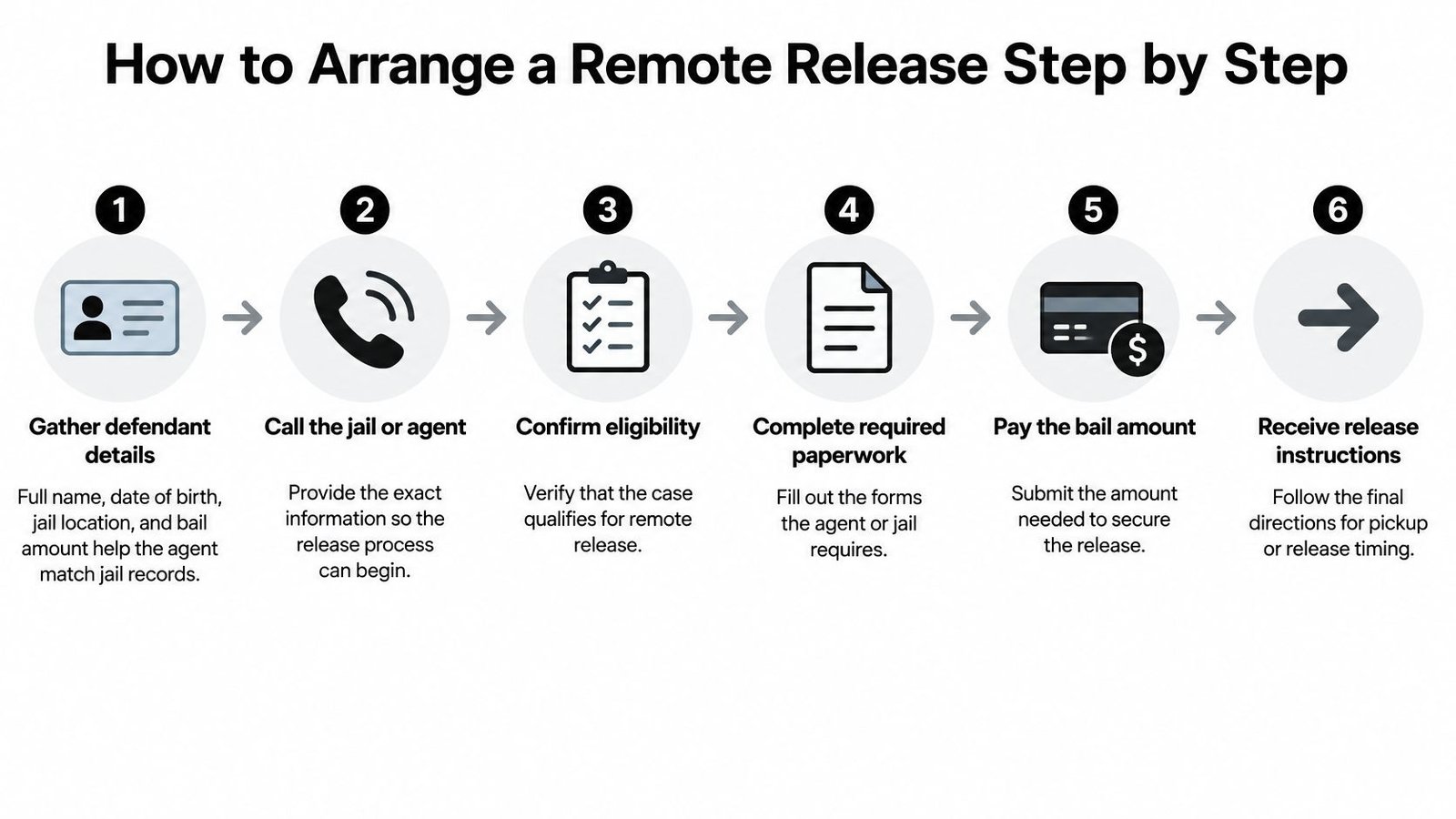
- Gather identifiers. Have the defendant's full name, date of birth, the jail holding them, and the bail amount ready. We match those four items to the booking, and a misspelled name slows the search.
- Confirm a bond is set. Call the jail or the court clerk. A judge has to authorize the amount before anything can be posted, so a call here saves you from paying against an order that doesn't exist yet.
- Get the right county. Video advisement commonly runs through a virtual courtroom in the jurisdiction where the alleged offense occurred. Pull the county docket and the facility contact before you send documents.
- Ask about a lighter option. Check whether non-monetary release is available, or whether counsel should request a bond modification, before you treat a surety bond as the only path.
- Screen the barriers. Ask about a no-bond hold, a mandatory protection-order advisement, unresolved warrants, or charges that exclude pre-advisement release. Any one of those stops the file, and no premium moves it.
- Lock the conditions. Confirm the bond type, the written conditions, and the next court date, and ask how court notices will reach the defendant. "Bond amount available" is not the same as immediate release.
- Apply from your phone. Family outside Colorado can complete the application and agreement electronically and submit it securely online. Our electronic document exchange moves that paperwork without a drive to the jail.
- Pay, then log the call. Send the premium once, against the written quote you already have. Call or text us at 720-984-2245, and write down every name, time, and reference number.
You're on track when the jail confirms it has the paperwork and the bond shows as posted. Facility acceptance is the signal, not the moment the card clears. From a distance, that confirmation call is your proof of progress, and it is the step only you can make.
Why Release Stalls After the Bond Is Posted
Paying the premium doesn't open the door. Once the paperwork is signed and the premium is paid, a licensed agent goes to the jail and posts the surety bond with the court clerk. The jail can still take one to eight hours to process the release, depending on staffing and how busy the facility is. Families who treat a receipt as a pickup time spend that window calling the wrong desk.
| Delay cause | What you may see | What to ask or do |
|---|---|---|
| Bond not yet authorized | Jail shows no bond amount | Ask the court clerk whether a bond has been set and for the exact amount |
| Hold from another case or warrant | Release is refused after payment | Ask whether any hold or warrant exists before paying |
| Protection-order advisement incomplete | Release waits on advisement | Ask the jail what advisement is still required |
| Facility processing after posting | Release takes longer than expected | Ask the jail for a release time estimate and a named contact |
| Sheriff release clock | Release runs past six hours | Ask whether extraordinary circumstances are recorded and when the clock started |
What each stall actually means
No amount on the screen means the judicial officer hasn't set or approved bond yet. Don't send a premium against a blank field.
A hold after payment usually means another case or warrant is sitting on the booking. Ask before you pay, because the surety bond on this charge doesn't clear a different hold.
Advisement can be mandatory on a protection order. The jail, not the bonding agent, finishes that step.
Processing time is the jail's queue after we post with the clerk. Ask for an estimate and a named contact, then use that name on the next call. More on a bond that looks posted but hasn't produced a release is on our page about posted bail when someone is still in custody.
The sheriff's clock
A Washington County Justice Center bulletin states that a sheriff must release a defendant within six hours after a personal-recognizance bond is set and the defendant returns to jail, or within six hours after a cash bond is set, the defendant returns, and the defendant or surety notifies the jail that the bond is prepared to be posted, unless extraordinary circumstances exist. Supervisory conditions don't themselves justify delay. A sheriff may hold someone for up to 24 hours to arrange required electronic monitoring.
A bond that shows as available is not immediate release. Court authorization, booking completion, holds, advisement, and facility processing each have their own clock.
Cosigner and Defendant Duties After Release
The cosigner supports the bond contract financially. The defendant must obey court orders, appear as directed, and meet the conditions the judge set. Those jobs are related, and they aren't the same job.
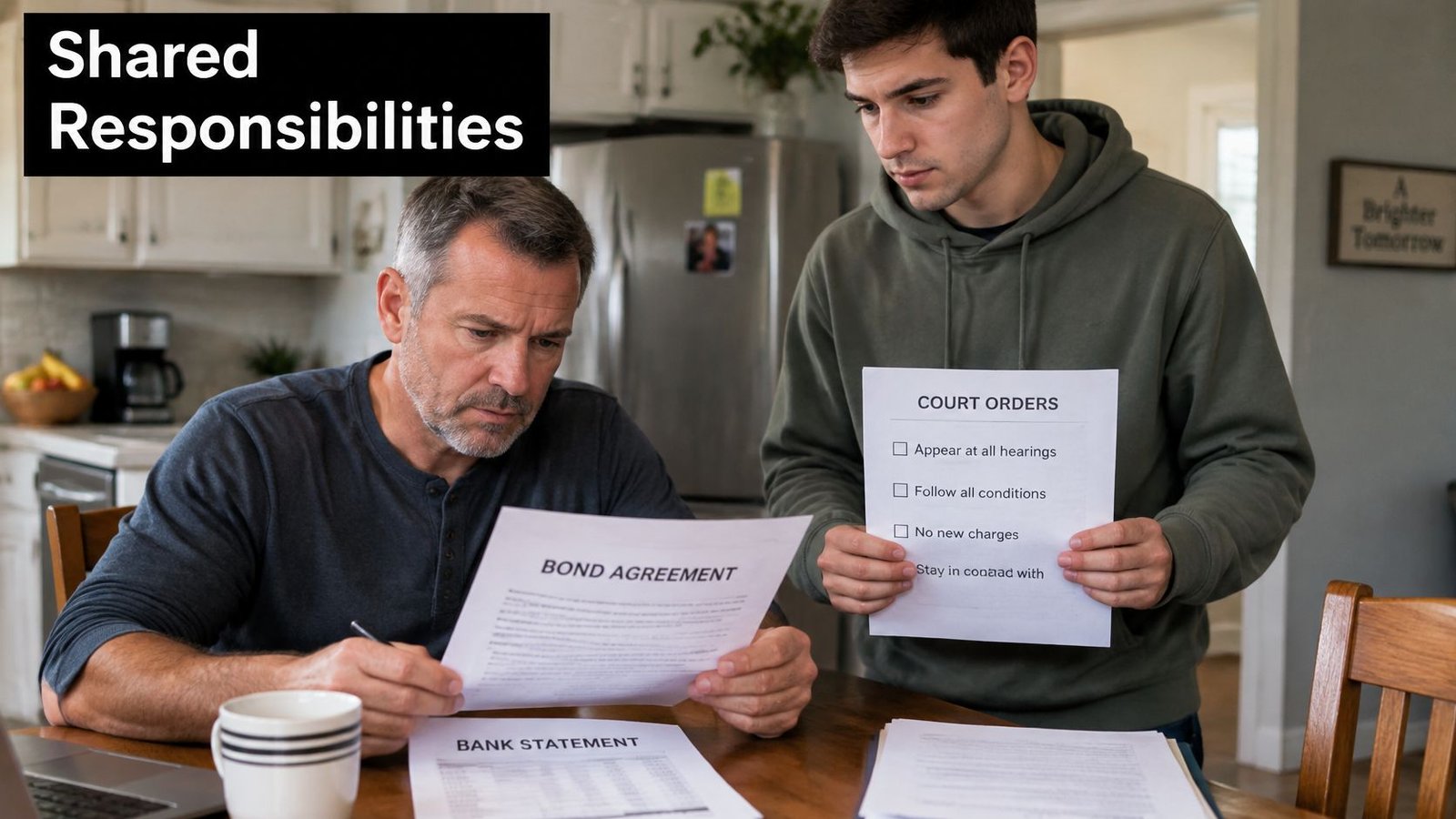
After release, our team follows up to confirm the defendant is out and gives guidance on court dates and bond conditions. Defendants must check in regularly with their bail agent, which can be a weekly phone call or a visit to the office. Court notices have to reach someone who will act on them. Set a shared inbox or a phone alert before the person walks out. A missed notice doesn't excuse a missed date, and a missed date can put the bond at risk and expose the cosigner financially.
Professional bonding is regulated, not a private handshake. The Colorado Division of Insurance may investigate bail-bond agents, write rules, and deny, suspend, revoke, or refuse to renew a license. It may also impose civil penalties. You can verify a license before you sign. Our page on cosigner responsibilities spells out the money side of that signature.
Use this checklist the day of release:
- Court date and courtroom: write both down, plus the time.
- Agent contact: save the number the defendant will use for check-ins.
- Ride and reminder: agree who drives, and who calls the night before.
- Signed copies: keep every document the cosigner and the defendant signed.
- Travel: ask whether the judge's conditions allow travel, and get that rule in writing before the first court date. The bond agent doesn't set travel rules.
No bond agency and no cosigner can override a judicial detention order or change conditions. Only the court can. If a check-in is missed, call the agent the same day, then contact the court about the date. Don't wait for a notice that may already have been sent.
Confirm the Release and Your Next Step
A posted bond starts a process; it does not finish one. After the paperwork is signed and the premium is paid, a licensed agent goes to the jail and posts the surety bond with the court clerk. From there, the jail can take one to eight hours to process the release, depending on its staffing and how busy it is. Your job during that window is verification: confirm the bond was received, ask whether a hold or a pending advisement could delay the release, and keep checking status with the facility instead of assuming the payment ended the matter.
Start the remote request today if the identifiers are in hand. Have the defendant's full name, date of birth, the jail, and the bail amount ready before you dial, so the first call answers the process questions instead of hunting for the booking.
Call or text 720-984-2245. You reach a licensed bondsman who can answer questions about the bail process, and the consultation is free. You can begin online at Express Bail Bonds. For a Jefferson County booking, use the Jefferson County and Golden page. For the Centennial area, use the Centennial bail bonds page.
If the jail or clerk sends bond paperwork by fax, a transmission report only proves the pages left the machine, and fax delivery confirmation explained lays out exactly what that report does and does not establish. It cannot prove a person received or acted on the packet. Pair it with a call to a named person at the facility who confirms the bond is posted, and ask the clerk's office to verify the filing on their end.
Once the defendant walks out, the Express Bail Bonds team follows up to confirm the release and gives guidance on court date compliance and bond conditions. Ask the clerk whether posting the bond created a new court date or left the original one standing, because that answer decides what the family tracks next.
A bond is a contract, and release is a process that continues after the money moves.
Express Bail Bonds helps Colorado families post a surety bond remotely, with electronic applications and a licensed agent who posts the bond with the court clerk once the paperwork and premium are complete. If you're trying to get someone or from jail and you already know the booking details, that remote path works for out-of-state relatives as well as people down the street. Visit Express Bail Bonds to start the application or to reach a bondsman by phone or text.