
In Colorado, the standard surety bond premium is 15% of the bond amount, while a common 10% rate may be available for bonds over $5,000 when an approved cosigner is added. On a $7,500 bond, that means a $1,125 standard premium or $750 with the approved cosigner rate.
At two in the morning, that difference matters. A family may be trying to understand a court figure, gather identification, reach a cosigner, and decide how to pay, all while someone they love is still in custody. The bond amount can look overwhelming, but the amount the family pays is usually the premium, not the full bond amount.
A Late-Night Reality Check on Surety Bond Rates
At 2 a.m., a spouse or parent may learn that a relative is in a Colorado county jail with bond set at $7,500. The first reaction is understandable: “We need to find $7,500 tonight.” A few minutes later, the more useful question is whether the family needs the full bond amount or the premium charged for arranging the guarantee.
For a surety bond, the bail bondsman works with a surety company that posts or guarantees the court-ordered amount. The family generally pays a percentage for that service. The practical conversation shifts from finding the entire bond amount to identifying the applicable rate and gathering the documentation the agent needs.
The practical question: Ask which premium rate applies and whether an approved cosigner could change the amount due. That answer can matter more than the bond figure printed on the court paperwork.
The term surety bond rates refers to the price of the surety's financial guarantee. The court still sets the bond amount, while the family pays the premium connected to arranging that guarantee. The premium is separate from a fine, and it is separate from the full amount named in the bond.
The first calculation families usually need
As noted above, the $7,500 bond example changes from a $1,125 premium at the standard rate to $750 at the 10% rate when the paperwork qualifies. At that hour, the useful task is confirming which rate the agreement supports, rather than trying to redo the arithmetic while stressed.
The premium generally remains earned even if the case ends favorably. Collateral is a separate matter. If collateral is required, its release depends on the agreement and the conditions being satisfied. Anyone signing the contract, including a person agreeing to indemnify the bond, should understand those responsibilities before payment or electronic signing.
Colorado bail-bond guidance describes the standard premium as 15%, with a 10% premium often available for bonds over $5,000 when an approved cosigner is involved (Colorado contracting guidance on the 10% and 15% structure). The discount is tied to eligibility and approved paperwork, so a family should request a clear quote instead of assuming that every bond receives the lower rate. Clear figures and confirmed requirements make a difficult late-night decision easier to handle.
How Surety Bonds and Their Rates Actually Work
Think of a surety bond like a financial guarantee arranged through three people or entities. The principal is the person whose obligation is being backed. The obligee is the court or other party requiring the bond. The surety is the company that provides the guarantee.
That three-party arrangement is the basic structure described by the National Association of Surety Bond Producers. In a bail setting, the court sets the bond amount, the surety becomes involved through the bail agent, and the defendant and indemnitors agree to the conditions of the contract.
Premium and bond amount are different
A useful comparison is car insurance. If your policy has a large liability limit, you don't hand the insurer that entire limit when you buy coverage. You pay the premium for the insurer's willingness to cover an obligation if a qualifying event occurs.
A surety bond works similarly in this respect. The bond amount is the financial obligation connected to the court's order. The premium is the price paid for the surety's guarantee. The family doesn't normally pay the full bond amount as the premium.
For a $5,000 bond, the math is straightforward:
| Rate | Calculation | Premium |
|---|---|---|
| 15% standard rate | $5,000 × 15% | $750 |
| 10% cosigner rate | $5,000 × 10% | $500 |
The 10% pathway depends on eligibility and the threshold described for Colorado bonds. It isn't automatically available on every bond, and a cosigner must satisfy the surety's approval requirements.
What happens to the money
The premium is the charge for arranging the surety guarantee and is generally paid once under the agreement. The bond amount itself isn't the family's purchase price. If collateral is requested, that collateral is governed by the indemnity agreement and can involve separate obligations.
A surety indemnity agreement may allow the surety to demand collateral and use it for asserted or actual liability, as explained in this legal overview of collateral demands. Read the agreement before signing, especially if a vehicle, cash, or property interest is involved.
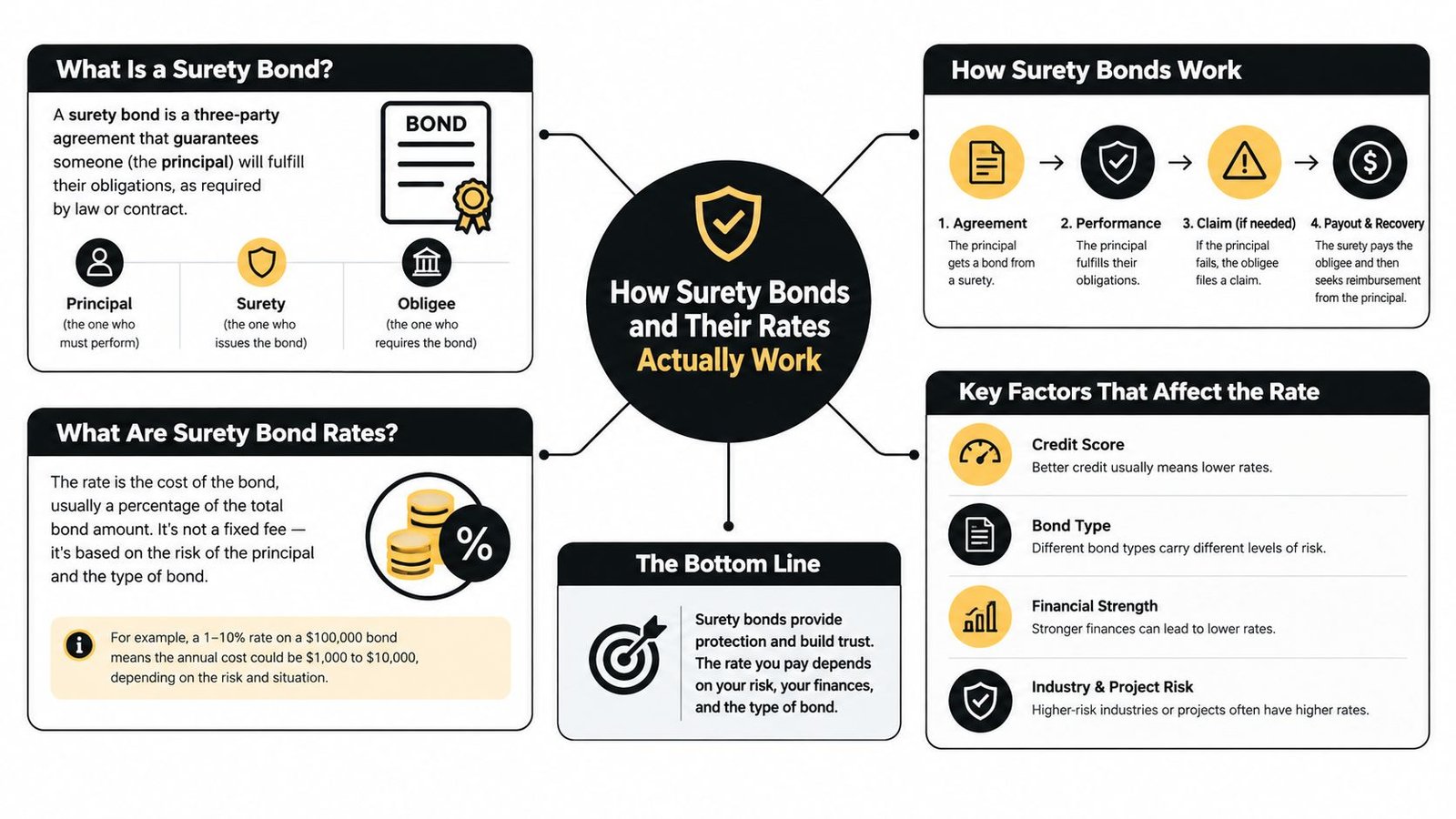
For a plain-language explanation of the arrangement, see what a surety bond is. The central idea is simple: the court sets the obligation, the surety provides the guarantee, and the premium is the cost of arranging that guarantee.
Key Factors That Move Surety Bond Rates Up or Down
The percentage is only one part of the conversation. A surety reviews the circumstances around the bond before deciding whether the standard rate applies, whether a cosigner is acceptable, and whether collateral or additional conditions are needed.
For a typical Colorado consumer bond, these factors usually matter most:
| Factor | Effect on Rate |
|---|---|
| Bond amount and type | A larger or more complex obligation can require closer review and may change the available terms. |
| Approved Colorado cosigner | On a bond over $5,000, an approved cosigner may make the 10% pathway available instead of the 15% standard rate. |
| Credit and financial stability | Stronger financial information can support more favorable underwriting, while higher perceived risk can lead to stricter terms. |
| Criminal history and court history | Prior failures to appear or other history can increase concern about future compliance. |
| Community ties | Employment, family, residence, and reliable contact information can help show stability. |
| Charge and case circumstances | A misdemeanor and a felony may receive different levels of review because the perceived risk can differ. |
| Payment and collateral arrangement | A secure payment method or acceptable collateral may support a smoother approval than a transaction the surety considers difficult to verify. |
The approved cosigner is often the most visible rate-changing factor for a family because it can affect the percentage directly. The cosigner isn't merely a reference. That person may take financial responsibility under the contract if the defendant fails to meet the agreement's obligations.
Underwriting looks beyond one number
For commercial surety, underwriting commonly considers credit, financial statements, working capital, profitability, prior bonding history, experience, and bond size or type (contractor underwriting factors). Consumer bail underwriting uses its own procedures, but the broad principle is similar: the surety evaluates the likelihood and consequences of a claim.
Immigration status can also lead to additional questions about identity, residence, and the defendant's connection to the community. That doesn't create one universal rate by itself. It means the agent may need clearer documentation before confirming the available terms.
A family should compare its quote with the Colorado benchmark, but it shouldn't assume every case is mechanically identical. Colorado bail rates and premium information can help you identify whether you're discussing the base premium, a cosigner arrangement, collateral, or an added service.
Sample Calculations for Common Colorado Bond Amounts
The easiest way to understand a quote is to write the bond amount on one line and multiply it by the applicable rate. The result is the premium, which is the amount being compared, not the full bond amount.
| Bond Amount | 15% Standard Premium | 10% Cosigner Premium | Savings |
|---|---|---|---|
| $2,500 | $375 | Not available under the stated over-$5,000 threshold | Not applicable |
| $7,500 | $1,125 | $750 | $375 |
| $25,000 | $3,750 | $2,500 | $1,250 |
The $2,500 example
A $2,500 bond at 15% produces a $375 premium. Because the bond is below the stated $5,000 threshold, the 10% cosigner pathway described for larger Colorado bonds isn't available under this structure.
The $7,500 example
At $7,500, the standard calculation is $7,500 × 15% = $1,125. If an approved cosigner qualifies the bond for 10%, the calculation becomes $7,500 × 10% = $750, a $375 savings.
The $25,000 example
At $25,000, the standard premium is $3,750. The 10% calculation is $2,500, so the difference rises to $1,250. The percentage stays the same, but the dollar effect becomes larger as the bond amount grows.
These examples illustrate why families should ask about eligibility before deciding that a quote is too high. The bond pricing explanation provides the same kind of rate-focused framework. For these scenarios, payments can be processed electronically through Express Bail Bonds, subject to application approval and the payment method accepted for the transaction.
Why the 10% Rate With an Approved Cosigner Matters
At 2 a.m., a family may hear a 15% quote and assume it is the only available option. The 10% rate can matter when the bond is over $5,000 and an approved cosigner joins the contract. It is a qualification-based rate, not a discount that applies just because someone requests it.
The cosigner shares financial responsibility for the agreement. If the defendant misses court or fails to follow the bond terms, the cosigner may have obligations under the signed indemnity documents. The arrangement works like adding another financially responsible person to the contract. That added accountability is why the surety may offer the lower rate.
What approval usually involves
Approval can include several checks:
- Colorado residency: The surety may verify that the cosigner lives in Colorado and can be contacted reliably.
- Stable income: Employment or other income records can help show the ability to meet contractual obligations.
- Valid identification: Identification and current contact details confirm who is signing.
- Credit review: A brief review may help evaluate financial reliability.
- Signed paperwork: The cosigner signs an indemnity agreement and confirms the information needed to administer the bond.
The exact review depends on the circumstances. A cosigner should understand the agreement before signing, because the role carries a real contractual responsibility. It is more than helping with paperwork.
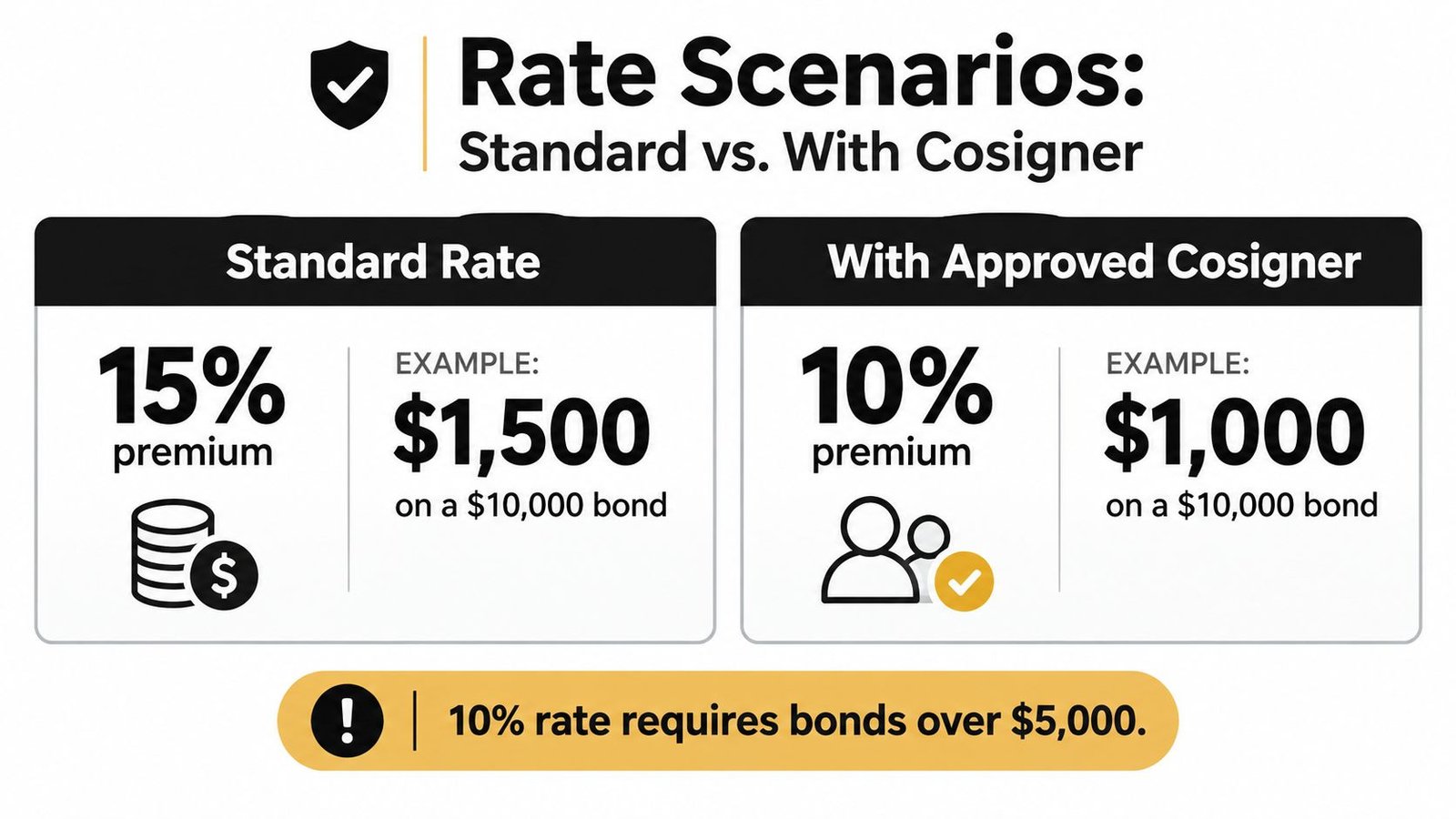
Before authorizing payment, ask the agent to confirm in writing whether the 10% quote depends on final cosigner approval. Ask what rate applies if approval is denied, and whether any additional charges affect the amount due. Review the premium processing fee information before choosing a payment method. Clear answers prevent a late-night quote from changing unexpectedly during signing.
For a visual comparison of the two rate pathways, review the following explanation:
How Express Bail Bonds Handles Rates and Payments Electronically
An electronic process can remove several late-night obstacles. Instead of driving to a jail office with paperwork and payment in hand, a family can begin by providing the case information and bond amount online or by phone, then confirm the rate that applies to the situation.
A typical application follows a clear sequence:
- Confirm the bond and rate: The agent reviews the bond amount, explains the premium, and identifies whether the standard rate or a possible cosigner rate is being considered.
- Upload documents: The applicant provides identification, contact details, and case information through the requested electronic process.
- Sign the agreement: The defendant's indemnitors and any cosigner review and digitally sign the indemnity documents.
- Verify the cosigner: For a bond over $5,000 seeking the 10% rate, the approved cosigner's residence, identification, income, and other information are reviewed.
- Pay electronically: The premium can be submitted through accepted electronic methods, including ACH transfer, debit card, or an approved mobile payment app.
- Receive confirmation: Receipts and completed documents can be delivered by email, while the bond is filed electronically with the Colorado jail when the application is approved.
The electronic workflow matters because the rate isn't useful until the family knows exactly how to pay it. A quote should identify the premium and any separate charge before the transaction is completed. Express Bail Bonds states that funds are held in a regulated trust account and that receipts are emailed promptly, with the bond filed electronically with the Colorado jail.
The electronic payment process can be especially useful for an out-of-state relative or a Colorado cosigner who can't reach the detention facility quickly. Electronic payment also creates a written record that the family can keep with the signed agreement and receipt.
Ask one direct question before paying: “Is this the complete premium and approved processing cost for the bond, or are other services being added?”
The rate confirmed during the application should be the rate paid for that approved arrangement. Review the final documents carefully, keep the emailed receipt, and ask about any fee that isn't clear.
Practical Ways to Lower What You Pay on a Surety Bond
The most effective cost-saving step is also the one families often overlook. If the bond is over $5,000, ask whether an approved cosigner can qualify for the 10% pathway. Moving from 15% to 10% reduces the premium by one-third of the standard percentage calculation, although approval is required and the cosigner accepts financial responsibility.
Other steps can help control the total cost:
- Prepare strong documentation: A stable employment letter, recent pay stubs, valid identification, and dependable contact information give the agent useful material for review.
- Ask about collateral carefully: Cash, a vehicle lien, or a property deed may be considered in some arrangements. Collateral can affect approval or retainers, but it also creates obligations that must be written clearly in the agreement.
- Compare the quote itself: Ask whether the number is only the bond premium or a package that includes GPS monitoring, attorney referrals, or another service.
- Use an accepted electronic method: ACH, debit card, or another approved method can make payment easier to document and may help avoid returned-check charges.
- Discuss the bond amount with counsel: An attorney may be able to address release conditions or seek a different court order, but that decision belongs to the court and the defense team.
Rate competition can exist among bail agents, so comparing more than one quote may reveal differences in payment options, collateral requirements, and included services. The lowest headline percentage isn't automatically the lowest total cost if the package adds charges that weren't explained at the start.
Cooperation matters after release, too. Keeping contact information current, attending every court date, and paying the agreed premium promptly helps the family avoid preventable problems. It may also give an agent better context if the family ever needs help with another Colorado surety bond.
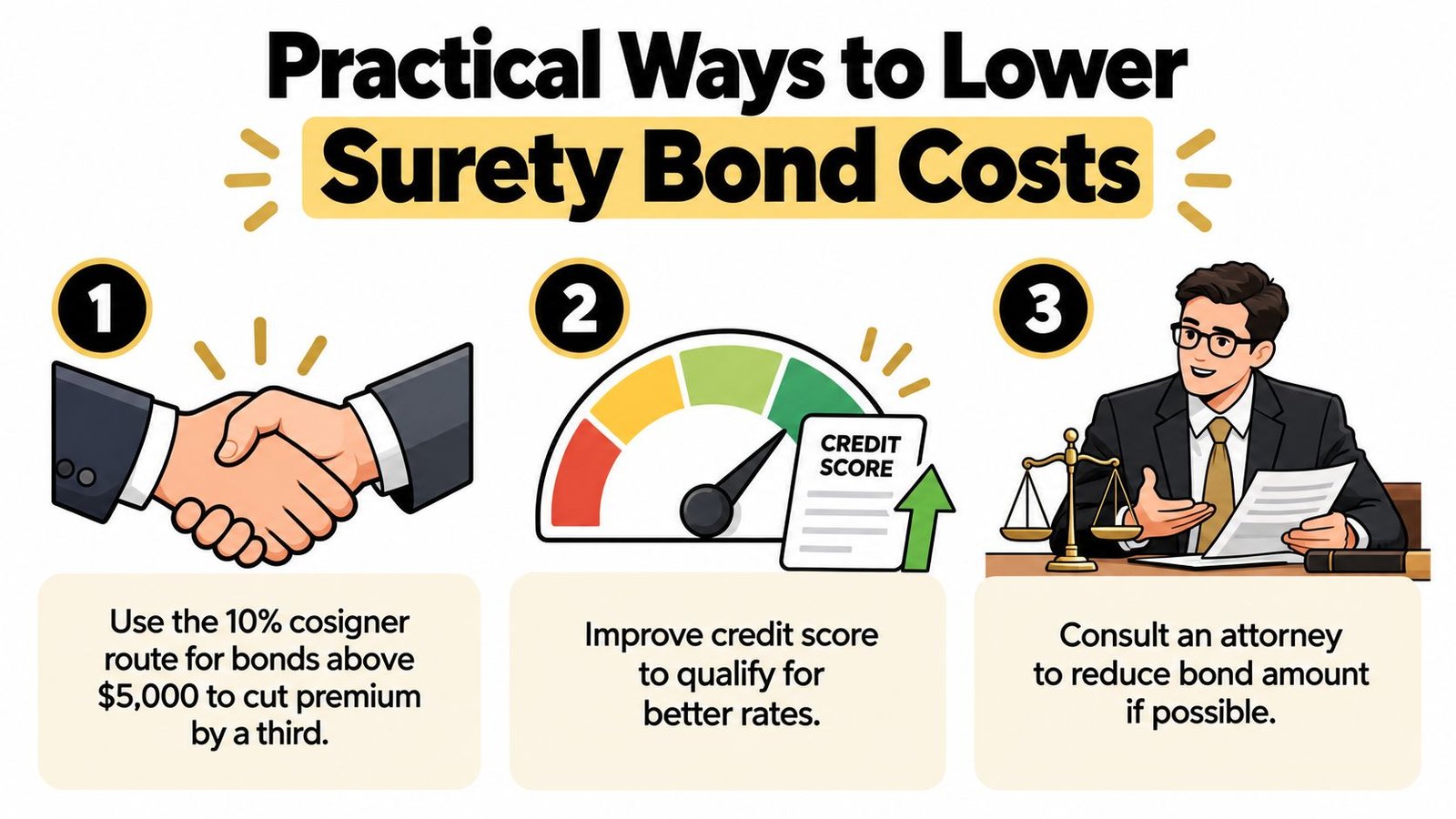
The key is to lower cost without signing away more than you understand. A cosigner route can reduce the premium, while collateral can create a separate financial exposure. Read both sides of that tradeoff before you commit.
Bringing It All Together and Taking the Next Step
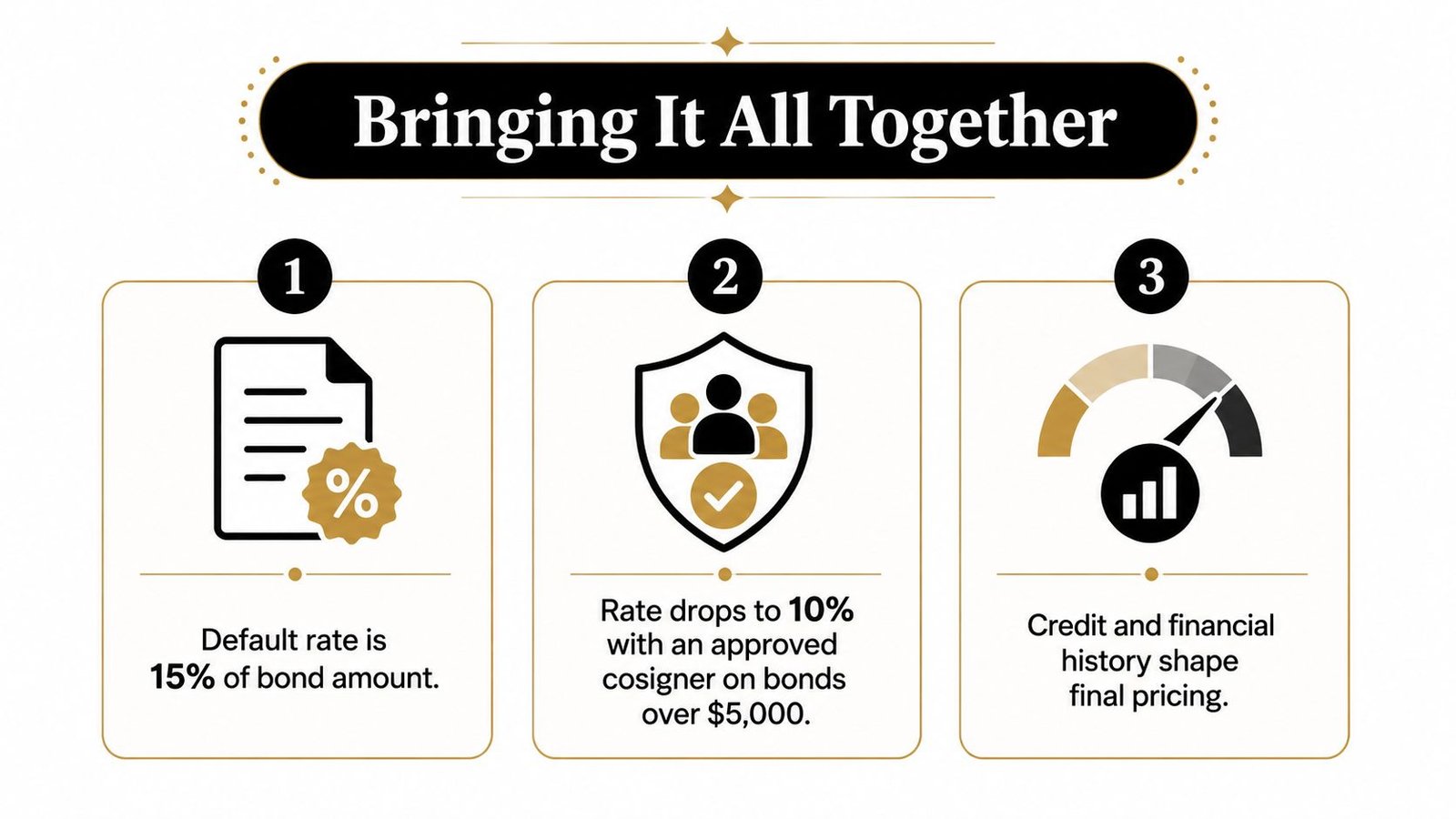
Colorado surety bond pricing becomes easier to understand once you separate three ideas. The court sets the bond amount. The surety charges a premium for its guarantee. The applicant's circumstances, including the cosigner, financial information, history, residence, employment, and collateral, influence which arrangement is available.
The Colorado benchmark is 15% of the bond amount. For a bond over $5,000, an approved cosigner may make the 10% rate available. A $7,500 bond therefore has a $1,125 standard premium or a $750 premium through the approved cosigner pathway. The premium is generally nonrefundable after release, while properly held collateral is handled under the agreement when the case resolves.
Surety pricing also varies beyond consumer bail. Federal policy analysis says commercial surety bonds generally cost about 0.5% to 3% of the contract price, with the SBA Surety Bond Guarantee Program closer to 3% (Congressional Research Service analysis of surety bond pricing). Industry guidance places strong-credit applicants around 1% to 3%, while higher-risk applicants can reach 5% to 15% or more (surety bond cost guidance). Those commercial ranges aren't a substitute for Colorado bail pricing, but they reinforce the central point: a surety rate is a percentage applied to an obligation, not the obligation itself.
You don't have to spend the night in a jail lobby trying to decode the numbers alone. Start an electronic application, provide the bond information and identification, ask whether a cosigner qualifies, and request the exact premium before signing. Families needing local guidance can review Jefferson County and Golden bail bond services or Centennial bail bond services while arranging the next step.
Express Bail Bonds offers Colorado surety bond guidance, electronic applications, digital contract signing, and online premium payment so families can review the 15% rate or ask about the 10% approved-cosigner option from home. Visit Express Bail Bonds to begin an application or request a clear quote for your specific bond.