Directory records answer this faster than any advertisement. Freedom Fast Bail Bonds is listed as a Pittsburgh, Pennsylvania bail bond company, with a Better Business Bureau profile at 622 Second Avenue, Suite 110, Pittsburgh, PA 15219-3118, and no Colorado licensing or Colorado jail coverage appears in those same records, so an arrest in Denver, Golden, Centennial or anywhere else in Colorado needs a Colorado-licensed agency instead.
It's 2:14 in the morning. Someone you love is in a county jail intake cell, and a friend texts you a company name or a search result puts it at the top of the page. Your hands are shaking and the only question in your head is how fast this can end.
Two questions matter more than the search ranking. What is this company, really? And how do you pick a bail bond service that can lawfully walk someone out of the specific jail holding them tonight? Answer the second one carelessly and you lose money. Answer it well and you lose less time than you expect.
Freedom Fast Bail Bonds at a Glance
A branded "fast bail" result works like a contractor ad on a phone pole. The ad can promise a quick arrival, and you still have to read the truck's home city before you send money. For Freedom Fast Bail Bonds, public listings answer that geography question in one pass.
The Better Business Bureau profile for Freedom Fast Bail Bonds places the primary office at 622 Second Avenue, Suite 110, Pittsburgh, PA 15219-3118, and shows the business profile was established or published in 2018. Yelp carries the same downtown Pittsburgh address. A second directory entry associates the company with 1003 Wood Street in the Pittsburgh area and reports about 17 years in business.
| Attribute | What public records show | Why it matters |
|---|---|---|
| Primary office | 622 Second Avenue, Suite 110, Pittsburgh, PA 15219-3118 | Confirms a Pittsburgh operation, not a Colorado one |
| Other listed address | 1003 Wood Street, Pittsburgh area | Shows more than one recorded local location |
| Track record | BBB profile established 2018; directories report about 17 years in business | Two plain directory figures for how long the name has been listed |
| Service area | Pittsburgh plus Allegheny, Armstrong, Beaver, Indiana, Lawrence, Washington and Westmoreland counties | At least eight named markets, all in Pennsylvania |
| Availability | Advertised 24/7 nationwide bail bond service; listed hours 8 a.m. to midnight or later, seven days | Extended-hours model rather than daytime-only |
| Online features | Online payment and online bail-bond service listed | Remote processing is part of the model |
| Bond types | Federal, cash, surety, felony, misdemeanor, DUI/DWI, warrant and appearance bonds | Broad bond menu rather than one specialty |
| Colorado relevance | No directory evidence of Colorado licensing or jails served | A Colorado arrest needs a Colorado-licensed agency |
Hours, counties, and the bond menu
Yelp describes a business open seven days a week, from 8:00 a.m. until midnight or later. That pattern fits overnight arrests better than a weekday storefront. Listed hours tell a family calling at 3 a.m. whether someone is supposed to answer. They do not show which state's license that person holds.
A Pittsburgh bail bonds directory listing names Allegheny, Armstrong, Beaver, Indiana, Lawrence, Washington and Westmoreland counties. Count Pittsburgh with those seven counties and the listing covers at least eight named markets, all inside Pennsylvania. The same listing advertises a 24/7 nationwide bail bond service and online payment, so the advertised footprint runs past the office door.
The bond menu is broad: federal, cash, surety, felony, misdemeanor, DUI/DWI, warrant-related, and appearance bonds. An agency that writes that range keeps jail paperwork and court checks for each type. You still match the license to the jail on the booking sheet. A Pennsylvania bondsman cannot post a Colorado surety bond, and a Colorado agent cannot post one in Pittsburgh. The state on the letterhead is the state whose licensing rules, fee limits, and jail procedures apply.
If the arrest happened in Colorado, the agency you pay has to be licensed in Colorado and able to post at that specific facility. Confirm the court dates and any cosigner duties that follow release before you treat speed as the whole purchase.
How a Surety Bail Bond Actually Works
A money bond is the machine at the center of everything that follows.
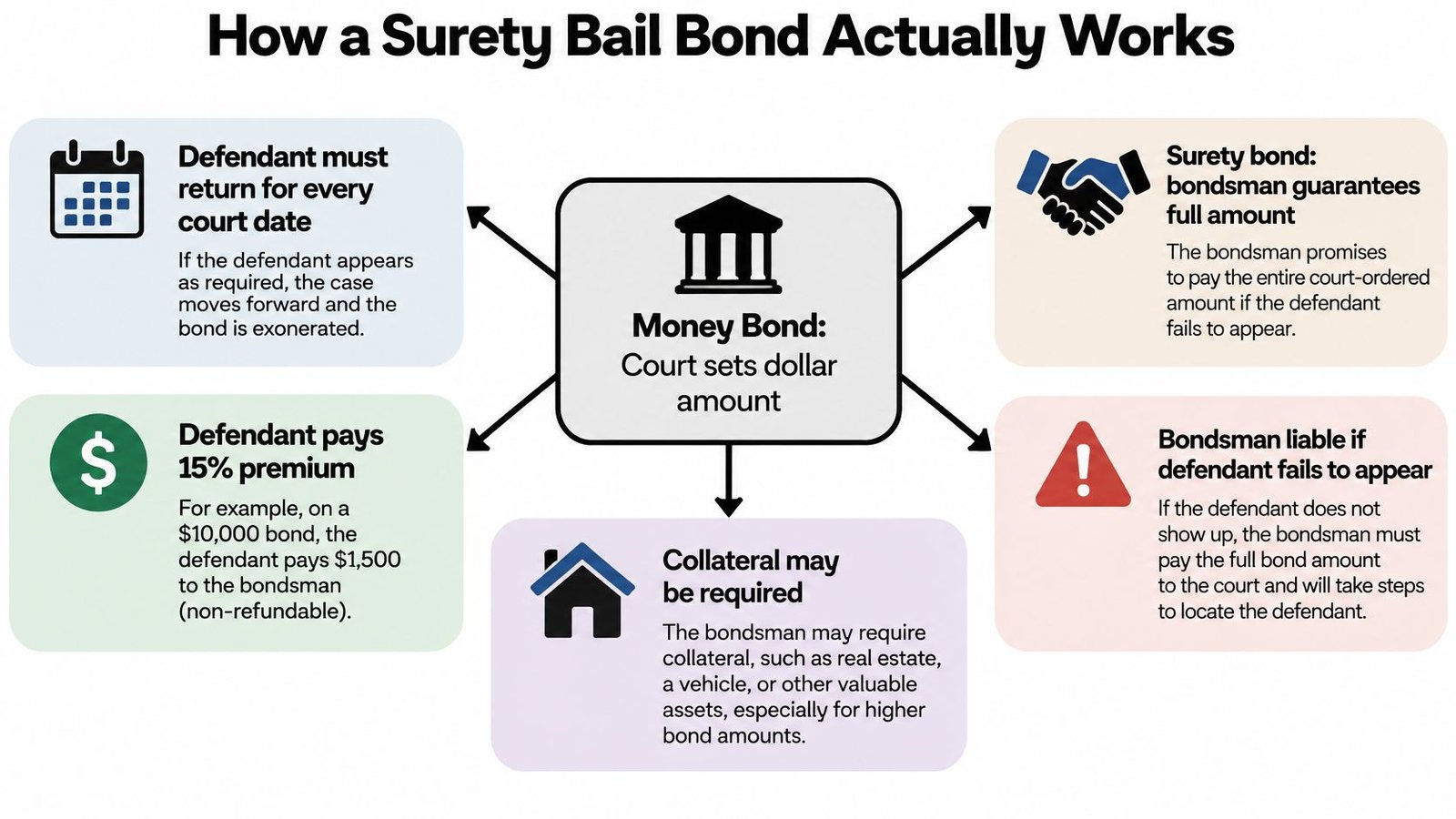
Say your brother is booked into a Colorado county jail and the court sets a $5,000 money bond. That number is not a fine and it is not a fee. It's a dollar figure the court holds as security, returned when he appears at every date on the calendar until the case resolves.
The cosigning analogy that makes it click
Think about co-signing an apartment lease for a friend with thin credit. You aren't renting the apartment. You're promising the landlord the rent gets paid, and if it doesn't, the landlord comes to you first.
A bail bond stacks that same promise twice. The bail agent promises the court the defendant will appear. The cosigner, also called the indemnitor, promises the agent to cover the loss if the defendant doesn't. Every signature along that chain carries real consequences.
Who is actually in the transaction
- Defendant: the person in custody, whose appearance is the thing being guaranteed.
- Indemnitor, or cosigner: the family member or friend who backs the bond financially.
- Licensed bail agent: an insurance producer authorized by the state to write bail bonds.
- Surety company: the insurer standing behind the full bond amount.
- The court and the jail: separate institutions with separate procedures, and both can hold up a release.
The money moves in one direction and the risk moves in another. The family pays a premium, which is the agent's fee for taking on risk. The agent posts the full bond through the surety. The court holds the full amount as security. When the case ends and appearances are complete, the court exonerates the bond and collateral comes back, assuming the premium is paid. The premium itself buys the service, not the outcome, so it isn't a deposit you reclaim.
What a fast posting actually depends on
Speed isn't a function of how quickly someone picks up the phone. Four dependencies have to clear, and they clear in parallel.
- The court's current monetary condition. The amount and type on the paperwork at this moment, not what a relative heard two hours ago.
- The jail's bond-acceptance procedure. Where the bond gets posted, by whom, with which identification, at which window or portal.
- The cosigner's identity and authority. A verified person with the legal capacity to sign the indemnity agreement.
- Completed documents. Indemnity and disclosure paperwork signed in full, with no blanks left for later.
Electronic signatures and remote payment trim travel and queue time, but they can't replace jail-specific acceptance rules or court verification, a distinction that runs through pretrial release research on how release actually happens. Understanding the mechanics behind a Colorado surety bond agent makes the rest of the checklist read like a sequence instead of a scramble.
Colorado Release Options Compared
It is after midnight, the jail has quoted a number, and someone is already searching for the fastest bond company that will take a card. The search does not tell you which release the court authorized. That type is set at advisement, and it decides what your family can do before morning.
| Release option | Who provides it | Typical cost | When it fits |
|---|---|---|---|
| Cash bond | Family or defendant pays the court or jail directly | Full bond amount up front, returned after the case, minus fees | Funds are available and you want to avoid a premium |
| Surety bond | Colorado-licensed bail bond agency posts a surety bond | Premium capped at the greater of $50 or 15% of bail: $750 maximum on $5,000, $150 maximum on $1,000 | You need release without tying up the full amount |
| Personal recognizance | Judge releases the defendant on a written promise to appear | $0 | Advisement grants PR for lower-risk cases |
| Property bond | Equity in Colorado real estate is pledged to the court | No cash, but the property is encumbered until exoneration | Property qualifies and cash flow is tight |
| Pretrial supervision | Court-ordered conditions managed through pretrial services | No bail premium | Assessment supports release on conditions instead of money |
A cash bond works like placing the full security deposit with the court yourself. A surety bond works like a licensed agency posting that security while you pay a capped premium for the service. Personal recognizance and pretrial supervision can mean no premium. A property bond uses equity, and the court keeps a claim on that property until exoneration.
The premium cap that does the math for you
Colorado statute limits what an insurance producer writing a bail bond may charge: no more than the greater of $50 or 15% of the bail amount (Colorado Revised Statutes 10-2-707). Compare the two figures and use the larger one. That figure is a ceiling, not a target price.
On a $5,000 bond, 15% is $750. Because $750 is larger than $50, $750 is the maximum premium. On a $1,000 bond, 15% is $150, which is above the $50 floor, so $150 is the maximum.
Other charges are limited to items the statute allows, such as a court or law-enforcement filing fee, documented secure collateral storage, or premium financing. A usable quote separates premium, allowed charges, collateral terms, and any financing cost. One blended total hides whether the premium stayed under the cap.
Confirm the jail's own process before sending money
Counties do not share one payment desk. Jackson County's sheriff and jail information, for example, publishes an online bond-payment option with a PLC inmate-locator number. Confirm that kind of facility detail before any funds move. Ask which payment method this jail accepts, what identification the person posting needs, and who confirms receipt.
Households that cannot move the full cash amount overnight usually turn to a surety bond. A judge can also release someone on a written promise, so read how a PR bond works in Colorado before assuming a premium has to be paid. Paying the entire bond in cash is uncommon when the amount is large compared with what a household can transfer at night.
The booking charge and the release type are different documents. bail application and criminal trial help does not replace the advisement order from the Colorado court that set the condition.
How to Evaluate a Bail Bond Service and Spot Scams
The right question isn't who can get someone out fastest. It's who can prove, in writing, that they're licensed in Colorado and what the total will be.
| Check | What to ask for | Red flag |
|---|---|---|
| License | State insurance producer license number verifiable with the Colorado Division of Insurance | No license number or verifiable business address |
| Written quote | Itemized quote separating premium, filing fee, collateral terms and financing | One unexplained total or pressure to sign before reading |
| Price cap | Premium no greater than $50 or 15% of the bail amount, whichever is larger | Charges above the cap or vague additional fees |
| Receipts | Written premium and collateral receipts at payment | Cash or card payments with no documentation |
| Collateral | Written terms for what is held, where it is stored and when it is returned | Verbal promises about getting collateral back |
| Payment channel | Pay the licensed agency directly by traceable method | Gift cards, cryptocurrency or payment to someone claiming to be a government officer |
| Availability | Genuine round-the-clock licensed agent with e-signature and remote payment | No after-hours contact or in-person signing required for remote families |
Start with the regulator, not the website. The Colorado Division of Insurance bail bond page explains that the division regulates bail agents and handles consumer complaints, including overcharging premiums, failure to return collateral, failure to provide written premium or collateral receipts, misappropriation of premium or collateral, and other fiduciary violations. That list is also a map of what can go wrong when you skip the written quote.
The scam check that takes four minutes
- Find the number yourself. Call the jail, court or pretrial services office using a number from the official government website, never a number read to you by the person who called.
- Refuse the government-officer story. Denver's Pretrial Services office warns that government personnel will never request payment for release, assessments, diversion, electronic monitoring or supervision, and it reports impersonation scams aimed at defendants and their families.
- Get the terms in writing first. Bond type, amount, premium, collateral terms and the refund or forfeiture rules, confirmed before any signature.
- Pay one party only. The licensed agency, by a traceable method, with a receipt in hand.
Urgency is the vulnerability. A caller who insists the next ten minutes decide everything is describing a pressure tactic, not a court deadline.
That is the uncomfortable part of buying bail in a hurry. Speed compresses the safeguards families rely on, and out-of-state relatives process everything remotely with no ability to walk into an office. Treat identity verification and document review as part of speed rather than paperwork afterthoughts. Checking that a licensed Colorado bail bondsman meets state requirements takes less time than recovering from a bad one.
A $5,000 Bond From First Call to Release
A loved one is in a Denver-metro county jail, and advisement has set a $5,000 surety bond. Work the price before anyone dials. A 3 a.m. quote is easier to judge when the ceiling is already on paper.
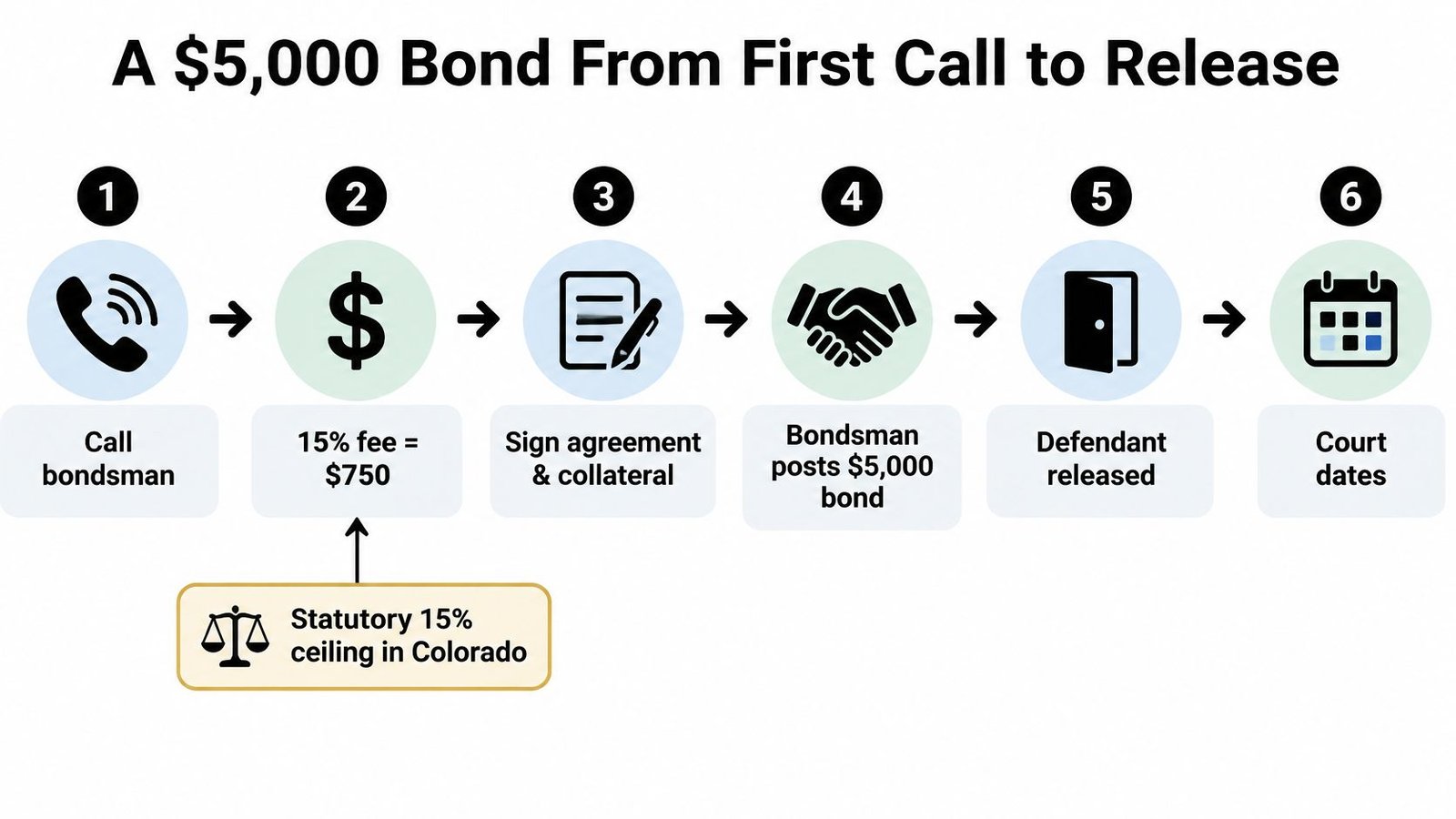
At the statutory ceiling of 15%, the maximum premium on this bond is $750. The lower 10% premium with an approved cosigner applies only to bonds over $5,000, and only when the written quote confirms it. A bond of exactly $5,000 does not qualify for that rate, so do not treat $500 as the price of this example. Compare the quote with the 15% cap, not with what another family paid last year.
Cosigner review works like a landlord reading a rental application. Approval generally looks at stable employment, established residency such as owning a home or a long rental history in the area, and a decent credit score. Those facts support the indemnity agreement. They do not change the premium ceiling.
Jail-side charges stay small and separate. A custodian may charge no more than a $10 bond-processing fee, including when a bond is posted online, may not add transaction or kiosk fees, and may apply a credit-card processing charge of up to 3.5% in the circumstances the statute describes. Bond, booking and other debts don't have to be paid to secure release on a money bond (Colorado HB25-1015).
The sequence, step by step
- Call or text the agency line with the defendant's full legal name, date of birth and the jail holding them.
- The agent verifies two things at once, the court's current monetary condition and the facility's bond-acceptance and posting procedure.
- The cosigner completes the application, e-signs the indemnity and disclosure documents, and pays the premium.
- The agent posts the bond at the jail. Once posted, there are zero delays on the agency's end.
- The release window belongs to the jail. Processing time, not the agency, sets when the door opens.
Speed helps only after those checks line up: the right jail, a licensed agent, and a premium that fits the cap. A relative in another state can finish every step electronically without flying to Colorado. If you want the full price breakdown first, this explanation of what bail bonds cost in Colorado walks through the components. For a broader walkthrough of the release process itself, this step-by-step guide to bailing someone out covers the jail-side sequence in plain language.
The 14-day edge case worth knowing
Colorado builds in one narrow refund window. If the court or a party changes the bond's terms within 14 days of posting, a court may order a compensated surety to refund part of the premium when necessary to prevent unjust enrichment and supported by factual findings. After 14 days, that authority ends, and the statute also ties collateral release to exoneration of the surety's liability once the premium is paid (Colorado Revised Statutes, title 16).
Confirm the Details Before You Pay Anyone
A caller at 1 a.m. says your brother can leave a Colorado jail tonight if you pay before the call ends. That sentence blends three milestones that do not happen at the same time. Separating them is what keeps a rushed payment from turning into a costly one.
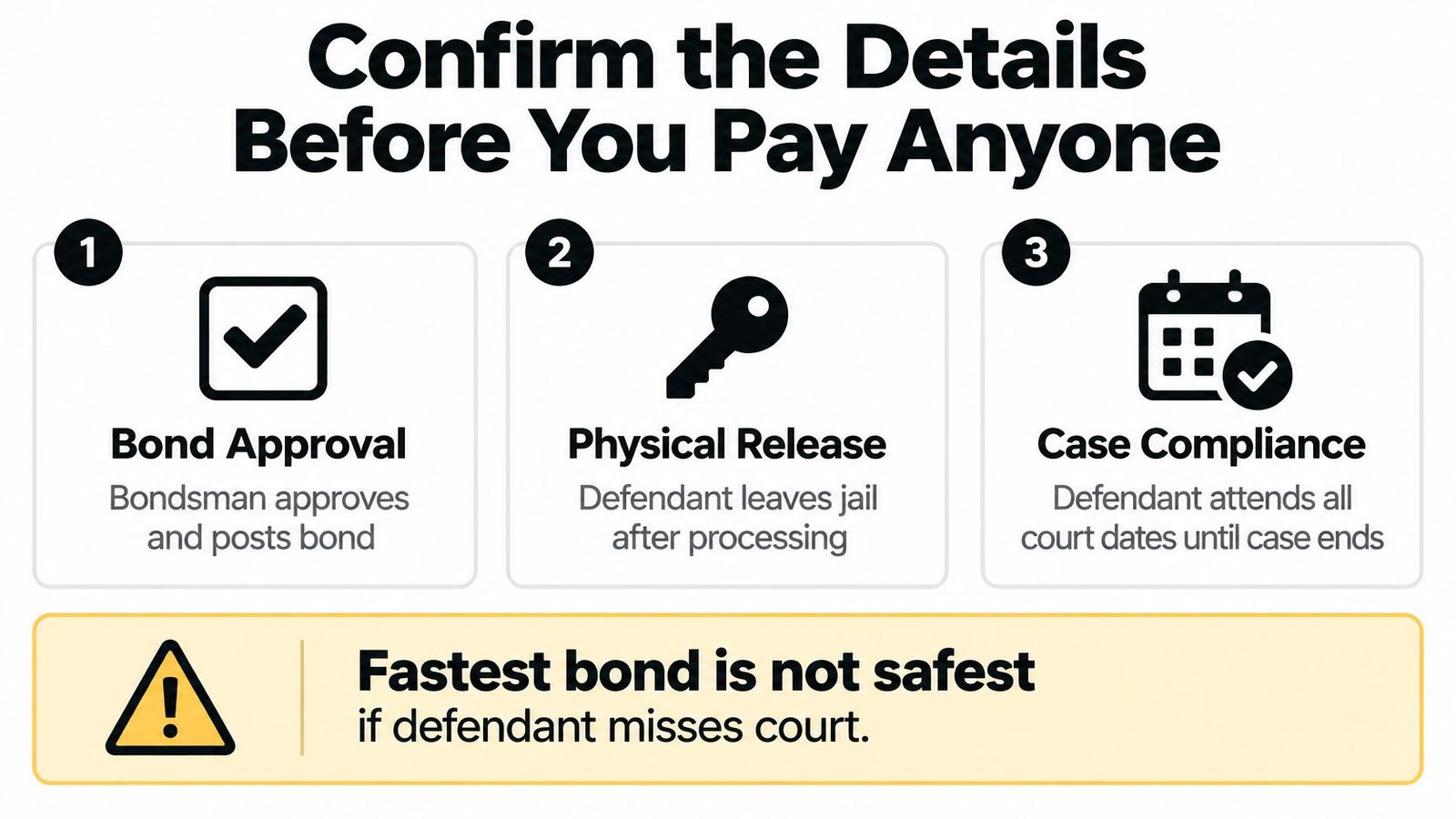
Bond approval means an agent has agreed to write it. Physical release means the jail has processed the paperwork and opened the door. Case compliance means the defendant appears at every date until the case resolves. Approval can be quick and still leave someone outside without a clear picture of reporting, treatment, monitoring, or how court notices arrive.
The post-release checklist
- Next court date and location, confirmed in writing, not remembered from a phone call.
- Every supervision condition imposed by the court or pretrial services, read line by line.
- Updated contact information on file with both the court and the bail agency.
- Transportation from the facility, arranged before release, not after.
- A clear answer from counsel on how continuances and schedule changes get communicated.
Colorado's official appearance-bond form requires the defendant to appear personally at the listed court date and at subsequent dates until the case reaches an authorized resolution. Failure to appear can trigger forfeiture, higher bail, or changed release conditions (Colorado Judicial Branch bond form). Denver Pretrial Services also assesses defendants before the first appearance and can impose supervision afterward.
Practical rule: read the bail bond contract before you sign it, and ask which obligations survive the release. If a caller's identity is unclear, checking who is really calling you is a two-minute habit that prevents most impersonation losses.
For a Colorado arrest, use a Colorado-licensed agency serving the state and answering around the clock. Start with the main service overview, then go straight to the county page that matches the jail: Jefferson County and Golden for a facility in that county, or Centennial and Arapahoe County for south-metro cases.
Verify jurisdiction, license, price, and post-release duties first. Then move as fast as the jail allows.
Express Bail Bonds is licensed, bonded and insured in Colorado, and has posted surety bonds across the state since 1988. Whether the arrest happened in Denver, Golden, Centennial or a rural county, the team can verify the court's current bond condition, prepare the documents electronically for out-of-state cosigners, and post at the facility holding your family member, day or night. Visit Express Bail Bonds to start the release process with a clear, no-obligation quote.