
A late-night jail call can make everything feel blurry. You're trying to catch the name of the jail, the charges, the bail amount, and whether your loved one is scared, hurt, or just embarrassed. Then someone says, “You need to sign a bail bond contract,” and that phrase can sound bigger and more dangerous than it really is.
Take a breath. A bail bond contract is not a trick document. It's a legal agreement, yes, but at heart it's a plain promise on paper. It says who is responsible, what must happen next, what the fee is, and what happens if the person out on bond doesn't go to court. If you understand those few moving parts, the whole process gets much less intimidating.
What Is a Bail Bond Contract
When families hear “contract,” they often picture pages of legal language designed to trap them. In practice, a bail bond contract is the paperwork that allows a licensed surety agency to post a bond so a defendant can be released from jail while the case moves through court.

The court requires a guarantee that the defendant will return to receive their release. The bail agency provides this formal assurance. To establish the rules of the agreement, both the defendant and the cosigner sign the contract.
What the contract really does
A bail bond contract usually covers four basic things:
Who is being released
The defendant, also called the principal, is the person who must appear in court.Who is guaranteeing the bond
The bail agency posts the surety bond with the court.Who is financially backing the defendant
The cosigner, often a parent, spouse, sibling, or close friend, agrees to take responsibility if the defendant disappears or breaks the agreement.What everyone must do
Court appearances, address updates, payment terms, and any collateral terms are written down so there's no guessing later.
A good contract should answer the questions you'll worry about at 2 a.m., not create new ones.
If you want a plain-English refresher on what makes any agreement legally valid, this guide to enforceable agreements is a useful outside reference.
Why these contracts matter
Bail contracts aren't some rare paperwork used in unusual cases. They're part of a large, active system. The U.S. bail bond services industry supports over 20,000 businesses and generates $3.5 billion in revenue, while felony pretrial releases with financial conditions rose from 37% to 61% across major U.S. counties, according to IBISWorld industry data.
If you're still sorting out the bigger picture, this explainer on what a surety bail bond is can help connect the contract to the actual release process.
The Parties Involved in Your Bail Agreement
When a family calls us in Colorado, this is often the point where the stress spikes. One person is in jail, another person is reading the contract on a phone screen, and everyone is asking the same question. “Who is responsible for what?”
A bail agreement makes more sense once you separate the four people and institutions involved. Each has a specific role. If you know those roles before you sign, the contract feels a lot less confusing.
The defendant
The defendant, sometimes called the principal, is the person being released from jail.
Their job sounds simple, but it carries the whole agreement. They must appear in court, follow any release conditions, and stay reachable if the contract requires address, phone, or work updates. If they miss court or stop communicating, the problem does not stay small for long.
For families signing electronically with Express Bail Bonds, this is one of the first things to confirm before you click “sign.” Make sure the defendant knows every court date, has reliable transportation, and understands that release is conditional, not open-ended.
The cosigner
The cosigner is the person who backs the bond financially. You may also see the word indemnitor. In plain English, that means the person who agrees to repay the bail agency if the bond causes a loss.
This is usually the role that deserves the slowest, most careful review.
A parent, spouse, sibling, or close friend may step into this spot. By signing, that person is telling the agency, “I believe this defendant will follow the rules, and if they do not, I may be the one paying for the fallout.” That can include unpaid premiums, recovery costs, or collateral issues described later in the contract.
If you want a plain-English explanation of that responsibility, this guide to a bail bond cosigner explains what to check before you agree.
The bail agency
The bail agency, or surety, is the company posting the bond to the court. In this article's context, that is Express Bail Bonds.
The agency prepares the contract, collects the premium, verifies information, and files the bond so the defendant can be released if the court accepts it. It also has to act quickly if the defendant misses court or breaks the bond terms. That is why agents ask detailed questions before sending an electronic agreement. They are not trying to make the process harder. They are checking whether the risk makes sense.
A good agency also translates the legal wording into ordinary language before you sign. Under stress, people often skim. That is understandable. But a bond contract works better when everyone slows down long enough to know what each signature means.
The court
The court sets bail, decides the release conditions, and controls what happens if the defendant complies or fails to appear.
The court does not negotiate your payment plan with the agency. It does not explain your cosigner duties. Its concern is narrower than that. The court wants the defendant back in court, on time, under the terms of release.
That is why the contract can feel like two systems meeting in one document. The court creates the release obligation. The bail agency creates the financial agreement that supports it.
A quick way to keep the roles straight
If you are reviewing the contract on your phone or laptop, use this checklist:
- Defendant: Will I show up for every court date and follow all release terms?
- Cosigner: Can I afford this obligation if the defendant does not comply?
- Bail agency: Have they explained the premium, signatures, and consequences clearly?
- Court: What dates, rules, and conditions must be followed exactly?
Plain rule. The defendant must comply. The cosigner accepts financial responsibility. The agency posts and manages the bond. The court sets the rules everyone must follow.
Key Clauses Inside a Bail Bond Contract
This is the section individuals often examine while feeling as though they require a translator. That is a reasonable reaction. Many bail bond contracts employ standard legal wording, yet the core clauses are not mysterious once the formal language is removed.
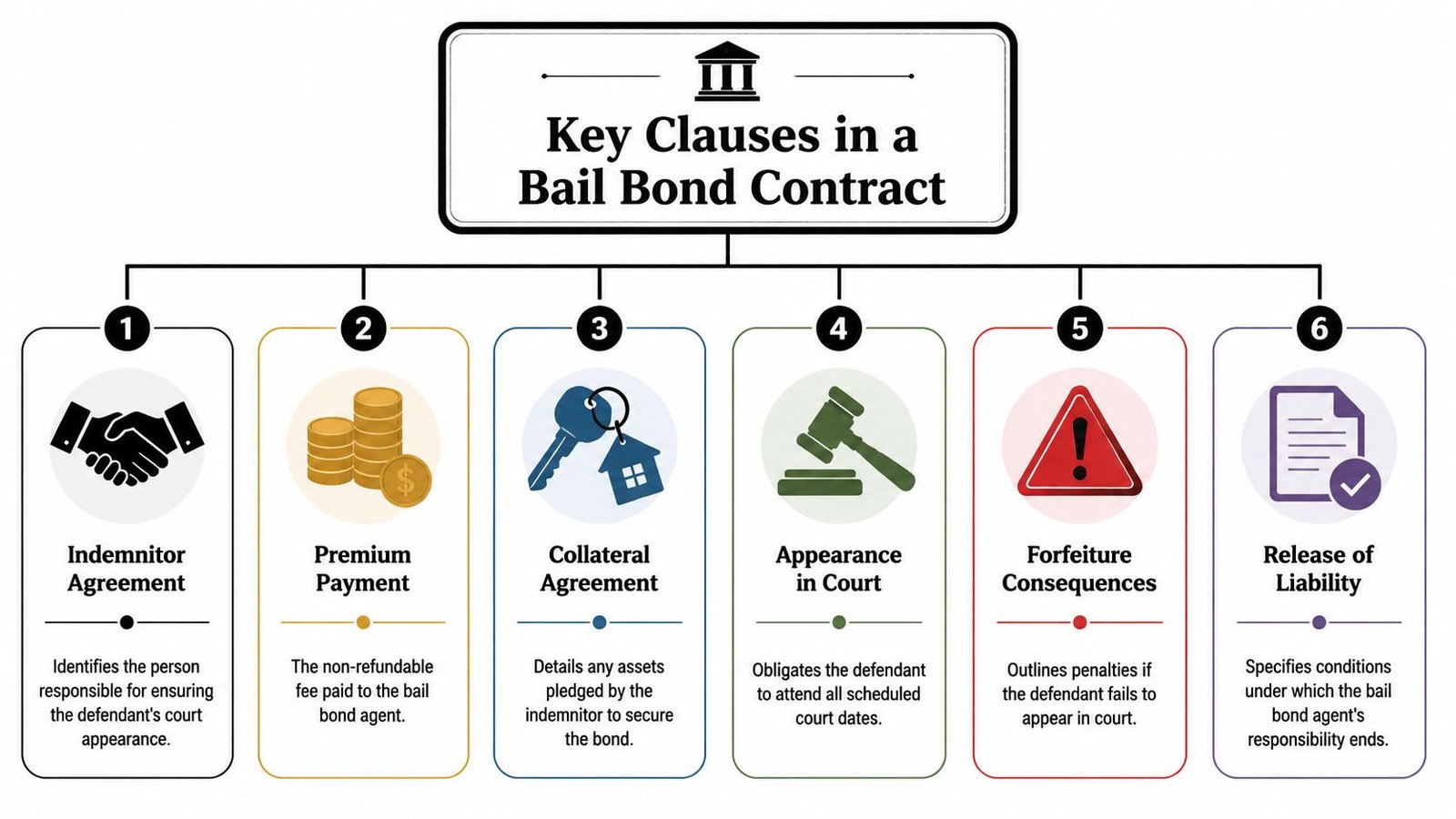
Premium payment clause
This section explains the service fee charged for the bond.
“The premium is fully earned upon release of the defendant.”
That sentence matters. It means the fee is for the service of posting the bond and getting the person released. It is not a deposit you get back at the end like apartment cleaning money.
Families often confuse the premium with bail itself. They are not the same thing. Bail is the full amount set by the court. The premium is the fee paid to the agency for posting the surety bond.
Indemnity clause
The cosigner promises to reimburse the agency if the defendant fails to appear or otherwise causes a loss.
What it means in plain English: “If this bond blows up because the defendant doesn't do what they're supposed to do, you agree to pay the damage.”
This clause is why agents ask detailed questions about work history, residence, and relationship to the defendant. They're trying to judge whether the people signing can fulfill that promise.
Joint and several liability
This phrase is one of the most misunderstood pieces of the contract.
It means every signer can be held responsible. Not “their share.” Not “just half.” Potentially the whole amount.
A key clause in bail paperwork establishes joint and several liability, which makes all signatories accountable. If a defendant fails to appear, that can trigger skip tracing and leave cosigners liable. Related debt can lower a FICO score by over 100 points, according to the surety packet materials summarized here in the bondsman packet forms reference.
Collateral agreement
This clause lists any property or assets pledged to secure the bond. Sometimes there's no collateral. Sometimes there is, especially when the bond is large or the risk is high.
A collateral clause may cover things like:
Vehicle title
The agency may take an interest in a car if the equity is sufficient.Real estate
Property can be pledged to back the bond obligation.Cash or other valuables
In some situations, liquid collateral is used because it's easier to value and recover.
The contract should say what was pledged, under what conditions it can be used, and what must happen for it to be released.
Appearance and cooperation terms
Many contracts also include practical rules the defendant and cosigner must follow.
Keep the agency informed about address changes, phone number changes, employment changes, and every court date.
That may sound basic, but those details matter. A missed notice, dead phone, or sudden move can create a mess very quickly.
If you want to understand what happens when a bond goes off track, this guide to bond forfeiture is a good next read.
Understanding Premiums Collateral and Fees
Families most often mix things up at this stage. They hear a number, pay money, sign papers, and later ask, “Wait, was that refundable?” So let's separate the buckets.
The premium is the service fee
The premium is what you pay the bail bond company for posting the bond. Bail bond contracts typically require a non-refundable premium, often 10% nationally but up to 15% in Colorado, and that fee is earned upon release regardless of how the case ends, as explained in this overview of bail bond contract fundamentals.
A simple example helps. If bail is set at $10,000, a typical national premium would be $1,000. In Colorado, the premium can be up to 15%, depending on the bond and the circumstances.
So if someone later says, “But the charges were dropped,” the answer is still the same. The premium was for the service already provided.
Collateral is different
Collateral is not the same as the premium. Collateral is security for the risk.
If the premium is like paying an insurance premium, collateral is more like saying, “If this goes badly, here is an asset standing behind my promise.”
Common forms of collateral can include:
- A vehicle title
- Real estate
- Cash
- Other valuables accepted by the agency
Collateral is often used on higher-risk bonds or when the agency needs added protection.
A quick side-by-side view
| Term | What it means |
|---|---|
| Premium | The fee paid for the bond service |
| Refundable | No, once the defendant is released |
| Collateral | Property or value pledged as security |
| Refundable | Usually returned if the bond terms are fully satisfied and there's no breach |
A short video can also help if you prefer hearing this explained out loud:
Why Colorado families ask about 15 percent and 10 percent
Colorado commonly uses a 15% standard premium. For some bonds over $5,000, a 10% premium may be available with an approved cosigner. That's why the exact terms matter. Two bonds can look similar at first glance and still have different financial structures based on risk and underwriting.
If you want to understand the business side of why agencies charge this way, this article on how bondsmen make money gives a straightforward explanation.
Consequences for Breaching the Contract
This is the part nobody likes to talk about, but it's better to understand it calmly now than in a panic later. A bail bond contract works well when the defendant appears in court and follows the rules. Trouble starts when that promise is broken.
What counts as a breach
The most common breach is failure to appear, often shortened to FTA. The defendant misses court, and the court treats that as a serious violation.
Other problems can also trigger action, such as disappearing, refusing contact, or violating release terms in a way that puts the bond at risk.
What usually happens next
The sequence is often more mechanical than people expect.
The defendant misses court
The court notes the non-appearance.The bond can be forfeited
The court can demand the full bond amount from the surety.The agency turns to the cosigner and collateral
The agency may seek repayment under the indemnity agreement.Recovery efforts begin
That can include skip tracing, surrender efforts, or civil collection steps.
Missing one court date is not “just a scheduling problem.” Inside a bail bond contract, it can trigger the biggest financial risk in the entire file.
Some states allow a short period for the defendant to be surrendered or return voluntarily. But counting on grace is a bad strategy. The safe move is always the same. Never miss court. If there's a real emergency, notify the attorney and the agency immediately.
Why agencies act quickly
Once the court places the surety at risk, the agency has to protect itself. That's not personal. It's part of the contract everyone signed.
That can mean contacting family, using the collateral rights in the agreement, or taking legal steps against the indemnitor. If the defendant has gone off the radar, agencies may use recovery methods allowed under state law.
If you're worried about what a missed court date means, this page on failure to appear explains the issue in plain language.
Signing Your Contract with Express Bail Bonds
It is 10:40 p.m. Your phone is in one hand, your wallet is in the other, and someone you love is waiting in jail. You are trying to read legal forms on a screen while family members ask, “What exactly are we agreeing to?”
That is a common moment in Colorado bail cases. The good news is that signing electronically is usually straightforward once you know the order of events and what each form is asking you to confirm. A bail bond contract works a lot like any other legal agreement signed online. You still need to read it carefully, verify the names and amounts, and make sure you understand who is taking on financial responsibility.
With Express Bail Bonds, the process is often handled by phone, text, and secure electronic documents, so a family member in another city or another state can usually review and sign without driving to an office first.
How the electronic process usually works
Here is the usual sequence, step by step:
You share the basic case information
Be ready with the defendant's full legal name, where they are being held, the bond amount, and your relationship to them.The bond agent reviews the file
The agent may ask about work history, residence, criminal history, prior bond issues, and whether any collateral will be offered.You receive documents electronically
These can include the bail bond contract, indemnity agreement, payment terms, and any collateral paperwork.You review the forms before signing
Slow down here. Check every name, every dollar amount, and every duty assigned to you as cosigner or indemnitor.You sign with an e-signature
Electronic signatures are commonly used for this process, which helps families sign from home, work, or out of state.The bond can be posted after approval
Once the paperwork, payment, and any supporting documents are complete, the agency can move ahead with posting the bond.
One simple way to approach the contract is to treat it like a car loan mixed with a promise to the court. One part deals with payment. The other part depends on the defendant following the rules of release.
Before you sign, confirm three things first. What is the premium? Who is legally responsible if something goes wrong? What happens if the defendant misses court?
That same slow, careful approach shows up in general contract guidance too. Start Right Now business contract advice is written for contracts broadly, but the reminder fits here well. Read the terms, verify the details, and do not sign until the obligations are clear.
Quick checklist before you sign
| Item to Verify | What to Check |
|---|---|
| Defendant information | Correct legal name, jail location, case details, and bond amount |
| Your role | Whether you are signing as indemnitor, collateral provider, or both |
| Premium terms | Exact amount due, due date, and any payment plan terms |
| Collateral terms | What property is listed, when it can be used, and when it will be released |
| Court duty | Your understanding that the defendant must appear at every required court date |
| Reporting duties | Whether address, phone, or job changes must be reported |
| All signers | Every financially responsible person is listed correctly |
| Your records | Save copies of signed documents, receipts, and payment confirmations |
If you feel rushed, pause and ask questions. A good bond agent should be able to explain a clause in plain English before asking you to sign it.
If you need immediate help, you can contact Express Bail Bonds or call or text 720-984-2245 any time.
Frequently Asked Questions About Bail Contracts
A lot of families ask these questions after everyone has calmed down just enough to read the paperwork. That is normal. If you are signing an electronic bail bond contract in Colorado with Express Bail Bonds, the goal is simple. Know what you are agreeing to before one more button gets clicked.
If the charges are dropped, do I get the premium back
No. The premium is the fee for the bond service once the defendant is released. It works like paying for a tow truck after your car has already been pulled out. Even if the underlying problem gets resolved fast, the service was still provided.
What if the case lasts a long time
Ask this before you sign, especially on a felony case or any case that may move slowly through court. Some contracts include renewal terms if the bond stays open for a long period.
A good question to ask is, “Will I owe anything beyond the first premium if the case is still pending later?” Get that answer in plain language. Then save a copy with your records.
Can I cosign from another state
Often, yes. Electronic signing makes it possible for a parent, spouse, or sibling outside Colorado to review and sign the agreement remotely.
The main issue is not distance by itself. The issue is whether you can still stay informed, reach the defendant, and respond quickly if a court date is missed or the bond company needs information from you.
When is collateral returned
Collateral is usually returned after the case ends and the bond is exonerated, as long as the contract was followed and the account is paid in full. In plain English, that means the court is done with the bond and the company no longer has financial exposure on that case.
Before you sign, ask what the release steps look like. Do they need proof from the court? Do you need to make a written request? Small details like that can save you a lot of stress later.
What if I want out after I sign
That depends on the contract and what is happening in the case. In some situations, a cosigner can ask for the defendant to be surrendered, which can remove future risk to the cosigner but may send the defendant back to jail.
That is why this question matters early. If you already have doubts about whether you can carry the responsibility, say so before signing the electronic contract. It is much easier to sort out concerns at the start than after a missed court date or a broken payment plan.
If your family needs calm, plain-English help understanding a bail bond contract or getting someone released, contact Express Bail Bonds. They serve Colorado statewide, handle electronic contracts for remote cosigners, and can walk you through the process step by step. Call or text 720-984-2245 any time, day or night.