You may be looking at Colorado's bail profession because someone close to you needs help posting a bond, or because you're considering a career that combines insurance, court procedures, and direct work with families under pressure. At first glance, the path can seem confusing. Colorado doesn't treat bail work as a simple standalone license, and the rules cover everything from education and background screening to premium receipts and online bond posting.
The practical way to understand the Colorado bail bondsman requirements is to view them as a sequence. First, you qualify as an insurance producer. Then you obtain the required casualty authority, complete bail-specific education and recovery training, pass the applicable exam, and secure an appointment from a bail insurance company. After licensing, your responsibilities continue through accurate pricing, signed paperwork, recordkeeping, and compliant service across local detention systems.
This guide walks through that path in plain language. It also explains the operating details that often create trouble for new agents, including Colorado's premium limits, the difference between a bond premium and an extra charge, and the move toward online posting. If you're trying to understand what happens after an arrest, this overview of the Colorado bail release process can provide useful context before you focus on licensing.
Introduction to Becoming a Bail Bondsman in Colorado
You may be exploring this career after speaking with a bail agent at a county detention facility. Perhaps you have seen the human side of the work: a defendant needs a financial guarantee for release, a family member may sign as an indemnitor, and the agent must explain contracts, collateral, court obligations, and payment terms clearly. The less obvious part is Colorado's regulatory structure. Bail work operates within the state's insurance system.
That structure shapes your first decisions. Opening an office or joining a local network does not by itself allow you to write bail bonds. Colorado requires an insurance producer license with the casualty line of authority, an appointment from a bail insurance company, and approved education focused on bail bonding. The Colorado Division of Insurance bail bond guidance describes the state's licensing model and training requirements, making it a better starting point than informal industry advice.
What the job actually involves
A bail bondsman connects a surety company's financial guarantee with the court's release conditions. The agent reviews the transaction, explains the premium and contract, obtains required signatures, manages documentation, and coordinates posting with the proper detention system. Work may involve city and county facilities across Colorado, so a statewide view helps even if you first plan to serve one community.
The job calls for careful judgment. If a conversation moves too quickly, a cosigner may misunderstand payment obligations. If a receipt is incomplete, the file may become difficult to verify. If a fee is unauthorized or poorly explained, the producer may face regulatory problems. Clear records function like a map: they let the client, insurer, and regulators follow what happened and why.
Practical rule: Treat every bond file as if another professional will need to understand it later without calling you for an explanation.
Before pursuing an appointment or building a client process, review the operating responsibilities. Colorado regulates who may write bonds, how premiums and payment arrangements are handled, and how bonds may be posted. The shift toward online posting also makes accurate digital information and consistent documentation part of practical preparation. Studying these duties early helps you judge whether the career matches your strengths in communication, organization, and compliance. For background on what happens after an arrest, the Colorado bail release process provides useful context alongside the licensing requirements.
How Colorado Licenses Bail Bondsmen Through Insurance
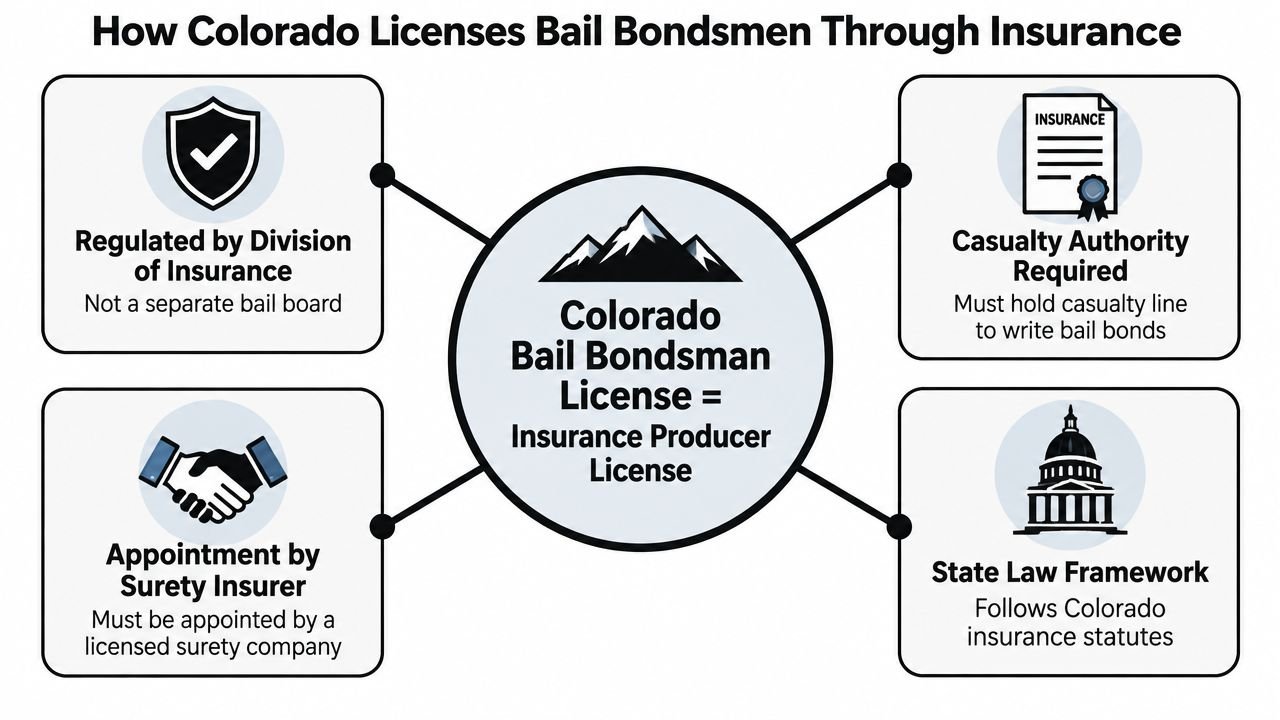
Suppose you want to write a bail bond after completing your training. The first document you need is not a separate local “bail agent” credential. Colorado places this work inside its insurance system, so the license pathway resembles entering a specialized lane of insurance production.
You need an insurance producer license with the casualty line of authority, an appointment from a bail insurance company, and state-approved preappointment education. The state's Colorado bail bonds license guide offers a practical overview of how those pieces fit together.
The three parts of the pathway
The producer license supplies the legal foundation. The casualty line of authority matters because Colorado treats bail bonding as an insurance activity rather than as a separate occupational license.
The insurer appointment connects you with a bail insurance company authorized to support the bonds you write. Holding a producer license by itself does not create that relationship. The appointment allows you to act for the insurer under the terms of the agency arrangement.
The bail education requirement supplies subject knowledge that a general producer course may not cover. Colorado's requirements address bail bonding, the criminal court system, industry ethics, bail bond laws, and bail recovery training. In practical terms, the education works like a route map, showing how insurance rules connect with court procedures and recovery responsibilities.
Colorado's licensing history also includes a major structural change. Effective January 1, 1995, qualified producers were issued a single Colorado Bail Bonding Agent Producer License, according to the Colorado bail bonding agent licensing handbook.
Why the insurance structure matters
This framework places bail agents under insurance oversight. Applicants therefore need to understand producer terminology, appointment requirements, and the Division of Insurance's compliance expectations. The Colorado Division of Insurance's bail bonds requirements is a useful reference for checking the applicable rules as you prepare your application and business procedures.
A local business permit does not replace this pathway. The practical sequence is insurance producer licensing, bail-focused education, and an insurer appointment. Keeping those steps separate makes the process easier to track and helps prevent the common mistake of treating a bail practice like an ordinary local service business.
Eligibility and Background Check Requirements You Must Meet
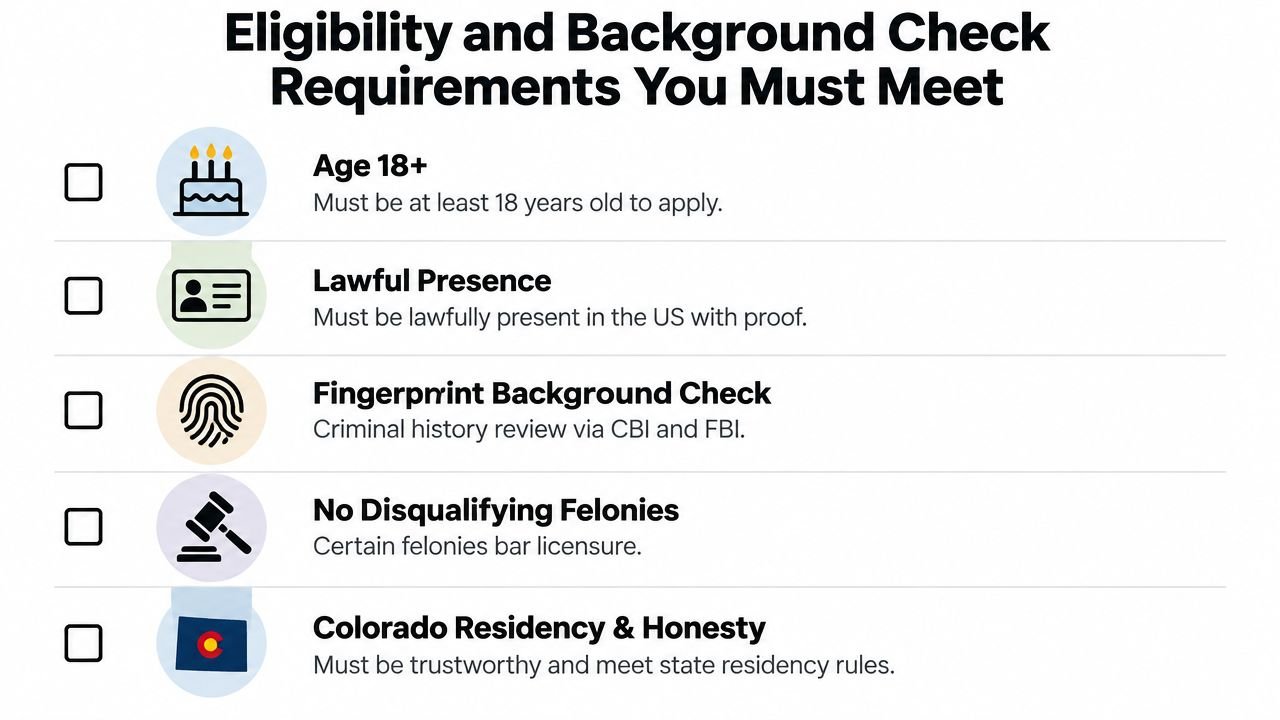
A licensing application can stall before training begins if your personal records do not meet Colorado's baseline standards. Before paying for a course or booking an exam, review whether you are at least 18, lawfully present in the United States, a Colorado resident, financially responsible, and of good reputation. These requirements reflect the responsibility of handling financial guarantees and court-related transactions as an insurance producer.
Colorado also applies specific felony restrictions. An applicant cannot have a felony conviction within the prior 10 years and cannot be within 10 years of completing parole, probation, or a deferred sentence for a felony. Treat this rule like a boundary on a map. Your records must show clearly whether you fall inside or outside it.
A practical self-audit
Review these questions before beginning the application:
- Age: Will you be at least 18 when you apply?
- Presence: Can you document lawful presence in the United States?
- Residency: Can you establish Colorado residency?
- Financial responsibility: Can you accurately explain your financial history and provide requested records?
- Reputation and criminal history: Does your record fall outside the applicable felony restrictions?
Background screening often exposes incomplete answers or missing documents. Gather identification, residency records, court disposition documents, and proof that you completed any sentence-related requirements. If an old case is difficult to interpret, obtain the official record before applying and ask the Division of Insurance how to disclose it.
Accuracy matters because the application evaluates both the underlying history and the information you submit. A past offense may still require review, while an inaccurate answer can create a separate licensing concern. Complete disclosure, supported by records, gives regulators a clear basis for evaluating the application.
A general resource on a criminal background check for volunteers explains why identity verification and record review depend on accurate information. Colorado's producer requirements remain the controlling standard for bail licensing.
For the larger sequence of eligibility, education, examination, and application tasks, review this guide on how to become a bail bondsman. Eligibility is only the starting checkpoint. Confirming it first helps you avoid spending on training before you know that your application can proceed.
Education Training and Exam Steps to Get Licensed
A new applicant may finish a course, pass an exam, and still be unable to write a bond if the steps occur in the wrong order. Colorado treats bail work as an insurance-producer pathway, so the education, examination, application, and insurer appointment must fit together like parts of one file.
The required education covers two connected subjects. Bail bonding education explains the legal and professional setting. Bail recovery training addresses the responsibilities involved in locating and returning a defendant who fails to appear under the applicable process.
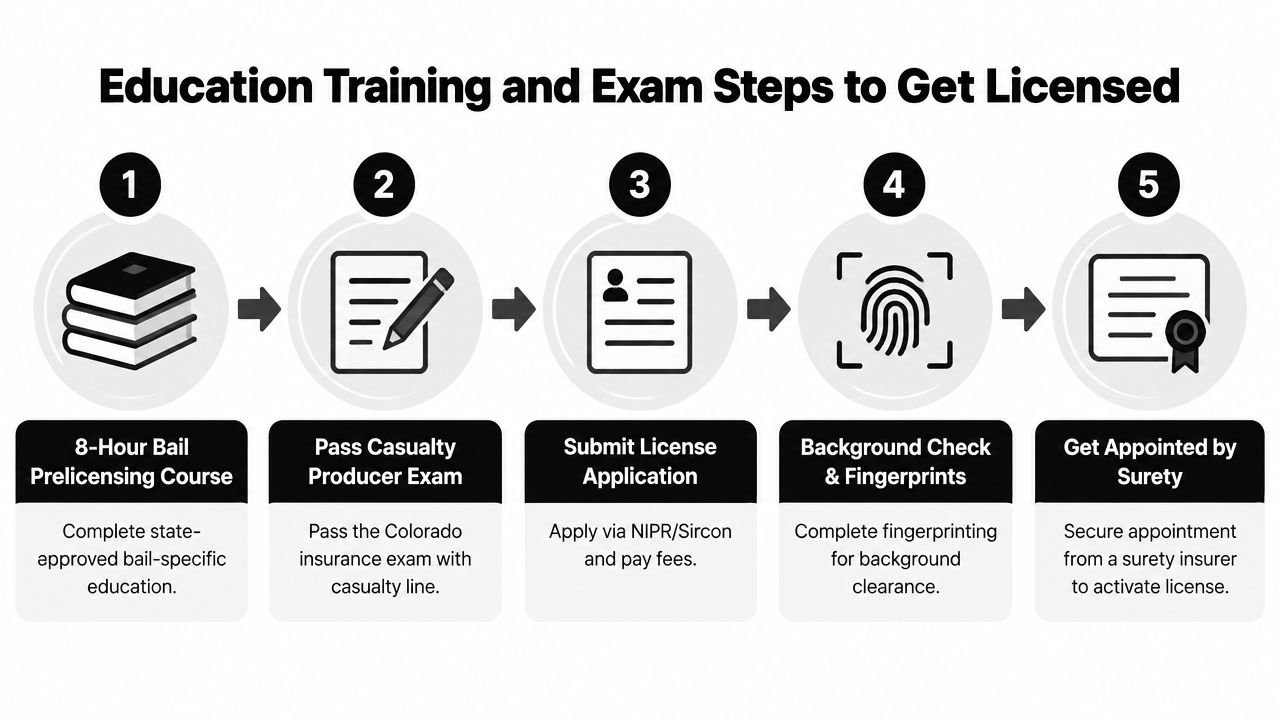
Colorado requires at least 8 clock hours of bail bonding education. The breakdown is 2 hours on the criminal court system, 2 hours on bail bond industry ethics, and 4 hours on bail bond laws. Applicants must then complete 16 clock hours of bail recovery training, as described in the state bail bond licensing requirements.
Put the steps in the right order
Complete approved education first. Verify that the provider and courses meet Colorado's requirements. Save completion certificates where you can retrieve them for the application or a regulatory response.
Finish recovery training. This course is part of the qualification process, not an optional supplement. It addresses the legal and ethical limits surrounding recovery work.
Prepare for the producer examination. Bail bonds fall within the casualty line of authority. Study general insurance principles alongside bail-specific material, since completing a course does not by itself prove readiness for every tested subject.
Schedule the Pearson VUE exam after both courses are complete. Colorado's handbook requires the education to be finished before the exam date. Booking the test first can leave you with a date you cannot use.
Submit the application and fee electronically. Follow the current electronic process and retain the confirmation, payment record, and exam result with your course certificates.
Secure the insurer appointment. Passing the exam and submitting an application do not finish the practical authorization. An insurer must appoint you before you can write bonds through that company.
Keep the records together. A completion certificate, exam result, application receipt, and appointment record should tell one consistent story about your licensing status.
Applicants considering employment before opening an agency can review Colorado bail bond agent jobs to compare credentialing with the daily work inside an established business. That distinction helps clarify whether you are preparing to operate independently or first learning procedures under an existing statewide agency.
Fees Premium Caps and Paperwork Rules for Every Bond
Licensing is only half the compliance picture. Once you write a bond, Colorado places precise limits on what you can charge and requires a clear paper trail for premium payments. New agents sometimes think of the premium as a flexible service price. It isn't. The statute establishes a ceiling and restricts additional charges to narrow, documentable categories.
Under Colorado law, a professional cash-bail agent or cash-bonding agent may charge no more than the greater of $50 or 15% of the bail amount furnished, as summarized in the Colorado bail bondsman fee rules. A legislative review also describes the 15% maximum premium and gives a $1,000 bond example involving a $150 nonrefundable premium. That example shows the calculation, but every transaction still requires correct documentation.
Colorado Bail Premium and Fee Limits at a Glance
| Charge Type | What Colorado Allows | Example |
|---|---|---|
| Premium | No more than the greater of $50 or 15% of the bail amount furnished | A $1,000 bond could involve a $150 premium |
| Court or law-enforcement filing charges | Allowed only within the narrow statutory category of filing charges | A documented filing charge may qualify |
| Secure collateral storage | Limited to the actual cost of storage in a secure self-service public storage facility | Charge the actual storage cost, not an invented markup |
| Premium financing | Recognized as a narrow additional category | Document the financing arrangement clearly |
| Unlisted convenience or service fees | Not a general permission to add charges | Don't stack unexplained fees onto the premium |
The paperwork is part of the transaction
Premium-payment arrangements must be written, signed, and dated, and must include the defendant's or indemnitor's signature. The producer must also provide a signed, dated receipt for each premium payment, according to the Colorado statute governing bail premium arrangements.
That means a verbal agreement isn't enough. If a cosigner pays in installments, each payment needs its own receipt, and the underlying arrangement should make the payment schedule understandable.
File discipline: If a charge, signature, date, or receipt isn't documented, assume the transaction is incomplete until you correct the file.
Some Colorado guidance also says bonds of $5,000 or more may be written at 10% when an approved cosigner is available. Because that arrangement depends on bond size and cosigner approval, agents should explain the actual terms instead of advertising one rate for every situation. Express Bail Bonds publishes a plain-language explanation of how bond pricing works, which can help families understand the distinction between a premium and other permitted costs.
Staying Compliant With Continuing Education and Online Posting
A producer's responsibilities don't end when the license arrives. Good compliance combines education, renewal planning, accurate records, and operational readiness. You need a process that works on a quiet weekday and during an urgent release request involving a detention facility in another county.
The supplied compliance graphic references continuing education, renewal, online information, and possible penalties. Because continuing education and renewal details can change, verify the current obligations directly with the Division of Insurance rather than relying on an old checklist or training note.
Build a repeatable compliance system
Keep one calendar for education completion and license renewal. Store certificates, appointment records, premium agreements, payment receipts, collateral records, and communications in a consistent file structure. A statewide practice also benefits from facility-specific operating notes, because each jail may have its own submission procedures even when the legal requirements are statewide.
Review forms before use. Confirm that names, dates, signatures, payment terms, and bond amounts match across the application, contract, receipt, and posting documentation. Electronic processing can reduce delays, but it doesn't remove the need to verify every field.
Online posting is becoming part of ordinary service
The Colorado General Assembly's 2025 bail-related legislation states that all bonds of any amount that are postable in person must also be postable online, according to the 2025 Colorado bail legislation. Pitkin County jail guidance also says the jail uses the eBonds platform for posting online surety bonds, illustrating how digital posting is entering county-level operations.
For an agent, the practical lesson is preparation. Maintain secure electronic forms, understand the platforms used by the facilities you serve, and explain to cosigners which documents they must complete remotely. Online availability doesn't mean every bond follows an identical workflow. Confirm the specific facility's process before promising a posting timeline.
Operational habit: Test your electronic workflow before an urgent case arrives. A missing signature field is easier to fix during training than during a late-night release request.
Your Next Steps Toward a Colorado Bail Bondsman Career
A first-time applicant can make the process manageable by separating licensing from daily operations. Confirm your age, lawful presence, Colorado residency, financial responsibility, reputation, and felony lookback requirements. Then check the current education rules, complete the bail bonding and recovery courses, prepare for the casualty producer examination, submit the electronic application, and seek an appointment with a surety insurer.
Build compliance into your routine from the start. Learn Colorado's limits on premiums and extra charges. Create a receipt process for each payment, retain signed and dated agreements, and organize renewal and education records. Online posting is now a practical service skill, since legislation and county procedures are shifting bond processing toward digital access.
Experience at a statewide agency adds context that a classroom cannot provide. Under supervision, you can work through questions about indemnitors, court conditions, facility procedures, electronic contracts, and communication during stressful release requests. That exposure can also clarify whether you prefer joining an established agency or developing your own practice.
Before applying, confirm current rules with the Colorado Division of Insurance. For local operating context, review Jefferson County and Golden and Centennial bail bonds. A producer must still follow each detention facility's submission and posting procedures.
Express Bail Bonds provides Colorado surety bond assistance, electronic applications, payment and contract processing, and guidance on fees, court requirements, and release steps. Visit Express Bail Bonds to review statewide resources and contact a licensed agency about the profession or a family's bond.