Your phone rings late, and the person on the other end is a relative calling from a Colorado jail. You have a booking number, a bail figure that feels huge, and about ten minutes before the next shift change. Someone at the desk says you can use a surety bond agent instead of writing a check for the full amount. You want your person home. You also don't want to hand money to the wrong person or sign a paper you can't undo.
A bond is a promise the court will accept, not a magic key that ends the case. The agent is the licensed person who arranges that promise. The court still decides whether release happens, and on what terms. This guide walks through who does what, what Colorado allows an agent to charge, how approval works, and what starts the moment the bond is posted.
What a Surety Bond Agent Is and How It Differs From a Bail Bondsman
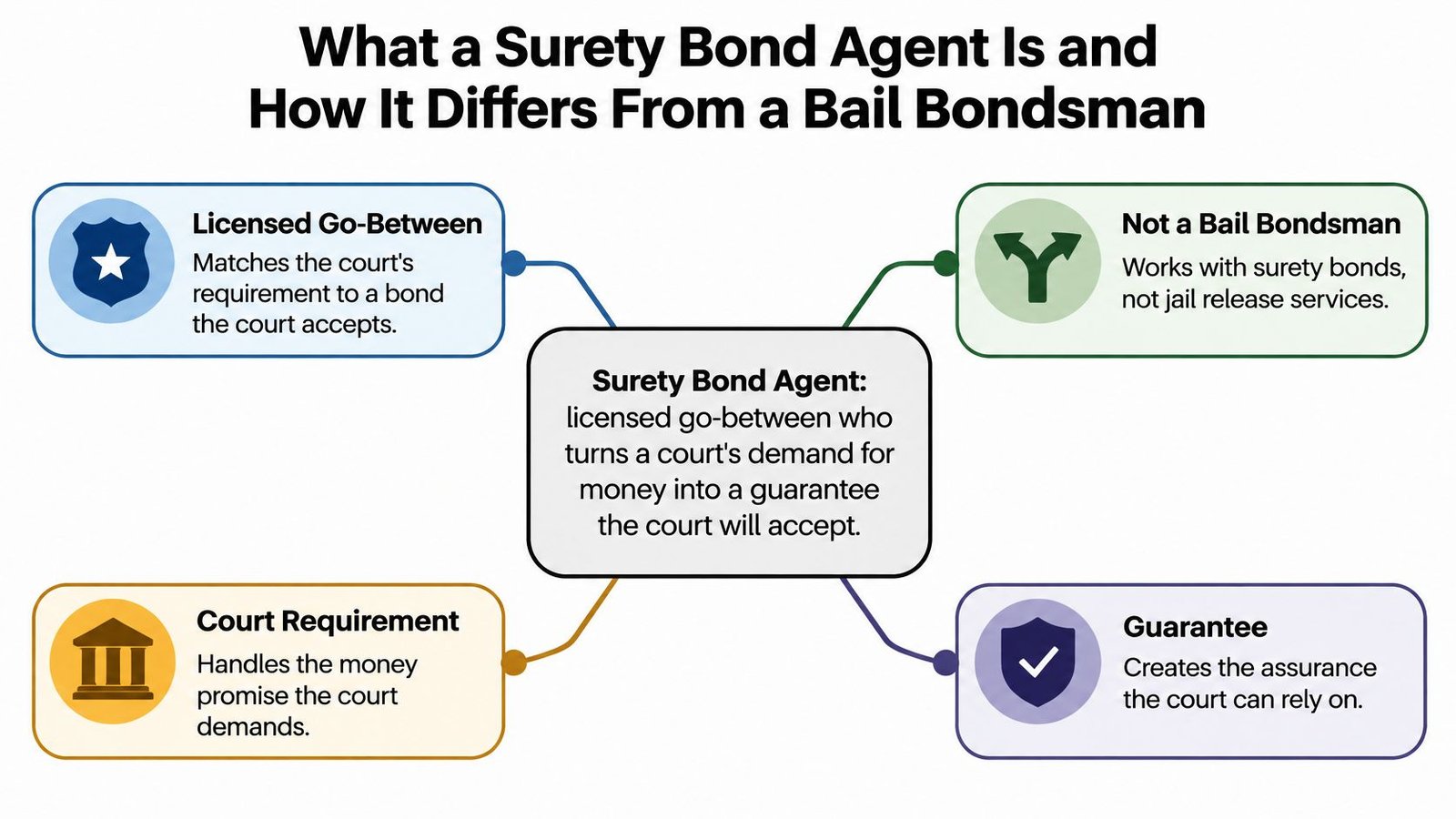
A surety bond agent is the licensed go-between who turns a court's demand for money into a guarantee the court will accept. You can repeat that sentence to a relative who is panicking in the parking lot.
Three parties sit inside that promise. The defendant is the principal who promises to appear. The court is the obligee that requires the bond. The bail insurance company is the surety that backs the promise with its own money. Under Colorado law, a bail insurance company may write appearance bonds only through a licensed bail bonding agent. Colorado's compensated-surety statute defines a compensated surety as a person or entity writing appearance bonds and regulated by the Colorado Division of Insurance, and it says bail insurance companies may write those bonds only through licensed bail-bonding agents. The agent is the regulated point of contact who executes or arranges the bond. The insurer supplies the financial backing the court relies on.
Four labels people mix up
Bail bondsman is the everyday name for that same licensed agent. The job doesn't change when the sign on the door uses older wording. A bail recovery agent is different. That person is hired by a licensed agent to locate defendants who miss court, and that person doesn't write the bond.
Colorado puts real screening on recovery work. Before a licensed agent hires, contracts with, or pays someone for recovery services, unless that person is another licensed bail-bonding agent, the agent must contact the Colorado Bureau of Investigation to verify fingerprint submission and check for a felony conviction or plea. For recovery work beginning on or after January 1, 1999, the agent must also obtain a training certificate in bail-fugitive apprehension from a private bail-recovery program or an accredited college. A person may not be used when that check is incomplete, or when the agent knows of a qualifying felony conviction or plea during the preceding 15 years, according to Colorado bail-recovery rules summarized by AIA Surety.
Cash bail is the other path families confuse with a bond. Cash bail means paying the full bail amount to the court, which holds it until the case ends. A surety bond ties up the premium, plus any collateral the company requires, while the insurer stands behind the full amount. If you want a plain comparison of bond types before you choose a path, start with types of bail bonds.
| Term | Who it is | Main job | Oversight |
|---|---|---|---|
| Surety bond agent | Licensed bail bonding agent writing bonds for an insurer | Evaluates the applicant, executes the appearance bond, and collects the premium | Colorado Division of Insurance |
| Bail bondsman | Everyday name for a bail bonding agent | Same work as a surety bond agent | Colorado Division of Insurance |
| Bail recovery agent | Person hired by a licensed agent to locate defendants who miss court | Apprehends fugitives and doesn't write the bond | Checked by the licensed agent before hire, including a CBI fingerprint and felony inquiry |
| Cash bail | Defendant or family pays the full bail amount to the court | No premium. The court holds the full amount until the case ends | Court rules |
Practical rule: Ask which of these four roles a person holds before you hand over money. If someone is in custody right now, call a licensed agent first, not a friend of a friend who "does pickups."
Colorado Fee Caps and Typical Bond Costs
Colorado puts a hard ceiling on the premium. Under Colorado Revised Statutes §10-2-707, the premium or commission can't exceed the greater of $50 or 15% of the bail amount furnished, and that statute is the benchmark you use when a quote lands in your texts.
| Bail amount | 15% of bail | Maximum premium allowed |
|---|---|---|
| $200 | $30 | $50 (the $50 floor applies) |
| $5,000 | $750 | $750 |
| $10,000 | $1,500 | $1,500 |
| $20,000 | $3,000 | $3,000 |
How to read a quote against the ceiling
15% is a ceiling, not a price the agent must charge. A written quote can come in lower. It can't legally sit above the greater-of rule. On a $200 bond, 15% is only $30, so the $50 floor is the maximum. On a $5,000 bond, 15% is $750, and that figure is the cap. On a $10,000 bond, 15% is $1,500. A quote above $1,500 on that bond is a signal to stop and check the statute before you pay. On a $20,000 bond, the cap is $3,000.
The premium pays the agent for assuming and administering the risk of the full bond. It isn't a deposit the court holds and hands back when the case ends. The same statute says the bail premium is earned in full when the defendant is released from custody, subject to the statute's own limits. Families often hear "you'll get it back." You won't get the premium back just because the case closes cleanly.
Fees that can sit beside the premium
The statute generally bars extra producer-imposed fees unless they fall in narrow categories. Those categories are a court or law-enforcement filing fee, the actual cost of securely storing collateral, or premium financing. A line item labeled "processing," "after hours," or "rush" needs a home in one of those buckets, or it doesn't belong on the invoice.
If the quote won't name the bail amount, the premium, and each added fee on one page, don't pay yet.
You can compare that paperwork with published surety bond rates so the percentage and the dollar figure are both visible before anyone signs.
Colorado Licensing and Regulation
On May 11, 2013, Governor John Hickenlooper signed HB 13-1236, known as "Best Practices in Bond Setting." The federal Bureau of Justice Assistance described that bill as Colorado's first major overhaul of its bail statutes since 1972, after multi-year work by the Colorado Commission on Criminal and Juvenile Justice. The reform directs courts to presume that people are eligible for release on bond with the "appropriate and least restrictive" conditions. The Colorado Division of Insurance enforces the insurance laws that regulate bail bonding and handles complaints against agents. The court, not the agent, sets those release conditions.
What the license actually is
A Colorado bail bonding agent holds a state insurance credential. The Division of Insurance administers the insurance laws that cover this work. A business card and a calm voice aren't the license. The license is the thing you can check before money moves.
Three checks before you pay
- Ask for the full name and license number in writing. A text or email is enough. If the person won't put it on paper, stop.
- Verify that license with the Colorado Division of Insurance before you pay. Match the name on the quote to the name on the license. A mismatch is a reason to walk away, not a detail to fix later.
- Know where complaints go. Complaints against agents are handled by the Division of Insurance, not by the jail lobby and not by the court clerk who accepted the bond.
You can see how Colorado ties that credential to the people who post bonds on our page about a Colorado bail bonds license.
A license confirms the agent is supervised under insurance law. It doesn't guarantee release, a lower bail, or a dropped charge. The agent doesn't replace a defense lawyer's advice on the charges, the plea, or how to handle the next hearing. Use the license check to confirm you're dealing with a regulated writer of bonds. Use the lawyer for legal strategy.
How Underwriting Decides Approval and Premium
Underwriting is how the agent estimates risk before anyone signs. The company is about to stand behind the full bail amount, so the file has to show who will appear and who will pay if that promise breaks.
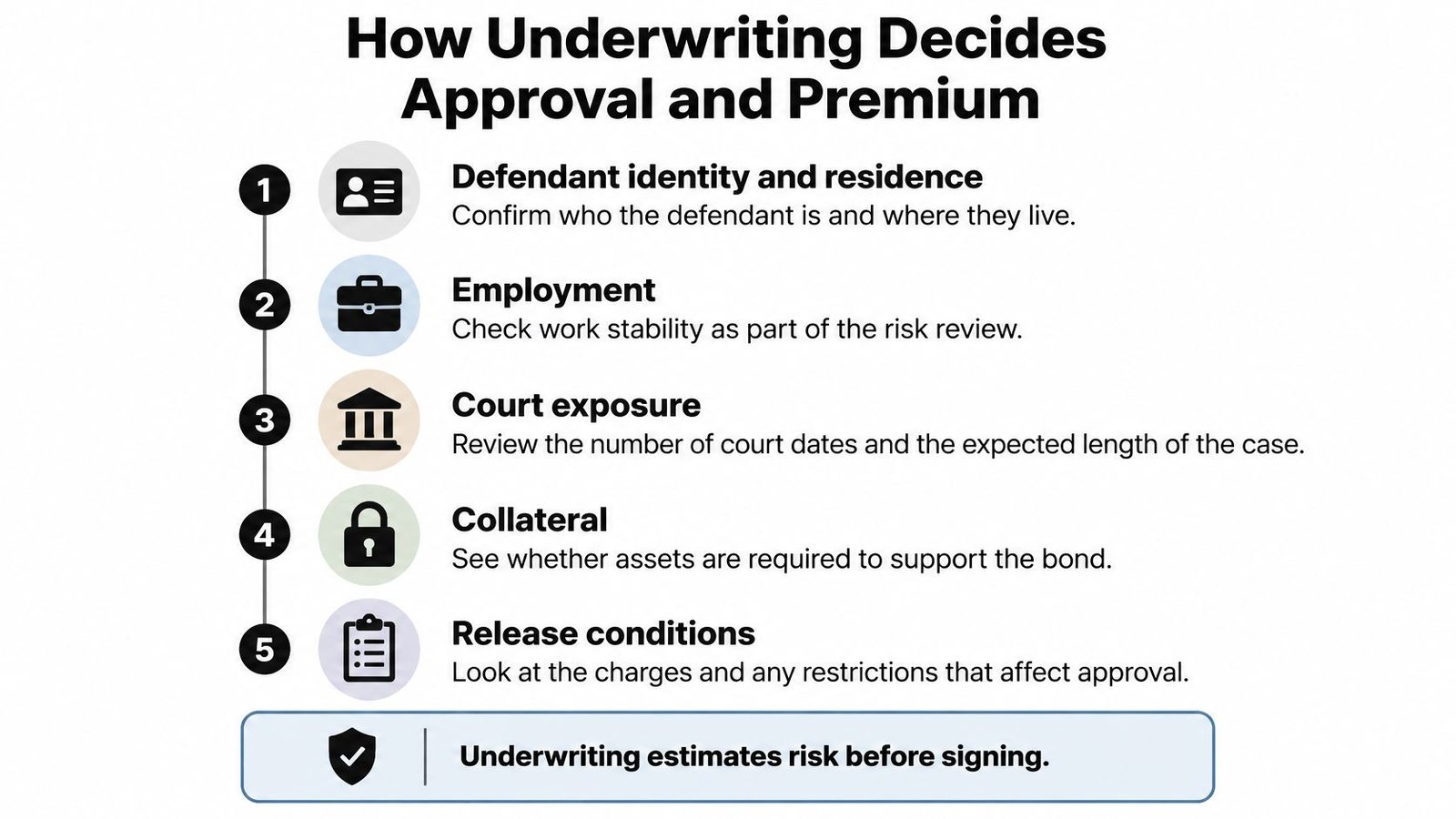
Colorado law defines a bail bonding agent as a person in the business of writing appearance bonds who is regulated by the Division of Insurance, and it requires a bail insurance company to write appearance bonds only through a licensed bail bonding agent. In practice, the agent checks identity, residence, employment, court exposure, financial resources, and whether a cosigner can and will indemnify the surety.
What the agent actually reviews
Identity and residence. A government ID and a real address, not a hotel that changes every week.
Employment. Steady work matters more than a job title. A recent hire with no history is a weaker file than a long-running paycheck.
Court exposure. The number of charges and the history of showing up, or not showing up, change the risk. A single misdemeanor with a clean record isn't the same file as several open cases.
Money behind the promise. The agent looks at financial resources, then at collateral. Using a bail bondsman typically requires collateral, which can include property or a cash deposit, and a cosigner with stable income may be needed. In some files, property or valuables secure the bond and come back when the obligations are met and the bond is discharged.
The cosigner. Approval of a cosigner typically involves a credit check and a background check. We look for stable employment, established residency such as owning a home or a long-term rental history in the area, and a decent credit score. The cosigner signs an indemnity agreement. That paper is how the surety can look to the cosigner if the defendant doesn't meet appearance obligations.
Compensation is generally limited to the premium. Collateral or indemnity can be accepted only inside the legal and insurance rules. Electronic signatures can speed a file for an out-of-state relative. They don't skip identity checks, written disclosures, or clear terms for when collateral comes back. Our surety bond qualifications page lists what a typical file needs so you aren't hunting for a pay stub at midnight.
Why the price moves
Think of expected cost as the chance the bond is forfeited, times the amount that can be collected, plus investigation, recovery, admin, and financing costs. Say a $10,000 bond carried a 10% chance of forfeiture. The expected forfeiture cost alone would be $1,000, before those extra costs. A strong cosigner can lower that chance. Neither the cosigner nor the collateral erases the duty to answer court deadlines.
Gather these before you call, if you can:
- Photo ID for the defendant and the cosigner.
- Proof of address, such as a lease, mortgage statement, or recent utility bill.
- Proof of income, such as pay stubs or a benefits letter.
- The booking details, including charges, facility, and the next court date.
- A short list of collateral you could pledge, with who owns it.
How the Surety Bond Process Works Step by Step
Posting a bond is one part of a pretrial decision, not a guarantee that the jail doors open on your schedule. Courts may add supervision, electronic monitoring, treatment, no-contact orders, travel limits, or appearance requirements. Federal court statistics show that 73,815 bail determinations were made in 2025, while 21,652 defendants released in that system received specified conditions, and pretrial-services supervision was the most common condition, imposed for 86% of defendants released under that category, according to the federal judiciary's 2025 pretrial services report. Colorado cases aren't those federal counts, but the lesson travels. Paperwork can be perfect and release can still wait on conditions, holds, or jail processing.
The six steps and the slip at each one
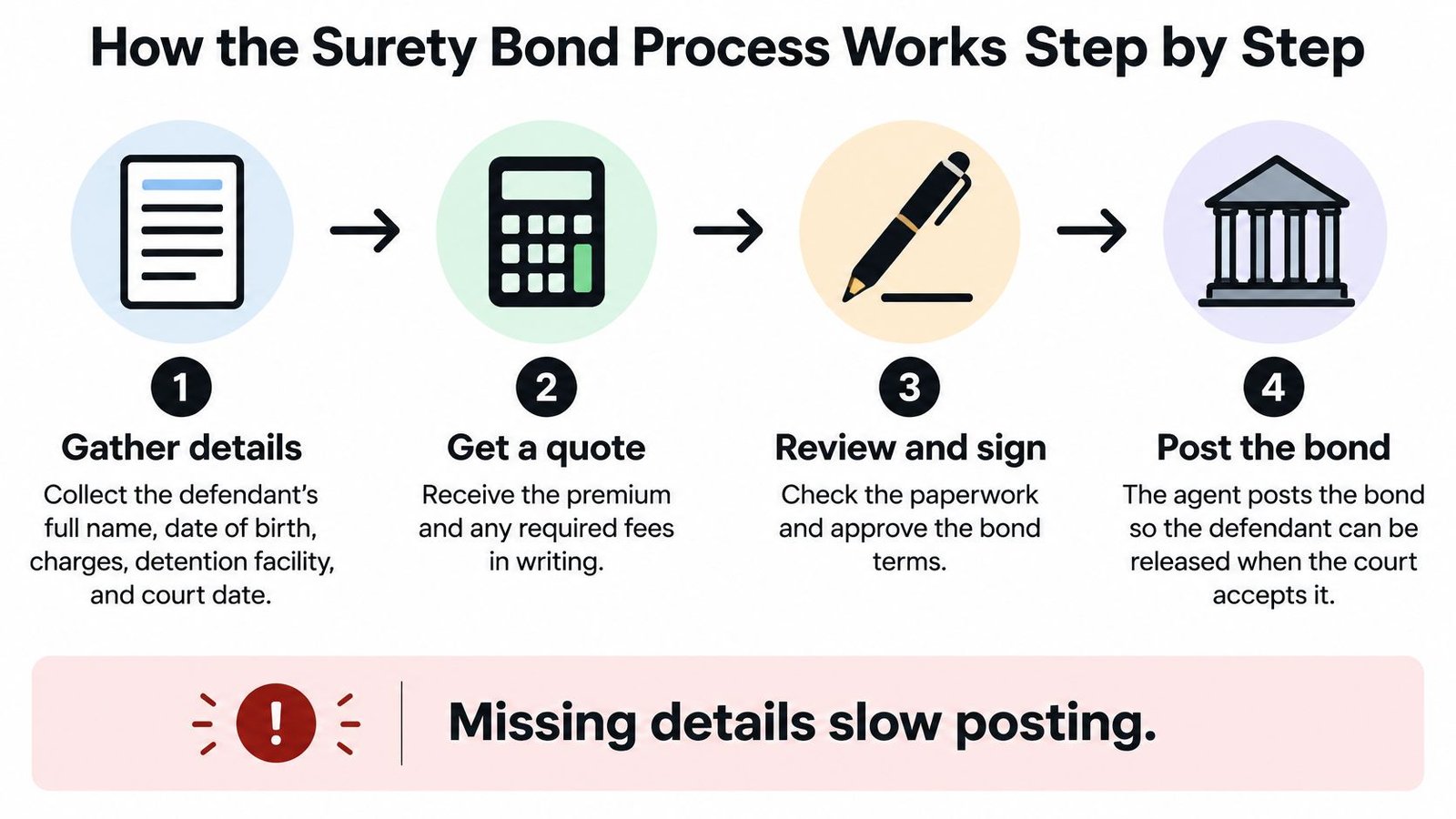
1. Gather the facts. You need the defendant's full name, date of birth, charges, detention facility, and court date. Missing details slow posting, and the agent can't write an accurate bond without them. The common slip is a nickname instead of the booking name.
2. Get the quote in writing. Confirm the bail amount and the premium on paper. Verbal quotes are where overcharges hide. If the number changes after you arrive, ask what fact changed.
3. Sign, then pay. The cosigner signs the indemnity agreement and pays the premium. Read the collateral terms before the pen moves. A rushed signature is the slip that hurts six months later.
4. The agent posts with the clerk. Once the paperwork is signed and the premium is paid, a licensed agent goes to the jail and posts the surety bond with the court clerk. That is a surety bond, not a stack of cash equal to the full bail. We handle the paperwork and the court coordination so you aren't standing in two lines at once.
5. Wait for release processing. Acceptance of the bond starts release. Jail processing can still take hours. A second hold, a warrant from another county, or a shift change can stretch that wait. Payment doesn't override a hold the court hasn't cleared.
6. Confirm the handoff. Get the release conditions and court dates in writing, and confirm the defendant understands them. A missed date is what puts the bond at risk. The agent explains the contract. The court sets the conditions. Pretrial services supervise when the court orders that. The lawyer advises on the case. Speed feels urgent at 2 a.m. An accurate handoff matters more, because a misunderstood no-contact order can put someone back in custody.
Families dealing with the Golden or Jefferson County jail can start with our Jefferson County bail bonds page so the facility and the court aren't a guessing game.
Conditions, Forfeiture and Cosigner Duties
Posting the bond starts the release obligations. It doesn't end the case, and it doesn't retire the promise the court accepted.
The judge can add supervision, electronic monitoring, treatment, a no-contact order, travel limits, or a strict appearance schedule. Keep a written list of every condition and every court date. Read it out loud with the defendant before anyone leaves the parking lot. A condition you didn't hear is still a condition.
What forfeiture means for the cosigner
If the defendant misses court, the bond can be forfeited. The court can order the bond amount due. The surety can pursue the cosigner under the indemnity agreement. That is why the cosigner should read those terms before signing, not after a bench warrant issues. Collateral is a separate pile from the premium. Collateral comes back once the obligations are met and the bond is discharged. The premium does not follow that path.
Colorado's timeline after a forfeiture notice is short. Compensated sureties seeking discretionary relief must request a show-cause hearing within 15 days of receiving notice, as described in the Bureau of Justice Assistance Colorado bail book on pretrial release. Address updates, reminders, and a working phone number are risk controls, not courtesy calls.
Before you sign, ask the agent in writing:
- What act triggers forfeiture on this bond, including a missed date or a violated condition.
- When collateral is released, and what document proves the bond is discharged.
- What the cosigner must do to end the indemnity, and who sends that notice.
If those answers stay verbal, you don't have a record when a clerk and an agent remember the deal differently. Our notes on the surety bond claim process spell out how a claim moves once the court says the promise was broken.
Pick a Licensed Agent and Confirm Release Terms Today

Run the license-number check before any payment. Then use the questions below to lock the terms. A careful agent will answer every one in writing.
Is the agency licensed in Colorado, and what is the license number? Match it to the Division of Insurance record.
Will the quote be written, with the premium and any allowed fees listed? You want the bail amount, the premium, and each fee on one page.
What collateral is required, and how is it returned? Ask who holds it and what event releases it.
Who explains release conditions and court dates? You want names, not "someone at the jail."
Will the agent attend the hearing with the defendant? Our agents can attend the bail hearing and advocate for the defendant when that helps the file.
Red flags that should stop the payment
Pressure to pay cash with no receipt. No written contract. A premium above the statutory ceiling. Refusal to give a license number. A promise that a bond guarantees release or dropped charges. Fees for services that don't fit the narrow statutory categories. Any one of those is enough to pause.
Choose the licensed agent who answers every question in writing. Express Bail Bonds is a fully licensed Colorado agency, licensed, bonded, and insured, serving Denver and the state since 1988. We offer a free consultation and 24-hour service, day and night, and we handle bonds for both misdemeanor and felony charges. Call or text 720-984-2245 with the defendant's full name, date of birth, charges, facility, and court date. You can also reach us through Express Bail Bonds or our Centennial bail bonds page if that is the jail you're dealing with.
The short video below walks through how a licensed agent talks a family through the quote, the contract, and the court date so you can see the handoff before you are the one in the lobby.
Express Bail Bonds posts surety bonds through licensed Colorado agents, with a free consultation and 24-hour help when a relative is in custody and you need the premium, the paperwork, and the court steps explained in plain numbers. Have the defendant's booking details and the next court date ready, then call 720-984-2245 or visit Express Bail Bonds to start a written quote before you pay anyone.