
Your phone rings past midnight. A relative has been arrested in Pennsylvania, a magisterial district judge has set bail at $25,000, and someone at the jail mentions calling a bondsman. Most families don't have tens of thousands of dollars sitting in a checking account, so your first search is for a surety bond in PA to see how much you need to pay tonight.
That financial shock isn't unusual in the Commonwealth. According to the ACLU of Pennsylvania statewide bail report, magistrates imposed cash bail in 43.4% of cases in 2016 and 2017, with an average cash-bail amount of $38,433 ranging from $15,099 in Armstrong County to $77,462 in Bucks County.
Before you pull out a credit card or sign an electronic contract, step back and look at what you're signing. A Pennsylvania surety bond isn't a service receipt that caps your risk at the upfront fee. It's a contingent financial guarantee that can leave a cosigner responsible for the full bail amount, and reading bail guides written for states like Colorado can lead Pennsylvania families into expensive assumptions.
What a Surety Bond Means in Pennsylvania
A Pennsylvania surety bond is a legally enforceable promise in which a surety guarantees the court the full bond amount if the defendant misses a hearing or breaks a condition of release. It is similar to a guarantor on an apartment lease: the landlord lets a tenant move in without a massive cash deposit because a third party promises to pay if the tenant walks away.
| Role | Who it is | What they owe |
|---|---|---|
| Defendant (principal) | Person charged and released on bail | Attend every hearing and follow all release conditions |
| Surety | Licensed bail bondsman or authorized surety company | Guarantees the full bond amount to the court |
| Cosigner (indemnitor) | Family member or friend who co-signs | Can owe the full forfeited amount if the defendant fails to comply |
| Court (obligee) | The court that set the bail | Holds the bond and orders forfeiture when conditions are broken |
Say your brother is arrested and the judge sets a $25,000 monetary bail. Your family doesn't pay the court $25,000 in cash. Instead, you ask a commercial surety to back the full $25,000 promise so your brother can leave jail while his case moves forward.
The diagram below maps how those four parties and the upfront premium fit together inside the Pennsylvania court system.

Why Your Signature Carries Real Exposure
Under Pennsylvania Code Chapter 5 bail rules, the court separates the defendant's compliance duty from the surety's financial liability. When a defendant deposits required bail money, the defendant becomes liable for the full monetary condition if a bail condition is violated. When another person deposits money and signs the bond alongside the defendant, that person takes on that same potential liability.
Those same rules specify who may serve as a commercial surety in the Commonwealth: professional bondsmen licensed under the Pennsylvania Judicial Code and surety companies authorized to operate in Pennsylvania. The upfront premium you pay that surety is a non-refundable service fee earned for backing the bond, completely separate from the reimbursement liability you accept when you sign the contract.
Cosigner check: Identify which role on the bond carries your name before you sign a single page. Paying a fee helps open the jail door, while signing as an indemnitor puts your finances behind the defendant's future court appearances.
When a Surety Bond Is Available in Pennsylvania
A family calls a bondsman after a relative is booked into a Pennsylvania county jail, expecting payment to bring them home. Before anyone signs, two questions matter: does the court permit release on a surety bond, and would another hold prevent release anyway?
The bail order controls that answer. A Colorado-based explanation of bond services cannot establish what a Pennsylvania court will accept.
Under the state constitutional standard reproduced in The Pennsylvania Manual, defendants are generally entitled to bail by sufficient sureties, subject to these exceptions:
- Capital offenses: Charges carrying the possibility of a death sentence, when the proof is evident or the presumption is great.
- Life-imprisonment offenses: Crimes carrying a maximum sentence of life in prison, under that same evidentiary standard.
- Public-safety denials: Cases where no condition or combination of conditions other than imprisonment can reasonably assure the safety of a specific person or the community.
A judge or bail authority first determines whether the person is bailable, then sets the monetary or nonfinancial terms. A surety bond cannot override a denial of bail. Posting one also leaves the charges and future hearing obligations in place.
Other Release Orders and Holds Families Encounter
A bailable case does not necessarily require a commercial bond. Courts can grant release on recognizance, set unsecured bail, impose nonmonetary supervision rules, or order nominal bail involving a token deposit backed by a designated surety. With unsecured bail, no cash is paid upfront, but violating a condition can trigger payment liability.
The distinction matters for families deciding whether to commit money and sign a financial guarantee.
A 2025 University of Pennsylvania Carey Law School report found that, after excluding outliers, sampled counties had a mean pretrial custody duration of 139.9 days and a median of 149 days, while among 25 responding counties, 80% held a majority of pretrial detainees because they could not post bail.
Even an accepted bond will not clear a separate detainer, probation hold, or remand order. Release works like a door with separate locks: satisfying the bail order does not remove another authority's hold.
Before committing to a PA surety bond, check:
- Charge eligibility: Confirm whether the court has found the person eligible for bail, rather than assuming eligibility from the charge alone.
- Bail classification: Establish whether the order permits a surety bond, rather than unsecured release or a cash-only restriction.
- Active jail holds: Ask the detention facility's records desk whether a probation detainer, parole hold, or out-of-county warrant would prevent release after posting.
A cosigner is backing a contingent financial obligation, not purchasing a guaranteed release. Confirming the order and any holds first helps avoid paying a non-refundable premium while your relative remains in custody.
How a Pennsylvania Surety Bond Gets Posted
A relative has the bail order, and you are ready to call an agent. Before paying, separate the transaction into its parts: the premium pays for the financial guarantee, while the cosigner agreement spells out what you may owe if that guarantee is called upon. A payment receipt alone does not explain your exposure.
Posting follows three phases: initial contact, paperwork, and filing the bond with the court.
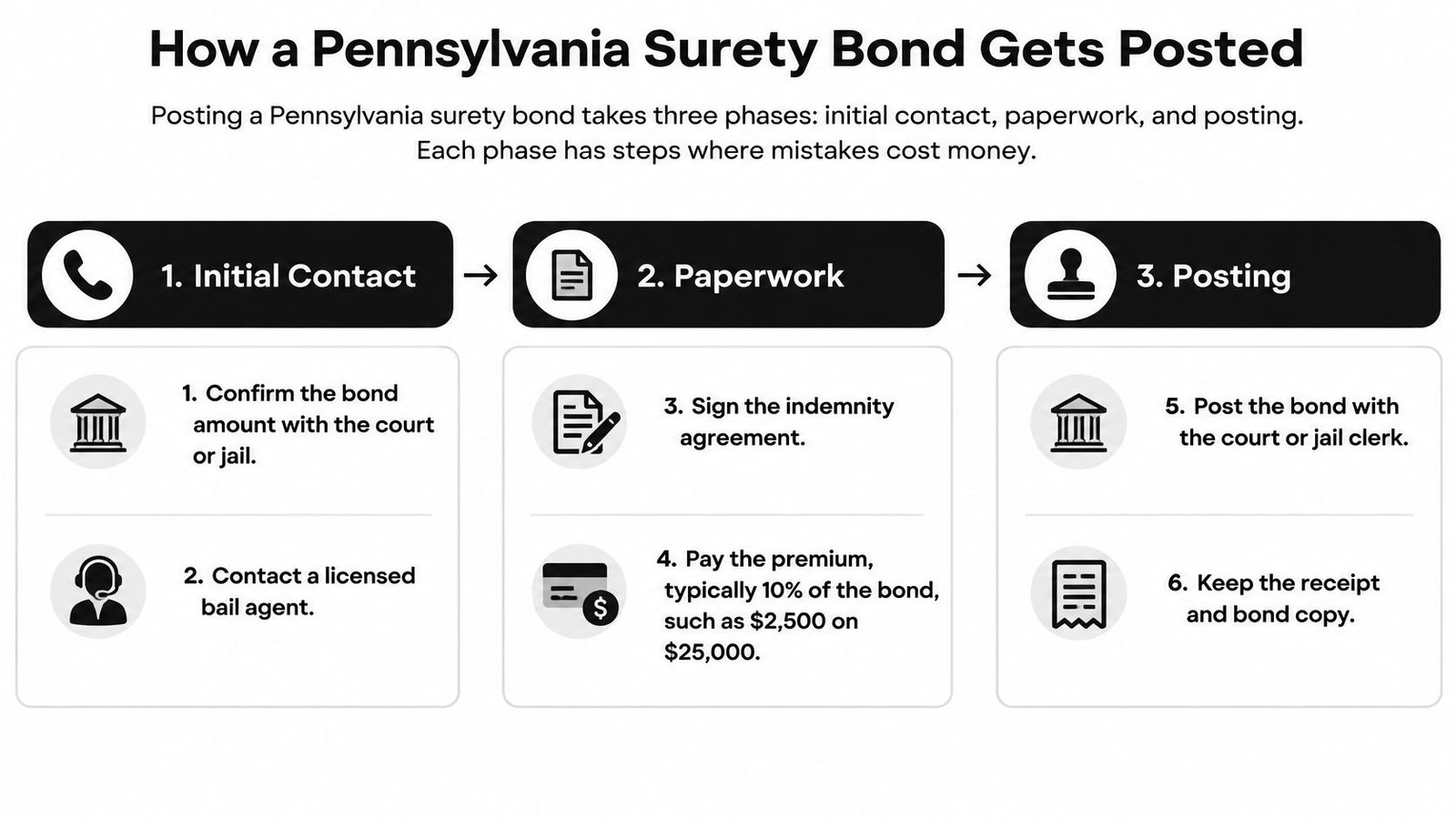
Use these seven steps to keep the court paperwork, payment, and cosigner obligations connected:
- Read the bail order line by line. Use the order itself when confirming the amount, bail type, release conditions, and next hearing date with the agent. A figure passed along during a jail phone call may leave out information the producer needs to prepare the bond correctly.
- Verify the producer's Pennsylvania license before paying anything. Surety-bond producers must hold a Pennsylvania license. Check the licensing information provided by the Pennsylvania Department of Banking and Securities, and confirm the producer you are dealing with before authorizing payment. An explanation written for Colorado customers does not establish anyone's authority to arrange a Pennsylvania bond.
- Give the licensed agent complete booking details. Gather the defendant's full legal name, date of birth, detention facility, booking number if known, and alleged charges. Check names and the facility carefully. Accurate details help the agent match the paperwork to the person in custody rather than spend time resolving discrepancies.
- Review the indemnity agreement and collateral terms. Identify the assets being pledged, the events that require reimbursement, and any additional costs the agreement assigns to the cosigner. The contract works like a promise to repay if the guarantee creates a covered loss. Read electronic documents as carefully as paper ones before signing.
- Pay the non-refundable premium and confirm the math in writing. The invoice should identify the total bail amount and the exact premium calculation. The premium covers the agency's financial risk in guaranteeing the bond; collateral secures obligations under the agreement. Keep those amounts separate, and obtain a dated receipt naming the agency and defendant.
- Wait for the agent to post the bond at the facility. After the paperwork is signed and the premium is paid, the licensed agent posts the surety bond with the court clerk. Posting and physical release are separate stages. The jail handles its internal release processing, so payment does not establish a walk-out time.
- Collect your paper trail and calendar the court date. Save the signed indemnity agreement, collateral records, payment receipt, filed bond copy, and written hearing schedule together. Make the next appearance easy to find. The cosigner's obligations continue after the payment clears and the bond is posted.
What a Completed Posting Looks Like
Request a copy of the filed surety bond identifying the court and docket number, a signed indemnity and collateral receipt documenting the agreement and assets pledged, and a written confirmation of the next court date. Keep the premium receipt alongside them so payment and collateral are clearly distinguished.
The guide to posting a surety bond step by step explains Express Bail Bonds' Colorado posting process. Its contact, paperwork, and posting sequence helps explain the mechanics, but its service procedures should not be treated as Pennsylvania requirements.
The video below provides a visual overview of the posting process.
Pennsylvania Versus Colorado Bail Bond Rules
A parent in Pittsburgh searches for a surety bond after midnight and lands on a Colorado agency page. The page quotes a 15% premium and describes cosigner costs as if every state used the same contract. That 15% figure is Colorado's state-regulated premium. Treating it as Pennsylvania law throws off both the budget and the point at which a cosigner can owe the full bond.
A surety bond works like a loan guarantee that stays open, not like a paid invoice. The premium compensates the producer for promising the full amount to the court. The cosigner signs a separate promise. That promise is collected only if the bond is forfeited.
| Factor | Pennsylvania | Colorado |
|---|---|---|
| Governing law | Pennsylvania Rules of Criminal Procedure and 42 Pa.C.S. forfeiture provisions | Colorado Revised Statutes and Colorado court bail rules |
| Who licenses the agent | Pennsylvania Department of Banking and Securities licenses surety-bond producers | Colorado Division of Insurance licenses bail agents |
| Standard premium | Set in the written contract with the licensed producer, not locked to Colorado's 15% rate | 15% of the bond amount, the state-regulated standard |
| Third-party forfeiture trigger | Failure to appear at a scheduled proceeding under Rule 536 | The missed obligation named in the court order and the bond contract |
| Recovery window after forfeiture | Statutory judgment clock and a tiered remission schedule of up to one year under 42 Pa.C.S. | Remission and exoneration on the timetable in the Colorado forfeiture order |
| Cosigner exposure | The cosigner can owe the full forfeited bond amount | Co-signers may owe additional costs if bond terms are not met |
The Forfeiture Trigger That Changes Outcomes Most
Fee quotes are only one split. The rule that changes a Pennsylvania cosigner's outcome most is how narrow third-party forfeiture is.
Under Pennsylvania Rule of Criminal Procedure 536, when a third party acts as surety, a court may order forfeiture only for failure to appear at a scheduled court proceeding. A missed curfew, a broken no-contact order, or a travel violation can still bring bail modification or revocation of the defendant's release. Those breaches do not, by themselves, forfeit the third party's bond while the defendant keeps coming to court.
Rule 536 also sets the paperwork. The judge must state the reasons for forfeiture on the record or in writing. The court must give written notice to both the defendant and the surety. That notice starts the enforcement clock. Pennsylvania then uses a statutory judgment clock and a tiered remission schedule that can run up to one year under 42 Pa.C.S. Colorado does not copy that Pennsylvania schedule. Its timing sits in the forfeiture order entered in that case.
A defendant's missed hearing triggers Pennsylvania third-party forfeiture, while other release violations typically lead to bail modification or revocation of the defendant's release rather than automatic surety forfeiture.
If the arrest is in Colorado, use a Colorado bail laws and regulations breakdown instead of a Pennsylvania rule sheet. Families with a local Colorado arrest can also check jail details on the Jefferson County Golden bail bonds page or the Bail Bonds Centennial resource.
A $25,000 Bond From Premium to Forfeiture
To see how a PA surety bond plays out financially, walk through a labeled hypothetical: a judge sets a $25,000 bond, and a family member pays a $2,500 non-refundable premium (a hypothetical 10% fee) and signs the indemnity agreement as cosigner.
That $2,500 fee covers the agency taking on the financial risk of guaranteeing the full $25,000 to the court. It doesn't cap your exposure at $2,500. Under Pennsylvania's bail regulations, when someone other than the defendant deposits money and cosigns the bond, that person becomes a surety and may be held liable for the full monetary condition if the bond is forfeited.

Look at how the numbers shift across five possible outcomes in this $25,000 scenario:
| Scenario | Cosigner exposure |
|---|---|
| Defendant attends every hearing and meets conditions | No forfeiture owed (only the $2,500 premium was paid) |
| Defendant misses a hearing and is not recovered | Court forfeiture order; judgment 90 days after notice; payment due on day 91; up to $25,000 plus any costs the contract allows |
| Defendant recovered within six months of the order | Surety may petition to recover the full forfeited amount less a $250 administrative fee |
| Defendant recovered six months to one year after the order | Surety generally recovers 80% of the forfeited amount, leaving a 20% permanent loss gap |
| Travel or contact violation without a missed hearing | Third-party forfeiture is tied to failure to appear, so financial impact is governed by the court order and contract terms |
How Pennsylvania's Statutory Forfeiture Clock Runs
When a defendant skips a hearing and the court revokes bail, 42 Pa.C.S. § 5747.1 sets a strict timetable. The revocation becomes a judgment of forfeiture 90 days after service of the revocation or forfeiture notice, and payment is due by the close of business on the 91st day.
Fast recovery drastically changes the math. If the defendant is apprehended after judgment but within six months of the revocation or forfeiture order, the surety may petition to recover the full forfeited amount less a $250 administrative fee. If apprehension happens between six months and one year, the statute generally allows recovery of 80% of the forfeited amount, leaving the remaining share permanently lost and collectible from the cosigner under the indemnity agreement.
Collateral, Indemnity Terms, and Extra Costs
Using a bail bondsman typically requires collateral, which can include real property or a cash deposit, and a cosigner with a stable income may be needed to qualify. If the defendant disappears and the surety has to pay the court or hire recovery agents, co-signers may be liable for additional costs if the terms of the bond aren't met.
Before signing, ask directly how bond fees and collateral interact by reviewing how bail bond pricing works. Get written confirmation of the exact discharge trigger that releases your collateral lien or returns your cash deposit once the court formally closes the bond.
Surrender, Re-Arrest and Getting Collateral Back
Once your relative walks out of jail, the bond stays active until the court formally discharges it through dismissal, sentencing, or another qualifying order. If the defendant is re-arrested on a new charge, or if you realize they're about to skip town and want off the bond, you can't cancel the agreement on your own. Any bond surrender or modification must go through the licensed agent and the court.
Ask the agent these four specific questions before signing so you aren't guessing during a crisis:
- How does a voluntary or agent-initiated surrender work? Ask what steps the bondsman takes to return the defendant to custody if you request to be removed as cosigner, and clarify who pays for transport or administrative expenses.
- What happens if the defendant gets re-arrested while out on this bond? A new arrest doesn't automatically erase your liability on the original bond. Confirm whether a re-arrest puts your pledged collateral at risk or requires the agent to surrender the first bond to protect against a missed hearing.
- When and how is collateral released after discharge? Get the exact paperwork timeline in writing: who signs the lien release on real property, how many days it takes to refund a cash deposit, and what court proof of discharge the agency needs.
- Which written records detail every fee and collection cost? Insist on a copy of the indemnity contract showing the premium paid, any unpaid payment-plan balance, and the specific legal or recovery costs the agency can charge if a claim arises.
For a deeper look at what happens when an indemnitor faces a demand for payment, read our breakdown of the surety bond claim process.
Notice discipline: Save every envelope, email, and docket sheet you receive from the court or the bondsman with the exact date it arrived. Because Pennsylvania's judgment deadline and remission window run from formal service of written notice, your dated records can protect you if a dispute over timing ever lands in front of a judge.
Verify the Agent and Choose Your Next Step
Check the producer's license, the court order, and the written indemnity terms before a single dollar leaves your account, and treat a commercial bond as one option rather than a default reflex.
Run through this five-point verification checklist before signing:
- Confirm state authorization: Look up the agent's surety-bond producer license through Pennsylvania's Department of Banking and Securities to make sure you're dealing with a regulated professional.
- Double-check the docket sheet: Verify the exact bail amount, release type, active holds, and next hearing date directly from the court order.
- Get every term on paper: Never rely on verbal assurances; require a written contract, itemized receipt, and complete indemnity agreement before paying.
- Pin down collateral and surrender rules: Confirm in writing how your property or cash deposit comes back after discharge and what happens if a re-arrest occurs.
- Confirm a bond helps: Make sure no constitutional bail denial or outside detainer will keep the defendant in custody after posting.
Why Insurer Identification Matters
Regulated bail bonds in Pennsylvania operate inside formal insurance oversight. According to the Pennsylvania Insurance Department property-and-casualty filing instructions, insurers writing bail-bond coverage must file a dedicated "Bail Bond Supplement" following NAIC Annual Statement Instructions rather than burying bail activity inside unrelated lines. Legitimate bond paperwork will clearly name both the licensed producer and the underwriting insurance company backing the guarantee.
When evaluating any bail agency, reading verified surety bond customer reviews also helps you spot transparent communication versus high-pressure tactics. If you're handling a Pennsylvania arrest, work exclusively with a surety-bond producer licensed in Pennsylvania.
If your arrest or cosigner question involves a Colorado jail rather than Pennsylvania, Express Bail Bonds is licensed, bonded, and insured to write bail bonds statewide in Colorado. You can review local Colorado guidance on Express Bail Bonds' Colorado bail services, and any cosigner questions can be answered in a completely confidential consultation by calling or texting us 24/7 at 720-984-2245.
Navigating a bail bond decision at midnight is stressful, especially when you're putting your own finances behind someone else's court dates. If you or a loved one need fast, transparent surety bond help anywhere in Colorado, our licensed team provides clear quotes, electronic contracts for out-of-state cosigners, and 24/7 support from start to finish. Visit Express Bail Bonds or call or text 720-984-2245 to speak confidentially with an experienced agent today.