
Your phone rings at 2 a.m. Your child has been arrested in Colorado, someone mentions a bail amount, and you're trying to figure out whether to call the jail, pay online, or find a bondsman. Before you reach for a credit card, you need the actual release order, not just a dollar amount relayed over the phone.
Posting a surety bond can provide a practical route out of custody when the court allows it. But the premium is only part of the decision, especially if you're being asked to cosign.
How to Post a Surety Bond in Colorado Step by Step
Confirm the Release Route Before Paying
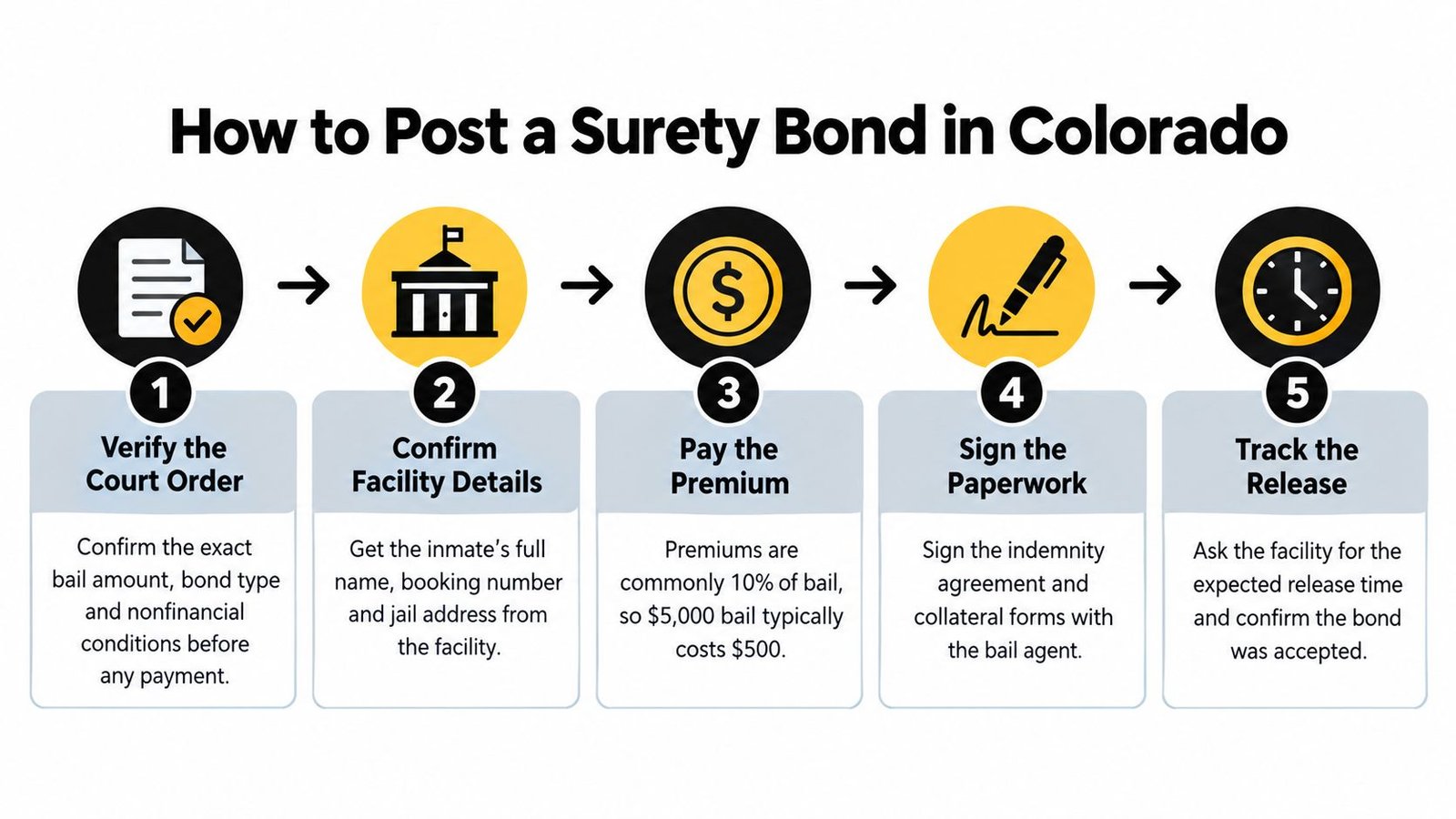
Check the court order and every release condition. Ask the detention facility or court clerk to confirm the exact bail amount, authorized bond type, and nonfinancial conditions. Specifically ask whether the order permits an unsecured or personal-recognizance release. A dollar amount on a jail roster doesn't automatically mean you need a commercial bond.
A Colorado study of unsecured and secured bonds, covering more than 1,900 defendants across 10 counties, found similar court-appearance and public-safety outcomes for unsecured bonds and secured cash or surety bonds, while secured bonds increased jail use. That doesn't determine anyone's eligibility; the actual order controls.
Common slip: Paying before confirming the permitted release method. Correcting that mistake can require another round of calls and, if a change is needed, waiting for court review.
Before you pay: Ask whether the defendant can be released under the existing order without purchasing a surety bond. If the answer is unclear, ask defense counsel to review it.
Locate the correct booking record. Use the defendant's full legal name, date of birth, and booking number. Check spelling variants, hyphenated surnames, and aliases, and confirm the actual detention facility rather than assuming it's in the city where the arrest occurred. A name mismatch can turn a quick lookup into repeated calls while staff locate the right record.
Request a written premium quote from a licensed agency. Give the agent the facility, booking number, case information, and current bond order. Compare the quote with the maximum-premium table below, and ask whether financing or collateral is required. An incomplete quote can force you to restart the approval process after you've gathered documents or arranged payment.
Complete the Application and Confirm Filing
Submit the application and identification. Provide the defendant's details and a government photo ID for each signer. Make sure addresses, phone numbers, and email addresses are accurate. A blurry ID upload or missing apartment number can leave the application waiting until someone responds.
Pay the agreed premium. This purchases the guarantee; it isn't a refundable deposit held until the case ends. Confirm the payment recipient and retain the receipt. A declined payment or unexplained difference between the quote and checkout amount stops progress until it's resolved.
Sign the indemnity agreement and collateral documents. Read the financial obligations before signing, and keep every page, including any collateral receipt. Missing signatures usually mean another document request and another wait for the signer to become available.
Confirm that the agency filed the bond. Ask whether the facility accepted it, not merely whether the agent sent it. Request an estimated release window and identify who will contact you if staff reject the paperwork. Treating a payment confirmation as filing confirmation can leave a problem undiscovered until someone follows up.
The Colorado Judicial Branch's advisement guidance explains that someone other than the accused posts a surety bond and takes responsibility for ensuring court attendance; if the accused fails to appear, the court may order the surety's posted money paid to the court. That's why accurate identity and case information matter throughout the application.
Keep the process checklist available while you make calls.
For relatives coordinating an unrelated arrest outside Colorado, One Call Bail Bonds' steps for securing release from Forsyth jail offer a separate local checklist. Don't transfer another jurisdiction's procedures to a Colorado case.
Before ending your calls, save the bond number, next court date, facility phone number, and agent's direct line. For surety-bond assistance, call Express Bail Bonds at 720-984-2245 or start an application; local information is available for Jefferson County and Golden and the Centennial area.
What the Premium Costs at Common Bail Amounts
What will you really pay? Start with the maximum, then compare the agency's written quote.
Under Colorado Revised Statutes § 10-2-707, a producer may charge no more than the greater of $50 or 15% of the bail amount furnished, which produces the calculated ceilings in this table.
Maximum premium by bail amount in Colorado
| Bail amount | Maximum premium (greater of $50 or 15%) | Notes |
|---|---|---|
| $300 | $50 | The $50 threshold applies because 15% equals only $45 |
| $1,000 | $150 | 15% of bail, above the threshold |
| $5,000 | $750 | 15% of bail |
| $10,000 | $1,500 | 15% of bail |
| $25,000 | $3,750 | 15% of bail |
Separate the Premium From Other Charges
These are maximums, not a promise that every agency will offer the same quote. The smaller-bond example illustrates the greater-of calculation; it doesn't make the statutory ceiling a required price.
The statute generally restricts additional charges to authorized court or law-enforcement filing fees, the actual cost of secure collateral storage, or premium financing. Ask for an itemized explanation of any charge beyond the premium, rather than accepting an unexplained processing total.
Budgeting rule: Compare the complete written transaction, including financing obligations and collateral requirements, not just the amount due today.
Know What the Payment Buys
The compensated surety earns the full premium when the defendant is released from custody. Successful court attendance doesn't turn that payment into a refund when the case ends.
The agency provides the financial guarantee to the court while the customer pays the premium and satisfies underwriting requirements. Review the agency's surety bond rates and calculate the ceiling from the current court order before calling.
Immigration detention involves a different bond system. If that's the family's actual situation, US Immigration Bonds & Insurance Services' bond budgeting for families facing ICE detention is a more relevant starting point than applying Colorado criminal-bail pricing.
Documents and Cosigner Requirements by Role
The agency's underwriting and the court order determine the final document list. Use this checklist to organize the family, then obtain written confirmation before uploading sensitive records.
Documents and obligations by role
| Role | Documents needed | Extra obligation | Practical note |
|---|---|---|---|
| Defendant | Full legal name, date of birth, booking number, court date | Must appear at every court date | Often no collateral on a standard surety bond; confirm with the agency |
| Colorado cosigner | Government photo ID, home address, phone, employer | Signs indemnity agreement and accepts financial responsibility | Ask what the agency may recover if the defendant misses court |
| Out-of-state cosigner | Photo ID, proof of address, email for e-signature | Same contract terms as an in-state cosigner | Confirm remote identity verification before starting |
| Property owner posting a property bond | Recorded deed, title, proof of equity | Required unencumbered Colorado equity | Property bonds are a separate route from a surety bond |
| Collateral provider | Title, appraisal, receipt request | Collateral held until the bond is exonerated, subject to applicable release terms | Get a written receipt for every item handed over |
The Colorado Judicial Branch's bond guidance states that noncompliance can result in forfeiture and separately requires unencumbered Colorado equity equal to 1.5 times the bond amount for a property bond. Don't confuse pledging property directly to the court with providing collateral to a commercial agency.
A Cosigner Isn't Just a Reference
A cosigner accepts financial responsibility under the indemnity agreement. If the surety becomes liable for the full bail amount after a missed appearance, the cosigner may face a reimbursement demand under that contract, not merely the loss of the premium.
Ask specifically about recovery expenses, notice requirements, collateral demands, and any obligation to report changes in the defendant's location. Also ask what surrender means, whether it ends your obligations, and what documentation establishes exoneration, the release of the bond obligation.
Don't sign an indemnity agreement unless you understand what the agency can demand from you and what must happen before your responsibility ends.
For remote signers, obtain the application, indemnity agreement, collateral receipt, court dates, and written release conditions before completing the electronic signature. Review the cosigner requirements and request the complete document list in writing. Missing address details and unsigned collateral forms are preventable reasons for a posting to stall.
Posting Online Without Visiting the Jail
A sister in Arizona needs to cosign for her brother in a Colorado county jail, but she can't drive there. Remote processing may let her complete the application, upload identification, sign contracts, make an electronic payment, and receive digital copies without visiting the detention facility.
The agency still has to complete its filing procedure, and the jail still has to accept the bond. An online checkout screen isn't a release authorization.

Keep Jail Processing Charges Separate
Under Colorado House Bill 25-1015, a jail custodian may not charge more than $10 for bond processing, including online posting, and release on a money bond cannot depend on paying outstanding fees, costs, or surcharges, including booking, pretrial-supervision, electronic-monitoring, or bond-processing fees.
That ceiling concerns the jail custodian's processing charge, not the commercial premium. Ask who imposed each charge so you don't mistake an unrelated jail balance for an amount that must be paid to obtain release.
Before signing electronically, verify:
- Facility acceptance: Does this jail accept the agency's electronic filing method for this bond?
- Filing confirmation: Will you receive confirmation that the facility accepted the submission?
- Document delivery: Which signer receives the executed contracts, payment receipt, and bond records?
- Rejection contact: Who can correct a rejected filing, and how do you reach that person directly?
Use the online bond-payment instructions to identify the appropriate payment process. Send identification through the agency's designated secure channel rather than an unverified text conversation.
Save a screenshot or PDF of every confirmation page. Download the signed documents instead of relying on a temporary email access link that may become unavailable when you need it.
How Long Jail Release Takes at Each Stage
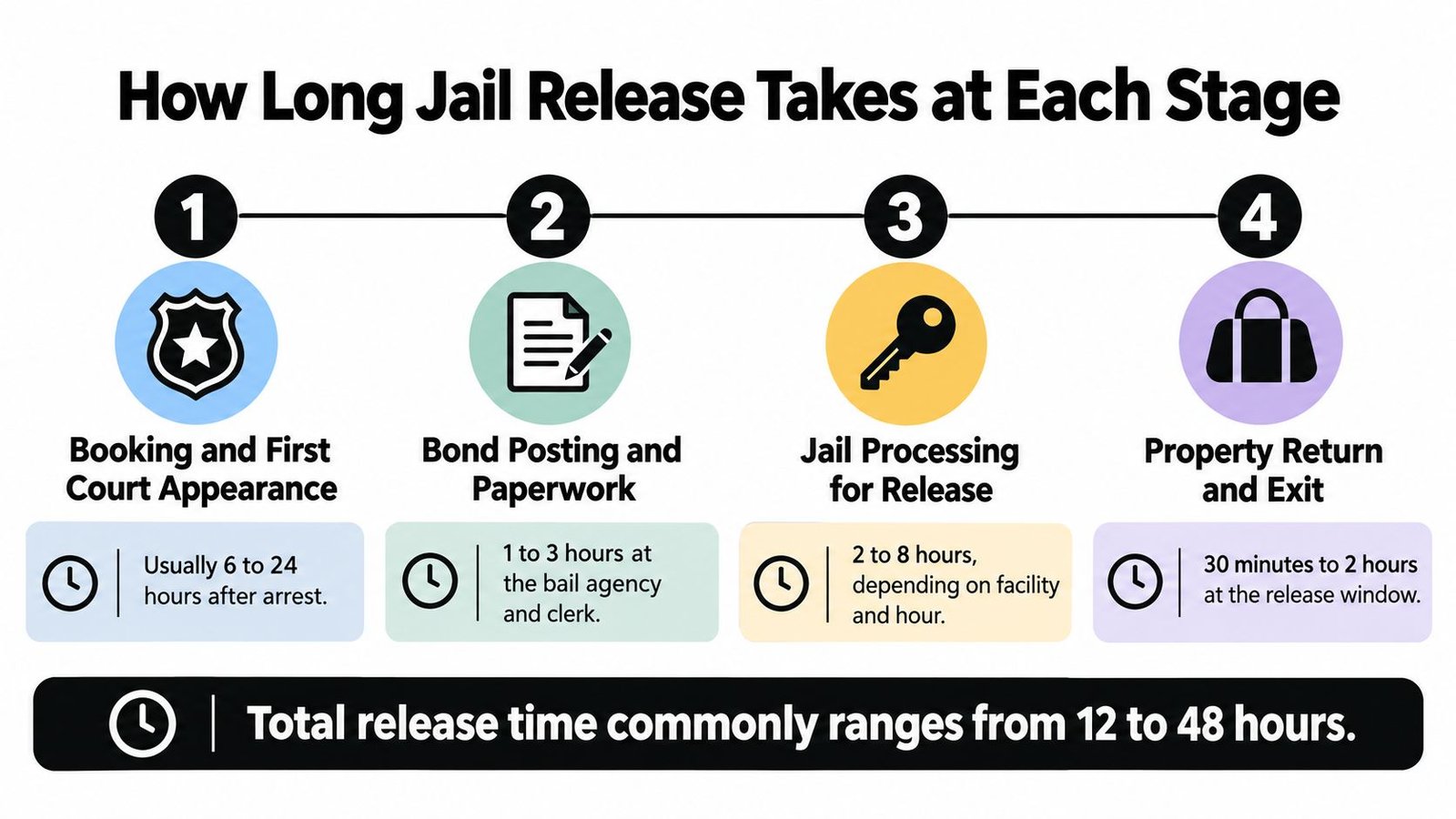
Release timing depends on the facility, the hour, the court order, and the paperwork. Plan around an estimated window rather than a promised pickup time; even an accepted bond doesn't tell you exactly when the defendant will reach the exit.
Follow the Custody Process
Booking and first court appearance. Say your relative has arrived at the jail but isn't yet listed in the public roster. Staff may still be completing intake, and the court may need to set or confirm release terms. Confirm the roster entry and current bail order before arranging payment.
Agency filing. Once the application, payment, and contracts are complete, the agency submits the bond. An incomplete signature or outdated order can stop this stage. Obtain the bond number and filing confirmation.
Facility review. Jail staff check identity, holds, and required paperwork. Respond to a document request the same day when possible, but remember that another agency's hold can prevent release independently of this bond.
Final release. Staff complete discharge procedures and return available property. Confirm that your relative has actually left custody, arrange transportation, and record the next court date.
Ask for a Window, Not a Guarantee
Same-day release is a reasonable expectation only when the bond is complete, no hold exists, and the facility can finish processing. It isn't a guarantee, and a late-night booking can mean waiting for court or administrative work before the release process can advance.
Ask the agency for an expected release window when the facility accepts the bond, and consult its explanation of how long bail takes to process. If that window passes without an update, call the facility once for a status check. For a paperwork gap, weekend delay, or outside hold, identify the specific obstacle before making more calls.
Common Hurdles and How to Fix Them
The most frustrating call is the one after payment: your relative is still inside, and nobody has explained what's missing. Payment may be complete while a required form, corrected court order, or separate hold still prevents release.
Common posting problems, causes and fixes
| Problem | Likely cause | Fix |
|---|---|---|
| Release stalls after payment | Felony defendant hasn't signed the extradition waiver | Have the defendant sign the Waiver of Extradition form before release |
| Roster search finds no one | Name spelled differently or booked under an alias | Search by date of birth and booking number, and try name variants |
| Cosigner ID rejected | Expired ID or address doesn't match the application | Provide a current government photo ID and matching proof of address |
| Bail amount differs from the quote | Judge changed bail at a later hearing | Request the newest court order from the clerk and send it to the agency |
| Bond posted but still in custody | Second hold from another county or agency | Address the other hold through the responsible authority; this bond doesn't resolve it |
| Posting requested on a weekend | The agency or court office handling a necessary step isn't processing until the next business day | Ask for an expected release window and confirm the next business morning |
Check the Required Felony Paperwork
Under the Colorado administrative order governing the applicable bond-release procedures.pdf), a person arrested for a felony cannot be released until the person seeking release completes and signs the Waiver of Extradition as a Condition of Bail Bond, identified as JDF 231 under Colorado Revised Statutes § 16-4-105. Ask staff whether that form is complete rather than assuming the commercial contract covers every release document.
That administrative guidance addresses cash or surety bonds within its applicable procedures. It shouldn't be read as eliminating other release options authorized by a defendant's actual court order.
Match the Fix to the Person Who Can Make It
An agent can correct a filing or request a missing signature. The court clerk can supply an updated order, while detention staff can identify an outstanding hold; defense counsel may need to address the legal basis for that hold.
A weekend doesn't automatically prevent posting, either. Ask which specific office or approval is unavailable instead of accepting a vague explanation that nothing happens until Monday.
Keep a short call log with the person's name, the unresolved item, and the promised next action. If you've posted bail but the person hasn't been released, ask the facility and agency to coordinate directly, ideally on a joint call. The facility can confirm custody barriers while the agency verifies exactly what it filed.
Express Bail Bonds offers Colorado surety-bond applications, electronic paperwork, payment processing, and coordination with detention facilities. Visit Express Bail Bonds to review your release order with an agent, request a written premium quote, and confirm what each signer must provide before proceeding.