
Your relative has been arrested, someone has mentioned a bond amount, and you're trying to work out what to do next. You may be calling from another state, comparing payment options, or holding a receipt while wondering why your loved one still hasn't left the jail.
Colorado bail laws distinguish permission to be released, posting a bond, and completing release. Those aren't interchangeable events. The court decides eligibility and conditions, while the jail processes the bond and physical release. Understanding who controls each step helps you ask useful questions without paying for an option the court hasn't authorized.
Colorado Bail Options at a Glance
Colorado release options compared
| Release option | Who pays | Money paid to court or agent | Typical use |
|---|---|---|---|
| Personal recognizance (PR) bond | No one | None | Lower-risk cases where the court accepts a promise to appear |
| Cash bond | Defendant or a third party | Full bail amount to the jail or court | Family or defendant can pay the full amount |
| Surety bond | Defendant or cosigner | Non-refundable premium to a licensed agent, rate set by agreement | Bail amount is too high to pay in cash |
| Property bond | Property owner | No cash; real estate pledged as collateral | Owner has equity in real estate that the court accepts |
A personal recognizance bond, often called a PR bond, releases the defendant on a written promise to appear without depositing bail money. It doesn't mean the defendant is free of supervision or other court-ordered conditions.
A cash bond requires the full amount. Return of that money follows the court's terms when the case ends, so the person paying should confirm who receives any refund and what deductions may apply.
What separates a surety bond from property collateral
With a surety bond, a licensed bail agent posts the bond and charges a non-refundable premium under a written agreement. A cosigner commonly signs that agreement, making it important to understand the obligations rather than treating the premium as the entire commitment.
A property bond pledges qualifying real estate to the court instead of cash. That's different from offering collateral to an agent under a commercial surety agreement. The guide to types of bail can help you identify the terminology on the paperwork, but the court order determines which route is authorized.
The court sets the bond amount and permitted bond type for the case. Don't assume an amount quoted over the phone means every payment method is acceptable.
A commercial bond isn't always necessary
Under C.R.S. § 16-2-111, people charged with misdemeanors or petty offenses may be admitted to bail or pretrial release under the applicable framework, and county courts may authorize designated officers to grant release when a judge isn't immediately available.
That means a surety bond is one route, not proof that money must change hands. If a hearing is pending, ask the court whether it will determine eligibility for PR release before committing to a commercial agreement.
Locate these items on the paperwork:
- Bond type: Identify exactly what the court permits.
- Bond amount: Verify the amount against the correct case and defendant.
- Release conditions: Check what must happen besides posting the bond.
If any item is missing or unclear, confirm the hearing status and eligibility ruling with the court.
Colorado's Constitutional Basis and How Judges Decide Release
Colorado's historical constitutional starting point is release on sufficient sureties. A Colorado Supreme Court decision from 1974 interpreted Article II, Section 19's capital-case exception as mandatory when “the proof is evident or the presumption great”; release procedures are organized in C.R.S. §§ 16-4-101 through 16-4-111. That historical ruling explains the foundation, not an exhaustive statement of every current detention exception.
The courtroom is where eligibility and conditions are resolved, rather than negotiated through a bond purchase.
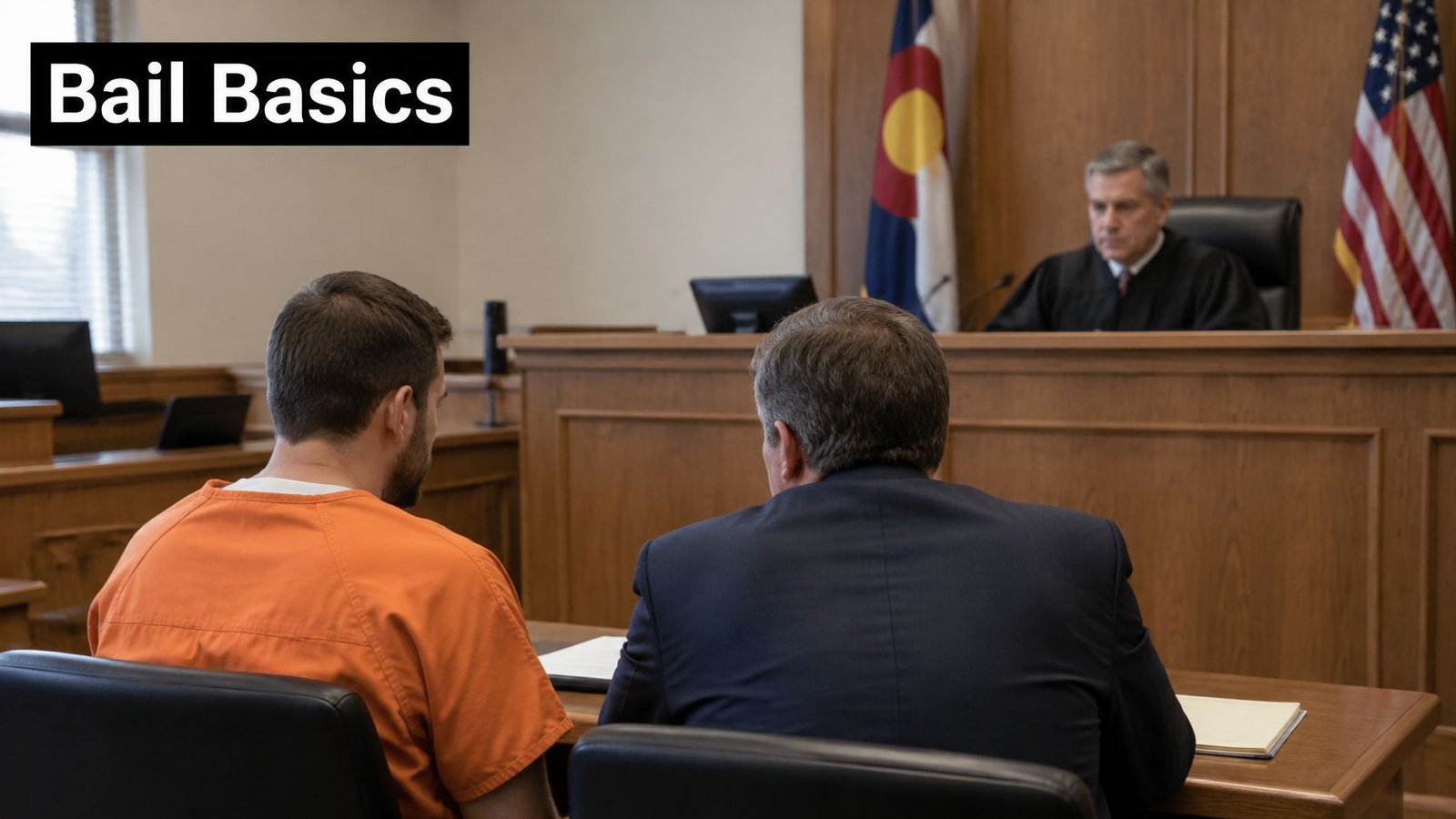
What happens at the release decision
At the initial appearance, the judge addresses release and the conditions attached to it. The useful distinction is between whether release is legally available and what conditions would govern release. A family's ability to pay doesn't answer the eligibility question.
The judge may receive information from pretrial services, including a risk assessment. The Colorado Division of Criminal Justice reform proposal recommends assessments throughout Colorado counties, identifies the Colorado Pretrial Assessment Tool as the recommended instrument, and expressly says an assessment cannot be the sole basis for setting bond or release conditions.
Treat that document as a reform proposal, not proof that every county currently operates an identical program. Ask whether an assessment was prepared, what information it contains, and whether counsel has reviewed any disputed entries.
Our pretrial risk assessment explainer provides context for that terminology. A score isn't a substitute for the judge's decision, and a family shouldn't assume it automatically dictates either release or detention.
Practical rule: Ask for the actual release order. A recommendation, a proposed amount, and a signed judicial decision aren't the same thing.
When the prosecution seeks detention
For specified serious cases, C.R.S. § 16-4-101's detention framework requires a hearing within 96 hours of arrest, reasonable notice, and findings that the proof is evident or the presumption is great and that release would place the public in significant peril.
Those requirements separate an allegation from a judicial detention determination. The charge matters, but under this framework it isn't the only finding the court must make.
Counsel should verify which current constitutional and statutory provisions apply to the particular charge. This is especially important when the case involves a listed violent or weapons-related offense, because an older explanation of bail eligibility may not answer the present question.
The defendant's procedural protections at this stage include a prompt hearing, reasonable notice, an opportunity to be heard, and assistance of counsel. A relative can help organize documents and questions, but counsel should address the evidence and legal grounds for detention.
For additional orientation to the bail process, the following video is available.
Questions to take to the hearing
- Identify the charge. Is it a listed serious or weapons-related offense, and which eligibility provision applies?
- Confirm the detention hearing. Has it occurred or been scheduled within the applicable statutory window?
- Get the release terms. What bond type and conditions did the judge order?
- Check the assessment. Was a risk assessment used, and was it treated as the only basis for the decision?
- Record the next appearance. When and where must the defendant return?
Write down the answers alongside the case number and keep a copy of the order. If the family receives conflicting information, ask the clerk or counsel to identify the controlling document rather than choosing whichever explanation sounds more favorable.
A surety application may accomplish nothing while eligibility remains unresolved. Don't post money before confirming that release is authorized and that the proposed bond matches the order.
Bond Costs, Processing Fees and Premium Rules
Bond costs and who sets them
| Cost item | Typical amount | Set by |
|---|---|---|
| Jail bond-processing fee | Capped at $10, including online posting, under the Colorado bond-processing statute | State statute |
| Gilpin County processing fee | $10 for each bond completed by detention staff, according to Gilpin County jail guidance | County jail procedure |
| Booking and other jail fees | Not required to secure release on a money bond in Gilpin County | County jail guidance |
| Surety premium on a $10,000 bond | $1,000–$1,500, representing a typical 10–15% premium | Licensed bail agent, regulated by the state |
| Cash bond | Full bail amount, returned under the court's terms when the case ends, with applicable court-cost deductions | Court |
Government charges and private premiums are different
The jail's processing charge pays for processing the bond. The statutory ceiling applies whether the defendant, surety, or another person pays, and an online posting method doesn't authorize the jail custodian to exceed that ceiling.
A surety premium is the commercial price of obtaining the agent's bond. The processing-fee limit doesn't set that premium, eliminate collateral requirements, or define a cosigner's contractual obligations.
Gilpin County's guidance makes another useful distinction: the payor needs to provide the bond amount to secure release on a money bond, rather than first clearing booking fees and other jail debts. An outstanding fee and an unmet release condition are different issues, so ask staff which one they mean.
A small government processing charge and a larger private premium can appear in the same transaction. They pay for different things and should be itemized separately.
A worked surety example
Say the court authorizes a $10,000 surety bond. The family pays the agent's agreed premium rather than depositing the full bond amount with the jail, and any jail processing charge must stay within the statutory ceiling shown in the table.
At Express Bail Bonds, Colorado premiums typically fall within the range shown above, but the written agreement establishes the actual quote. Our surety bond rates guide helps explain the terminology; review the premium, payment obligations, and collateral terms before signing.
Don't assume collateral is another name for the premium. Ask what property or funds are being pledged, what event could create additional liability, and what must happen before collateral is returned.
If you're coordinating assistance across state lines, Blandon Bail Bonds, Inc. offers a resource to compare bail payment options in Florida. Use it to understand jurisdictional differences, not to establish a Colorado rate or release rule.
Before paying, obtain an itemized explanation that separates the government charge from the commercial agreement. The county fee answers what the jail charges to process a bond; the premium answers what the surety arrangement costs.
Release Timelines After a Bond Is Posted
A family completes an online surety transaction at 7 p.m. The payment confirmation arrives within minutes, and the defendant is still in the jail's processing queue. The receipt settles the bill; the release is a separate task the jail still has to finish.
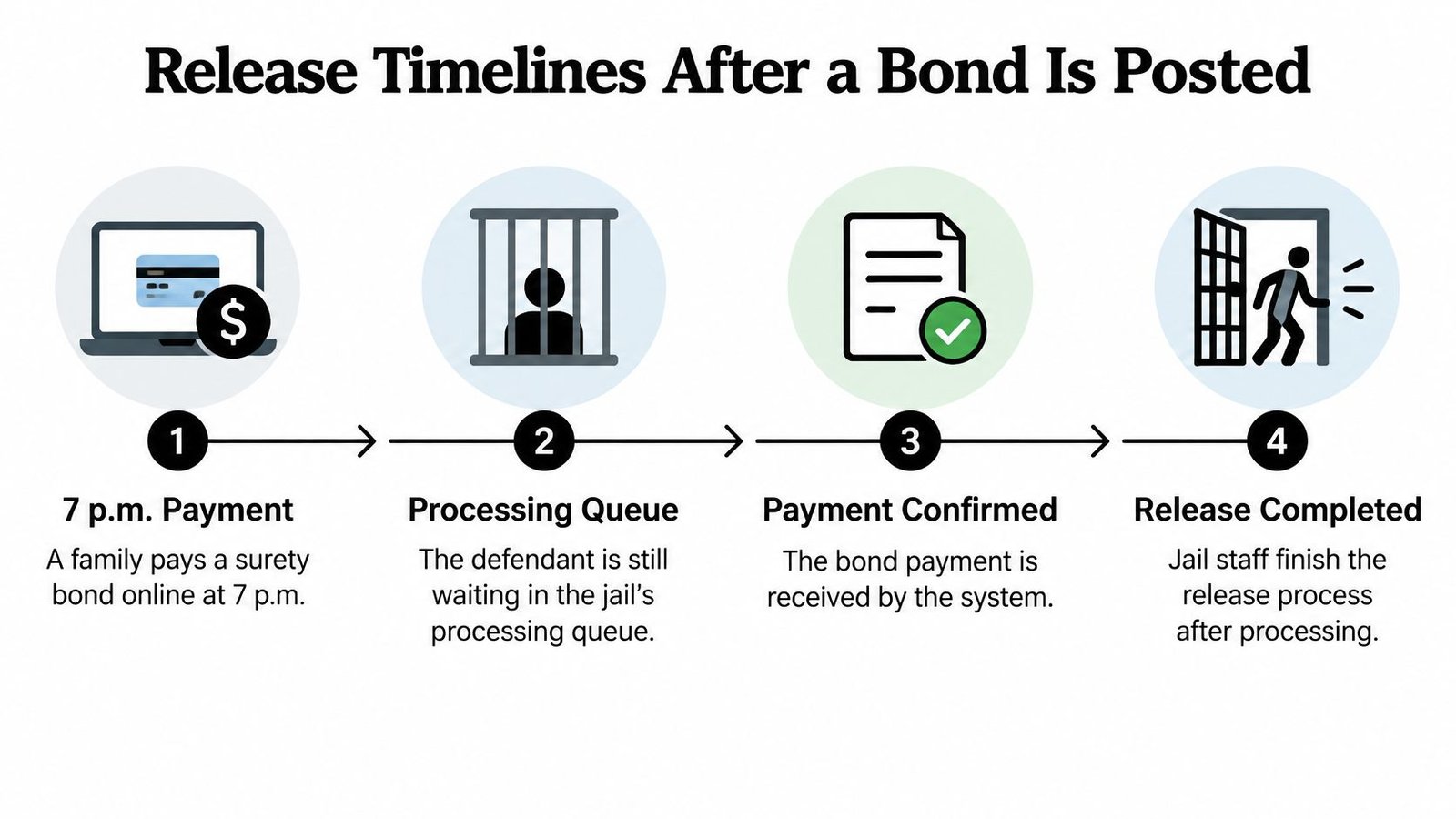
House Bill 25-1015, signed in 2025, required every jail to offer online posting by October 1, 2025, accepting credit cards at minimum, and requires release after bond is posted despite unpaid booking, processing, pretrial-supervision, or electronic-monitoring fees. It also requires a next-court-day appearance when a person remains jailed more than 24 hours after posting while awaiting monitoring equipment fitting.
Which clock applies
Each stage below runs on its own clock, and the starting condition matters as much as the deadline itself.
Release timelines after bond is posted
| Stage | Time limit | What families should do |
|---|---|---|
| Initial bond hearing | Set by the court's schedule rather than a fixed statewide deadline | Confirm the hearing date and the applicable deadline with the court |
| Personal recognizance release | As soon as practicable, generally within 6 hours of physical arrival, unless extraordinary circumstances exist | Ask when the jail recorded physical arrival |
| Cash bond release | 6 hours after bond is set, the defendant is physically present, and the jail is notified that the bond is ready, subject to extraordinary circumstances | Record when the jail receives notice |
| Electronic monitoring fitting | More than 24 hours after posting triggers a next-court-day appearance | Ask for the reason for delay in writing |
| Detention hearing for listed serious offenses | A hearing must occur within the statutory window measured from arrest | Confirm the applicable deadline and an eligibility ruling with the court before posting |
The PR and cash-bond clocks start under different conditions in the enacted release-timing provisions. Applying the cash-bond clock to a surety transaction, or assuming a clock starts when the payment receipt appears, produces the wrong expectation.
What the family should document
In the evening scenario, the next useful call asks which step remains unfinished.
- Save confirmation. Record when the bond was posted and keep the receipt or acceptance record.
- Identify the obstacle. Ask what condition, if any, is preventing release.
- Check monitoring. Ask whether fitting is required and when it is scheduled.
- Keep a call log. Record the date, time, staff member's name, and explanation.
Monitoring delays need a second question, because unpaid monitoring fees and equipment that hasn't been fitted are different problems under the statute. Unpaid fees alone cannot hold someone once the bond is posted. A pending equipment fitting is what triggers the next-court-day appearance requirement.
Family members in another state can still handle the paperwork. Express Bail Bonds uses secure electronic contracts that cosigners can review and sign from anywhere in the country, so no one has to travel to Colorado to complete a bond. Remote families should plan transportation around confirmed release information rather than the receipt alone, and if the jail's explanation stays unclear, they can hand the timeline to counsel to raise the specific delay with the jail or court.
County Differences and Recent Bail Reforms
A bond accepted at one jail can still leave a family waiting while the same paperwork clears in an hour somewhere else. Courts weigh the individual case, and the steps between payment and release, screening, staffing, posting procedure, belong to each county. That gap between "paid" and "walks out" is where local practice matters most.
The Colorado Commission on Criminal and Juvenile Justice's bail presentation documented the historical shifts summarized below, including 37 counties without a pretrial-services or risk-assessment program at the time of its review and wider use of personal recognizance bonds after legislation enacted in 2013.
Recent Colorado pretrial and bond changes
| Change | Year | Status or result |
|---|---|---|
| PR bonds in District Court cases | 2013–2016 | Rose from 18% to 31% of cases |
| PR bonds in County Court cases | 2013–2016 | Rose from 26% to 46% of cases |
| Counties with no pretrial services or risk assessment | At the commission's review | 37 counties |
| Online bond posting in every jail under HB 25-1015 | 2025 | Enacted; required by October 1, 2025 |
What the historical figures do and don't show
Read the PR numbers the way you'd read a weather report from years ago. They describe a shift in how courts used one bond type during a specific period, and county programs may have changed since the review. The outlook for a case filed this week still turns on the current court order and the judge's findings, so treat the table as background for your questions rather than a prediction.
The online-posting law changed how families can submit bonds, while the local jail still determines which system accepts payment and how it gets matched to the defendant. Gilpin County illustrates how a jail can publish county-specific processing instructions inside the statewide framework. When a proposal has been discussed rather than enacted, ask counsel to confirm the operative statute instead of relying on summaries of pending legislation.
Our cash bail reform overview gives context for these distinctions. For an immediate release decision, the controlling sources remain the current court order, applicable law, and the detention facility's instructions.
Verify the county's actual process
- Pretrial services: Does a program operate locally, and has it completed the required screening?
- Online posting: Which official system accepts the authorized bond type?
- Processing charge: What does the jail assess, and how does it itemize that charge?
Call the detention facility where the defendant is physically housed, rather than the county where relatives live. Keep the booking and case numbers ready so staff can pull the right record.
Confirm the Bond Terms Before You Pay
Treat verification as the final step before money changes hands. Urgency is understandable, but a payment that doesn't match the court's order won't resolve the underlying release question.
Your pre-payment checklist
- Match the order. Confirm the bond type, amount, defendant's identifying information, case number, and release conditions.
- Verify eligibility. Make sure the court has ruled, especially when a listed violent or weapons-related offense is involved.
- Check the jail's instructions. Confirm the processing charge and accepted posting methods, including the official online option.
- Review the agreement. Obtain an itemized document separating the premium, collateral terms, and other fees.
Use the bail bond contract guide to prepare questions about the agreement. Don't sign a provision you don't understand, and don't substitute an agent's explanation for counsel's advice about the criminal case.
Keep the paperwork together: The bond order, signed agreement, posting confirmation, and receipts should be available when you call about release.
We're a fully licensed Colorado bail bonds agency. For local coordination, our guidance for Jefferson County and Golden and Centennial can help you organize the next questions.
Confirm the controlling details with the court or jail before paying. After posting, keep asking which release step remains incomplete rather than assuming the receipt establishes when someone will walk out.
We offer online applications, payments, contract documents, and bond posting at most Colorado detention facilities for court-authorized surety bonds. Visit Express Bail Bonds once you've confirmed the bond terms, or call or text 720-984-2245, available 24/7, to discuss the documents and next steps for arranging the bond.