You get the call late at night. A son, daughter, spouse, or friend has been arrested. Nobody in the family knows how bail works, everybody's scared, and the first thing that happens is a frantic search for surety bonds reviews.
That search can help, but it can also mislead you fast.
A polished website, a pile of star ratings, and a lot of emotional comments don't tell you the one thing that matters most in a crisis: can this agency legally, reliably, and quickly do the job without creating a second problem for your family? In Colorado, that means looking past hype and checking what sits behind the reviews, including legitimacy, clarity, and real working access to the courts and jails involved.
Why Surety Bonds Reviews Are Just the Starting Point
At two in the morning, most families read reviews the wrong way. They scan for the highest star count and call the first company that sounds friendly. I understand why. You want relief, not homework.
But panic is when people make expensive mistakes.

Good reviews can still hide a bad choice
A review can tell you whether someone felt relieved after a phone call. It usually does not tell you whether the company is financially legitimate, properly backed, or whether the person you're talking to is operating the way they should.
That gap matters. Construction Coverage's guide to surety bonds notes that people searching for surety bond providers often want to know how to tell a legitimate provider from a fraudulent broker, yet many review pages leave out a key check: verifying status on the U.S. Department of the Treasury's Circular 570, also called the T-List, along with independent credit ratings.
That's the kind of detail worried families rarely know to ask about.
Practical rule: Reviews tell you how people felt. Verification tells you whether the agency deserves your trust.
What reviews are actually good for
Reviews still have value. I read them the same way I'd read witness statements. Not as the whole truth, but as clues.
Use them to spot patterns like:
- Clear communication: Did the reviewer say the agent explained paperwork, court dates, and cosigner risk in plain English?
- Consistency: Do multiple reviews mention the same level of professionalism, or do the stories swing wildly?
- Process details: Did the agency move the case forward, or did the review only praise someone for “being nice”?
If you want to see how public feedback can be useful when it's read carefully, look at bail bond reviews from a local agency and focus on the details people mention, not just the stars.
The real question behind every review search
Families usually think they're asking, “Who has the best reviews?”
The better question is, “Who can handle this correctly, explain the obligations, and avoid surprises?”
That's what keeps a hard night from turning into a long, expensive mess.
What a Surety Bond Guarantees in a Bail Situation
Before you can judge a bond agency, you need to know what the bond does. Most families confuse it with insurance. It isn't insurance.
A bail surety bond is closer to a financial guarantee tied to one job: getting the defendant released on the promise that they'll show up when the court requires it.
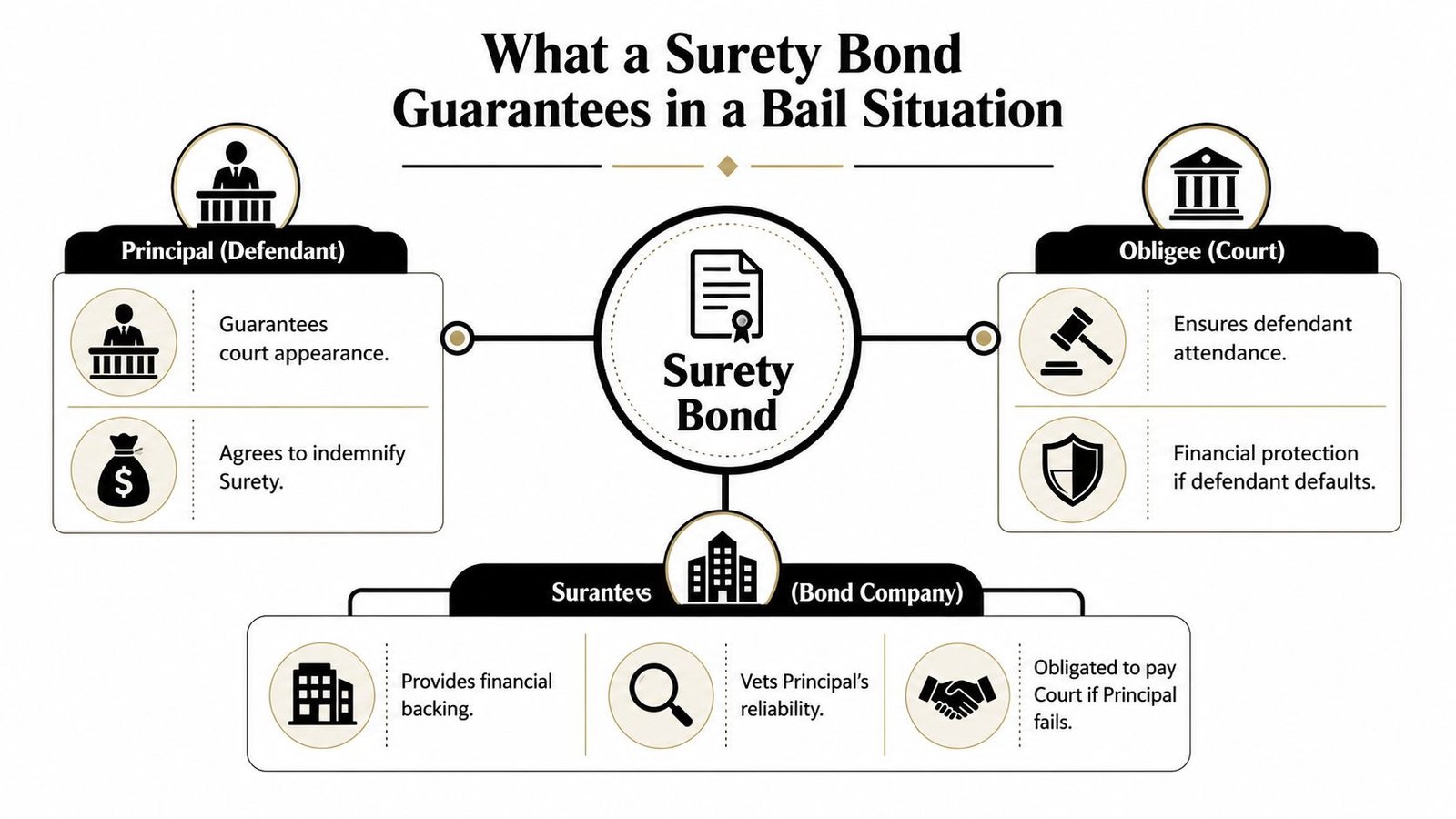
The three people in the deal
This is similar to co-signing for a car, except the court is involved.
| Party | Role | What they expect |
|---|---|---|
| Principal | The defendant | To be released and appear in court |
| Obligee | The court | To have financial backing if the defendant fails to appear |
| Surety | The bond company | To guarantee the obligation and step in if the terms are broken |
That triangle matters because everybody has a different responsibility. The defendant must appear. The court requires assurance. The bond company backs that promise.
Why this is not insurance
Insurance usually protects against certain losses. A surety bond is different. It guarantees performance of an obligation.
Distinguished's overview of surety bonds explains that the claims process is distinct from insurance claims. It involves a multi-stage investigation, and the surety's liability depends on the obligee proving the principal failed to meet the terms.
In plain language, that means this isn't a simple payout product. The bond company doesn't just shrug and write a check because something went wrong. There's a structured process because the bond exists to enforce a commitment.
In bail, the commitment is simple to say and serious in practice: the defendant must appear when the court says so.
Why that matters to a family
This is why agencies ask questions. A professional agent isn't being difficult when they ask where the defendant lives, who the cosigner is, what ties the person has to the area, or whether someone can help keep them on track.
They're evaluating whether the promise is solid enough to back.
If you want the deeper plain-English version of that relationship, this explanation of a surety bond for jail lays out how the guarantee works in a bail setting.
The big takeaway is this: the fee you pay is for the agency to post that guarantee. It is not a savings account, and it is not the same thing as buying insurance protection.
Decoding Online Surety Bond Reviews for Real Insights
Once you understand what the bond does, online reviews start to read differently. You stop asking, “Did people like them?” and start asking, “Did this agency behave like professionals under pressure?”
That's a much better filter.
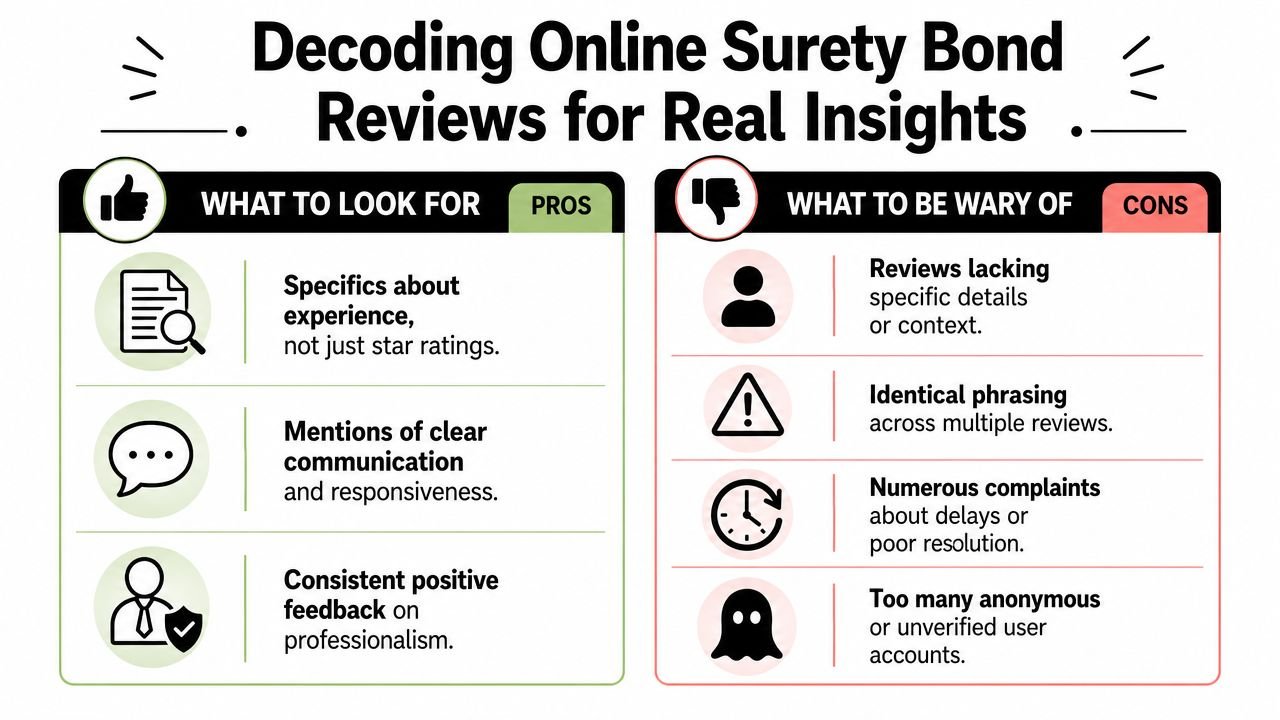
Read for specifics, not emotion
A review that says “Amazing service!!!” is pleasant, but it doesn't help much. A review that says “they explained the cosigner paperwork, told me what jail to go to, and answered my calls after release” tells you something useful.
Here's the difference:
Green-flag review language
- Explained every document: That usually means the agency didn't rush the signer through legal obligations.
- Fees were clear up front: Transparency beats charm every time.
- Answered calls or texts quickly: In bail work, responsiveness matters because timing matters.
- Told us what happens next: Good agents reduce confusion, not just anxiety.
Red-flag review language
- Fees kept changing: That suggests either poor practice or deliberate gamesmanship.
- Could never get anyone on the phone: Bad sign when court deadlines and jail release timing matter.
- Didn't explain the contract: That's how families get trapped in obligations they didn't understand.
- Everyone says the same sentence: Repetitive, generic praise can look manufactured.
Look for pattern clusters
One bad review doesn't prove much. One glowing review doesn't either. What matters is repetition.
If several reviewers mention that the agent was calm, explained cosigner duties, and handled the process smoothly, that has weight. If several people complain about surprise collateral demands or poor follow-up, believe the pattern.
A solid way to compare that feedback with what agencies say publicly is to read online bond review examples and commentary. You're looking for alignment between the public comments and the actual process the company describes.
Here's a quick visual breakdown that helps many families sort signal from noise.
What a review should mention if it's genuinely useful
Use this short screen before you call anyone:
- Names and actions: Did the review mention what the agent did?
- Timing: Did the reviewer describe quick movement, or just say the company was “great”?
- Clarity on obligations: Did anyone mention court appearance rules, indemnity, or cosigner responsibility?
- Professional tone: Did the agency stay respectful when the family was stressed?
A trustworthy review usually includes inconvenience, confusion, or fear at the beginning, then explains exactly how the agency solved it. That kind of detail is hard to fake.
That's how you turn surety bonds reviews into a tool instead of a trap.
Your Step-by-Step Agency Verification Checklist
Reviews are passive. Verification is active. Here, families separate real agencies from polished nonsense.
You don't need to become an expert overnight. You need a short checklist and the nerve to ask direct questions.
Start with legal authority and real-world access
First, confirm the agency is properly licensed to operate in Colorado. If they dance around that question, stop there.
Second, ask if they can post at the specific jail or court involved. “We serve Colorado” sounds nice, but your family member is sitting in one facility, tied to one case, under one court's schedule. That's what matters tonight.
Third, ask how the process functions. A serious agency should be able to explain whether documents can be handled electronically, what identification is needed, and how quickly they can move once they receive the required information.
If you want a plain explanation of the professional role you're dealing with, this overview of what a bail bond agent does is a useful primer.
Ask the money questions without apology
At this point, families get shy. Don't.
NASBP's introductory guide to contract surety bonding explains that surety underwriting is a form of credit analysis and that premium typically ranges from 1% to 15% of the total bond amount depending on creditworthiness. It gives the example that a $10,000 bond may cost $100 for a low-risk principal or up to $1,500 for a higher-risk one.
That fact comes from broader surety underwriting, and it gives you the right mindset for asking questions in any bond setting: price comes from risk, underwriting, and the bond terms.
Ask these questions plainly:
What is the premium, exactly?
Get the number and ask whether it is the full premium or only the initial payment.Are there any additional fees?
If the answer is fuzzy, walk away.What collateral, if any, is required?
If they might hold a car title, jewelry, cash, or property paperwork, you need that in writing.What makes the price change?
A professional answer should mention real underwriting factors, not pressure.
Get the cosigner terms in writing
A lot of family fights start here. One person says, “I'm just helping him get out.” Then later they learn they signed much more than that.
Check these points before signing:
- Indemnity obligation: Ask what the cosigner must repay if the defendant fails to appear or causes expenses.
- Missed court procedure: Ask what happens first. Who gets called, how fast, and what the family can do to fix the situation.
- Collateral release terms: If collateral is posted, ask exactly when and how it is returned.
- Out-of-state signing: If the cosigner lives elsewhere, ask whether the agency can legally and practically handle remote paperwork.
Bottom line: If an agent won't slow down long enough to explain your financial responsibility, that agent hasn't earned your signature.
Watch how they answer, not just what they answer
This part gets overlooked. The right agency doesn't just give correct information. They give it calmly, clearly, and without irritation.
A reliable agent sounds organized. They don't need to bully you. They don't need to dodge basic questions. In a stressful moment, competence has a tone. Learn to recognize it.
Red Flags That Signal a Predatory or Unreliable Bail Agent
Some warning signs are subtle. Others are loud enough that you should hang up immediately.
The hard truth is that desperate families are easy targets. Predatory agents know that. They count on confusion, shame, and urgency doing the selling for them.
Red flags you should treat as deal-breakers
- They won't explain the paperwork. If they push you to sign first and ask later, leave.
- They stay vague about collateral. Anything involving property, titles, or valuables must be clear before you commit.
- They pressure you with urgency they created. Real urgency comes from the arrest. Fake urgency comes from an agent saying you must sign right now or lose your chance.
- They answer basic questions with attitude. You're about to sign a legal and financial obligation. You're allowed to ask.
The bait tactics families fall for
The most common trap is emotional convenience. The agent sounds fast, confident, and casual, so the family mistakes that for reliability.
Another trap is the “cheap deal” pitch. If someone talks more about being cheaper than about being clear, you should get suspicious. In regulated bail work, clarity matters more than salesmanship. If you're comparing offers and wondering how realistic unusually low pricing sounds, read this explanation of 1 percent bail bonds and pay attention to how pricing claims should be examined.
Behavior that should make you stop the conversation
Here's my short personal list:
| Red flag | What it usually means |
|---|---|
| No clear written terms | Trouble later |
| Changing story on costs | Trouble now and later |
| Refuses to discuss cosigner liability | They know you may back out if informed |
| Promises everything instantly | They may be telling you what you want to hear, not what's real |
If the agent acts like your questions are the problem, the agent is the problem.
A good bail professional understands that families are stressed. They don't exploit that stress. They reduce it with straight answers.
Finding a Trusted Surety Bond Provider in Colorado
Your phone rings late at night. A relative has been booked, everyone is panicking, and the first agent who answers sounds polished. That is not enough. In Colorado, the right choice starts with whether the agency can legally write the bond, reach the jail involved, and explain the money without dodging.
Use Colorado-specific facts, not generic review chatter
Colorado families do better when they verify local facts instead of scrolling star ratings. Colorado Legal Defense Group's explanation of bail bonds gives a useful baseline on how bail bonds work in this state. The Colorado Judicial Branch also maintains public reporting related to surety accountability in other bond contexts. The lesson is simple. Colorado gives you public ways to check whether a bond company is legitimate. Use them before you sign.
What a trustworthy Colorado agency should be able to prove
A solid Colorado agency does not rely on charm. It proves competence fast.
Look for an office that can confirm it handles the jail and court tied to the case, explains the premium and any collateral in plain language, supports remote cosigners if family is out of town, and stays reachable after release. That last point matters more than many families realize. Release is only the start of the obligation.
If you want a legal perspective on how to examine an insurance-related business instead of trusting appearances, the Nares Law Group investigation guide is a useful reference. The same habit applies here. Verify the company behind the promise.
A practical Colorado standard
Keep your screening tight:
- Confirm the agency is properly licensed and willing to identify who is writing the bond.
- Confirm it has real access to the jail, court, or detention facility involved in your case.
- Confirm every cost and any collateral requirement in writing before you sign.
- Confirm someone will answer the phone after the defendant is released.
For broader statewide information, start with Express Bail Bonds in Colorado.
Useful surety bonds reviews should push you toward verification, not popularity contests. In Colorado, that means checking the license, the court access, and the financial legitimacy behind the agency name.
Common Questions from Families and Bail Bond Cosigners
What am I really agreeing to as a cosigner
You are agreeing to more than helping someone get out of jail. You are signing a legal contract that can make you responsible for the bond terms, the premium agreement, and any collateral rules in the paperwork. Slow down and read every page. If an agent rushes you past the indemnity agreement, stop right there.
What happens if the defendant misses court
Trouble starts fast. The court can revoke the bond, and the agency can enforce the agreement signed by the defendant and cosigner.
Call the agent the same day you learn there is a missed court date, a warrant issue, or even confusion about the schedule. Families get into bigger problems when they freeze, avoid the call, or assume it will sort itself out.
Can I cosign from another state
Often, yes. But ask that on the first call, not after the paperwork starts. A reliable Colorado agency should already have a clear process for remote signatures, ID checks, and document delivery.
Is the premium refundable
Usually, no. Treat the premium as the fee for the bond service, not money sitting there waiting to be returned. Collateral is a separate issue. Ask how it is held, what triggers its return, and what must happen before the file is fully closed.
What should I ask on the first call
Use plain questions and listen for straight answers:
- What do you need from me right now
- What is the full premium
- Will you require collateral
- How quickly can you post the bond
- What am I responsible for as cosigner
Those answers tell you more than a five-star review ever will.
If your family needs help tonight, choose a Colorado agency that can verify who is writing the bond, explain the contract in plain English, and stay available after release. Express Bail Bonds is a practical place to start for statewide help. If your case is tied to Jefferson County or the south metro area, ask directly whether the agency handles that court and jail regularly, as noted earlier. Reviews can point you toward a name. Verification tells you whether that name can effectively protect your family.