
Colorado's standard bail bond premium is 15% of the bail amount, with a $50 minimum, while bonds over $5,000 may qualify for a 10% premium when an approved cosigner is involved. That means the cost can be calculated before you sign, although the agency must confirm the final terms.
It's 2 a.m. when a family member calls from a Colorado jail. Your loved one has been arrested, the court has set bail, and the first question is immediate: “How much do we need to pay?” You don't need a complicated answer in that moment. You need the rate, the math, and a clear explanation of what can change the final amount.
Bond pricing works differently from paying the entire bail amount directly to the court. A bail bondsman posts a surety bond for the full court-set amount, while the family pays a regulated premium for that service. The sections below explain Colorado's pricing rules, common fees, worked calculations, payment options, and practical ways to avoid unnecessary costs.
What You Pay When You Call a Bondsman
Suppose a relative tells you that the judge set bail at $1,000. Under Colorado law, a professional cash-bail agent's price is capped at the greater of $50 or 15% of the bail amount, so a $1,000 bond produces a $150 premium because 15% of $1,000 is $150. The statutory rule is explained in Colorado's bail bond pricing law.
That $150 isn't the full $1,000 bail. The bondsman generally provides the court with a surety bond for the required amount. In exchange, the person arranging the bond pays the premium, agrees to the contract terms, and may need to provide a cosigner or collateral depending on the circumstances.
The first number to identify
Ask the jail, court, or bondsman for the exact bail amount, then apply the applicable premium rate. If 15% produces less than $50, the statutory minimum applies. If the calculation produces more than $50, the percentage determines the premium.
The premium pays for the bonding service and the financial responsibility the agency accepts when it posts the bond. It isn't the same as handing the entire bail amount to the court, and it isn't automatically refundable because the criminal case later ends.
Families often need more than a percentage. They need to know whether the agency requires collateral, whether payments can be arranged, what happens if the defendant misses court, and whether additional court-related expenses could arise. Before signing, request a written breakdown and review how to pay a bail bondsman so every expected payment is clear.
What the premium does
The premium gives the family access to a surety arrangement rather than requiring the family to produce the entire bail amount immediately. The bondsman then works with the jail and court process so the defendant can seek release under the conditions ordered by the judge.
A family member may still have obligations after release. The defendant must follow court orders, attend required hearings, and comply with the bond agreement. If the defendant fails to appear, the agency may take steps allowed by the contract and applicable law.
The Colorado Premium Explained
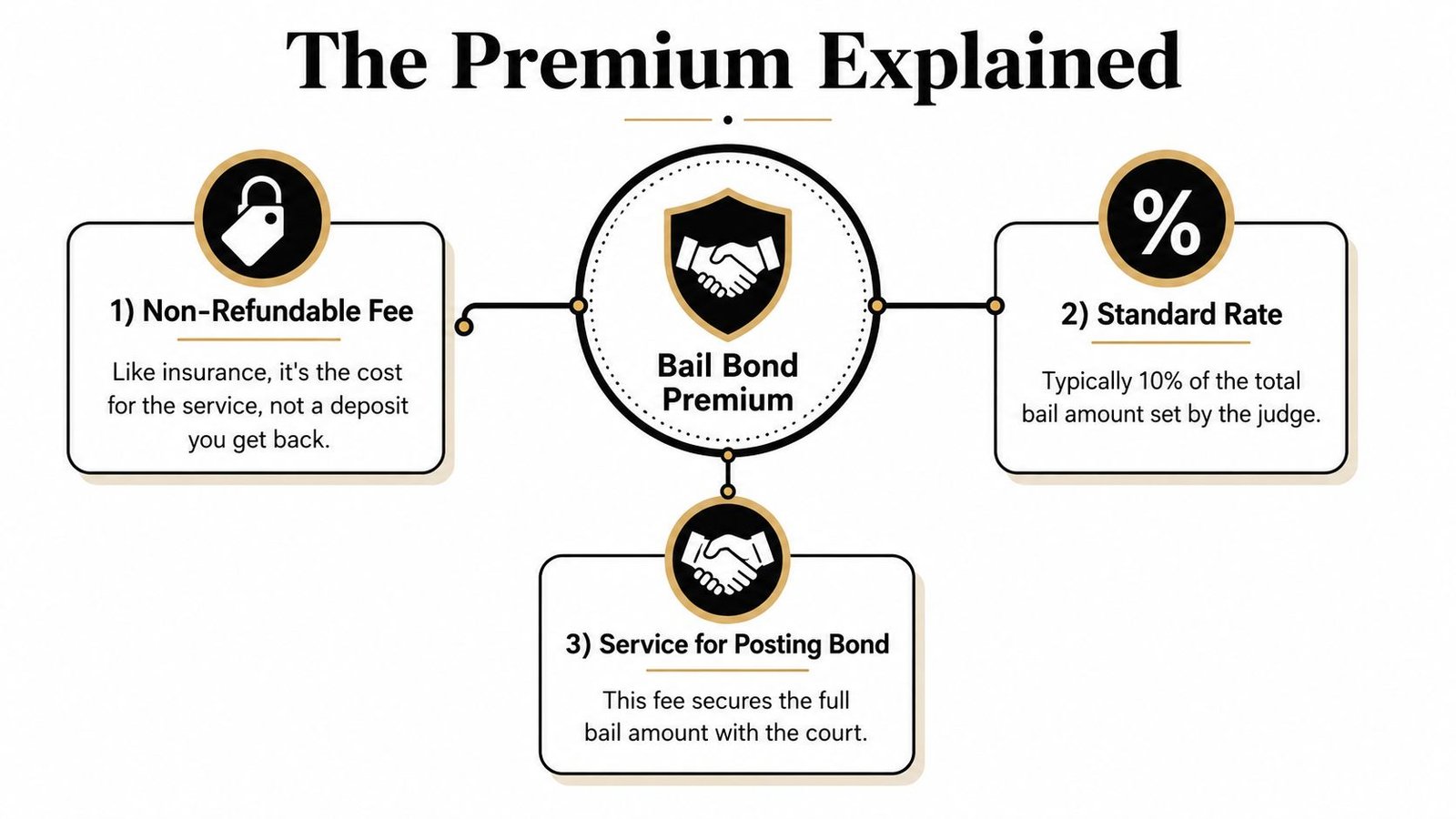
Think of the premium more like an insurance premium than a deposit. You pay for the agency's service and its assumption of responsibility for posting the surety bond. Because the payment purchases that service, it generally isn't a deposit held for return when the case ends.
The distinction matters at 2 a.m. A family may hear “$10,000 bail” and assume it must find $10,000 in cash. A surety bond can reduce the amount paid upfront to a percentage-based premium, subject to the agency's approval, contract terms, and any collateral requirements.
Colorado pricing rule: A professional cash-bail agent's premium is capped at the greater of $50 or 15% of the bail amount. Bonds over $5,000 may qualify for a 10% premium with an approved cosigner, depending on the agency's underwriting and contract requirements.
The 15% rate is the standard figure families should use for an initial estimate. The 10% figure is a possible reduced rate for qualifying bonds over $5,000 when an approved cosigner is involved. It isn't automatic, and the bondsman must decide whether the cosigner and the overall application meet the company's requirements.
Why the premium isn't a refund
A surety agency performs work when it reviews the application, evaluates the risk, prepares contracts, and posts the bond. The defendant's later compliance with court requirements doesn't erase the service already provided. That's why families should treat the premium as a non-refundable service charge, unless the written agreement or applicable law provides otherwise.
The exact paperwork can include payment schedules, indemnity obligations, collateral terms, and responsibilities for keeping the agency informed. Read those provisions before signing rather than relying on a verbal quote. You can also compare the basic structure with Colorado bail rates and pricing guidance.
A quote far outside the regulated structure deserves careful questions. Ask the agent to explain the rate, every additional charge, and the conditions attached to any reduced premium in writing.
Factors That Change Your Bail Bond Price
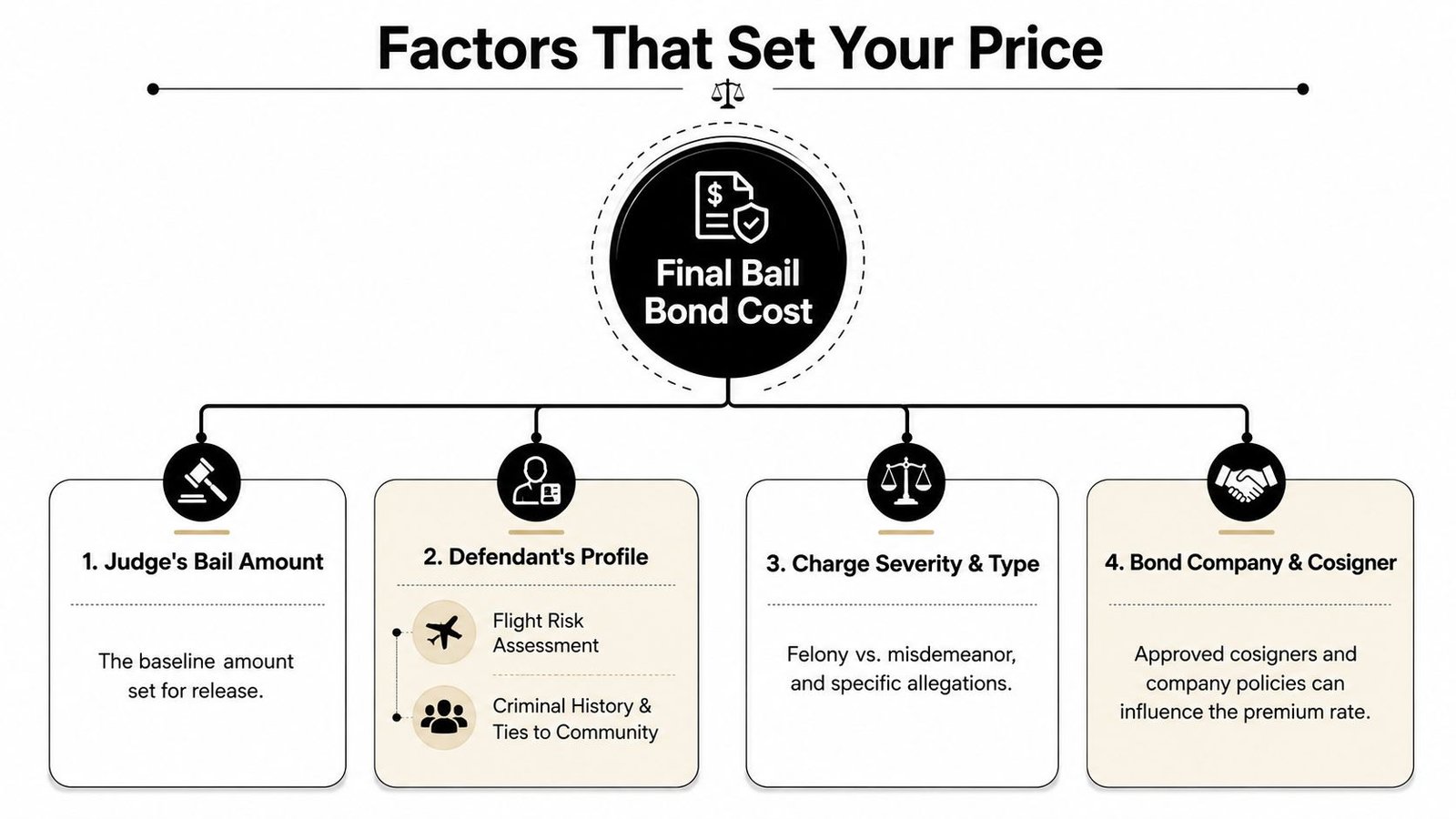
The bail amount is the starting point, but it isn't the only issue. A bondsman reviews the application as a financial and compliance risk, so the final terms can depend on the defendant's profile, the cosigner, collateral, and the type of bond involved.
The judge's bail amount
The court sets the underlying bail amount. A higher bail amount creates a higher percentage-based premium, so the same rate produces a different dollar cost at each bail level. The bondsman doesn't choose the court's bail amount, although the agency uses it to calculate the initial premium.
The defendant's profile
The agency may review the defendant's flight risk, criminal history, employment, residence, and ties to the community. A defendant with a stable address and reliable local contacts may present a different underwriting picture from someone with no verified residence or limited community ties.
This review doesn't determine guilt. It helps the agency assess whether the defendant is likely to follow the bond's conditions and appear for court.
The charge and bond type
The allegations and the type of bond can affect the application. A felony matter may receive different scrutiny from a misdemeanor matter, and a court may impose conditions that require additional review.
Cash-only bonds also matter because they aren't the same as ordinary surety bonds. Express Bail Bonds does not post cash-only bonds, so families facing that requirement should identify the restriction early and ask the court or another provider what options exist.
The cosigner
A qualified cosigner can support the application by accepting contractual responsibility and showing stable employment, good credit, or strong Colorado ties. Those details may help the agency evaluate risk and, for bonds over $5,000, may lead to the possible 10% rate rather than the standard 15% rate.
The cosigner should understand the obligation. Signing isn't merely helping with paperwork. The cosigner may become responsible for payments, collateral conditions, and consequences if the defendant fails to comply with the bond agreement.
Collateral and company requirements
Collateral can give the agency additional protection, particularly when the bond amount or risk profile is substantial. The asset's type, value, ownership, and documentation matter. Collateral doesn't automatically reduce the premium, but it can influence whether the agency approves the application or offers particular terms.
Before agreeing to anything, ask how the company evaluates the cosigner and collateral. A useful explanation of the agency's business model appears in how bondsmen make money, but your written contract remains the controlling document for your specific transaction.
Sample Bond Price Calculations You Can Do Yourself
The basic calculation is straightforward. Multiply the bail amount by 0.15 for the standard premium, or by 0.10 when a bond over $5,000 qualifies for the reduced rate with an approved cosigner.
Example one with a smaller bond
For a $1,000 bail amount:
$1,000 × 15% = $150
The result is above Colorado's $50 minimum, so the estimated standard premium is $150.
Example two with a larger bond
For a $10,000 bail amount at the standard rate:
$10,000 × 15% = $1,500
The estimated premium is $1,500, before any separately disclosed charges or contract-specific requirements.
Example three with a qualifying cosigner
For the same $10,000 bond at the possible reduced rate:
$10,000 × 10% = $1,000
The difference between the standard and reduced calculations is $500. The 10% rate requires an approved cosigner and applies to qualifying bonds over $5,000, so the family shouldn't assume it applies until the agency confirms approval.
| Bail Amount | Standard 15% Premium | 10% Premium with Approved Cosigner |
|---|---|---|
| $1,000 | $150 | Not applicable because the bond isn't over $5,000 |
| $10,000 | $1,500 | $1,000 if approved |
| $20,000 | $3,000 | $2,000 if approved |
These examples show why asking about the cosigner option can matter. The percentage difference becomes a meaningful dollar difference as the bail amount rises, but approval depends on the application and the written agreement.
Use this Colorado bail bond cost guide to prepare your questions, then ask an agent to confirm the exact figure. A quote should identify the bail amount, rate, premium, payment terms, collateral, and any additional charges.
Common Fees and Payment Options
The premium is the main cost, but it may not be the only amount discussed. Depending on the situation and contract, families may encounter charges connected with reinstatement, court requirements, paperwork, travel, or other services. Those costs aren't universal, so the responsible approach is to ask rather than assume.
Request a written itemization that separates unavoidable charges from conditional ones. Ask these questions before signing:
- Premium: What rate applies, and what is the exact dollar amount?
- Additional services: Could reinstatement, court-related work, or other administrative charges apply?
- Collateral: What asset is required, who owns it, and how will release conditions work?
- Payment timing: What is due before posting, and what payments remain afterward?
- Nonpayment: What happens if a scheduled installment is missed?
Electronic processing versus in-person signing
Electronic processing can help an out-of-state relative or cosigner who can't travel to a Colorado detention facility. Depending on the agency, applicants may complete forms, payments, and contract documents electronically, then communicate with an agent by phone or text.
The traditional in-person process may suit a local family that wants to review documents at an office. It can also create travel and waiting demands, especially when the person responsible for the bond lives far from the jail.
| Online and electronic process | In-person process |
|---|---|
| Helpful for remote cosigners | Useful for local families who prefer face-to-face review |
| Documents and payments may be completed electronically | Paperwork is completed at an office or detention location |
| Communication can happen by phone or text | Questions are handled in person |
| Reduces the need to travel | May require travel and waiting |
Ask specifically about flexible bail bond payment terms and whether the proposed schedule appears in the contract. A payment plan can make the premium manageable, but it doesn't eliminate the underlying obligation.
How to Reduce Your Bail Bond Costs
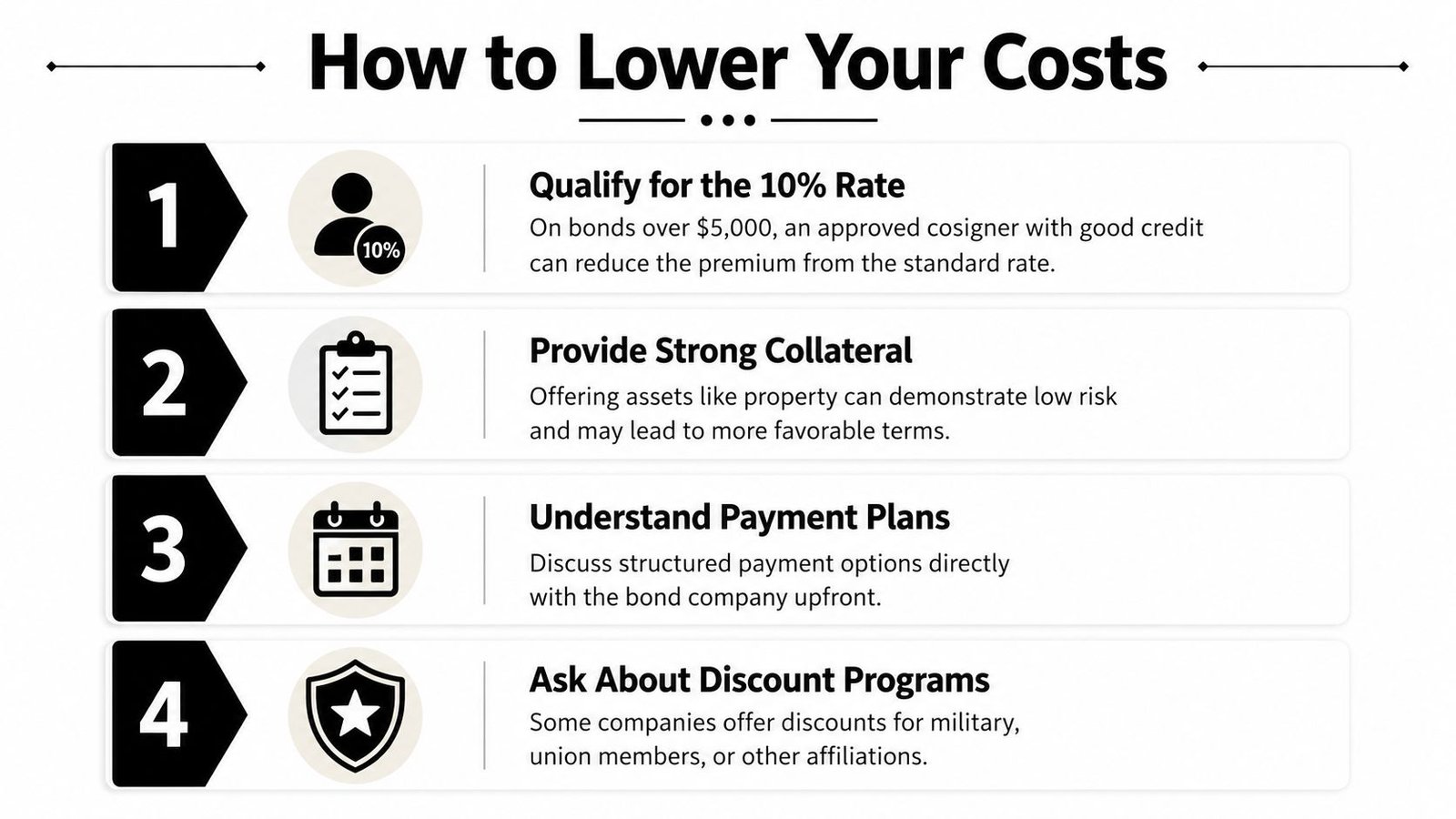
The most direct saving may come from qualifying for the reduced rate. On a bond over $5,000, an approved cosigner may allow a 10% premium instead of the standard 15% premium. On a $10,000 bond, that changes the calculation from $1,500 to $1,000, a potential savings of $500.
That option depends on approval. Start by identifying a cosigner who can document stable employment, good credit, a reliable residence, and meaningful Colorado ties. The cosigner should also understand the legal and financial responsibilities before signing.
Actions to take before signing
- Ask for the reduced-rate review: Tell the agent that you want the application evaluated for the 10% rate if the bond exceeds $5,000.
- Bring complete information: Have identification, employment details, residence information, and contact details ready for the defendant and proposed cosigner.
- Discuss collateral early: Property or another acceptable asset may strengthen the application, although it doesn't guarantee a lower premium.
- Request the full price in writing: Confirm the premium, payment schedule, collateral terms, and conditional charges before authorizing the bond.
- Compare payment schedules: A structured schedule may help with cash flow, but ask whether it changes the total amount owed.
- Ask about legitimate discounts: Some agencies may have programs tied to qualifying affiliations, so ask what documentation is required.
Know the cash-only boundary
A cash-only bond requires a different solution from a surety bond. Express Bail Bonds doesn't post cash-only bonds, so ask about the bond type before spending time on an application. If the court requires cash, explore the available court process or another provider as early as possible.
A transparent agency should explain what it can post, what it can't post, and what approval requires. That clarity can prevent a family from paying an application-related charge without a realistic path to release.
The following video offers another visual explanation of the basic bail bond process:
Getting Clear Answers Before You Pay
You now have the core framework. Start with the court-set bail amount, calculate the standard 15% premium, and ask whether a bond over $5,000 qualifies for the 10% rate with an approved cosigner. Then move beyond the percentage and confirm collateral, payment timing, additional fees, and the obligations that come with signing.
A careful call should answer practical questions, not leave you guessing. Ask the agent to state the total premium in dollars, identify every amount due before posting, explain any installment arrangement, and describe what happens if the defendant misses court or violates the agreement.
A short call checklist
- What is the exact bail amount?
- Which premium rate applies?
- Does the proposed cosigner qualify for the reduced rate?
- Is collateral required?
- What additional charges could arise?
- What amount is due now?
- Can the cosigner complete documents remotely?
- Does the agency post this type of bond?
A licensed Colorado agency with statewide experience can also help you identify the next procedural step. Express Bail Bonds is based in Denver and has served Colorado city and county detention facilities since 1988, with agents available 24/7 by call or text at 720-984-2245. The company offers electronic applications, payments, and contract documents, which can help relatives or cosigners who aren't near the jail.
For a loved one in Jefferson County or Golden, use the Jefferson County and Golden bail bonds page. For an arrest in Arapahoe County, the Centennial bail bonds page provides a facility-specific starting point. The Express Bail Bonds website is another option for online contact and general information.
Understanding how bond pricing works gives you control during an upsetting phone call. You can check the percentage, convert it into an exact dollar estimate, ask about the cosigner rate, and refuse to sign until the written terms match the explanation.
Express Bail Bonds provides 24/7 guidance for Colorado surety bonds, including help with premiums, cosigner requirements, electronic paperwork, and payment terms. Visit Express Bail Bonds to request assistance online or call or text 720-984-2245 so an agent can explain the expected cost for your loved one's bond.