
You've heard that someone you care about has been arrested, but you can't find a clear answer about where they are. You enter their name, get an empty result or an unfamiliar record, and wonder whether you should call the jail, contact the court, or start arranging bail.
An Arapahoe County jail inmates search is a useful starting point, but it's not the whole answer. The safest approach is to confirm the person's identity first, then separate the questions about custody, charges, and bond before making travel or payment arrangements.
Why Arapahoe County Inmate Searches Need Careful Handling
Suppose a relative tells you that your brother was arrested earlier today. You search his name and find nothing, while another family member finds a similarly named person on an unofficial website. Neither result gives you enough information to decide what happened.
That's a common point of confusion: an online lookup is a current-status snapshot, not a permanent custody record. A person's situation can change after you run a search, including through booking, transfer, release, or court movement. Save what you find, but confirm consequential details before acting on them.
The search can feel especially difficult when you're trying to make decisions from home.

A large facility with changing custody information
The county describes the Arapahoe County Detention Facility, opened in 1987 at 7375 South Potomac Street in Centennial, as accommodating approximately 1,400 inmates and receiving an average of 17,000 inmates annually, according to its Detention Services Bureau overview.
Those figures provide context, not a timetable. They don't establish when a particular person's booking will appear online or how long release processing will take. Don't use the facility's overall workload to predict an individual outcome.
Practical rule: Treat a search result as information to verify, not permission to assume that someone is available for release.
Match the person before interpreting the record
Keep your questions separate:
- Identity: Does this record belong to your relative?
- Custody: Which agency can confirm where the person is held?
- Court and bond: Who can verify the case status and applicable release requirements?
If you're comparing unofficial pages, social profiles, or other web results, Digital Footprint Check's resource on safer research into online identities offers a useful companion to careful identity checking. It isn't a substitute for detention or court confirmation.
You don't need to solve every question at once. Start with the official county channel, collect the identifiers you can verify, and leave uncertain details marked as uncertain rather than filling in the gaps.
Official Arapahoe County Search Tools and Phone Lines
Choose the contact channel according to the question you need answered. A custody inquiry, a records request, and a visitation-account problem aren't interchangeable, even when they concern the same person.
Official Arapahoe County Inmate Information Channels
| Resource | Best use | Contact or access |
|---|---|---|
| County inmate-information page | Start a name-based lookup through the county's official pathway | Navigate from the county sheriff's detention information |
| Main and automated information | Ask about detention information or follow the release-notification prompts | 720-874-3500 |
| Records inquiries | Ask where to direct a records-related question | 720-874-3875 |
| Detention facility | Confirm the destination before an in-person trip | 7375 S. Potomac Street, Centennial, Colorado 80112 |
The telephone numbers and address above are listed in the county's official emergency communications contact information, which also identifies option 7 on the automated system for victim-notification information concerning an inmate's release.
Use official channels for confirmation
Begin with the county's inmate-information pathway rather than assuming that the first search-engine result is the county database. Look at the page's organization, its stated data owner, and any disclaimer about accuracy or delay.
An unofficial directory may help you locate a resource, but it shouldn't replace the county when you need to verify custody. The county jail phone-number directory can serve as a navigation aid if your search expands beyond Arapahoe County.
When calling, state your purpose plainly. For example, explain that you're trying to confirm whether a named person has completed booking, rather than asking broadly for everything about an arrest.
Prepare a focused inquiry
Keep a short note beside you so you don't lose important details during an automated menu or conversation:
- Person sought: Full legal name and any known booking identifier.
- Question to resolve: Current location, booking confirmation, release information, or records access.
- Information already checked: The page searched and when you checked it.
- Next contact: The department or agency you're directed to contact.
Don't send a records question to a visitation vendor or ask an account-support representative to interpret a court order. If you reach the wrong office, ask which office owns the information you need.
Before traveling, confirm both the destination and the purpose of your visit. Having an address doesn't establish that an in-person visit is necessary or that staff can resolve every question at the front desk.
Searching by Name and Other Identifiers
Search broadly enough to find a possible match, then verify narrowly enough to avoid identifying the wrong person. A familiar name alone isn't enough, especially when the result could affect payment, visitation, or a family member's privacy.
The identifiers below are useful for verification, but don't assume the online interface provides a separate search box for each. Use the available fields, then carry additional identifiers into your telephone inquiry.
Begin with the legal name
Use the person's full legal name rather than the nickname everyone uses at home. For example, a family might know someone as Chris, while an official record uses Christopher. That's a hypothetical search problem, not evidence about how any particular county record is entered.
Watch for differences involving:
- Compound surnames: A family name may contain more than the last word you normally use.
- Hyphens and spacing: Compare the spelling carefully rather than assuming punctuation is irrelevant.
- Name order: Check which field is labeled as the surname.
- Middle names: Use them to distinguish possible matches when they're available.
A search for a common first name and surname can produce a plausible-looking result that belongs to someone else. Don't let familiarity with the name substitute for verification.
Narrow a possible match
Date of birth helps separate people with similar names. If the displayed information conflicts with what you know, pause and ask for confirmation rather than dismissing the mismatch.
Booking number, when available, helps you refer to a particular intake record. Copy it exactly and identify where you obtained it. Don't assume a number from an older record belongs to the current arrest.
Arrest date provides context when you're discussing a recent event. Keep it distinct from the date on a booking record, and ask about discrepancies rather than treating those dates as automatically equivalent.
| Search situation | Better next action |
|---|---|
| Full name produces no clear match | Try the surname approach described in the troubleshooting section |
| Similar names appear | Compare independent identifiers before selecting a record |
| A nickname finds nothing | Return to the legal name |
| Details conflict | Ask the detention authority to resolve the mismatch |
Keep a compact search log with the exact spelling entered, identifiers compared, time checked, and agency shown as the data owner. Note whether a detail came from the county, an unofficial page, or a family member.
That log is particularly useful when relatives are helping from different locations. Everyone can work from the same verified information instead of passing along screenshots without context.
Reading Booking, Custody, and Bond Records
A record can help answer a narrow question without answering every related question. Custody information, charge information, and bond information should be read separately, even when a website presents them together.
The distinction is easier to follow when each part has a defined purpose.
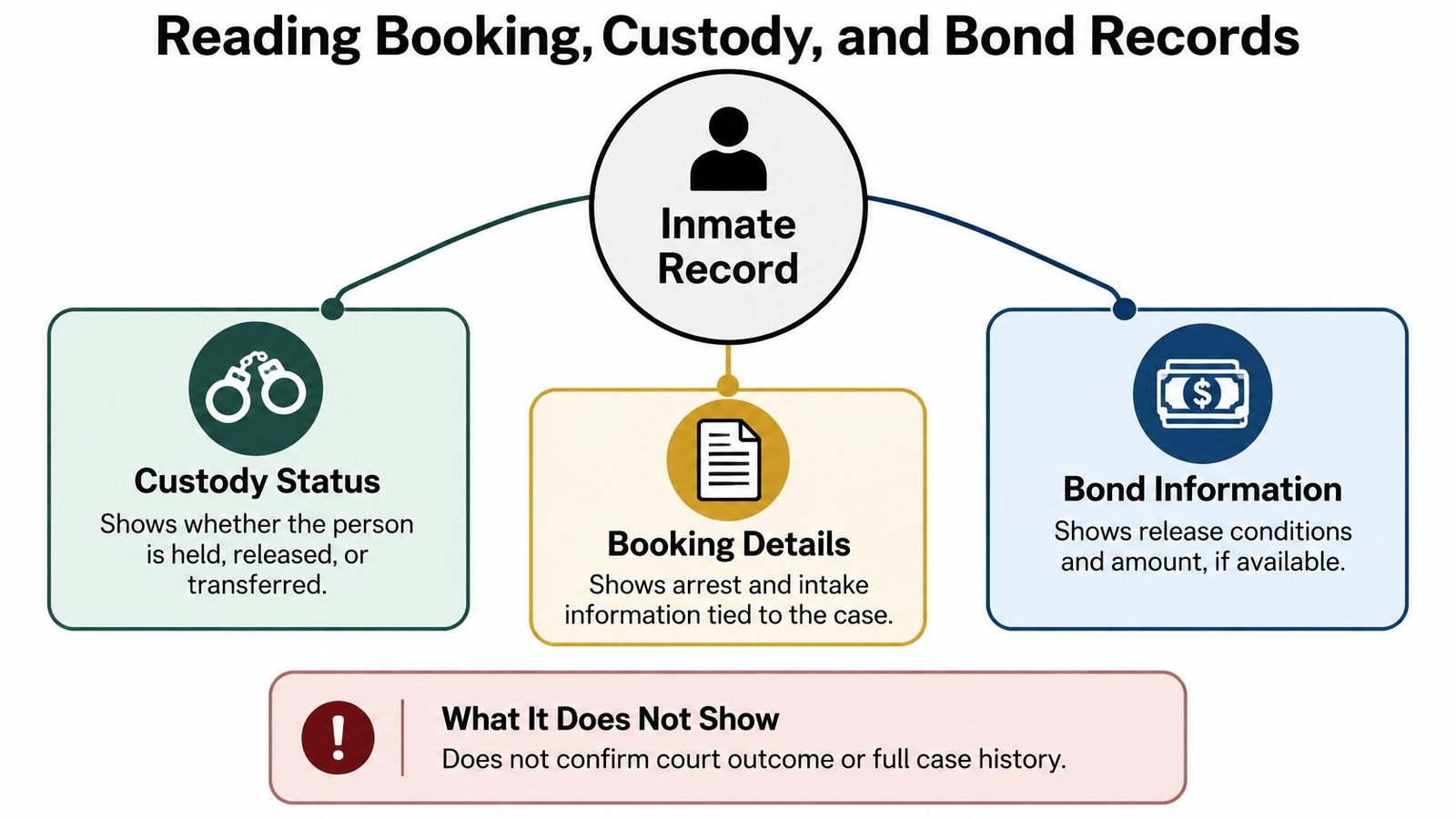
Custody and booking information
Use custody information to identify what the listing reports about detention status. Don't invent a meaning for an unfamiliar label or assume a general definition applies to the county's system.
Booking details concern intake information associated with the record. They aren't the same thing as a complete court history. A family member who sees a booking entry should still ask which agency can confirm the person's present location.
The Arapahoe County jail booking guide can provide supplementary orientation. For a disputed date, uncertain status, or unclear identifier, return to the detention authority.
Charges and court information
Read a listed charge as an allegation associated with the record, not as proof of guilt or a final court outcome. If your question concerns what the court has decided, seek confirmation from the relevant court rather than trying to reconstruct the answer from a jail listing.
Keep separate notes for:
- Custody information: What the jail reports about detention.
- Case information: What the judicial system reports about proceedings.
- Bond or payment information: What the authorized agency confirms is applicable.
This separation helps when one source shows information that another doesn't. Don't assume the systems are synchronized or interpret a missing entry as a legal conclusion.
Bond amount and release requirements
The county states that bond is intended to assure a defendant's court appearance and is set according to a court-approved schedule; when posting directly with the facility, it requires the full bond amount and accepts certified bank checks or money orders at any time of day, according to its official bond instructions.
Those instructions also recommend arranging an appointment before arrival. Confirm the current bond type, amount, payment requirements, and applicable release conditions before obtaining a payment instrument.
A displayed bond amount is a detail to verify, not a promise that payment will produce an immediate release.
Ask whether the information applies to the current booking and whether there are other requirements you need to understand. Don't estimate release eligibility from the charge name or assume that completing a payment resolves every custody question.
Why an Inmate May Not Appear in Results
An empty result doesn't prove release. It tells you only that the search you just performed didn't locate a matching entry.
When you're worried, repeatedly entering the same name can feel productive. A deliberate troubleshooting sequence gives you more useful next steps.
Immediately after an unsuccessful search
The county's official inmate-information page permits full or partial-name searches and directs users who can't locate someone to call 720-874-3500, but it doesn't clearly explain booking delays, transfers, spelling variations, or arrests involving municipal facilities.
Start with corrections you can make yourself. Retry using a partial surname, check your spelling, and compare the name against a reliable personal document if one is available.
Then consider whether the person may still be undergoing booking. This is a possibility to investigate, not a county-confirmed explanation for every missing result. There's no verified universal waiting interval that makes a later search conclusive.
If the result remains missing
Move from repeating the search to checking jurisdiction:
- Confirm the arresting agency: Ask which agency made the arrest and where it took the person.
- Ask about destination: An arrest in Arapahoe County doesn't automatically establish booking into its detention center.
- Investigate movement: Ask whether a transfer or another facility could explain the missing entry.
- Use the county's telephone direction: Follow the official inquiry route rather than guessing from third-party pages.
The supplementary inmate locator resource may help you explore additional lookup options. Verify the data owner before relying on any result.
This video is an additional viewing resource; use county confirmation for operational decisions.
Before paying or traveling
Don't turn elapsed time into proof. A historical report on Arapahoe County jail crowding provides background on facility pressures, but it doesn't establish today's database-update schedule or a particular person's processing time.
If you're still uncertain, record the unanswered question and the agency responsible for resolving it. The useful conclusion is location not yet verified, not released, missing, or definitely in another jail.
Visitation, Medical Needs, and Release Planning
Finding the person is the beginning of practical coordination. Before creating accounts, sharing health information, or arranging transportation, confirm that each next step applies to the facility where the person is housed.
Set up the correct visitation account
The county's virtual visitation system applies only to people housed at the Arapahoe County Detention Center. Its official visitation instructions describe visits by phone, tablet, or computer through ViaPath/GTL, require visitors to confirm they're at least 18 by entering their date of birth, and list 1-866-516-0115 for account problems.
Follow the county's pathway to create an account, select the incarcerated person, and schedule the visit. If you can't select the person, distinguish an account problem from an unresolved custody question before deciding whom to contact.
- Account access problem: Use the visitation provider's support channel.
- Uncertain housing location: Return to the detention inquiry route.
- Visit rules question: Check the current facility instructions before scheduling.
The jail-rules resource can help you organize questions, but the receiving facility's current directions should determine your arrangements.
Prepare medical information privately
A public inmate lookup isn't the place to resolve confidential medical questions. If the detained person needs medication, behavioral-health support, or a disability accommodation, ask the detention facility which staff or process handles that concern.
Prepare a private note containing the medication names, prescribing clinician, pharmacy information, allergies, and the concern you need staff to understand. Don't post that material in public comments or send it to an unverified search website.
Care-planning reminder: Locate the person through the public information channel, then ask for the appropriate private channel for sensitive health information.
If a concern is urgent, say that clearly when contacting the facility and ask how to reach the appropriate staff. Don't assume a completed lookup or a message sent through an unrelated account has notified medical personnel.
Coordinate the practical handoff
Ask who will arrange transportation, who can receive a call, and what the person may need after release. Keep those plans flexible until the facility confirms the relevant instructions.
A family contact can maintain a private task list covering pickup, access to prescribed care, suitable clothing, and a safe destination. This approach keeps the lookup from becoming an isolated task while avoiding promises about visitation availability, treatment decisions, or release timing.
Comparing Self-Search With Professional Bail Help
Choose assistance according to the task you can't comfortably complete yourself. Finding a record, arranging direct payment, and applying for a surety bond are different activities, and outside help doesn't remove the need for official confirmation.
The available paths differ in how much coordination you handle personally.
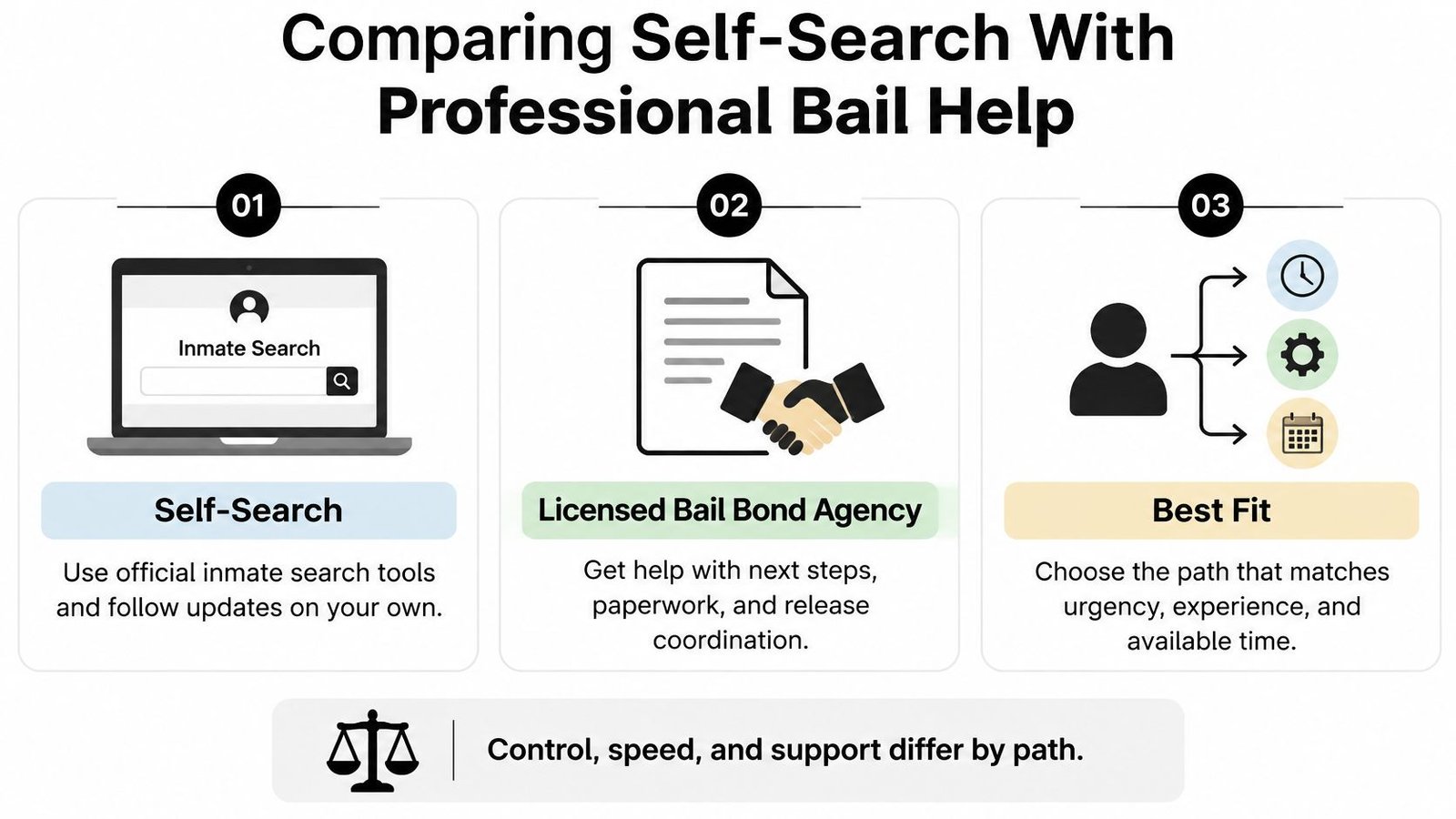
Compare the work involved
| Path | What you handle | What to confirm before proceeding |
|---|---|---|
| Official self-search | Lookup, identity checks, and follow-up calls | Correct person and current detention authority |
| Direct posting | Facility instructions, payment preparation, and any necessary trip | Applicable bond and accepted payment procedure |
| Surety agency | Application, contract review, and requested supporting information | Eligibility, premium, cosigner obligations, and posting arrangements |
Self-search may be sufficient when you only need location information. Direct posting may suit someone who intends to follow the county's payment process without an agency.
Remote relatives may prefer an agency that supports electronic paperwork. That can reduce the need to attend to documents in person, but it doesn't guarantee a particular release time.
Where agency assistance fits
Express Bail Bonds is a licensed Colorado bail bond agency based in Denver that serves detention facilities statewide and has operated since 1988; its published service information describes electronic applications, payments, and contract documents.
The agency describes a standard Colorado premium of 15%, a 10% rate for bonds over $5,000 with an approved cosigner, and 24/7 call or text availability at 720-984-2245, according to its Centennial bail-bond service information. It does not post cash-only bonds. Confirm the quote, eligibility, and contractual obligations for the individual situation before signing.
Readers coordinating a case in a neighboring jurisdiction can consult the Jefferson County and Golden service page. Location-specific information matters because you should first establish which facility and case you're dealing with.
Ask for defined help, not a promised outcome
A good initial conversation should clarify what the provider needs from you and what it can handle. Ask about written terms, payment, cosigner responsibilities, and what remains subject to detention processing.
The guide to bonding someone out can help you prepare that discussion. For families coordinating with a law office, VirtualLegal's explanation of legal intake specialists is also relevant to organizing information for the initial legal-service conversation, though it isn't a jail lookup or bail service.
Choose help that addresses your actual barrier, whether that's uncertainty about paperwork, distance, or understanding the next step. Don't mistake assistance with coordination for authority over the jail's decisions.
Quick Reference and Next Steps to Take Today
Use a single working note to keep confirmed details separate from assumptions. Give the person making calls access to the same note so relatives don't unintentionally provide conflicting information.
Collect before you search
- Legal identity: Write the full name as it appears on reliable documentation.
- Alternate spelling: Note relevant surname variations, spacing, or hyphenation.
- Additional identifiers: Gather date of birth, booking number if known, and the reported arrest date.
- Arrest context: Identify the arresting agency and the source of your information.
- Your contact details: Decide who will receive updates and coordinate follow-up.
Keep sensitive identifiers private. You may need them for verification, but that doesn't mean they belong in public messages or social-media posts.
Keep the right references within reach
Use the official contact table above as your call sheet rather than copying telephone numbers from an unfamiliar page. Before dialing, label your question as a detention, records, visitation-account, or court matter.
| Question to resolve | Information to record |
|---|---|
| Does the record belong to this person? | Matching identifiers and any discrepancy |
| Is the location confirmed? | Responsible agency and confirmation time |
| Is the bond information applicable? | Current type, amount, and source of confirmation |
| What remains unresolved? | Exact question and next office to contact |
| What action is authorized? | Instructions received before payment or travel |
Don't record an inference as a confirmed answer. If the person who answers can't resolve your question, note the referral rather than assuming the question has been settled.
Use focused questions when information is unclear
You can keep a conversation brief without leaving out the important issue:
- Booking uncertainty: Ask whether the person has completed intake or whether another agency should be contacted.
- Identity mismatch: Explain which identifier conflicts with your information.
- Location uncertainty: Ask which authority can verify where the person is held.
- Payment uncertainty: Request current instructions before obtaining a payment instrument.
- Care concern: Ask for the appropriate private channel to communicate urgent health information.
After the call, update your note with what was confirmed. Keep older information identifiable as older information rather than overwriting it in a way that hides a change.
Assign the next action
Choose who will make the next inquiry, who will handle any application, and who will coordinate transportation if needed. Set a follow-up point based on the instructions you receive rather than an assumed database-refresh schedule.
If custody and the applicable bond are confirmed, decide whether you'll proceed through the facility directly or ask an agency about a surety option. Review written obligations before paying or signing, and keep copies of the documents you receive.
You don't have to resolve every uncertainty at once. The immediate objective is a verified identity, a confirmed location, and a clearly assigned next action.
Express Bail Bonds offers surety-bond assistance and electronic applications, payments, and contract documents for families moving from a confirmed inmate search to release planning. Call or text the agency using the contact information above, or visit Express Bail Bonds to discuss the applicable bond, paperwork, and next steps before making arrangements.