
That phone call usually comes in the worst moment. Late at night, during work, while you're putting kids to bed, or from a number you don't recognize. A family member says they were arrested, or a friend texts that someone has been taken to jail in Arapahoe County, and suddenly you're trying to figure out where they are, what happens next, and how long any of this will take.
The hardest part is the first few hours. Information is incomplete, timelines are fuzzy, and the person you care about may still be moving through intake with no way to give you updates. If you're dealing with arapahoe county jail booking, the best approach is simple. Slow down, confirm where they are, find out whether a bond has been set, and avoid making assumptions based on outdated advice.
Navigating the First Hours After an Arrest in Arapahoe County
If the arrest happened in or around Centennial or elsewhere in the county, the person is often taken to the Arapahoe County Detention Facility at 7375 South Potomac Street in Centennial, Colorado. Families often expect immediate answers once someone arrives there. That usually isn't how it goes.

The first move is to stop chasing rumors. A person may be in transit, in line for intake, being medically screened, or waiting for their information to appear in the jail system. That lag creates a lot of panic. It doesn't always mean anything is wrong.
What to do first
- Get the legal name right. Nicknames cause problems fast. Use the full legal name if you have it.
- Confirm the arresting agency if possible. City police, deputies, and other agencies may all book into county jail, but the route there can differ.
- Wait for the booking record to appear. If you search too early, you may not find them yet.
- Keep your phone close. If bond information becomes available, decisions often need to happen quickly.
Practical rule: The first useful answer usually comes from the jail record, not from social media, not from hearsay, and not from someone's guess about "how it usually works."
If you're trying to understand the broader sequence after an arrest, this guide on what happens after you get arrested helps put the early steps in plain language.
What works in these first hours is calm, accurate information. What doesn't work is showing up at the jail expecting immediate access, assuming release will happen quickly, or relying on an old timeline from a different county.
How to Find Someone in the Arapahoe County Jail
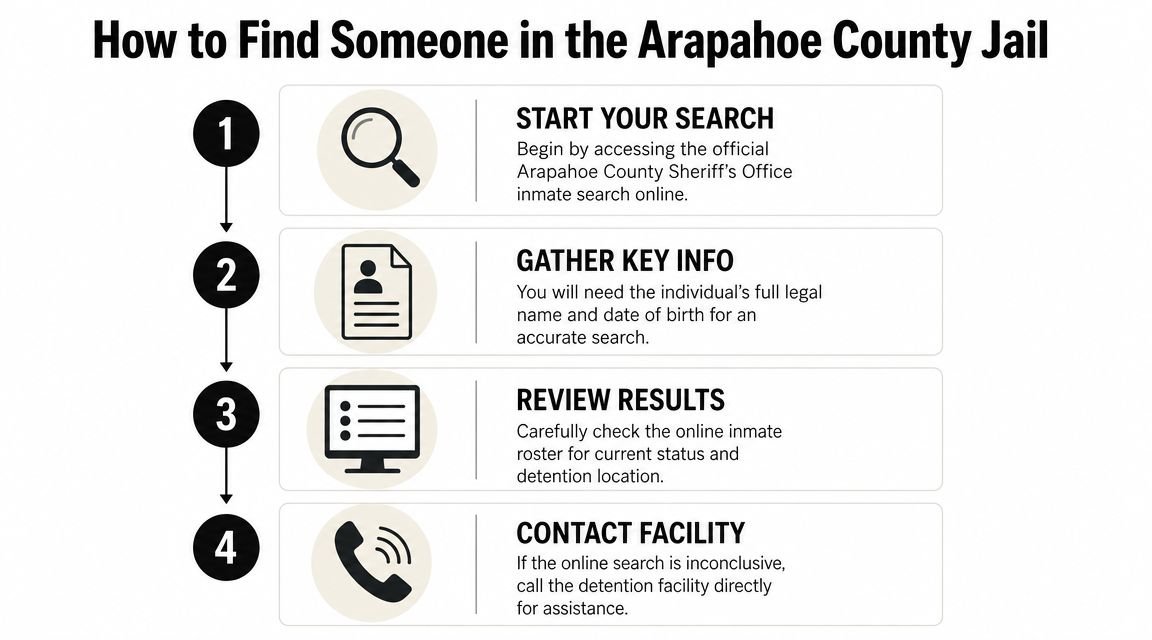
The fastest public way to locate someone is the county's online booking system. The Arapahoe County Detention Facility runs 24/7, and its online portal shows booking photos, charges, bond amounts, release dates, and related details in real time through the county booking site, according to the Arapahoe County booking records portal. That matters because the jail has a maximum capacity of 1,400 inmates and an average daily population of 1,700 offenders, so phone lines and front-desk answers aren't always the quickest path through the noise.
Use the online roster first
Start with the official inmate search system, not a third-party arrest site. Third-party pages are often stale, incomplete, or stripped of the details you need.
When the record is live, you can usually review key items such as:
- Booking photo
- Charges filed at booking
- Bond amount, if one has been entered
- Release date, if the person has already been processed out
- Upcoming court information when available
That one screen often tells you whether you're dealing with a simple delay, a bond issue, or a more serious hold.
Search carefully
A clean search usually starts with the person's legal name. If you know their date of birth, keep it handy. Small errors matter. Misspelled last names, hyphenated names, suffixes, and middle names can throw people off.
Here are the common search problems I see most often:
- The arrest was recent. If transport or intake is still underway, the name may not appear yet.
- The name was entered differently. Try common spelling variations if you're confident you're in the right county.
- The person was booked under a full legal name. A nickname won't help.
- The record is there, but you missed the bond field. Slow down and read the full listing.
Check the record twice before you act. Families sometimes focus on the charge line and miss the bond amount or custody status.
If the name isn't showing yet
Don't assume they were released. Don't assume they were moved to another jail. Early in arapahoe county jail booking, there can be a delay between physical arrival and public visibility in the online system.
Use this sequence:
| Step | What to do | Why it helps |
|---|---|---|
| First pass | Search the exact legal name | Catches the most straightforward listing |
| Second pass | Try alternate spacing or spelling | Booking data entry can vary |
| Third pass | Wait and search again later | Intake may still be active |
| Final step | Call the facility at 720-874-3500 | Useful when the portal is still inconclusive |
If you need a broader walkthrough for statewide search methods, this article on how to find someone arrested is useful when the first search doesn't give you a clean answer.
What works is patience plus exact information. What doesn't work is refreshing random websites and assuming no result means no booking.
The Arapahoe County Jail Booking and Release Process Explained
Arapahoe County jail booking starts long before a family sees a bond amount online. Once the arresting officer transfers the person to the jail, deputies begin intake. Personal property is taken, logged, and stored for later return. Then the person moves deeper into the booking chain.

Outside expectations for the booking process usually break down. Families often imagine a quick photograph, a few forms, and a release decision. Inside the jail, the process is more layered than that.
What happens during intake
The booking process includes biometric scanning, fingerprinting, mugshots, demographic verification, medical screening, and then housing assignment, according to the Denver-area booking overview from At Bail. That same source notes an average processing time of 4 to 8 hours per inmate, with delays that can stretch to 12+ hours during peak arrest volumes.
The order matters. A person may be physically inside the facility but still not be ready for release because one stage hasn't cleared.
A typical path looks like this:
Arrival and property intake
Deputies take custody of personal belongings and inventory them.Identification procedures
Fingerprints and booking photos are collected as part of the official jail record.Record verification
Staff confirm identity data and compare it against law-enforcement databases.Medical review
Screening helps identify withdrawal concerns, mental-health issues, and immediate safety risks.Classification and housing
The jail decides where the person will be held based on charge level and other risk factors.
Why delays happen even when bond is possible
A family may learn that bond exists and assume release is close. Sometimes that's true. Sometimes the person still has to clear earlier booking steps before the jail can move them out.
At the jail level, delay usually comes from practical bottlenecks, not mystery. Intake volume rises. Medical review takes longer. Identity details need another check. A classification issue holds the file. None of that is visible from the outside, but all of it affects timing.
A bond isn't a magic switch. Posting bond starts the release process. It doesn't erase the jail's internal checklist.
The same Denver-area source notes that pre-submitting cosigner financials electronically can accelerate surety posting by 40%, which is one reason experienced handlers try to get paperwork in order early rather than waiting until every internal jail step is finished.
After bond is posted
Release isn't immediate just because payment or paperwork has been completed. Jail staff still have to confirm the bond, update the record, complete release checks, and physically process the person out. If the booking side is backed up, the release side often feels it too.
A few things help families avoid extra stress:
- Stay available by phone. Missing a paperwork or cosigner call can slow things down.
- Use matching information. Name mismatches create avoidable headaches.
- Ask about holds, not just bond. A person can have a bond amount and still face another release barrier.
- Don't promise a pickup time too early. Wait until release is in motion.
For a county-by-county look at timing expectations, this page on how long booking takes in jail helps families understand why the process so often takes longer than expected.
Understanding Your Bail and Bond Options
Once bond is set, the next question is usually financial. Families want to know whether they should pay the court directly, wait for a hearing, or use a bail bond company. The right answer depends on the type of bond and how much liquidity you can afford to tie up.
The three options families usually encounter
| Option | How it works | Main trade-off |
|---|---|---|
| Cash bond | Full bond amount is paid directly to the court or jail | Requires all funds upfront |
| Surety bond | A bail bond company posts the bond for a premium | Premium is a fee, not a refundable deposit |
| PR bond | Release is granted on a promise to appear | Not available in every case |
A personal recognizance bond, often called a PR bond, doesn't require the family to post cash or hire a surety company. If the court grants one, that can be the simplest path. But many people booked into county jail won't get that option at the start.
Cash bond versus surety bond
The most common decision is whether to pay the full amount in cash or use a surety bond.
With a cash bond, you come up with the entire amount yourself. That may sound attractive if you want to avoid a service fee, but large cash bonds can force families to drain savings, borrow from relatives, or sell assets under pressure.
With a surety bond, a licensed bail bond company posts the bond on the defendant's behalf for a premium. The trade-off is straightforward. You don't have to produce the full bond amount, but the premium is generally non-refundable.
When families are under stress, preserving cash matters. The strongest option isn't always the one that looks cheapest in the first ten minutes.
Colorado families also ask what happens to money after a case ends. While Florida procedure differs from Colorado practice, this plain-English piece on how bail money works in Florida is still helpful for understanding the basic difference between paying cash into the system and paying a bond premium to a surety company.
What works and what doesn't
What usually works is stepping back and asking three practical questions:
- Can you comfortably part with the full amount right now?
- Do you need remote processing because cosigners are out of town?
- Will expert help save time and reduce mistakes in paperwork?
What usually doesn't work is emptying an account just to avoid a premium, then finding out there were holds, delays, or court conditions that made the cash scramble feel even worse.
If you want a deeper comparison of release types, this overview of the different types of bail in Colorado gives a useful breakdown without legal jargon.
How Express Bail Bonds Accelerates the Release Process
When a family chooses a surety bond, speed usually depends on two things. First, how quickly the paperwork gets completed. Second, whether the agency can handle the case without sending everyone on a long drive and a long wait.

A well-run bail process doesn't feel dramatic. It feels organized. The best agencies collect the needed information, verify the cosigner, complete signatures electronically, and move the bond into the jail system without making the family stand in line outside a detention center.
What the process usually looks like
For Arapahoe County cases, an efficient surety process often includes:
- Remote application handling so the family can start from home
- Electronic contracts and signatures instead of in-person document chasing
- Electronic payment options when approved
- Direct bond posting coordination with the jail
- Phone and text communication so updates don't get lost
That matters most when cosigners are working, caring for children, out of state, or too shaken to find their way through a county building in the middle of the night.
The fee structure people ask about most
Express Bail Bonds states that Colorado's standard premium is 15%, and for bonds over $5,000 they often secure 10% with an approved cosigner, as described on the Express Bail Bonds website. The company specializes in surety bonds, not cash-only bonds.
That's an important distinction. If a court or jail requires a cash-only bond, a surety agency isn't the answer. But when a surety bond is allowed, remote processing can spare families a lot of wasted motion.
A few practical advantages stand out:
- You don't need to bring the full bond amount in cash
- You may be able to complete everything from your phone
- The agency handles the posting side
- You avoid unnecessary trips and lobby waiting
Good bail work is mostly logistics. Fast answers, correct documents, and no avoidable backtracking.
When local knowledge helps
County procedure isn't identical from one jail to another. A team that handles Arapahoe regularly will know the common pain points, the booking rhythms, and the paperwork issues that trip people up when they're trying to rush.
If the case is in Centennial, the page for Centennial bail bond help is the most direct fit. If you're trying to compare nearby counties because an arrest happened outside Arapahoe, the Jefferson County Golden bail bonds page and the county-specific Arapahoe County bail bonds page help narrow down where to start.
For people who want to verify reputation before making a call, these public business profiles for Express Bail Bonds reviews and additional local feedback can help.
Common Issues and Expert Answers
The most stressful problems usually aren't basic. They're the exceptions, the unexplained delays, and the situations where the jail record exists but release still isn't happening.
Why is booking taking so long
Older articles often suggest a short, predictable intake window. That's not always realistic anymore. A recent report highlighted overcrowding concerns in Arapahoe County, noting an 18% year-over-year surge in inmate population and average booking wait times of 12 to 18 hours, which is far above the older 4 to 6 hour timeline still repeated in outdated guides, according to this report on overcrowding-related booking delays.
That means a long wait doesn't automatically signal a special problem with your loved one's case. It may reflect the current booking load.
What if there is a no-bond hold
A no-bond hold changes the conversation. In that situation, the issue usually isn't speed of payment. It's legal eligibility for release. Holds can come from another case, another county, a probation matter, or a court restriction. When that happens, the right next call may be to defense counsel rather than a payment source.
Can I talk to them during booking
Usually not right away. During intake, access is limited and communication can be delayed. Families should expect silence early on. That's frustrating, but it's normal.
What happens to personal property
The jail typically inventories and stores personal property during intake, then returns it according to jail procedure after release. If you're trying to recover medication, keys, or a phone, ask specifically about property rules rather than assuming those items can be picked up immediately.
Why do professionals sometimes move things faster
Because they know where delays usually happen. A low-risk booking can still sit in a crowded system. A missing document can add more time than families expect. An experienced bail agent doesn't control the jail, but they often know how to keep paperwork clean, follow up in the right order, and avoid mistakes that cost hours.
The biggest myth in arapahoe county jail booking is that everyone moves through the same timeline. They don't.
If you need immediate help with an Arapahoe County release, Express Bail Bonds is available 24/7 to guide you through surety bond options, remote paperwork, and the fastest practical next steps.