
You get a call, or a text, and the message is short. Someone you care about was arrested in Colorado. You try searching online right away, nothing shows up, and now you're wondering if you have the wrong county, the wrong spelling, or the wrong information entirely.
That reaction is normal. The hard part is that online search failure doesn't always mean your person isn't in custody. It often means you're searching during the worst window possible, right after booking, when public systems haven't caught up yet.
Families run into this constantly. A loved one is picked up at night, moved through intake, and by morning they still don't appear in a public inmate locator tool. That gap has a name. The Temporal Blackout. According to the National Institute of Corrections resource on finding someone who is incarcerated, 73% of the U.S. incarcerated population is in local jails, and families in Colorado can face a 24 to 72 hour blackout before a local jail updates its public system.
If you're in that spot right now, don't assume the trail is cold. It usually isn't. You just need the right order of operations.
Your First Step When Someone Is Arrested in Colorado
The first thing to do is slow the process down and gather the basics. Panic makes people jump straight to broad statewide tools, but recent arrests in Colorado usually start at the local level, not the statewide one.
Start with what you know
Write down every detail you have before you search:
- Full legal name as it appears on an ID
- Date of birth if you know it
- Approximate arrest location such as Denver, Lakewood, Golden, Centennial, or Aurora
- Time of arrest or last contact
- Possible arresting agency if anyone mentioned police, sheriff, or state patrol
That list matters because small mistakes cause big delays. A nickname, missing middle name, or wrong county can send you in circles.
Practical rule: If the arrest happened recently and the online search is blank, the problem is often timing, not your effort.
Don't trust one failed search
Colorado families often search one jail roster, get “no results,” and assume the person was released or transferred. That's not a safe assumption. Booking, classification, transport, and public posting don't always happen at the same speed.
If your loved one was arrested in Jefferson County, they may be processed differently than someone arrested in Arapahoe County. City arrests can also lead to county detention, which adds another layer of confusion. During that delay, calling the detention center's booking desk is often more useful than refreshing a public page.
A practical first move is to review a what to do when arrested checklist for Colorado families, then start narrowing down the county where the person is most likely being held.
What works in the first few hours
In the first hours after an arrest, the most reliable approach is usually:
- Identify the likely county
- Search that county's jail roster
- Call the jail if the online result is empty
- Keep the person's full name and date of birth in front of you
- Be ready for a delayed public listing
What doesn't work well is bouncing between random national search tools and hoping one catches a fresh arrest. For local custody in Colorado, direct county-level checking is usually the fastest path.
Choosing the Right Colorado Inmate Search Tool
Not every inmate locator tool does the same job. In Colorado, the right choice depends on where the person is in the system. Recent arrest, county jail. Convicted and serving time in state prison, DOC search. Unsure where they landed, VINE may help.
Three tools, three jobs
The first mistake people make is treating all inmate searches as one database. They aren't. Public systems are split by jurisdiction and purpose.
According to the government documents guide to prisoner databases, 48 states and the District of Columbia offer online inmate search systems, but only 15 states provide real-time custody updates. That's why a county-first approach in Colorado is often more effective when the arrest happened recently.
Here's the practical comparison.
Colorado Inmate Locator Tool Comparison
| Tool Type | Best For | Update Frequency | Information Provided |
|---|---|---|---|
| County Jail Roster | Recent arrests, short-term detention, pretrial custody | Varies by county | Booking status, charges, bond information, housing details, court information when available |
| Colorado DOC Offender Search | People serving felony sentences in state prison | Varies | Prison location, offender record, custody-related information |
| VINELink | Broad custody check and notifications when county is unclear | Varies by participating agency | Custody status and notification options |
When each one makes sense
County rosters are where most Colorado families should start. If someone was arrested last night in Golden, Lakewood, Littleton, Centennial, Greeley, or Denver, county detention is the likely first stop.
Colorado DOC is not a recent-arrest tool. It's for people already in the state prison system after conviction and sentencing.
VINELink can help when the family isn't sure which county booked the person, or when they need status alerts rather than a one-time search.
Search by process, not by brand. You're not looking for the most popular tool. You're looking for the database that matches the person's current stage in custody.
A broader walkthrough on how to find someone arrested in Colorado can help if you only know the city, not the detention facility.
Common missteps
Families lose time when they:
- Use DOC too early and search state prison records for someone arrested the same day
- Rely on one spelling when a name may be entered with a suffix, hyphen, or full middle name
- Ignore county geography and search the wrong detention system
- Expect identical update speed across every jail roster
The practical trade-off is simple. County systems are narrow but timely for local bookings. State systems are broader in prison scope but wrong for fresh jail arrests. VINELink is useful, but it isn't a substitute for checking the likely county first.
How to Search Local County Jail Rosters
For a recent arrest, local county rosters are usually the first screen worth opening.

Use full identifying information
A lot of online guides tell people to type in a name and hit search. That's where many searches break down. According to the Virginia DOC locator guidance referenced here, 68% of local jail systems require more than just a name, often needing a birthdate or ID number. That's one of the main reasons families get empty results.
For a county search, gather:
- Full legal name
- Date of birth
- Any booking or case number
- Likely county of arrest
If you only have a nickname or partial name, your odds drop fast. Local systems tend to be stricter than federal or state prison tools.
Jefferson County example
If the arrest likely happened in Golden, Lakewood, Arvada, Wheat Ridge, or another city in Jefferson County, start with the county jail roster. Use the person's legal name exactly as you believe it appears on their ID. If the first search fails, try small variations like a full first name instead of a shortened version.
What you're looking for is not just the name. You want the booking record that confirms:
- Booking number
- Current custody status
- Filed charges
- Bond amount
- Court setting if posted
If your family is specifically trying to narrow down a Jefferson County booking path, the Jefferson and neighboring county inmate search help page is a useful reference point for understanding how these local searches are usually structured.
Arapahoe County and Centennial
If the arrest happened around Centennial, Aurora, Englewood, or nearby areas, Arapahoe County may be the better place to check first. The same search rules apply. Full name plus date of birth gives you a much better shot than name alone.
One practical issue I've seen over and over is families searching the city they recognize instead of the county that books the person. Someone arrested in a city police contact can still end up in county custody.
This short video gives a helpful visual sense of how custody lookup and next-step decisions usually work.
If the roster says no results
Don't stop there. Try this checklist:
- Check spelling carefully. Jr., Sr., hyphenated names, and full middle names matter.
- Add the date of birth if you didn't use it the first time.
- Search the neighboring county if the arrest happened near a county line.
- Call the booking desk and ask whether the person has been booked but not yet posted publicly.
A blank online result in the first day after arrest often means the database is late, not that the person vanished.
That's the core reality families miss when they rely on a single inmate locator tool and expect instant visibility.
Using the Statewide DOC and VINELink Systems
If local county checking hasn't turned up a result and enough time has passed, statewide systems become more useful. These tools serve a different purpose than county rosters, and they're most effective when you understand that difference before you search.
Colorado DOC is for prison custody
The Colorado Department of Corrections offender search is for people in the state prison system. That usually means felony conviction and post-sentencing custody, not a fresh booking from the night before.
If your local search is blank, DOC can still matter in one situation. You may be looking for someone you haven't heard from in a while and you don't know whether they're in jail or prison. In that case, a DOC check can rule in or rule out state custody quickly.
VINELink is useful when county is uncertain
VINELink works differently. It's commonly used as a notification system, but it can also help when the family doesn't know which participating agency has custody.
Use VINELink when:
- You're unsure which county booked the person
- You need custody alerts
- You're checking across more than one jurisdiction
DOC is narrower but specific. VINE is broader but depends on participating records and update timing. Neither replaces a direct call when urgency is high.
If the county search fails and the need is immediate, pick up the phone. Public portals are tools, not guarantees.
Understanding Search Results and What to Do Next
Once you find the person, the page itself can still be confusing. Jail records are built for recordkeeping, not for calming families down. The key is to focus on the entries that tell you where the case stands right now.
What the main fields usually mean
Here's the plain-English version of the terms that matter most:
Booking Number
This is the unique ID for that specific arrest event. If you call the jail or a bondsman, this number helps them find the exact record faster.Charges
These are the alleged offenses tied to the arrest. They may be listed in legal shorthand that isn't easy to read at first glance.Bond Amount
This tells you whether release may be possible through bond and how much the court has set.Next Court Date
This is the scheduled appearance tied to the case at that stage.
Read the record for action, not just information
Families sometimes focus on the charge description first because it feels most important emotionally. For release logistics, the more urgent fields are usually the booking number, the bond information, and custody status.
If you're also trying to understand the paper trail around the arrest itself, this overview of Colorado arrest records and what they typically show can help connect the jail entry to the broader record.
If you still can't find them
Use a short troubleshooting pass before you assume the search is over:
- Try alternate name formats such as full first name, middle initial, or suffix
- Confirm the county rather than the city
- Call the detention center directly and ask if the person has been booked but not posted online
- Ask whether the person was transferred to a different holding facility
A failed search can mean wrong county, delayed posting, or stricter search requirements. It doesn't automatically mean release.
You Found Them Now Secure Their Release Fast
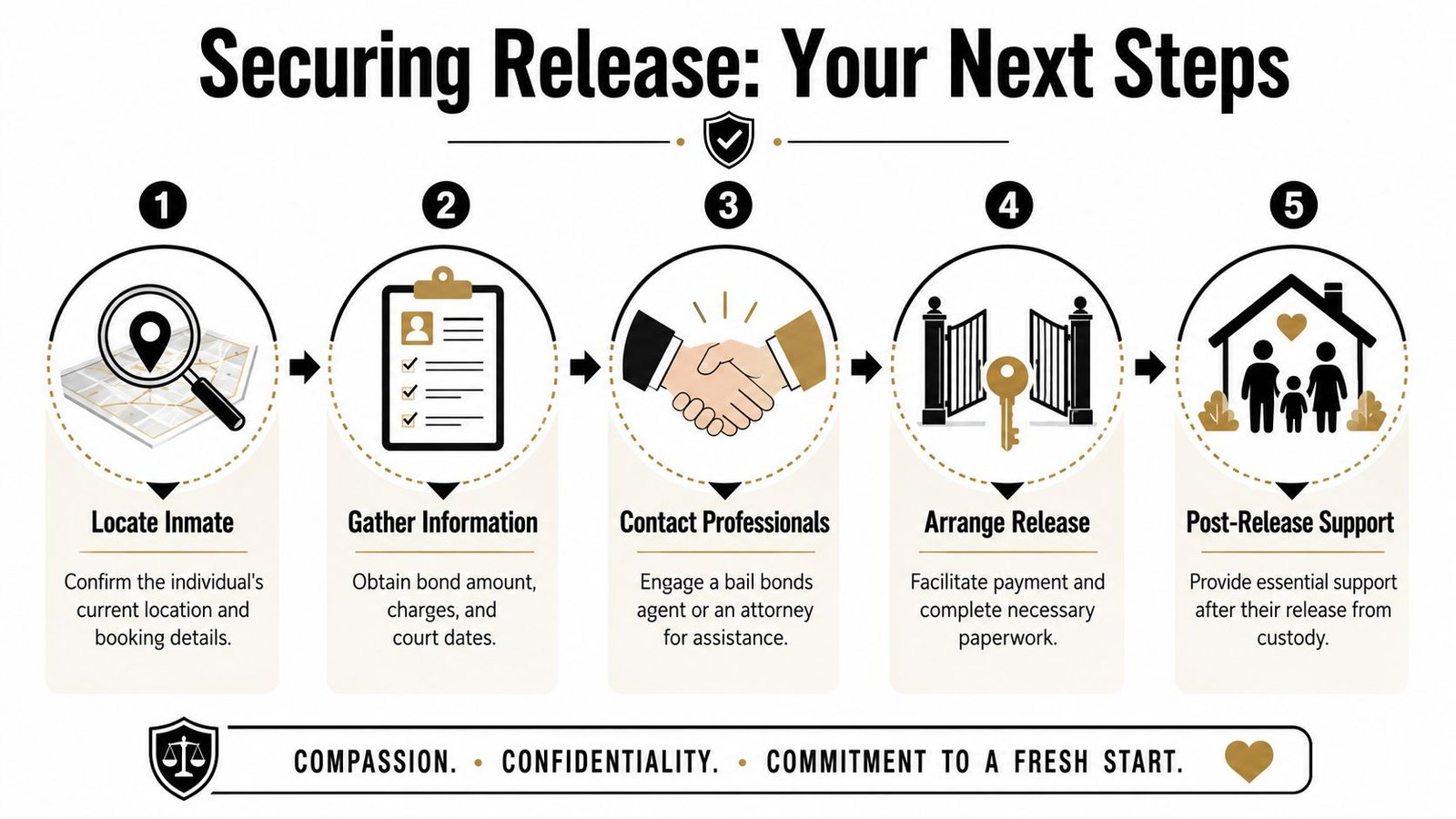
Once you have the booking record, the next question is practical. How do you get them out as quickly as possible?
For many Colorado families, the answer is a surety bond. Instead of paying the full bail amount directly to the court in cash, a bail bond agent posts the bond on the defendant's behalf. In Colorado, bail bond premiums are legally capped at 15% of the total bail amount, and many agencies can offer a 10% rate for bonds of $5,000 or more with an approved co-signer, as described in this Colorado bail premium overview.
What you need before calling for a bond
Have these details ready:
- The person's full legal name
- Booking number
- Jail location
- Bond amount
- Charges, if listed
- Co-signer information
That shortens the process. It also reduces mistakes when the jail has multiple people with similar names.
What works fastest in practice
A surety bond usually moves faster than scrambling to assemble full cash bail, especially when family members are in different cities or states. Some agencies handle applications, signatures, and payment electronically, which helps when no one can get to the jail in person right away.
One practical option is Express Bail Bonds, which handles Colorado surety bonds statewide and processes documents electronically. If the bond qualifies and there's an approved co-signer, the lower premium structure may apply.
If you're comparing how bail money works in another state or just want a plain-language outside explanation, this guide to Florida bail after arrest is a useful companion read because it breaks down what families often misunderstand about bail payments and what happens afterward.
The fastest release cases usually have one thing in common. The family has the booking details in hand before they start making calls.
If the bond is active and the jail is ready to accept it, the path is usually straightforward. Confirm the facility, confirm the amount, line up the co-signer, and move on the paperwork right away.
For county-specific help, Jefferson County in Golden and Arapahoe County in Centennial are two places families often need to act quickly after finding a booking record.
When you're trying to find someone in custody and every hour matters, clear information helps more than guesswork. Express Bail Bonds can help you sort out the jail location, review the bond details you found, and move the release process forward so your family knows what happens next.