
80138 is centered on Parker, Colorado, and it's a large suburban ZIP that reaches into Douglas County, with some overlap into Aurora and Elbert County. If somebody you care about was arrested there, stop worrying about the map and focus on the jail, the court, and the bond.
A family call after an arrest usually starts the same way. Someone is scared, someone else is trying to figure out where the person is being held, and every wrong guess burns time. In the 80138 zip code, that time matters because the county line can change the facility, the court, and the release process.
Understanding the 80138 Zip Code Area
When a family member calls from a detention center and says the arrest happened in 80138, the first job is simple, figure out where that address sits. The ZIP is centered on Parker, Colorado, and it's not a tiny pocket of suburbia. It reaches across a broad area that includes parts of Douglas County, some Aurora addresses, and even some Elbert County addresses, so ZIP code shortcuts can send you in the wrong direction fast. That's why a map alone is never enough.
The practical question is always this, where is the person now, and which county is handling the case? A Parker address, an Aurora address, and an Elbert County address don't move through the same system. If you guess wrong, you can end up calling the wrong jail, contacting the wrong court, or asking for release details from the wrong clerk.
A family dealing with this needs clean information, not theory. Start with the exact address, then match it to the correct county and detention facility. If the address is tied to a different area nearby, a page like the 80138-adjacent 80231 zip code guide can help you compare how ZIP boundaries and local jurisdiction often diverge.
Practical rule: never treat a ZIP code like a county line. For arrests, the address and the holding facility matter more than the mailing zone.
If you're in the middle of a crisis and still hunting for a contact method, don't wait until you've sorted every detail. Keep the family focused on the arrest location, the booking facility, and the bond status. Even something as routine as sending documents by fax can slow people down if they don't know the right format, so a practical reference like the 2026 guide to fax numbers can save a few frustrating minutes when paperwork has to move quickly.
Geography and Demographics of 80138
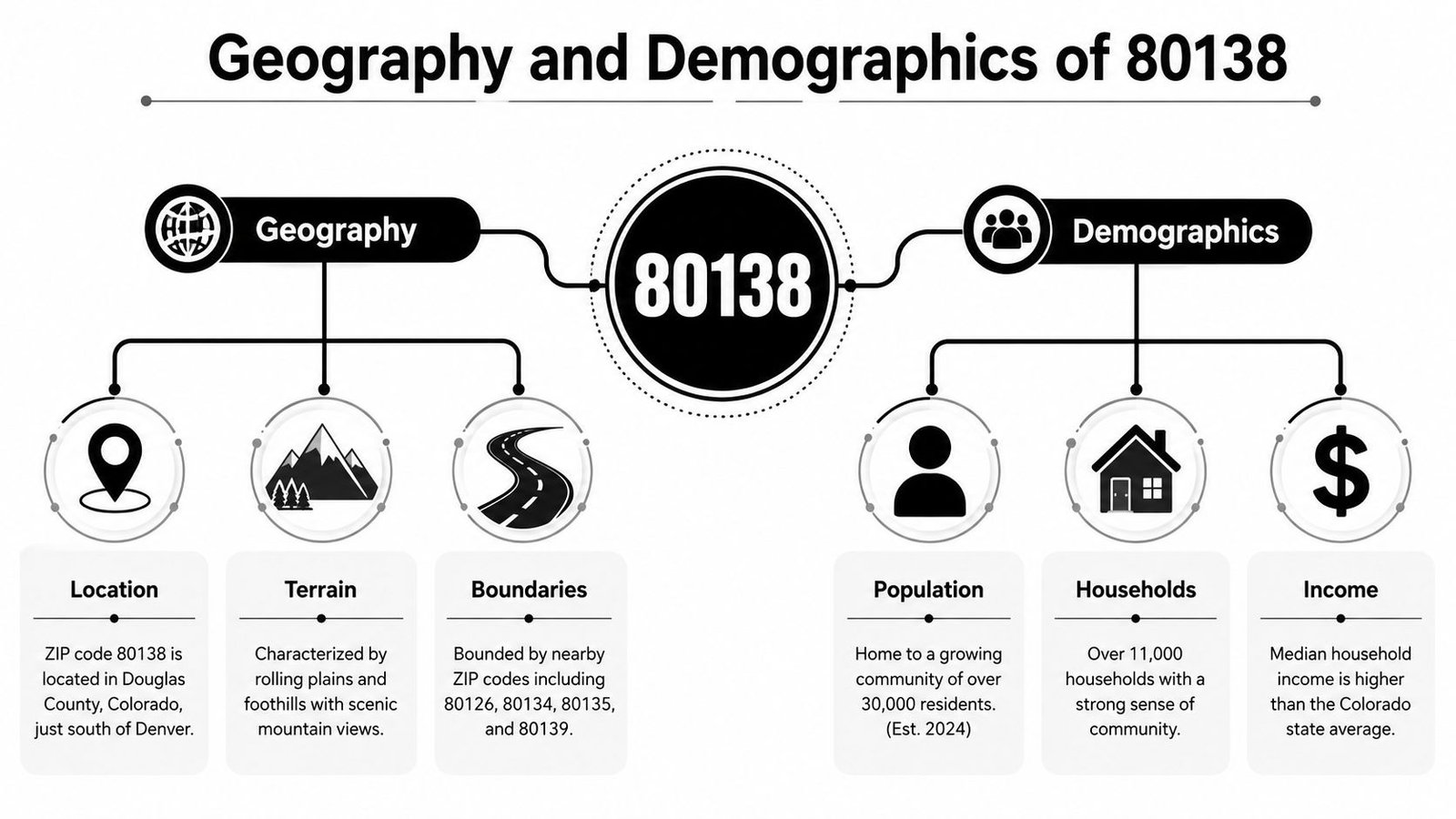
The geography of 80138 matters because it covers a wide suburban area, not a tight city center. One dataset places the ZIP at 61.92 square miles with 34,337 residents, while another reports 36,113 residents and 549 people per square mile. Those differences come from source year and methodology, but they point to the same practical reality, this is a large Colorado ZIP with a lot of ground to cover. (United States Zip Codes)
What the housing picture tells you
The area is built around stable neighborhoods. Current demographic profiles estimate 12,878 to 13,214 housing units, and about 76.2% of them are owner-occupied, which shows a steady suburban market rather than a high-turnover rental area. That matters in an arrest situation because families in owner-heavy neighborhoods often need fast, local help close to home, not a broad citywide search. (Simplemaps)
The income and education profile is also strong. Median household income is reported at $142,397 to $150,418, per-capita income at about $62,308 to $63,787, and median home value at about $679,785 to $690,246. About 48.5% of residents have at least a college degree, and the median age is 39.8 years. That points to a working-age community with a lot of household responsibility, which means an arrest can cut straight into work schedules, childcare, and school pickups. (Colorado Hometown Locator)
Why that matters during an arrest
This isn't background trivia. A stable, affluent suburban ZIP usually means families are trying to coordinate work, childcare, transportation, and release logistics at the same time. Average household size is about 2.78 people, average family size about 3.00, and family households account for 9,729 of 12,878 total households, which shows how often one arrest disrupts an entire home. Roughly 30% of households make over $200,000 a year, and the area's diversity index is 46, so local needs can vary even within the same ZIP.
With a median age of 39.8 and 9,729 family households, an arrest here can throw a stable home off fast, so families need the correct jurisdiction and a fast release plan.
Healthcare access can matter too. Federal tools now let you check shortage designations by exact address, which is useful if the person in custody has medication needs or ongoing care concerns. In a fast-growing suburban area like this, broad ZIP-level averages can hide real access problems, so use an address-level search instead of guessing. (HRSA address tool)
For a nearby comparison, the 80016 zip code page shows how another Denver-area location can sit in a very different local context even when the emergency feels the same.
County Jurisdiction and Court Access in 80138
The county question is where families waste the most time. Most of 80138 falls under Douglas County, but the ZIP also overlaps into other jurisdictions, so the right move is to verify the exact address before anyone drives to a facility or calls a clerk. That's the difference between getting accurate release information and chasing the wrong office.
Start with the address on the arrest paperwork, not the ZIP on the envelope. Then match that address to the county and the agency handling the case. ZIP boundaries and county boundaries are not the same thing, and that's why a single “80138 county” answer can be too simple for an actual arrest.
How to avoid the common mistake
Use this order every time.
- Confirm the address. Use the home, traffic stop, or incident location tied to the arrest.
- Check the county. Most of the area is Douglas County, but some addresses fall elsewhere.
- Identify the holding facility. The jail location follows jurisdiction, not convenience.
- Ask about the court date. Court access depends on where the case is filed.
- Keep the paperwork matched. Wrong jurisdiction means delayed posting and extra calls.
The stakes are practical, not abstract. A detention center won't release someone just because a family member is ready to pay. The bond has to line up with the correct case, and the court has to recognize the filing. That's why local arrest logistics work best when someone handles the jurisdiction check first and the payment second.
If the arrest happened near the Douglas County side, the Douglas County bail bonds page is the right local reference point for figuring out where the process usually starts.
Don't let a ZIP code talk you into the wrong courthouse. Verify the address, then work outward to the county and jail.
One more point that saves families from bad advice. A ZIP can include more than one county, but a detention facility only answers to one set of local rules. That's why the address-level jurisdiction check has to happen before anyone makes promises about release timing or court appearance locations.
Bail Process and Detention Facilities for 80138 Arrests
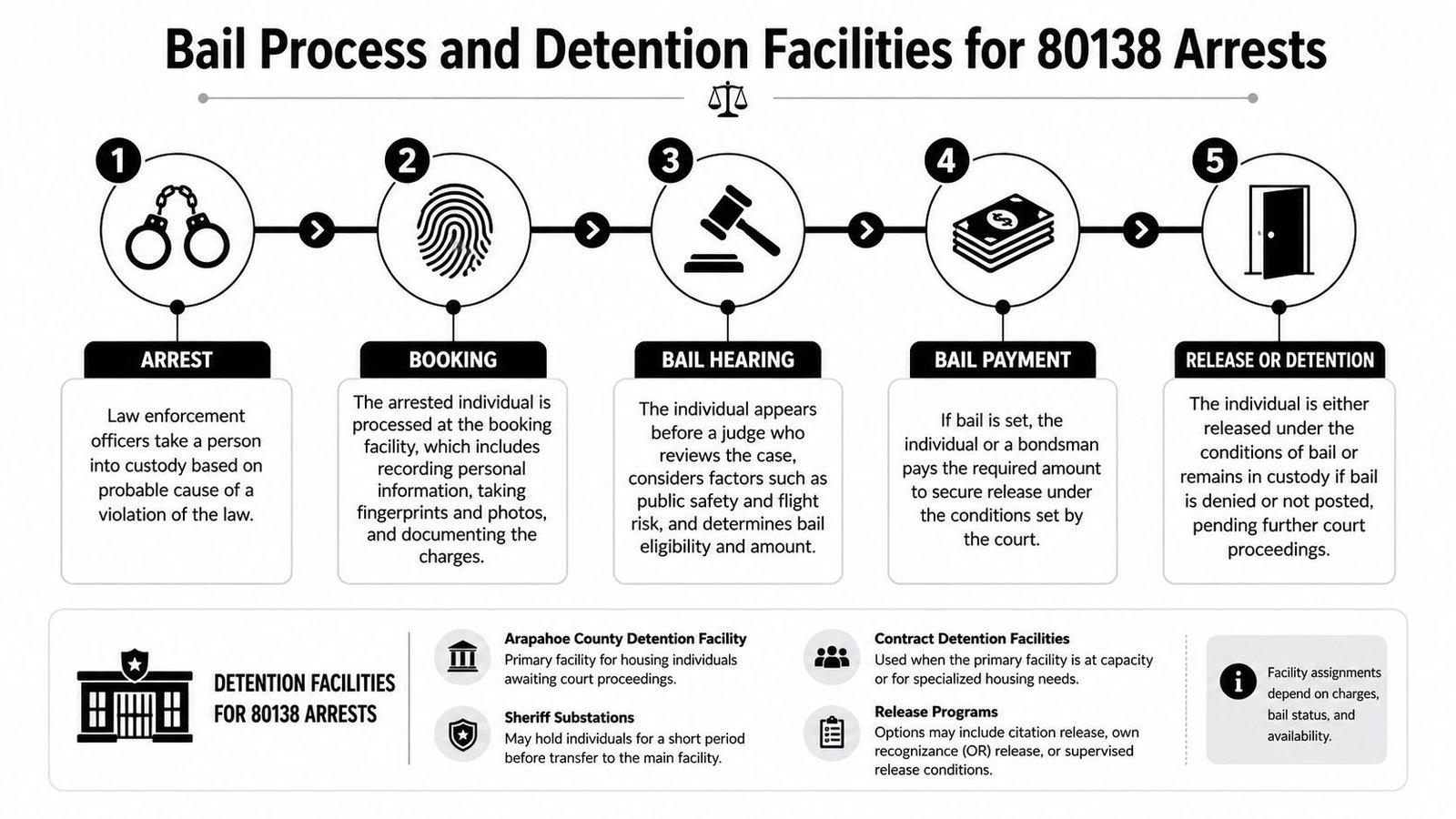
A family gets the booking call, hears a bond amount, and assumes that number controls everything. In Colorado, that is not always true. The amount can change depending on the charge, the court, and where the case stands, so the first job is to confirm the actual bond terms, not just react to the arrest.
Know the bond type before you call
Colorado families usually deal with two bond categories. Cash-only bonds require the full amount to be paid directly, while surety bonds use a bonding company and an approved cosigner to secure release. If the facility wants a cash-only payment, that is a different process than a surety bond, and the family needs to know which one applies before gathering money or paperwork.
The bond listed at booking is not always the final word. Colorado courts can adjust it at arraignment, and sometimes the facility follows a different path depending on the case. Call about the bond terms first, then decide how to post it.
What families should have ready
The right documents save time. Bring the full legal name, date of birth, booking number if you have it, the detention facility name, and the county if it is already confirmed. If a cosigner is involved, that person should be ready to provide identification and basic contact information, because the agent needs to verify the bond application before posting.
For families keeping case paperwork and release records in order, legal case document tools can help organize forms and keep copies clean when several people are handling the file.
Release usually moves faster once the bond is accepted, but the family still has to match the paperwork to the right case and facility.
The video below shows how the process unfolds from arrest through release.
One jail does not handle every 80138 arrest. Jurisdiction decides the facility, and the facility controls how bond gets posted. If you need a straight answer on the first moves after booking, the what to do when someone gets arrested guide keeps the sequence clear.
Next Steps for Families After an Arrest in 80138
A family call usually starts with panic and bad guesses. Skip both. Confirm where the person is held, get the booking details, and start with the next steps after an arrest in the what to do when someone gets arrested guide.
Do these in order
- Call the detention facility first. Confirm the person is booked and ask for the booking number, because every release step depends on that file.
- Confirm the county and court. Use the exact address tied to the arrest, not just the ZIP, so you do not waste time with the wrong jurisdiction.
- Pull together ID and contact details. The bonding agent will need the arrestee's full name, date of birth, and the family member's information for the file.
- Choose the cosigner carefully. Pick someone stable, reachable, and clear on the financial responsibility before the bond is posted.
- Ask about bond type before payment. If the case is a surety bond, the release path is different from a cash-only situation.
If the person arrested has medical needs, tell the facility and the bonding agent early. Medication, disability concerns, and follow-up care can shape what the family needs to arrange after release. Do not assume those details will be handled automatically.
Out-of-state relatives should not try to manage this by rumor or text chains. Use phone or electronic processing when available, keep one person in charge of the file, and make sure every name matches the official paperwork. That prevents the classic mistake where three people call different offices with slightly different facts.
Keep one version of the truth, one case number, and one person coordinating the next step.
The timing can feel brutal, but the process is usually straightforward once the right facility and bond type are identified. Families who prepare the cosigner, the ID, and the booking details before the call usually avoid the needless back-and-forth that slows release.
How Express Bail Bonds Can Help with 80138 Bail
When an arrest happens in the 80138 zip code, families need a bond company that understands county lines, detention facilities, and the difference between a fast answer and a wrong one. Express Bail Bonds has served Colorado since 1988, works statewide, and handles the kind of release process that families need when time is tight. They're available 24/7 by call or text at 720-984-2245, and they offer electronic application, payment, and contract processing so families don't have to sit at a detention center longer than necessary. Express Bail Bonds
Their model fits the reality of Colorado bail. The standard premium is 15%, and for bonds over $5,000 they often secure 10% with an approved cosigner. They do not post cash-only bonds, which keeps the focus on surety solutions that can move a release forward without confusion. That's a good fit for families who need clear guidance, not generic promises.
If the arrest involves a nearby jurisdiction, use the local page that matches the county. For Golden-area matters, the Jefferson County Golden Colorado page gives a better local starting point, and for other metro-area cases the Centennial bail bonds page helps narrow the search fast. The value here is simple, the right local page cuts down on guesswork when the family is already under pressure.
If someone you love was arrested in 80138, don't spend the night chasing the wrong court or jail. Visit Express Bail Bonds, get the jurisdiction checked, and let a Colorado bond professional help you move from panic to release as quickly as possible.