
A cosigner is someone who legally agrees to take full financial responsibility for another person's bail bond if that person doesn't meet the bond obligations. In plain terms, the cosigner is the financial backup, and if the defendant fails to appear, that responsibility can fall on the person who signed.
If you're reading this because the phone rang late, your stomach dropped, and someone you care about said they'd been arrested, you're not alone. Families across Colorado end up in this spot with almost no warning. One minute you're asleep or at work, and the next you're trying to understand bail, court dates, paperwork, and whether signing your name could put your own money at risk.
That's where people start asking, what is a cosigner, really? In bail bond situations, it's not just “helping out.” It's a serious promise. You're telling the bond agency, “If this person doesn't do what they're supposed to do, I understand I may be responsible.”
That sounds heavy because it is. But it doesn't have to stay confusing. Once you understand the role, the questions get simpler. What am I agreeing to? What happens if the person misses court? Can I cosign from out of state? What should I ask before I sign anything?
That Phone Call What to Do When Someone Needs Bail
When families call after an arrest, they usually sound the same at first. They're scared, rushed, and trying to piece together half the story from a short jail call.
A sister might say, “My brother got picked up in Jefferson County. They told me he needs a bond, and now someone says I may have to cosign. What does that even mean?” A parent might ask whether cosigning is the same as paying bail. A spouse may think signing just helps with paperwork, not realizing it can create real financial responsibility.
The first thing to do is slow the moment down.
Start with the basics
Before you agree to anything, confirm a few key details:
- Find the jail location: You need to know where the person is being held.
- Ask about the bond amount and type: Some cases allow a surety bond. Others may have different conditions.
- Get the defendant's full legal name and date of birth: This helps the bond agent locate the case quickly.
- Ask about the next court date: Court appearance is at the center of the bond obligation.
If you need a practical first step, this guide on what to do when someone gets arrested helps break the immediate process into manageable actions.
Why cosigning comes up so fast
In many bail situations, the person in jail can't secure release on their own. They may not have the money, the paperwork, the credit profile, or the ability to complete the process while in custody. That's when a family member or friend gets asked to step in.
When you cosign a bail bond, you're not just helping someone get out. You're putting your name behind their promise to return to court.
That doesn't mean you should panic. It means you should treat the decision with open eyes. If you trust the defendant, understand the terms, and can handle the responsibility if something goes wrong, cosigning may be a workable path. If you have doubts, those doubts matter.
The Core Concept of a Cosigner Explained
A cosigner is the person who steps in with their own name, credit, and finances to help someone else get approved. In a bail bond case, that usually means helping a defendant secure release from jail through a bond agent when they cannot qualify on their own.
Outside of bail, the same idea shows up in car loans, apartment leases, and other contracts. One person wants the agreement. The other person agrees to share the risk if that first person does not follow through.
What a cosigner is really doing
Here is the plain-English version. The company offering the agreement is not fully comfortable relying on the main person alone, so it asks for another responsible adult to stand behind that promise too.
In a loan, that promise is usually about payment. In bail, the promise centers on the defendant showing up for court and following the release terms. The setting changes, but the commitment is still serious.
A simple comparison helps. If the defendant is the person driving the car, the cosigner is the person who hands over their own keys as security. You may not be the one behind the wheel, but your property, finances, and peace of mind can still be affected if things go wrong.
That is why cosigning is never just a favor done on emotion in the middle of a stressful night.
According to the Federal Trade Commission, a cosigner on a loan can be held legally responsible if the primary borrower does not pay, and that obligation can appear on the cosigner's credit reports, as explained in the FTC's cosigning loan FAQs.
Practical rule: If you sign as a cosigner, treat the obligation as yours from the moment you sign.
Why a cosigner is often needed in bail
In Colorado bail cases, families are often surprised by how fast this question comes up. The defendant may be in custody, stressed, short on cash, or unable to provide the financial backing a bond company needs. A cosigner fills that gap by giving the bond agent another layer of assurance.
That does not mean the cosigner is taking the charges onto themselves. You are not accepting criminal blame. You are agreeing to support the bond agreement and to carry risk if the defendant fails to meet the court's requirements.
If you are trying to figure out whether your own finances are stable enough for that kind of responsibility, it can help to review broader basics like income, debt, and credit standing. This a guide to household credit health explains those ideas in plain language.
How this works in a bail bond setting
In practical terms, cosigning for bail means you are helping create the trust that makes release possible. The bond company is looking at two things at once. First, whether the defendant is likely to appear in court. Second, whether the cosigner has the stability to stand behind the agreement if there is a problem.
That is part of how a surety bail bond works in Colorado. The bond company takes on risk with the court, and the cosigner takes on responsibility with the bond company.
For families, this is usually the point that matters most. A cosigner is not a bystander and not just an emergency contact. A cosigner is an active part of the bail process, and their signature has real weight.
Your Legal and Financial Responsibilities as a Bail Bond Cosigner
A bail bond cosigner takes on real responsibility the moment the paperwork is signed. You are putting your name behind the defendant's release, and that can affect your finances, any collateral tied to the bond, and the amount of stress you carry while the case is active.

In Colorado bail cases, your role centers on one practical question. Will the defendant follow the release terms and show up for court? If that answer turns into no, the bond company can look to you based on the agreement you signed.
What you're really promising
A bail bond contract works a lot like vouching for someone with your wallet attached. Your signature tells the bond company, “I believe this person will do what the court requires, and I understand I may be responsible if they do not.”
That responsibility usually includes more than paying a fee up front. You may be agreeing to keep in contact with the defendant, help the agent reach them, make sure court dates are not ignored, and protect any property or collateral used to secure the bond. Agencies ask about your job, address, ID, and financial stability for a simple reason. They need to know whether you can realistically stand behind that promise if the case goes off track.
Read the contract slowly. If a term is unclear, stop and ask. A plain-language overview of a bail bond contract and what cosigners agree to can help you know what to look for before you sign.
What can happen if the defendant doesn't appear
This is the part families cannot afford to treat lightly.
If the defendant misses court, disappears, or breaks bond conditions, the court can revoke the bond and the bond company can pursue the cosigner based on the contract. Depending on the agreement, that may mean you owe money, lose collateral, or have to help locate the defendant quickly. The pressure can build fast because bail cases move on court deadlines, not on your family's schedule.
Sign only if you can answer one hard question with confidence. If this person stops picking up the phone tomorrow, what will that mean for you?
If your family is already juggling debt problems, bankruptcy questions, or other shared obligations, this article from LifeBack Law on Chapter 7 cosigners gives helpful background on how cosigner risk can overlap with other financial trouble.
This short video explains the seriousness of the agreement in visual terms:
Questions to ask before you sign
Ask these directly. A good bail agent should answer them in plain English.
- What exactly am I agreeing to pay if something goes wrong: Ask for the clearest possible explanation of your financial responsibility.
- Is collateral part of this bond: If the answer is yes, ask what property is at risk and under what conditions.
- What does the defendant have to do after release: Get the court dates, check-in expectations, and any release conditions spelled out clearly.
- What happens if I cannot reach the defendant: You need to know what the agency expects from you if contact is lost.
- How can I get a copy of everything I sign: Keep your own records. In a stressful case, memory is not enough.
How to Cosign for a Bail Bond in Colorado Step by Step
When someone needs release, families want the process, not theory. In Colorado, cosigning for a bail bond usually moves through a short sequence of decisions, documents, and verification.
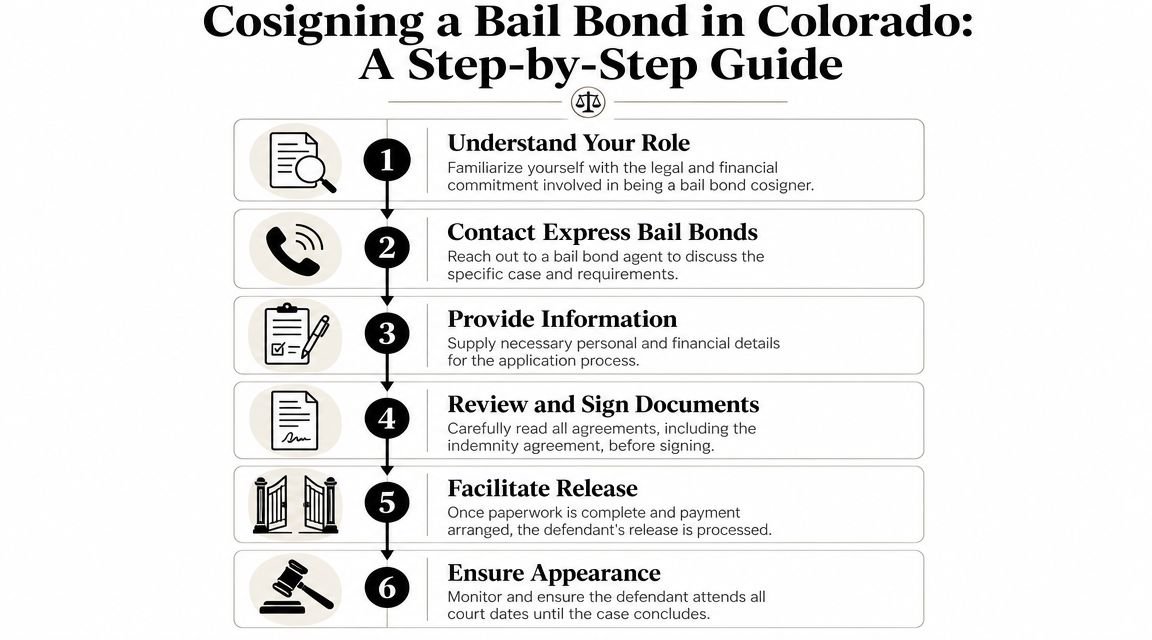
Step 1 Understand who you're signing for
Before paperwork starts, stop and ask the hardest question first. Do you trust this person to go to court and stay in contact with you?
If the answer is shaky, don't ignore that. A bail bond cosigner isn't just lending a name. You're tying your own financial stability to the defendant's behavior.
Step 2 Make the initial call
The next step is contacting a bail bond agency with the defendant's basic information. That usually includes full name, jail location, booking details if available, and whatever you know about the bond.
If the case is in a local area such as Jefferson County bail bond service or Centennial bail bond help, location-specific details can speed things up because jail procedures differ by facility.
Step 3 Provide your information
A bond company will usually ask for details that help evaluate whether you can cosign. Expect questions about identity, residence, employment, and income.
Common items include:
- Government-issued ID: This confirms who you are.
- Current address: The agency needs to verify where you live.
- Employment or income information: This helps them evaluate your ability to back the bond.
- Relationship to the defendant: Agencies often want to know why you're involved and how closely connected you are.
Step 4 Review the agreement carefully
This is the step people rush, especially when emotions are high. Slow down here.
Read the contract. Ask the agent to explain unfamiliar terms. If collateral is involved, make sure you understand exactly what is being pledged and under what circumstances it could be at risk.
You can also start the paperwork process through an online bail bond application, which can help if you're handling things remotely or trying to move quickly from outside the jail's area.
Step 5 Sign and arrange payment
After approval, the paperwork is signed and payment is arranged. In Colorado, some agencies handle this electronically, which can be helpful for out-of-state relatives or family members juggling work, childcare, or travel.
One option families often use is Express Bail Bonds, which offers electronic applications, contract documents, and payment processing for Colorado surety bonds. That can reduce the need to sit for hours at a detention center while trying to complete the release process.
Step 6 Stay involved after release
Signing the bond is not the finish line. It's the start of your responsibility.
Once the defendant is released, keep track of court dates, check that they understand their conditions, and don't assume they've “got it handled.” Many bond problems happen after release because nobody stays organized.
A careful cosigner acts early. They confirm dates, keep contact information current, and respond fast if the defendant starts drifting.
Weighing the Risks and Exploring Alternatives
Cosigning can help someone get out of jail. It can also create real stress inside a family. Both things can be true at once.
The biggest mistake I see is people treating cosigning like a moral decision only. It's also a financial and practical decision. Love for the defendant matters, but it isn't enough by itself. You also need trust, follow-through, and a realistic sense of whether this person will show up when required.
The risks you need to take seriously
Some risks are emotional. Some are financial. Some turn into both.
- Your money may be exposed: If the defendant breaks the bond terms, the agreement can come back to you.
- Your relationship can get strained: Court stress, missed calls, and broken promises hit families hard.
- You may feel responsible for supervising an adult: Many cosigners don't expect how much follow-up is involved.
- Collateral can be part of the deal: If property or other assets are pledged, the stakes rise fast.
Cosigner and guarantor are not the same
Many people use these words like they mean the same thing. They don't.
Progressive notes that the terms cosigner, guarantor, and co-borrower have distinct legal meanings, and a guarantor is often liable only after collection options against the primary borrower have been exhausted, while a cosigner is immediately responsible for missed obligations, as explained in Progressive's article on cosigning and apartment lease obligations.
That distinction matters because families sometimes say, “I'll just guarantee it,” when the document in front of them instead makes them a cosigner with more immediate exposure.
Bail options compared
Here's a simple side-by-side look at the two paths families usually weigh.
| Factor | Cosigning for a Surety Bond | Paying Full Cash Bail |
|---|---|---|
| Upfront cash needed | Usually less upfront than paying the full bail amount directly | Requires the full cash bail amount up front |
| Need for approval | Bond agency may review your credit, income, identity, and risk factors | Court process centers on payment of the full amount |
| Ongoing responsibility | Cosigner stays tied to the bond obligations and defendant's court appearance | Cash payer still cares about court compliance, but doesn't sign a surety contract |
| Collateral possibility | May be required depending on the case | Not typically part of a surety arrangement because it's cash posted directly |
| Best fit for | Families who can't or don't want to post the full cash amount | Families who have the full amount available and prefer direct payment |
How to decide
A simple test helps:
- Choose cosigning if you trust the defendant, understand the agreement, and don't want to tie up the full bail amount in cash.
- Pause and ask more questions if you feel pressured, confused, or unsure whether the defendant will appear.
- Consider cash bail if you have the means and want to avoid a surety contract.
There's no shame in saying no. Sometimes the wisest help you can offer is helping the person find another lawful option instead of putting yourself in a position you can't manage.
Frequently Asked Questions for Colorado Cosigners
Families usually have the same last round of questions once the basics are clear. Here are the ones that come up most often.
Can I cosign if I live out of state
Often, yes. Many Colorado bond transactions can be handled electronically, which helps relatives who aren't local. You'll still need to provide identification and complete the required documents, but you may not need to appear in person.
Can I be removed as a cosigner later
Sometimes, but not solely because you changed your mind. Removal depends on the bond status, the agency's requirements, and whether another qualified person can take your place. If you're already worried about this, read about when a cosigner can be removed from a bail bond before you sign anything.
What if the defendant gets arrested again while out on bond
That can create new problems fast. A new arrest may affect the defendant's release status, the original bond, or both. If that happens, contact the bond agency immediately and don't wait for the next court notice to sort things out.
Will I need collateral
Maybe. Some bonds require only the signed agreement and premium. Others may require collateral based on the bond amount, the defendant's history, or the agency's risk assessment. Ask exactly what is being pledged and when it could be at risk.
What should I ask the defendant before I agree
Ask direct questions, even if the conversation gets uncomfortable:
- Do you know all your court dates
- Do you have a reliable phone and transportation
- Are there other pending cases or warrants
- Will you stay in regular contact with me and the bond agency
If they dodge simple questions now, that tells you something important.
What's the biggest mistake first-time cosigners make
They focus only on getting the person out of jail. They don't think about the weeks and months after release.
Cosigning works best when the defendant is organized, reachable, and serious about showing up. If those pieces are missing, the cosigner often ends up carrying more risk than expected.
If you're still unsure, trust that hesitation. It's better to ask five more questions before signing than to sign fast and regret it later.
If someone you care about needs help with a Colorado bail bond and you need clear answers before cosigning, contact Express Bail Bonds. An agent can explain the process, review what the agreement means, and help you understand your options before you commit.