
Conditional release means leaving custody only while following court-ordered conditions meant to secure court appearance and community safety, even when no money is paid. In federal fiscal years 2011–2018, 79% of defendants released before trial had at least one release condition.
You may be reading this with a jail notice on your phone while a relative asks whether someone can come home tonight. The paperwork says conditional release, but it may not explain who needs a payment, who expects a check-in, or whether the person can return to the family home.
Start with the signed order. For a Colorado family, the useful question isn't just what does conditional release mean. It's which legal stage the person is in, who supervises them, and what they must do to stay out of custody.
What Conditional Release Means in Plain Terms
A relative can explain it this way: the person can leave custody, but only while obeying restrictions that bring them back to court and protect other people.
Pretrial conditional release isn't a finding of guilt, an acquittal, or the end of the case. A judge can impose supervision and behavioral requirements without requiring money at release. Think of the signed order as the person's supervision plan, not a receipt for getting out.
Which release status the paperwork describes
| Status | When it applies | Money required | Who supervises | Main duty |
|---|---|---|---|---|
| Pretrial conditional release | Before trial, after custody | Not always | Court or pretrial services | Appear and follow ordered limits |
| Unsecured personal recognizance with conditions | Colorado pretrial release without secured money | No secured deposit | Court or pretrial services | Appear plus tailored nonmonetary rules |
| Secured cash or surety bond | Judge sets a monetary bond | Yes, cash or a surety bond | Court, and the bail agent if a surety is used | Appear; other conditions still apply |
| Probation | Part of a criminal sentence | No bail premium | Probation officer | Follow sentence conditions |
| Parole or other post-custody conditional release | After incarceration | No | Parole or releasing authority | Follow post-custody supervision |
| Federal supervised release | After a federal prison term | No | Federal probation officer | Follow the term set at sentencing |
| No-bond hold | Judge or law blocks release for now | Cannot post yet | Jail until court | Remain in custody |
Read across the row that matches the jail or court document. The first column identifies the status; the remaining columns separate payment, supervision, and conduct. An unsecured bond answers the payment question, but it doesn't answer whether testing or reporting is required.
Probation, parole, and federal supervised release belong to different stages than pretrial bail. A no-bond hold isn't a form of community supervision at all. Mark the matching row before calling an agency, because the correct supervisor and the response to a missed obligation follow that legal stage.
Conditions are common, not an unusual extra
The U.S. Bureau of Justice Statistics reports that, in federal fiscal years 2011–2018, 79% of defendants released before trial had at least one release condition, including travel restrictions for 78%, substance-abuse testing or treatment for 63%, and weapons restrictions for 51%.
Those federal figures show how ordinary conditions are within that system. They aren't a list of requirements for a particular Denver defendant. Only the person's order tells the family which restrictions apply.
Paperwork check: Locate the release status, the conditions page, and the supervising agency. A bond amount alone doesn't explain the release plan.
How Colorado Chooses the Form of Release
Colorado's starting point is release eligibility, not a family shopping for a bond. The judge chooses the form of release and the safeguards attached to it.
The Colorado bond-reform framework favors the least restrictive conditions and release without monetary conditions unless the court finds a substantial risk of danger, flight, or obstruction of the criminal process and concludes that reasonable nonmonetary conditions can't adequately manage that risk.
The decision path separates the question of risk from the question of payment.
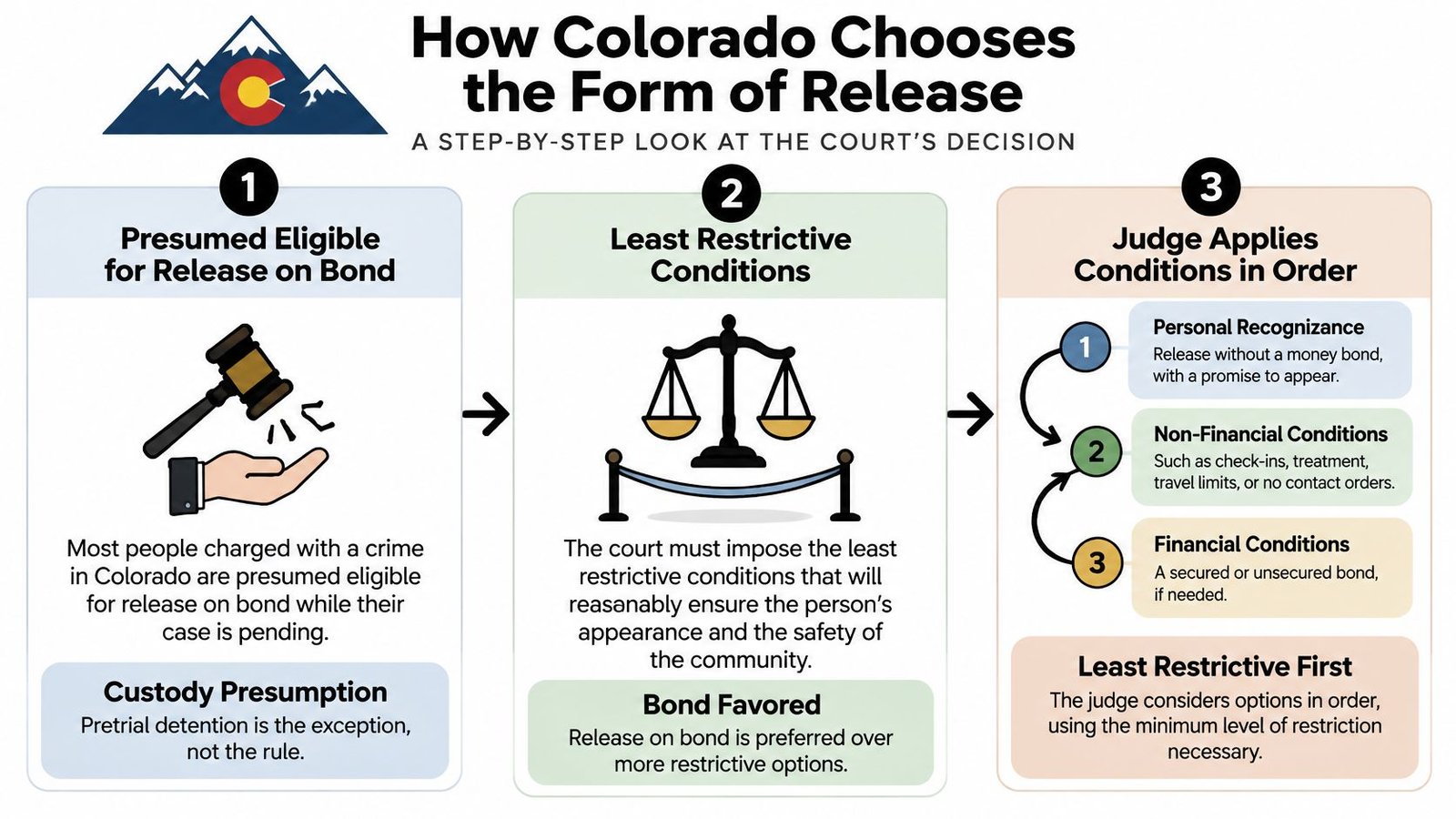
The judge's decision in order
- Start with eligibility. People in custody are presumed eligible for release on bond with appropriate conditions.
- Identify the concern. The court considers danger, flight, and obstruction rather than treating every defendant as presenting the same problem.
- Test nonmonetary safeguards. The judge asks whether reporting, conduct restrictions, or another workable requirement can address the identified concern.
- Select the bond form. The options include unsecured personal recognizance, with or without specific nonmonetary conditions, and a bond containing secured monetary conditions.
A family's guide to pretrial risk assessment can help explain the vocabulary surrounding that decision. An assessment isn't the signed release order, and it doesn't authorize the family to substitute its own plan.
The exception is a no-bond hold. When a judge sets one, the defendant must remain in jail until their court appearance; arranging money doesn't remove that hold.
Questions for the clerk or attorney
Ask which statutory release path the judge used, whether the money is secured, and which nonmonetary conditions address a specific concern. The clerk can help locate documents; counsel can explain the legal basis or challenge a disputed restriction.
Don't assume the amount shown on a booking screen describes every requirement. Ask for the order and any attached conditions before making arrangements.
Conditions That Come With Getting Out
Court attendance is the starting duty. Under Colorado's criminal-procedure statute, every bond requires appearance at the set place and date, including a later place or date when proceedings move or continue, and breach of that appearance condition can expose the surety or security to forfeiture.
The statute also permits scheduled telephone contact with pretrial services, office visits, home visits, applicable behavioral-health or substance-use treatment, and periodic alcohol or drug testing. A missed hearing therefore presents a different bond problem from a missed class, even though both can require court attention.
Use the attendance requirement as the first item when reviewing the conditions page.
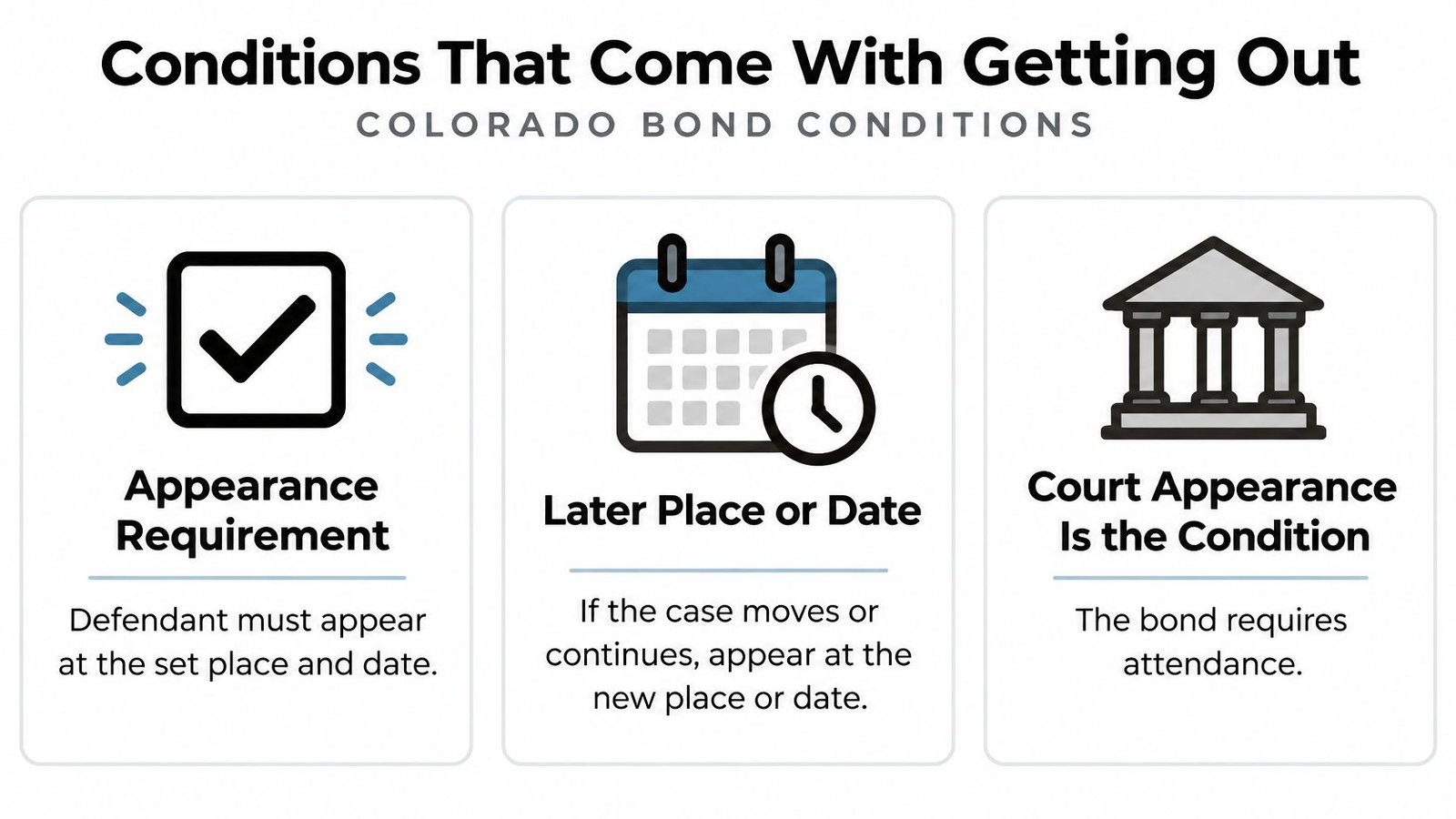
Common conditions and what they control
| Condition | What it controls | Where it usually appears |
|---|---|---|
| Court appearance | Attend the set place and date, including continuances | Every Colorado bond |
| Pretrial reporting | Phone check-ins, office visits, or home visits | Cases supervised by pretrial services |
| Testing or treatment | Alcohol or drug tests, behavioral-health or substance treatment | Risk tied to substance use or mental health |
| No-contact order | No calls, messages, or visits with a named person | Victim or domestic cases |
| Travel or residence limit | Stay in a set county or state and keep a known address | Flight or stability concerns |
| Curfew | Be home during set hours | Higher supervision cases |
| Firearms restriction | Do not possess weapons | Safety-risk cases |
| Work, school, or classes | Keep employment, education, or a required class | Conditions tailored to a specific concern |
These are possible requirements, not a universal checklist. A charge category doesn't establish the exact restriction, and a relative shouldn't infer permission from a blank space on a booking website.
Separate court supervision from bond obligations
Conditions set by the court and the bail agent after release are not optional. Travel restrictions, no-contact orders, and mandatory classes are examples of requirements that must be followed. Keep the court order and the agency agreement together, but distinguish who issued each instruction.
Our explanation of conditions of bond can help families identify those categories. For relatives comparing paperwork across jurisdictions, 24-7 Best Bonding's guide to common bail conditions in Forsyth County offers another plain-language reference, but it doesn't establish Colorado requirements.
Copy only the rows printed on the signed release order into a phone note. Include the named agency, location, contact information, and instructions attached to each duty. If an attachment is missing or illegible, obtain a readable copy rather than guessing.
What Breaks Release and What Follows
A broken supervision rule and a missed court date aren't interchangeable. A technical condition breach can bring the defendant back for a hearing, tighter restrictions, or revocation and return to jail, even without a new criminal charge.
When a defendant fails to appear in court, the judge cancels the bond, issues a new arrest warrant, and the bail bond is forfeited. Families need to identify which event occurred rather than describing every problem as a bond violation.
The distinction helps explain what counsel needs to address.
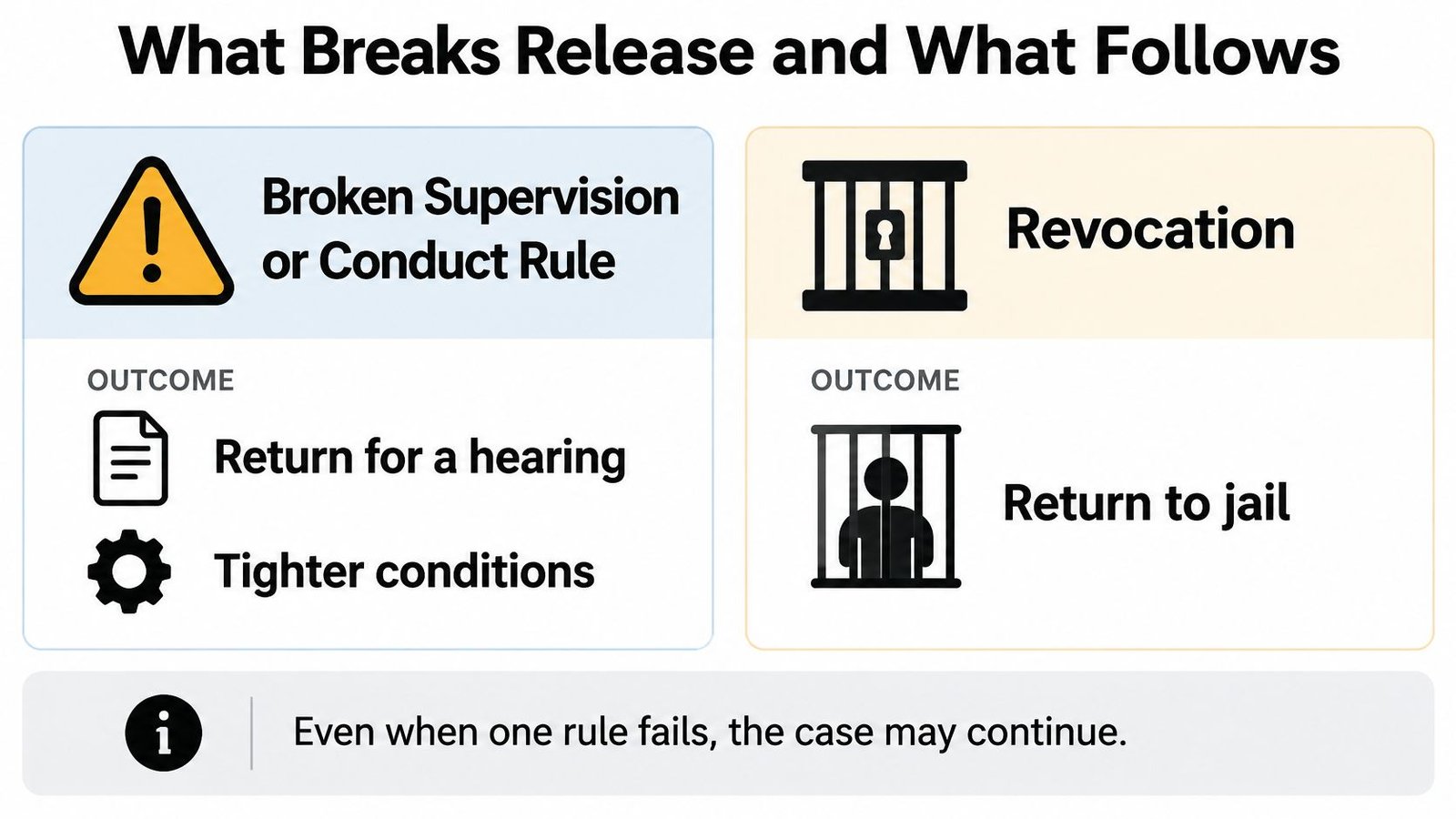
Breach Type and Likely Court Response
| Breach | Example | Likely court response | Stakes |
|---|---|---|---|
| Technical condition breach | Missed check-in, positive test, broken curfew | Hearing, tighter conditions, or revocation and return to jail | May occur with no new criminal charge |
| Failure to appear | Missed court date, including a continued hearing | Bond canceled, new arrest warrant, forfeiture | Serious; can expose surety or collateral |
The Administrative Office of the U.S. Courts reports that 86% of defendants released in the federal system commit no new violations and don't fail to appear, leaving approximately 14% with at least one reported violation or failure to appear under that measure.
That benchmark describes federal release, not the odds for a Colorado family. Federal judges can review assessed risk, the most serious charge, and violation information when evaluating release decisions. An alleged breach still needs an individual response, not an assumption that detention is inevitable.
What the cosigner has at stake
If the defendant skips court and the cosigner can't pay the forfeited bond amount, the agency can take possession of pledged collateral to cover the loss. The cosigner's exposure isn't limited to whether the defendant picks up another charge.
Our bail bond violation guide explains the bond side of that problem. Counsel should address the alleged violation and the court's response.
After any miss, ask counsel immediately: Is this a technical condition breach, a failure to appear, or both?
Keep the notice, warrant information, and alleged violation details available for that conversation. Don't treat a new hearing notice as proof that the original restriction has disappeared.
How to Comply in the First Two Days
Treat the first two days as an organizing routine, not a grace period. A reporting instruction can require action before the family has settled transportation or housing.
Begin with the document and calendar tasks shown below.
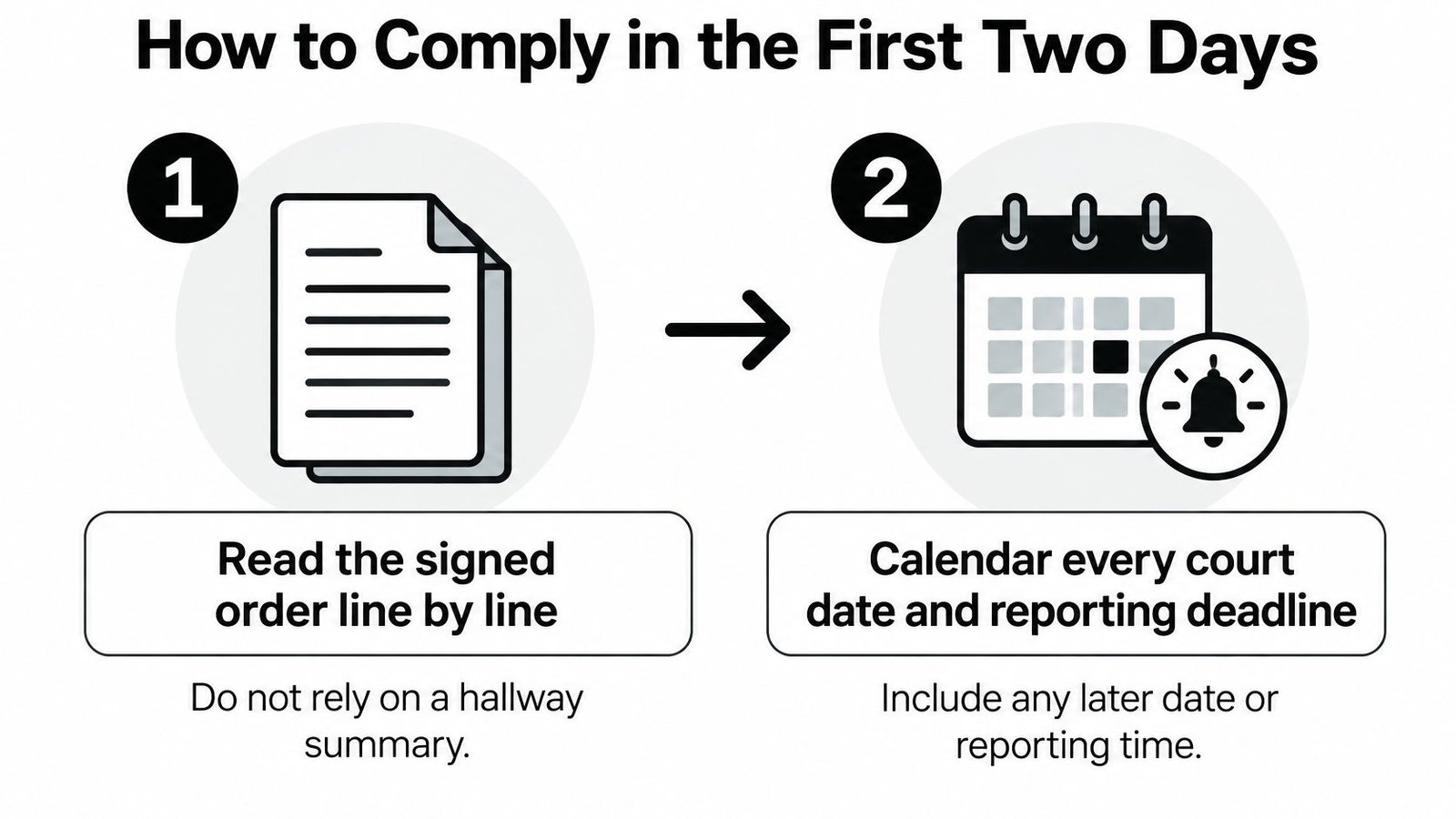
Build a routine the defendant can follow
Read the signed order line by line. Don't rely on a hallway summary. Collect attachments and keep a readable copy on the defendant's phone.
Calendar every court date and reporting deadline. Include continuances and later reporting instructions. Set reminders that leave time to arrange transportation.
Name the supervisor. Identify whether the contact is pretrial services, probation, parole, or the court. Save the person's name, office number, and reporting location.
Check only the duties ordered. Look for reporting, testing, treatment, electronic monitoring, no-contact provisions, and travel or address limits. Don't add obligations from someone else's case.
Request clarification or modification before a miss. Transportation, unstable housing, work schedules, technology, and treatment access can make an instruction unworkable. Under Colorado's bond-setting statute, release conditions should address appearance and safety with appropriate, reasonable requirements; ask counsel to bring a concrete barrier to the court rather than ignoring the rule.
Explain the actual obstacle: the reporting office closes before a shift ends, the testing site isn't reachable by available transportation, or the proposed residence conflicts with a protected person's address. Ask counsel to seek a workable alternative and written confirmation. A pending request isn't permission to stop complying.
Save proof. Keep call logs, appointment confirmations, visit receipts, and testing records. Document failed connection attempts and report the problem promptly.
Maintain bail-agent contact when a surety bond is in place. Keep weekly contact by phone or an office visit, following the agency's instructions. Our check-in requirements guide helps distinguish that contact from court supervision.
Test the plan before setting it aside
The defendant should be able to name who they report to, when they report, and whom to contact before changing travel, housing, or communication with a protected person. A family member can help organize reminders, but shouldn't assume they can report in the defendant's place.
Use this video alongside the written paperwork, not as a substitute for it.
Common Colorado Release Scenes Families Misread
Jefferson County illustration
Say a defendant leaves custody in Jefferson County on an unsecured personal-recognizance bond after a domestic-related arrest. The family hears that no secured payment is required and offers to bring the person straight home.
In this illustration, the order requires court attendance, phone check-ins with pretrial services, and no contact with a protected person who lives at that home. The ride home is now a supervision question, not just a transportation question. The family needs counsel's guidance on a permitted destination, not the protected person's informal invitation.
Centennial illustration
In another hypothetical situation, relatives arrange a surety bond for someone held in the Centennial area. They treat payment of the premium as the finish line and focus on getting the defendant back to work.
The order also requires alcohol testing and attendance at every continued hearing. The useful handoff is the signed order, the testing instructions, and an accurate calendar. Payment hasn't supplied permission to miss testing or disregard a changed hearing date.
A notice saying someone was released by court order should prompt a document check, not an assumption about which obligations ended.
Post-sentence supervision is a different scene
Probation is supervision imposed as part of a criminal sentence and administered by a probation officer. Parole and other post-custody conditional releases follow incarceration and involve a parole or releasing authority rather than ordinary pretrial supervision.
The Bureau of Justice Statistics terms and definitions includes discretionary parole, mandatory parole, post-custody probation, and other conditional releases within its broader release category. That's why the phrase alone doesn't tell a family whether bail is relevant.
Match the advice to the legal stage before acting on it.
Which scene matches the notice in your hand? Confirm the supervising authority before following instructions intended for someone awaiting trial when your relative is serving a sentence in the community.
Frequently Asked Questions About Conditional Release
How long does conditional release last?
Pretrial conditions generally continue until the case reaches a legally recognized endpoint or the court changes the order. Check for a stated end date and ask counsel what event ends each obligation. Don't assume release from jail, payment, or a postponed hearing ends supervision.
Can conditions change after release?
Yes. Counsel can request clarification or modification, and the court can change a condition; a judge may also tighten restrictions after an alleged violation. An attorney's request doesn't itself amend the order. Obtain the court's decision before treating a proposed change as approved.
Does a cosigner have to attend hearings?
No, cosigning alone doesn't require attendance at the defendant's hearings. The defendant carries the appearance duty, while the cosigner has financial responsibilities under the bond agreement. A separate subpoena or court order is a different matter and shouldn't be ignored.
What if the defendant needs to move or travel out of county?
Read the travel and residence provisions before making plans. A geographic restriction may require permission, and an address change may involve a reporting requirement even if the destination is nearby. Contact counsel or the designated supervisor to identify the required process, and obtain approval before acting when the order requires it.
Confirm the Order and Arrange the Next Call
Identify the release status before deciding whether a surety bond is the right tool. Have the defendant's name, detention facility, case information, and readable bond order ready for the conversation.
If the document shows a no-bond hold, stop the payment arrangements and wait for the court appearance. If it shows an unsecured release, focus on the release instructions. A cash-only designation also requires a different path because we don't post cash-only bonds.
When a surety bond fits
For an eligible secured bond, a licensed surety agency posts the bond instead of the family paying the full bail amount in cash to the court. Express Bail Bonds can help with the release arrangement, while the attorney handles legal advice or requests to change conditions.
Our licensed agents are available around the clock. The first conversation is a chance to ask about costs, the meaning of cosigning, and any collateral requirement before agreeing to anything. We explain those terms upfront in plain English.
Remote signing is available, so relatives don't need to travel to the Golden facility in person. After release, our team follows up to confirm the defendant is out and provides guidance on court-date compliance and bond conditions.
Choose the location that matches the hold
- Statewide starting point. Use our Colorado bail information and contact page to begin with the facility and order details.
- Jefferson County detention. The Jefferson County and Golden page is the location-specific starting point for that facility.
- Centennial area. Use the Centennial bail bonds page when the person is held in that area.
Call or text 720-984-2245 before anyone assumes the conditions or tries to arrange the wrong kind of bond. Keep the signed order available so the conversation starts with what the judge authorized.
Express Bail Bonds offers surety-bond assistance, remote signing, and plain-language guidance on the bond obligations that continue after release. Visit Express Bail Bonds or call or text 720-984-2245 to review the release paperwork and ask what cosigning would mean for your family.