The phone rings late. It's your son, your wife, your brother, or the friend you helped get out of jail a few days ago. Their voice is tight. They missed court. They got contacted by pretrial services. They tested dirty. They spoke to someone the judge told them to stay away from. Now everyone's asking the same question at once. “What happens next?”
That sick feeling is normal. A bail bond violation puts pressure on everybody at the same time. The defendant worries about getting arrested again. The cosigner worries about money, paperwork, and whether the bond company is about to come after them. Families start making bad decisions when panic takes over.
Slow down.
This problem is serious, but it's not helped by hiding, arguing, or waiting for it to blow over. It won't. What helps is knowing exactly what a violation means in Colorado, what the court can do next, and what both the defendant and the cosigner need to do today.
If your family is still trying to understand the basic arrest-to-release process, read what happens after you get arrested so you can place this violation in the bigger timeline. Then deal with the violation head-on.
Introduction The Moment Your Stomach Drops
Most families don't learn about bail conditions in a calm office with time to think. They learn about them in the middle of a workday, from a rushed call, with half the facts missing.
A common Colorado scenario goes like this. A defendant gets released, promises everybody they'll follow the rules, then misses one thing they thought was small. Maybe it's a check-in. Maybe it's a court date they wrote down wrong. Maybe they went somewhere they weren't supposed to go. Then the calls start. The cosigner feels betrayed. The defendant says it was a misunderstanding. Both may be telling the truth from their own angle, but the court usually sees one thing first. Noncompliance.
That's why families get blindsided. They think a violation has to mean a new arrest for a new crime. Sometimes it does. Often it doesn't. A missed requirement can trigger the same panic and many of the same consequences.
Practical rule: Once you know there may have been a violation, treat it like an emergency with paperwork attached. Stay calm, move fast, and communicate clearly.
The good news is that Colorado bail situations usually become less chaotic once everyone stops guessing and starts acting. The defendant needs a plan. The cosigner needs a different plan. Those plans overlap, but they are not the same.
One person is trying to protect their freedom. The other is trying to protect their finances and keep the situation from getting worse. If you mix those roles up, families make emotional choices instead of smart ones.
What Counts as a Bail Bond Violation in Colorado
A bail bond violation is any break from the terms of release. Some violations are obvious. Some are the kind people talk themselves into minimizing. That second category causes a lot of trouble.
A simple way to think about it is this. There are technical violations and substantive violations. Technical means you broke a release rule without being accused of a brand-new substantive offense. Substantive means the violation involves alleged criminal conduct or a more direct attack on the court's authority.
Technical violations are still real violations
According to this explanation of bond condition violations, a technical bail bond violation is defined as a non-criminal failure to comply with specific release conditions, such as missing a court appointment, failing a drug test, breaching curfew, or disregarding travel restrictions, which does not involve committing a new substantive offense but still triggers judicial penalties.
That's the part people miss. “Non-criminal” does not mean “no big deal.”
If the court order says don't travel, don't travel. If it says test clean, test clean. If it says show up, show up early.
Common examples families see in the real world
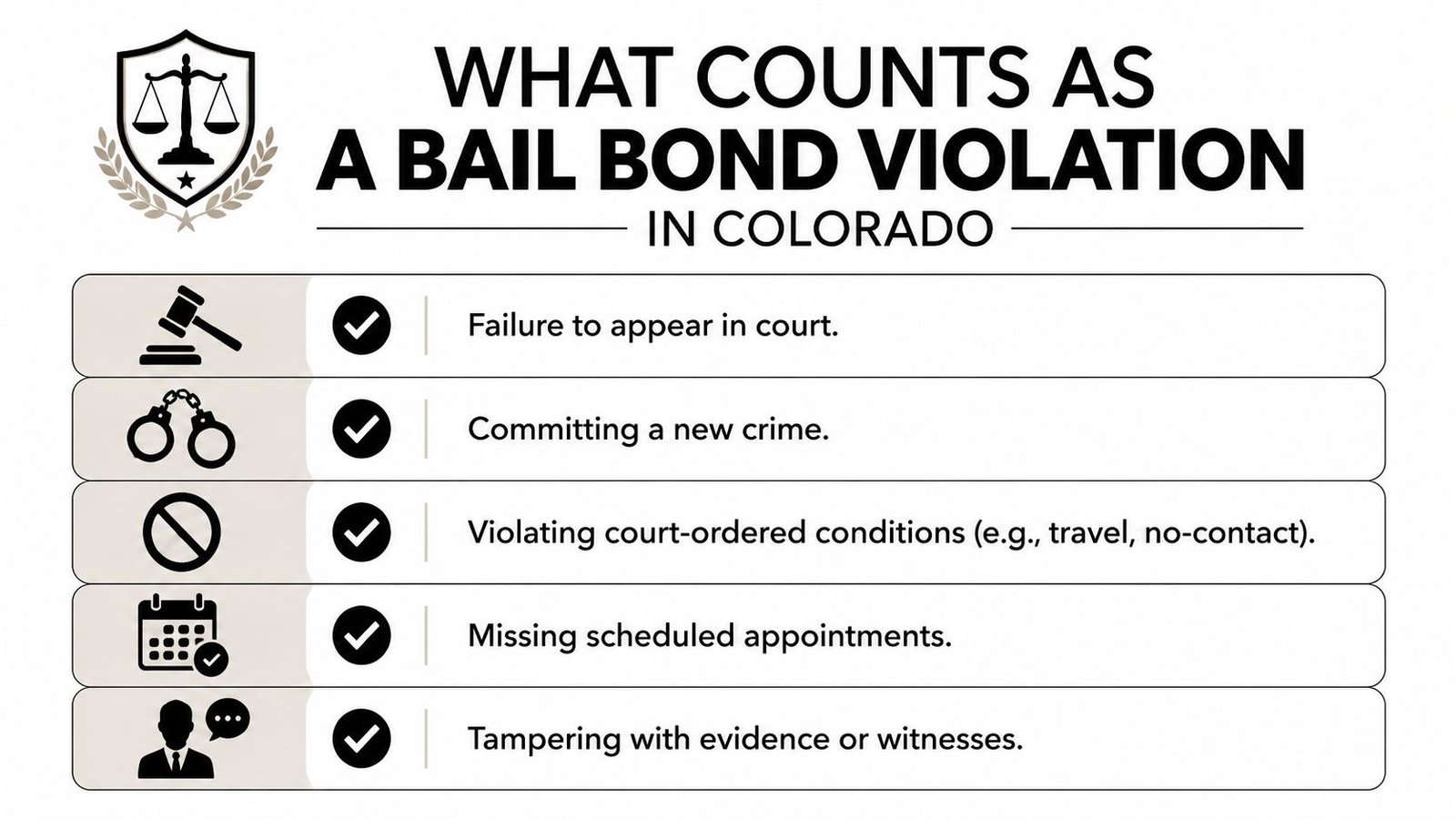
If you want the fine print behind release terms, review typical conditions of bail in Colorado. In everyday language, violations often look like this:
- Missing court: This is the one people recognize immediately. It can happen because of confusion, bad planning, fear, or flat-out avoidance.
- Skipping a required appointment: Pretrial services, treatment, testing, or supervision meetings count.
- Breaking a no-contact order: Calling, texting, messaging through another person, or showing up in person can all create problems.
- Traveling without permission: Crossing county or state lines when the release terms say otherwise.
- Failing a drug or alcohol test: “I only slipped once” usually doesn't fix the violation.
- Ignoring curfew or monitoring rules: If there's electronic monitoring or a time restriction, the court expects exact compliance.
- Tampering with witnesses or evidence: This moves the case into much more dangerous territory.
- Getting arrested for a new offense: That can lead to both a new case and consequences in the original one.
Why the small stuff turns big fast
A bail bond agreement is a trust arrangement backed by legal consequences. The judge allowed release because the court expected compliance. The minute the defendant stops following instructions, that trust starts collapsing.
Families often want to argue intent. “He didn't mean to.” “She forgot.” “It was a misunderstanding.” Those explanations may matter later. They do not erase the violation itself.
A bond condition isn't a suggestion. It's the price of staying out of jail while the case is pending.
The Unforgiving Legal Consequences of a Violation
Once a violation is on the court's radar, the consequences can stack up quickly. In Colorado, this can turn from a scheduling problem into a custody problem and then into a new criminal problem.
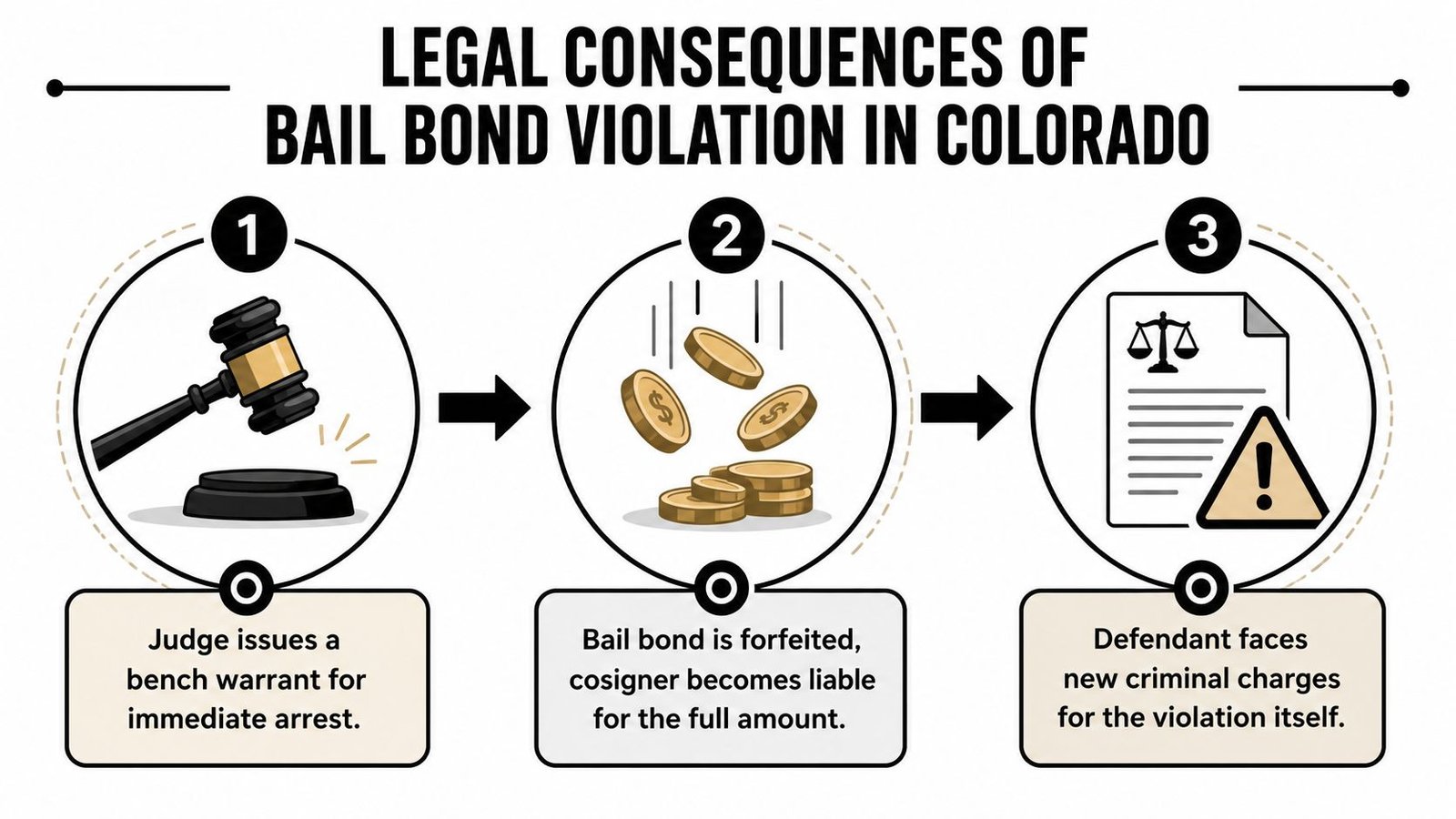
The sequence usually follows a hard logic. First, the court addresses the noncompliance. Then it addresses the bond. Then everybody starts dealing with the financial fallout and any added charges.
The first hit is usually a bench warrant or bond revocation
A violation can lead the judge to issue a bench warrant or revoke the bond. The National Conference of State Legislatures explains that when a pretrial defendant fails to appear or violates release conditions, the court can revoke release, forfeit the bond amount, or do both, as outlined in the NCSL report on pretrial release violations and bail forfeiture.
That means arrest and forfeiture are related, but they are not the same thing. One deals with the defendant's liberty. The other deals with money.
If you need the financial side spelled out in plain English, read what a bond forfeiture means. Families confuse revocation and forfeiture all the time. They shouldn't.
Colorado treats these violations harshly
Colorado is not soft on this issue. According to this Colorado bail bond overview, a conviction for Violation of Bail Bond Conditions involving a felony charge carries a minimum sentence of 12 months in jail, cannot be waived by the judge, and must run consecutively to any sentence from the original charges. For misdemeanors, the minimum is 6 months, with no eligibility for probation.
That should change how you think about the phrase “just a bond violation.” It isn't just anything.
Here's a clean breakdown:
| Problem | What it can trigger |
|---|---|
| Missed court or release breach | Bench warrant |
| Serious or repeated noncompliance | Bond revocation and return to custody |
| Violation proven in court | New penalties tied to the violation itself |
| Bond forfeiture | Financial liability tied to the full bond amount |
Details matter, especially across language barriers
Families sometimes make things worse because they didn't understand the release paperwork, a court notice, or an interpreter issue. That doesn't excuse the violation, but it can affect how a lawyer responds. If language confusion played a role, review Translators USA on legal translation risks so you understand how small wording errors in legal settings can create major consequences.
For families dealing with Arapahoe County courts and nearby jurisdictions, local process matters too. If the case touches Centennial, it helps to know the area and detention flow through Centennial bail bond support.
When a violation happens, speed matters. But accuracy matters too. A rushed explanation with bad facts can hurt as much as silence.
The Bondsman's Role and the Cosigner's Nightmare
When a family signs for a bond, many people think they're paying a fee for a release service. That's incomplete. A surety bond also creates risk for the bond agency and serious responsibility for the cosigner.
The bigger the panic, the more important it is to understand who owes what and why the bondsman reacts so fast after a violation.

Why the bondsman acts quickly
The U.S. bail bond services industry is projected at a $3.5 billion market size in 2026, and when a defendant violates bail, the bond agency can be forced to pay the full amount to the court, which creates a loss far beyond the premium originally collected, according to IBISWorld's bail bond services industry profile.
That's why a bondsman doesn't shrug off a violation. The agency is not being dramatic. The agency is protecting itself from a real financial obligation.
This is also why bond companies monitor defendants, ask questions, and insist on communication. If the defendant disappears, the problem doesn't stay personal. It becomes contractual and financial.
What the cosigner needs to accept immediately
If you cosigned, your role has changed the moment the violation happened. You are no longer just the helpful relative or loyal friend. You are the person tied to the agreement.
Read the details on what it means to be a bail bond cosigner and take them seriously. In practical terms, here's what matters most:
- Your obligation is active now: If the bond is forfeited, the financial consequences can land on you.
- Your cooperation is not optional: If the bond company asks for updated contact information, work history, vehicle details, or likely locations, give accurate answers.
- Protecting the defendant by hiding facts is a bad move: It can deepen the damage for everybody involved.
- Recovery costs may become part of the problem: Families often focus only on the original premium, when the bigger risk is everything that follows a violation.
The defendant and cosigner do not have identical interests
Such situations often lead to many households breaking down. The defendant may still be thinking emotionally. “I need a day to figure this out.” “I can explain later.” “Tell them I'm not here.”
The cosigner cannot afford that mindset.
If you're the cosigner, your best move is blunt honesty and fast action. If you're the defendant, understand this clearly. The person who signed for you may now be exposed because of your decision, your mistake, or your delay.
For Jefferson County cases, local knowledge matters. Families navigating Golden and nearby courts should at least know the local process through Jefferson County and Golden bail information.
What to Do Immediately If You Violated Bail
If there's one section to follow without improvising, it's this one. A bail bond violation gets worse when people hide, stall, or start freelancing. The right move is fast, direct, and organized.
Colorado lawyers and courts take this seriously because violating any bail condition can lead to immediate revocation of the bond and return to custody, even without a new criminal charge, as explained in this Colorado FAQ on failure to appear and bond violations.
Start here.
First steps for the defendant
Stop making it worse.
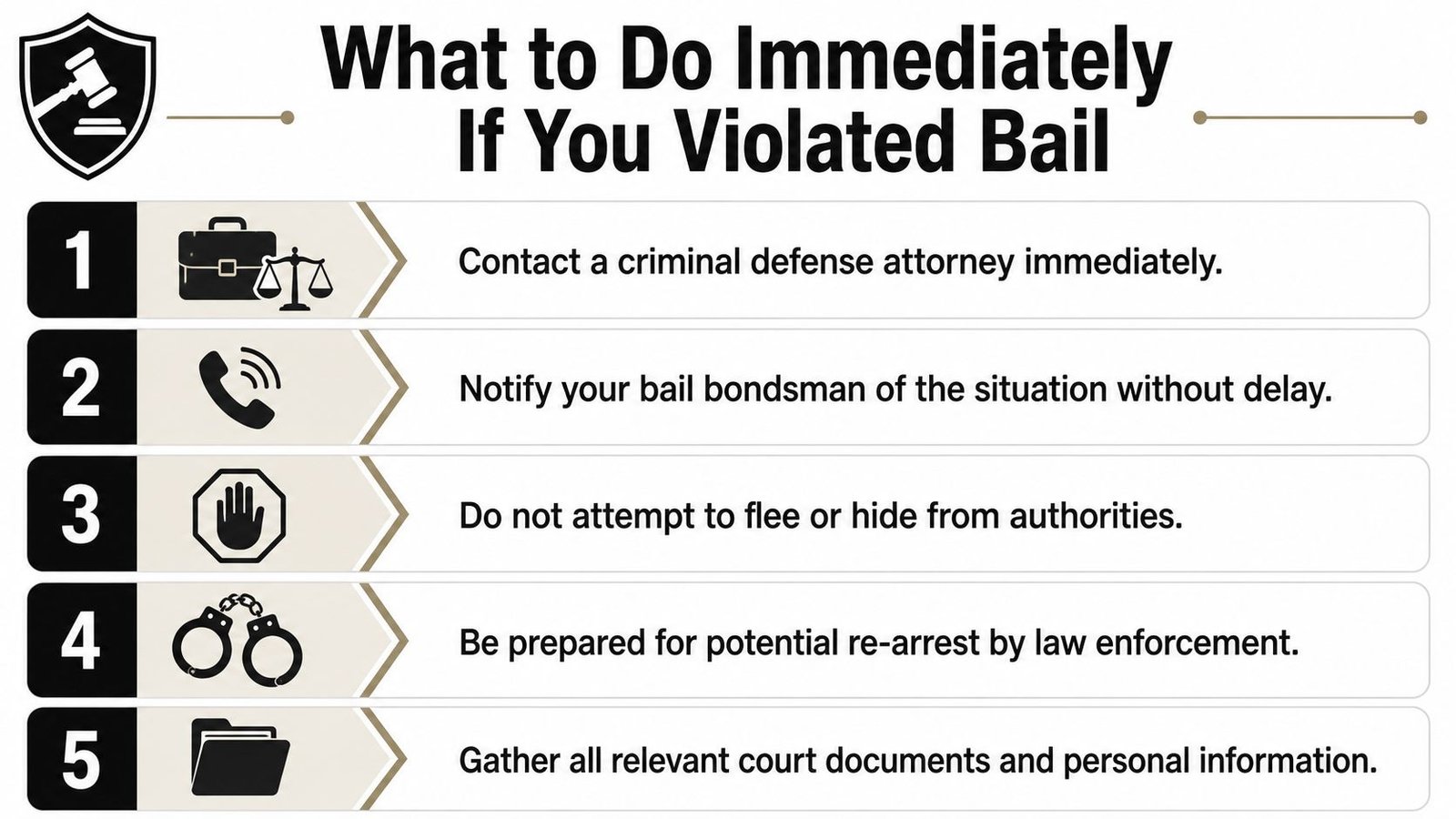
Don't run. Don't switch phones. Don't leave town. Don't ask other people to lie for you. Hiding turns a manageable legal problem into proof that you can't be trusted on release.Call your attorney.
Your lawyer needs to know exactly what happened, when it happened, and what proof exists. If you missed a hearing because of confusion, transportation trouble, hospitalization, or notice problems, your lawyer needs documents and names, not excuses.Notify your bondsman immediately.
If you missed court, review what happens if you miss court in Colorado and then make the call. Don't wait until the bond company finds out from the court or from someone else.Get your paperwork together.
Gather your bond paperwork, release conditions, next court date information, ID, and anything that explains the violation. If you need help organizing filings or understanding submission basics, this guide on avoiding court document mistakes is useful because small paperwork errors can cost you time you don't have.Prepare for the possibility of re-arrest.
That means arranging child care, work notice, transportation, medications, and contact numbers now, not after deputies show up.
Here's the video version for people who need the basics reinforced before they make the next call:
Separate checklist for the cosigner
If you cosigned, your steps are different. Don't just sit beside the defendant and hope their lawyer handles everything.
- Confirm the facts yourself: Get the court date, the alleged violation, and the current status in writing if possible.
- Contact the bond company directly: Give accurate contact details and ask what they need from you right now.
- Secure documents and communications: Save texts, voicemails, appointment notices, and reminders.
- Do not bankroll hiding: Paying for hotels, gas money to leave, burner phones, or secret transportation is a terrible decision.
- Plan for fast decisions: If surrender becomes the least harmful option, delay usually makes it worse.
If you violated bail, honesty gives you a chance. Delay takes that chance away.
What not to say and do
A lot of damage gets done in the first few hours. Avoid these mistakes:
| Bad move | Why it hurts |
|---|---|
| “I'll deal with it next week” | The court may move before you do |
| “Tell them I never got notice” without proof | Unsupported claims damage credibility |
| “I'm staying with a friend, don't tell anyone” | That puts the cosigner in danger too |
| “It was only a minor violation” | Minor to you may still be major to the judge |
Preventing a Violation Before It Happens
The best way to deal with a bail bond violation is to avoid one in the first place. That sounds obvious, but most violations don't happen because someone sat down and planned to wreck their case. They happen because people treat release conditions casually, rely on memory, or stay quiet when they're confused.
Colorado law has teeth here. Under Colorado Revised Statutes § 18-8-212, a person charged with a felony who knowingly fails to appear in the felony case with intent to avoid prosecution commits a Class 6 felony. That should settle any debate about whether skipping court is “just procedural.”
The habits that actually help
Use a system, not good intentions.
- Create a shared calendar: The defendant and cosigner should both have every court date, testing date, and check-in saved on their phones.
- Read every condition line by line: Don't skim bond paperwork. Ask questions until the rules are plain.
- Keep one folder for the case: Put release documents, attorney contact info, reminders, and receipts in one place.
- Report problems early: Transportation trouble, work conflicts, rehab scheduling issues, and confusion about restrictions should be addressed before a missed obligation.
- Treat no-contact and travel terms strictly: Don't look for loopholes. Judges don't like creative interpretations.
The bigger lesson for families
A bond is a second chance with rules attached. Families do better when they treat the bondsman, the lawyer, and the court dates as part of one system instead of three unrelated headaches.
The defendant needs discipline. The cosigner needs visibility. Both need communication. That combination prevents most avoidable disasters.
Compliance is what keeps freedom in place. Once compliance slips, everybody pays for it in stress, time, and often money.
If you need fast, clear help with a Colorado bond situation, contact Express Bail Bonds. They serve detention facilities statewide, handle documents electronically, and can help families and cosigners understand what needs to happen next before a bad situation gets worse.