
It's late, your phone keeps buzzing, and someone you love has just been taken to a Colorado jail. You may know that a bond was set, yet the person still isn't walking out. That gap is where most families lose time. The jail release process has several separate stages, and posting bail is only one of them.
The practical rule is simple: identify the correct facility, confirm the charges and release conditions, use the fastest available paperwork route, and keep expectations realistic. A surety bond can remove payment and document delays, but no bondsman can erase the jail's own safety checks, holds, property procedures, or staffing queue.
Navigating the Initial Arrest and Booking Phase
A late-night arrest usually starts with a confusing chain of handoffs. Police transport the person to a detention facility, jail staff accept custody, and the booking unit begins creating the record that will control the next steps. Until that record is complete, family members may not be able to confirm the person's location or determine whether bail can be posted.
Start with facts, not guesses. Search the relevant county sheriff's inmate database, call the detention facility, and write down the person's full legal name, date of birth, arresting agency, booking number if available, and exact facility. A similar name can produce the wrong record, especially when several people are being processed at once.
What booking staff record
Booking creates the identity and custody record. Staff generally verify identifying information, take fingerprints and a booking photograph, document the alleged charges, screen for medical concerns, and inventory personal property such as identification, keys, money, and a phone. The jail also checks whether another jurisdiction or agency has placed a hold.
The initial charge information matters because the release route depends on the court's order and the type of bond. A person might receive a personal recognizance release, a financial bond, a surety-bond option, or additional conditions that require court or agency action. Don't send money before you know which facility holds the person and what the jail will accept.
Practical rule: Get the booking details in writing or save a screenshot. Names, birth dates, court information, and booking numbers prevent avoidable errors when a jail, court, and bond agency are all handling the same case.
Booking speed changes with staffing, medical needs, fingerprint verification, property handling, and the number of people entering custody. For a closer look at the early intake stage, read how long booking takes in jail. That information helps explain why a bond agency may not be able to start the final release paperwork immediately after an arrest.
Don't treat the allegations as a final legal conclusion. The booking record reflects the charges filed at that moment, not the outcome of the case. If the arrest involves impaired driving, another state's rules can be different, so a resource such as Georgia DUI rules explained may help with general questions outside Colorado, but it doesn't replace advice from a Colorado defense attorney.
Legal Timelines and Administrative Release Bottlenecks
Colorado law puts firm limits on important parts of the release timeline. An arrestee must be brought before a court for bond setting within 48 hours of arriving at a jail or holding facility, according to Colorado's bond-setting statute. That deadline concerns court review and bond setting. It doesn't mean the person will be physically released at the end of the hearing.
Once a personal recognizance bond is set, the jail must release the defendant as soon as practicable and no later than six hours after the defendant is physically present at the jail. The same six-hour maximum applies after a cash bond is set and the jail receives notice that the bond is ready to be posted. The clock depends on the legal trigger and the jail's receipt of the required information.
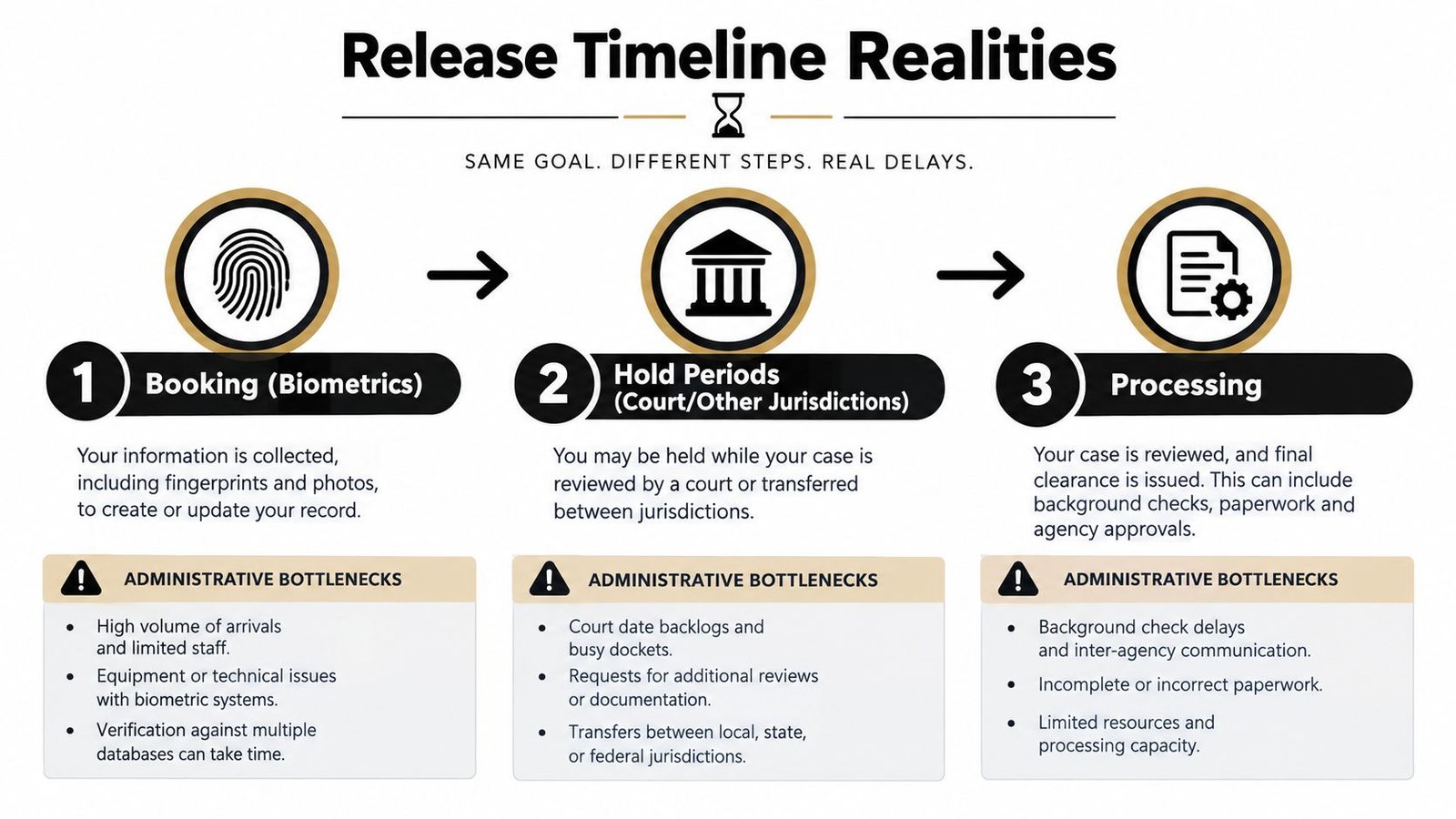
Why eligibility isn't the same as freedom
A Colorado county jail explains that release processing commonly takes two to six hours after the release order is received, and its normal processing estimate is usually four to six hours, with evenings, weekends, and holidays among the busiest booking periods. See the Jefferson County Sheriff's jail information for that operational guidance.
The queue may include several separate tasks:
- Order verification: Staff confirm that the court order matches the person and the bond filed.
- Hold review: The jail checks for detainers, warrants, probation matters, or another legal reason the person can't leave.
- Medical handoff: Staff address medication, withdrawal concerns, medical instructions, or a required transfer.
- Property return: The facility retrieves and reconciles stored belongings.
- Final release work: Staff review conditions, signatures, identification, and transportation procedures.
Shift changes and booking surges can slow the queue even after the bond has been accepted. Administrative records also matter. If you need to understand how case information is organized for review, what a case processing summary is provides useful context for the paperwork side of a criminal matter.
A family should also know that historical state-court data found wide variation in how long released defendants remained in the broader pretrial system. In the 75 largest U.S. counties, 62% of felony defendants were released before case disposition between 1990 and 2004, and released defendants waited a median of 127 days from arrest to adjudication, compared with 45 days for detained defendants, according to the Bureau of Justice Statistics release and detention report. Those figures describe the wider case timeline, not the hours between posting bond and walking out. For the immediate issue, see why someone can be posted on bail but not released.
Evaluating Colorado Bail Options and Surety Bonds
Colorado release options serve different financial and legal purposes. Personal recognizance requires no financial payment when the court permits it, but the defendant still must follow every condition and attend court. A cash bond requires the payor to provide the full bond amount directly through the approved jail or court process.
A property bond uses qualifying real estate as security. It can involve title review, valuation, court approval, and additional documentation, so it isn't usually the practical choice when a family needs a prompt release. The court determines whether the property satisfies its requirements.
Comparing the main choices
| Option | How it works | Main advantage | Main drawback |
|---|---|---|---|
| Personal recognizance | The defendant promises to appear and follow conditions | No bond payment is required | A violation can lead to a warrant or renewed detention |
| Cash bond | The full bond amount is posted directly | The money may be returned under applicable court rules | It ties up the entire amount while the case continues |
| Property bond | Real estate is pledged as security | Useful when qualifying equity is available | Review and approval can take time |
| Surety bond | A licensed agency guarantees the bond for a premium | It reduces the immediate cash requirement | The premium and contract obligations remain |
A surety bond is a three-party arrangement. The court receives the agency's guarantee, the defendant agrees to appear and comply, and the cosigner or indemnitor accepts financial responsibility under the contract. The agent files the bond rather than requiring the family to deliver the entire amount in cash.
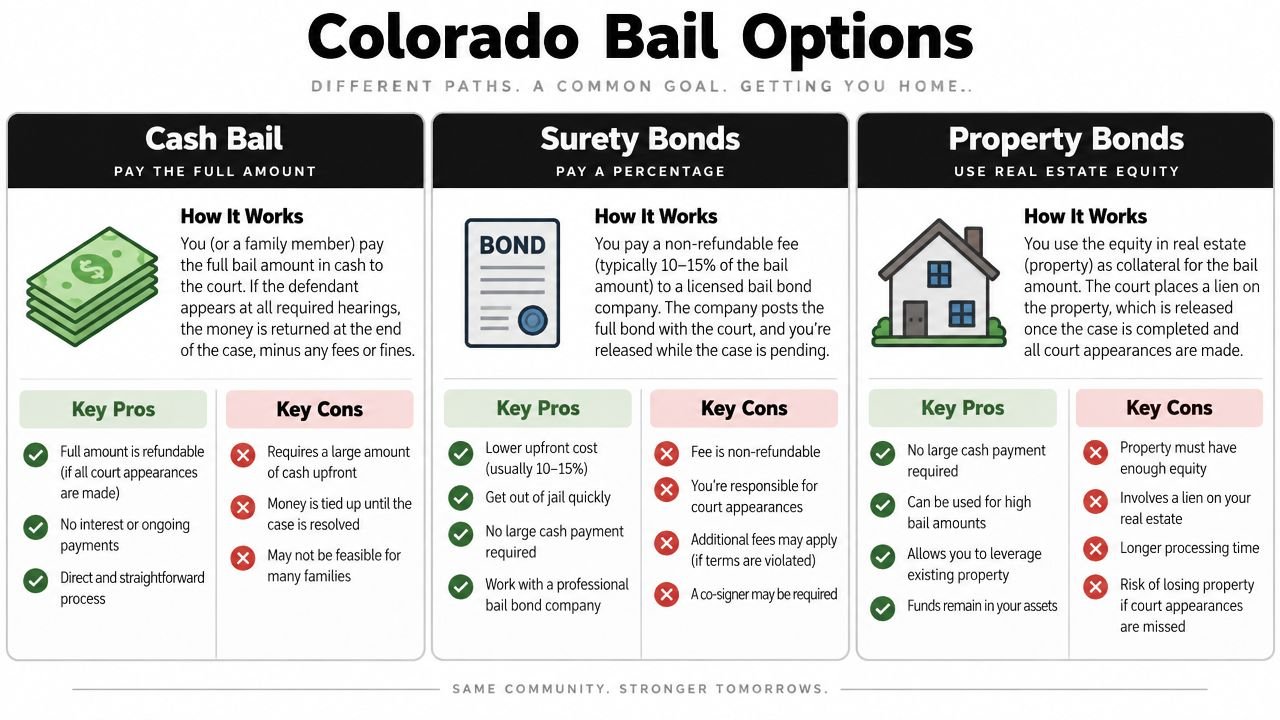
Why families often choose a surety bond
Cash can be appropriate when the payor has the full amount available and understands the court's refund rules. It can be a poor choice when using that money would disrupt rent, payroll, medical care, or other essential obligations. A property bond may preserve cash, but the paperwork can make it unsuitable for an urgent release.
A surety bond doesn't guarantee instant freedom. It does allow the bond paperwork to move through an experienced agent while the family avoids carrying the full bond amount to the facility. Review the distinctions between release instruments in the types of bail bonds before choosing a route.
Colorado county materials also state that a surety bond may be posted through a state-licensed bond agent, who may require a cosigner or collateral. The premium commonly falls between 10% and 15% of the total bond amount, according to Arapahoe County bond information. Ask for the total premium, collateral terms, payment schedule, and surrender conditions before signing.
Streamlining Release with Electronic Bail Applications
Electronic processing changes where the family does the work. Instead of waiting at a detention center to complete every form, a cosigner can often begin by phone or text, review documents remotely, and send required identification electronically. The agent then handles the jail-facing portion of the filing.
The workflow should be orderly:
- Confirm the person and facility. Provide the full legal name, date of birth, charges if known, and booking details.
- Review the contract. Read the premium, collateral provisions, indemnity language, payment obligations, and court-appearance requirements.
- Submit identification. Send clear digital copies through the agency's secure process, not through an informal public channel.
- Sign electronically. Complete the required bond and cosigner documents only after asking questions about unfamiliar terms.
- Make the agreed payment. Confirm which payment method is authorized and obtain a receipt.
- Wait for filing confirmation. The agent submits the bond to the proper jail or court and confirms when the facility accepts it.
- Track the facility queue. After acceptance, the jail still completes its own release checks, property return, and final discharge work.
Why remote cosigning helps
Out-of-state relatives often can't drive to Colorado on short notice. Electronic applications let an eligible cosigner review and authorize the bond from home while the agent coordinates with the detention facility. That removes travel time and reduces the chance that a family member loses hours carrying paperwork between offices.
Electronic documentation is useful only when it is secure, complete, and accepted by the relevant agency. Learn how this process works through electronic documentation for bail paperwork, then ask the agent which forms and identification are required for the specific jail.
Express Bail Bonds offers statewide surety-bond processing, electronic applications, digital contracts, payment coordination, and bond posting at Colorado jails. Its published service information says the agency is available by call or text and focuses on surety bonds rather than cash-only bonds. The agency's role is to move an accepted bond into the jail workflow efficiently, not to control the jail's internal release queue.
What electronic processing removes: travel, paper handling, and unnecessary waiting by the cosigner. It doesn't remove court conditions, legal holds, or the jail's final safety procedures.
Understanding Cosigner Responsibilities and Premium Fees
A cosigner, also called an indemnitor, isn't just paying a service charge. The cosigner enters a contract that can create financial responsibility if the defendant fails to appear, violates the agreement, or causes the bond to be forfeited. Read every provision before signing, especially collateral, payment deadlines, surrender rights, and duties to keep contact information current.
Colorado bond materials describe the usual surety premium as 10% to 15% of the bond amount, with the exact arrangement depending on the licensed agent and the approved application. A premium pays for the agency's risk and service. It generally isn't treated like a refundable deposit, so don't assume successful completion of the case automatically returns it.
The obligations that matter most
The cosigner should maintain reliable contact with the defendant and the agency. The defendant must attend every required court date and obey conditions such as no-contact orders, testing requirements, travel restrictions, or reporting duties when imposed by the court.
Use a written system immediately:
- Court calendar: Record every date, time, courtroom, and appearance type.
- Contact updates: Give the agency prompt notice of a new address, phone number, employer, or travel plan.
- Transportation plan: Arrange dependable transportation to court rather than relying on a last-minute ride.
- Document storage: Keep the bond contract, receipts, release paperwork, and court notices together.
- Condition review: Ask defense counsel to explain legal conditions the defendant doesn't understand.
For a more detailed explanation of the indemnitor's role, review cosigner responsibilities. The bondsman can explain the contract, but a defense attorney should answer questions about criminal charges, defenses, and court strategy.
Refund protections and surrender issues
Colorado law provides a limited protection when bond conditions change soon after posting. If conditions are changed within 14 days, the court may order a compensated surety to refund part of the premium after a hearing when necessary to prevent unjust enrichment, as described in Colorado's premium refund statute. This isn't an automatic refund and doesn't mean every modification qualifies.
The same materials explain that a surety may be exonerated by surrendering the defendant, which can affect premium refund rights. Never treat surrender as a casual option. Speak with the bond agency and defense counsel before taking action, because the timing and circumstances can affect the contract, collateral, and court obligations.
Debunking Myths About Release Delays and Hidden Fees
Families often hear, “The bond is posted, so they should be outside already.” That statement confuses legal eligibility with physical release. The jail still has to verify the filing, check holds, complete release paperwork, return property, address medical handoff issues, and discharge the person through its controlled release area.
Myth one, bond set means immediate release
Fact: A court's decision starts the release path. It may not complete the bond filing, and it doesn't complete the jail's discharge work. Colorado's statutory limits and county processing estimates create a framework, but the precise wait depends on when the jail receives the order and what remains in the queue.
Myth two, every extra fee must be paid before release
Fact: Colorado bond materials state that bond fees, booking fees, and other debts don't have to be paid to secure release on a money bond. The payor needs to provide the bond amount. Park County explains that an extra $10 bond fee and a credit-card fee of up to 3.5% are treated as debts after release rather than conditions for release, as detailed in its right-to-bond requirements.
That rule concerns the jail or court's bond requirements. A surety agency's premium, collateral, and contract charges are separate matters. Ask for those terms before signing, and don't confuse a jail debt with an agency obligation.
Myth three, a bondsman can guarantee the exact release time
Fact: An agent can submit accurate paperwork and reduce avoidable travel or document delays. The agent cannot control staff queues, lockdowns, medical review, property retrieval, court notifications, or another jurisdiction's hold.
The practical response is to request status updates tied to specific milestones: Was the bond accepted? Was a hold found? Has the person entered the release queue? Is property return complete? Those answers are more useful than repeated calls asking only whether the person is out yet.
The honest answer: Faster bond filing helps, but the final release remains a jail operation.
Post-Release Compliance and Court Notification Next Steps
Walking out of the jail ends custody, not the case. The defendant now has to protect the release by following conditions, appearing in court, and keeping the bond agency informed. The cosigner should treat the first days after release as an organization task, not a time to relax all oversight.
Read the release paperwork before leaving the facility. Confirm the court name, appearance date, time, location, and every written condition. Then create redundant reminders on a phone calendar and a second calendar used by a family member or cosigner.
Build a compliance routine immediately
The defendant should:
- Save court information: Photograph or securely store the release order and court notice.
- Set reminders: Use alerts well before each appearance, not just on the morning of court.
- Confirm transportation: Plan the route and allow time for parking, security, and check-in.
- Follow restrictions: Treat no-contact, travel, testing, treatment, and reporting conditions with strict compliance.
- Update contacts: Notify the bond agency promptly about changes in address, phone number, employment, or residence.
- Coordinate with counsel: Ask a Colorado defense attorney to explain anything unclear or conflicting.
Court notices can arrive by mail or through court systems, and dates can change. Don't rely on a friend's memory or an informal text from another person involved in the case. Verify changes with the court, defense counsel, and the bond agency.
If a court date is missed
Act immediately. A missed appearance can trigger a warrant, a bond problem, and additional financial exposure for the cosigner. Waiting for the court or agency to discover the absence makes the situation harder to manage.
The defendant should contact defense counsel and the bond agency as soon as the problem is known. Explain whether the date was missed, rescheduled, or misunderstood, and provide any written notice. The bondsman may need to respond to a court issue or discuss surrender procedures, while only the court can resolve the underlying attendance problem.
The broader federal picture reinforces why release compliance matters. One Bureau of Justice Statistics report found that 82.9% of federal defendants were released before trial, while 17.1% were detained, and among those released, about 10% were rearrested for a new crime, violated release conditions, or failed to appear, according to the BJS pretrial release report. Another BJS analysis found that 76% of released federal defendants received non-financial release conditions, including personal recognizance or an unsecured bond. Release is a structured responsibility, not a conclusion.
Express Bail Bonds helps Colorado families start the surety-bond process through remote applications, electronic documents, payment coordination, and bond posting at the appropriate jail or court. If someone you care about is waiting in custody, visit Express Bail Bonds to begin the application, or use the local resources for Jefferson County and Golden and Centennial bail bonds for location-specific assistance.