The phone usually comes at the worst possible time. Late at night. During work. While you're trying to put the kids to bed. A loved one says they've been arrested in Colorado, and suddenly you're trying to sort out jail, bond, court, and what “release” even means.
Most families use the phrase release from prison to describe any urgent effort to get someone out. In everyday conversation, that makes sense. In practice, though, there are two very different situations. One is release from a local jail after an arrest, usually through a bond or a court order before trial. The other is release from prison after a sentence has been served. If you're dealing with a fresh arrest, you're almost always dealing with the first situation.
That distinction matters because the next steps are different. The good news is that release is a normal part of the justice process. In fact, over 95% of the prison population will eventually be released and return to society according to the Congressional Research Service report on reentry. Families often feel like they're facing something unusual. They usually aren't. They're facing a process that moves fast, uses unfamiliar language, and punishes hesitation.
Your First Call After an Arrest in Colorado
When someone calls from a Colorado jail, the first instinct is usually panic. The second is often to ask the wrong question. Families jump straight to “How do I get them out tonight?” before they know where the person is being held, whether bail has been set, or whether the court allowed release at all.
Start with basics. Get the full legal name, date of birth if possible, the jail location, and the charges if they know them. Ask whether the jail gave them a booking number. If they don't know, don't get stuck there. Name and facility are usually enough to start confirming status.
What release usually means right now
In a new arrest, “release from prison” usually means release from jail before trial, not walking out after finishing a sentence. That's why bond type matters so much in the first few hours.
A family that understands that difference makes better decisions. They stop waiting for the wrong event. They start asking the right questions: Was bond set? Is it cash only? Is it a surety bond? Is the person eligible for personal recognizance?
Practical rule: Don't assume a person stays in custody until the case is over. In many Colorado cases, the first real decision is whether they can be released while the case is pending.
What helps and what slows things down
What helps is calm, accurate information. What slows things down is guessing, arguing with jail staff, or sending five relatives in different directions with conflicting instructions.
Use one point person if you can. One family member gathers details, speaks with the court or jail, and handles paperwork. That avoids mistakes with names, charges, and payment plans.
If you're still at the very start, this guide on what to do when arrested gives a practical checklist for the first hours after booking.
Cash Bond vs Surety Bond vs Personal Recognizance
The biggest source of confusion for families is that “bond” doesn't mean one thing. Colorado recognizes four mechanisms for pretrial release: Cash Bond, Surety Bond, Personal Recognizance Bond, and Property Bond, as outlined in this Colorado bail and bond guide. Most families deal with the first three.
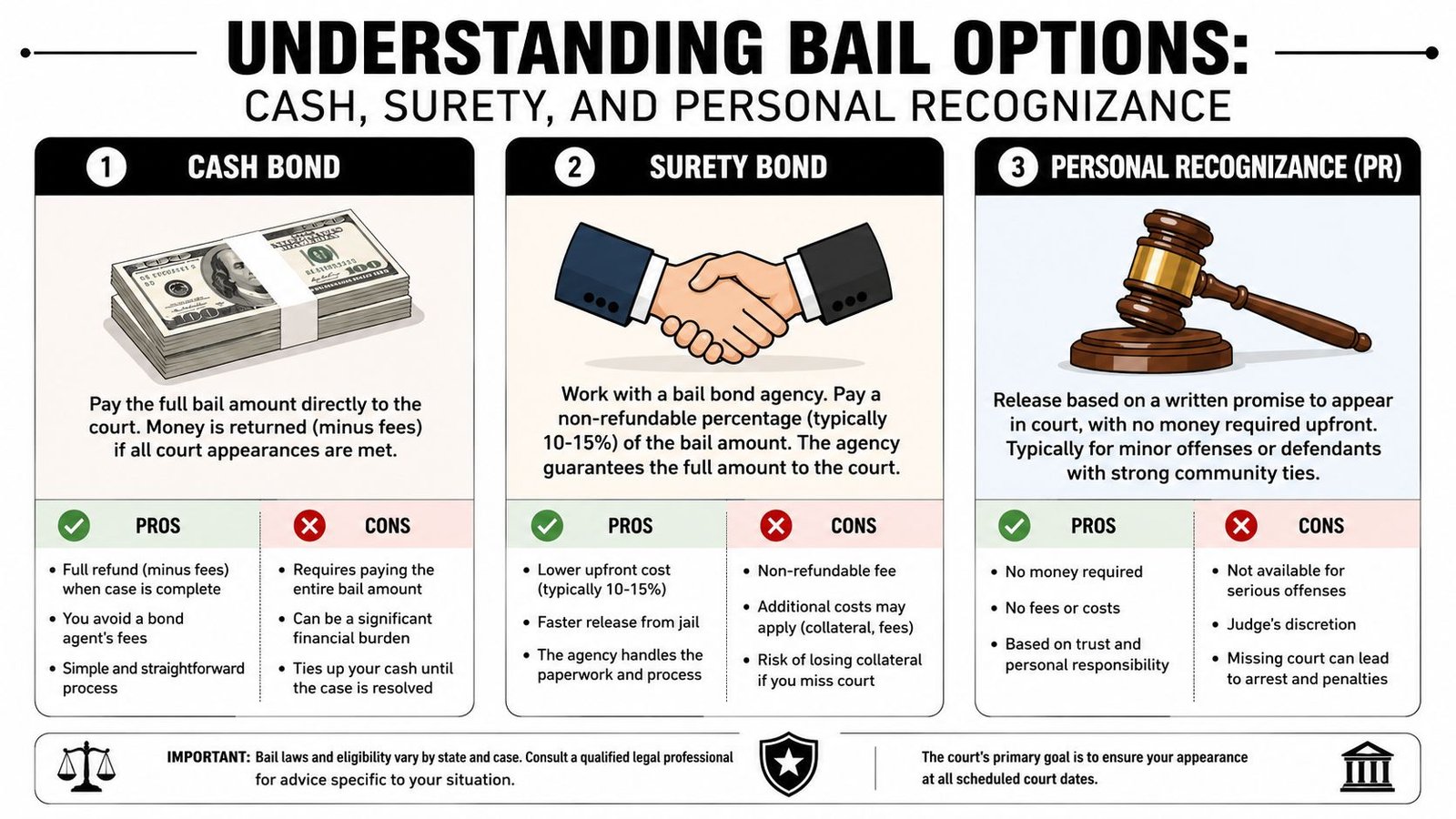
The practical difference between the main options
Here's the short version.
| Release option | How it works | Main advantage | Main trade-off |
|---|---|---|---|
| Cash bond | You pay the full amount directly to the court | Potential refund if the case requirements are met | Ties up a large amount of money |
| Surety bond | A licensed bondsman posts the bond for a fee | Lower upfront out-of-pocket cost than full cash | The premium is not refunded |
| PR bond | The court releases the person on a promise to appear | No upfront payment | Not everyone qualifies |
Cash bond
Cash bond is straightforward. The court sets an amount, and someone pays the full amount to the court. If the defendant follows the court's rules and appears as required, the money may be returned according to the court's process.
This option works best when the family has immediate access to the full amount and wants to avoid paying a non-refundable premium. It works poorly when pulling together that amount would wreck rent, payroll, or a household emergency fund.
Surety bond
A surety bond is the typical service associated with contacting a bail bond company. Instead of paying the full bond amount to the court yourself, a licensed agency guarantees the amount to the court and charges a premium.
The key trade-off is simple. You keep more cash in your pocket up front, but the premium isn't returned. For many families, that trade is worth it because speed matters and tying up the full amount isn't realistic.
For a more detailed side-by-side breakdown, see this guide to cash bond vs surety bond.
PR bond
A Personal Recognizance bond, often called a PR bond, means the court releases the person based on a written promise to return. No money is required up front.
This can be the best result for the defendant financially, but it's not something a family can force into existence. The judge looks at the charge, history, local ties, and risk factors. Families waste time when they assume they can “request a PR” as if it's a form they need to file.
If the court grants PR, take the win and focus on compliance. If the court sets money bond, switch immediately into decision mode instead of arguing with the result.
Posting a Surety Bond in Colorado Step by Step
A Colorado judge sets a surety bond late in the day. Your loved one is in custody. You are trying to help from home, and every bad detail slows things down. The fastest path is a simple one. Get the right information, choose the right cosigner, and complete the paperwork carefully the first time.
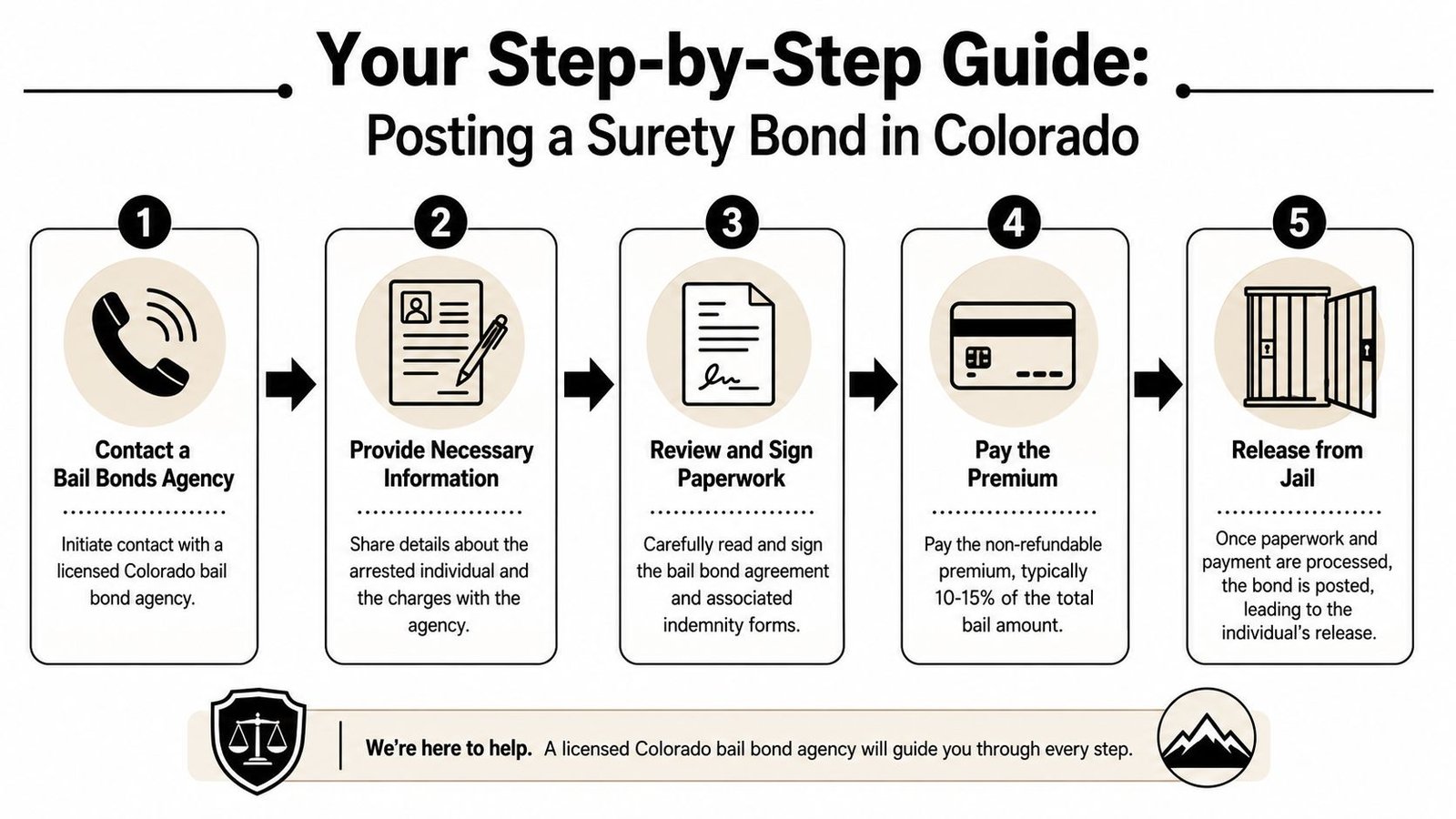
Step one through step three
Confirm the jail, case status, and bond type.
Start by verifying where the person is being held and whether the court set a surety bond. Families lose time when they assume any bond can be handled the same way. It cannot. A surety bond does not apply to a cash-only bond, and a transfer between facilities can change who needs the paperwork.Gather the details the agent will need.
Use the defendant's full legal name, date of birth if you have it, the jail location, and the booking number if one has been assigned. Charge information also helps because conditions tied to the case can affect timing and paperwork. If you do not have every detail yet, start the call anyway and fill in the gaps as they come.Choose one cosigner and discuss responsibility plainly.
The cosigner is the person signing the indemnity agreement and taking financial responsibility if the defendant skips court or breaks bond conditions. That role should be clear before anyone signs anything. In practice, cases move faster when one responsible adult handles decisions instead of three relatives debating the same questions by group text.
What the premium covers
The premium is the fee paid to the bail bond company for writing the bond. It is separate from the court's bond amount, and it is generally not refunded just because the case ends well later.
That point matters. Families under stress often hear "bond" and assume every dollar comes back at the end. With a surety bond, the premium pays for the service and the risk the agency takes on.
Step four and step five
Review and sign the paperwork carefully.
Read the indemnity agreement. Confirm the defendant's legal name, the bond amount, and any appearance requirements. Ask direct questions about collateral, check-in expectations, travel restrictions, and what happens if the defendant misses court. Small errors matter here. Wrong names, rushed signatures, or incomplete forms can delay posting.Pay the premium, then wait for the bond to be posted and processed.
After signing and payment, the agency submits the bond through the jail or court process used in that county. Posting the bond is one step. Release is another. The jail still has its own release workflow, and that can take time depending on staffing, shift changes, warrants, holds, or medical clearance.
If you want a practical walkthrough before you sign, this guide on how to post bail for someone covers the common trouble spots.
What helps the process move faster
The families who get through this with the fewest delays usually do a few things right:
- They keep one point of contact. One cosigner and one decision-maker cuts down confusion.
- They answer screening questions truthfully. Prior failures to appear, holds, or supervision history usually come out anyway.
- They watch the details. Legal names, dates of birth, and signed documents need to match.
What slows things down is avoidable. Calling five agencies without having basic booking details, arguing with jail staff about timing, or treating the cosigner role like a favor instead of a legal obligation usually creates more stress than progress.
Express Bail Bonds handles surety bond applications, payments, and contract documents electronically for qualifying cases. That is especially useful when the person helping with the bond is not in Colorado and needs to complete the process remotely.
How Remote Bail Bonds Work for Out-of-State Cosigners
Distance used to stop families cold. A brother in Arizona, a parent in Nebraska, or a spouse traveling for work might want to help but couldn't get to a Colorado detention facility fast enough to sign papers in person.
That problem is smaller now because many parts of the bond process can be handled remotely.

Why remote processing matters now
Modern jails have changed the workflow. Many jails now require digital-only contract signing for surety bonds, creating a digital reentry barrier for people without smartphone access, as noted in this Prison Policy Initiative discussion of education and digital access.
That sounds technical, but the practical point is simple. Paper-only assumptions can slow release. If the cosigner is out of state, remote electronic processing can remove a major bottleneck.
What the remote process usually looks like
A remote bond usually follows this pattern:
- Initial contact: A family member provides the defendant's information and jail location.
- Document review: The agency sends agreements electronically for review and signature.
- Identity and responsibility check: The cosigner confirms their role and financial responsibility.
- Electronic payment: The premium is handled without requiring an in-person office visit.
- Bond posting: Once the file is complete, the agency moves to post the bond.
For families outside Colorado, this guide to out-of-state bail bonds is useful because it addresses the mechanics that usually trip people up.
Some readers prefer to see the process rather than read about it. This walkthrough helps:
What remote help does not change
Remote processing doesn't change the legal obligations. The defendant still has to appear. The cosigner still has to understand the risk. The jail still controls the physical release timeline.
What it does change is logistics. You no longer have to be physically present in Colorado just to move the file forward.
After the Bond Is Posted What Happens Next
Families often think posting the bond is the finish line. It isn't. It's the point where the release process begins inside the jail.
Why release can still take time
After the bond is accepted, jail staff still have work to do. They have to verify the bond, complete internal processing, check for any holds, and finish release procedures. That's why a person may still sit for a while after everyone on the outside thinks the issue is “done.”
The best approach is patience paired with clear communication. The bond gets the legal authority for release in place. The jail controls the physical exit.
Don't promise a pickup time until the jail actually confirms release is moving. Families create unnecessary conflict when they assume every release should happen immediately.
The defendant's job after walking out
Once released, the defendant has obligations. The two biggest are simple and serious:
- Appear for every court date. Missing court can create a new problem fast.
- Follow every bond condition. That may include travel limits, no-contact orders, sobriety requirements, or treatment instructions.
If substance use or treatment is part of the court's concern, families often need a clearer picture of how conditions can interact with care. This overview of understanding court-ordered rehab gives useful context.
Jail release is not parole
One mistake I see often is families mixing up pretrial release with parole. They're not the same.
For someone already serving a sentence, parole eligibility in Colorado for class 2 through 6 felonies begins after serving 50% of the sentence, reduced by earned time credits, according to this Colorado parole process explanation. That's a sentence-completion issue. Bond is a pretrial release issue. Different stage, different rules, different timeline.
Colorado Jail and Prison Release FAQ
Does the premium come back if the case is dismissed
No. The surety bond premium pays for the bond service. It isn't the same as posting the full cash amount directly with the court.
That's why families should ask the right question up front. Not “Do we get it back?” but “What are we paying for, and what responsibility does the cosigner take on?”
How long does release take after the bond is posted
It depends on the jail's internal process. Some releases move quickly. Others take longer because of booking volume, staffing, shift changes, or additional holds.
The safest advice is practical. Don't assume the person will walk out the minute paperwork is complete. Stay reachable and wait for confirmation.
What risk does a cosigner take
A cosigner is backing the bond. If the defendant doesn't appear or violates the bond in a way that triggers a serious problem, the cosigner can face financial consequences under the agreement they signed.
That's why the best cosigner isn't just the person with the strongest feelings. It's the person who understands the responsibility and can help keep the defendant on track.
Before you cosign, ask yourself one blunt question: “Can I trust this person to follow rules when they're back out?”
What if the court set a cash bond instead of a surety bond
Then the family may need to post the full amount with the court if they want release that way. A surety bond doesn't replace a cash-only order.
Families often lose time by assuming all bonds work the same way. They don't. Confirm the exact bond type before making plans.
Can someone out of state still help
Yes, often they can. Remote paperwork and electronic payment have made that much more workable, especially when in-person travel would cause delay.
That matters for modern families. People don't all live in the same city anymore, and emergencies don't wait for everyone to get on a plane.
Where can I learn more about bond conditions after release
Bond conditions vary by state and court, but it helps to see how these issues are handled in other jurisdictions too. This article on navigating bond conditions in Texas gives a useful outside comparison for families trying to understand what post-release compliance looks like.
Is judicial release the same as posting bond
No. Judicial release is a separate legal concept and not the same as arranging a pretrial surety bond after arrest. If you want a plain-English explanation, this page on what judicial release means clears up the difference.
Who should I call if I need fast release help in Colorado
If you or a loved one needs fast release from jail in Jefferson County, Golden, Centennial, or anywhere in Colorado, contact Express Bail Bonds immediately at 720-984-2245 or use their online process through Express Bail Bonds, Jefferson County Golden bail bond help, or Centennial bail bond services.
If you need help right now, contact Express Bail Bonds. Families can start the application electronically, get clear answers about surety bond requirements, and move the release process forward without waiting around at a jail lobby.