
Does finding a name on a jail website confirm where someone is being held, or whether you can visit or post bail? Not necessarily. For families trying to understand Las Animas County Jail, the safest starting point is a phone confirmation, not an online listing or an assumption based on where the arrest happened.
Once you've confirmed custody, you can ask useful questions about visits, mail, bond conditions, and release processing. Keep those questions separate: permission to visit doesn't establish release eligibility, and available jail beds don't mean someone will be released quickly.
Key Contacts and Location at a Glance
Las Animas County Jail contacts and location
| Detail | Value | Use it for |
|---|---|---|
| Operator | Las Animas County Sheriff's Office | Confirming who runs the facility |
| Address | Garcia Justice Center, 2309 E. Main Street, Trinidad, CO 81082 | Getting to the facility |
| Main line | 719-846-2211 | Custody status, bond amounts, charges and visitation times |
| Counter hours | Monday to Friday, 8:00 a.m. to 4:00 p.m. | In-person questions during business hours |
| After-hours non-emergency | 719-846-4441 | Non-emergency questions outside counter hours |
The Las Animas County Sheriff's Office publishes the facility's location, main contact number, counter hours, and after-hours non-emergency number listed above. Use the main line for custody and booking questions, and the after-hours non-emergency line for non-emergency questions outside counter hours.
This table is a quick lookup, but each entry serves a different purpose. The street address tells you where the facility is, while counter hours identify when the public-facing counter is open. Neither establishes that a particular person is available for a visit or ready for release.
Third-party roster and directory pages can be incomplete or out of date. Treat them as starting points rather than confirmation that someone is currently detained. A missing online entry also shouldn't be treated as proof that the person isn't in custody.
If another county may be involved, our county jail phone number directory can help you identify the appropriate contact. Confirm the holding facility before arranging a long drive, sending documents, or coordinating pickup.
Before dialing, gather enough identifying information for staff to distinguish your family member from someone with a similar name.
How to Confirm Someone Is Held Here
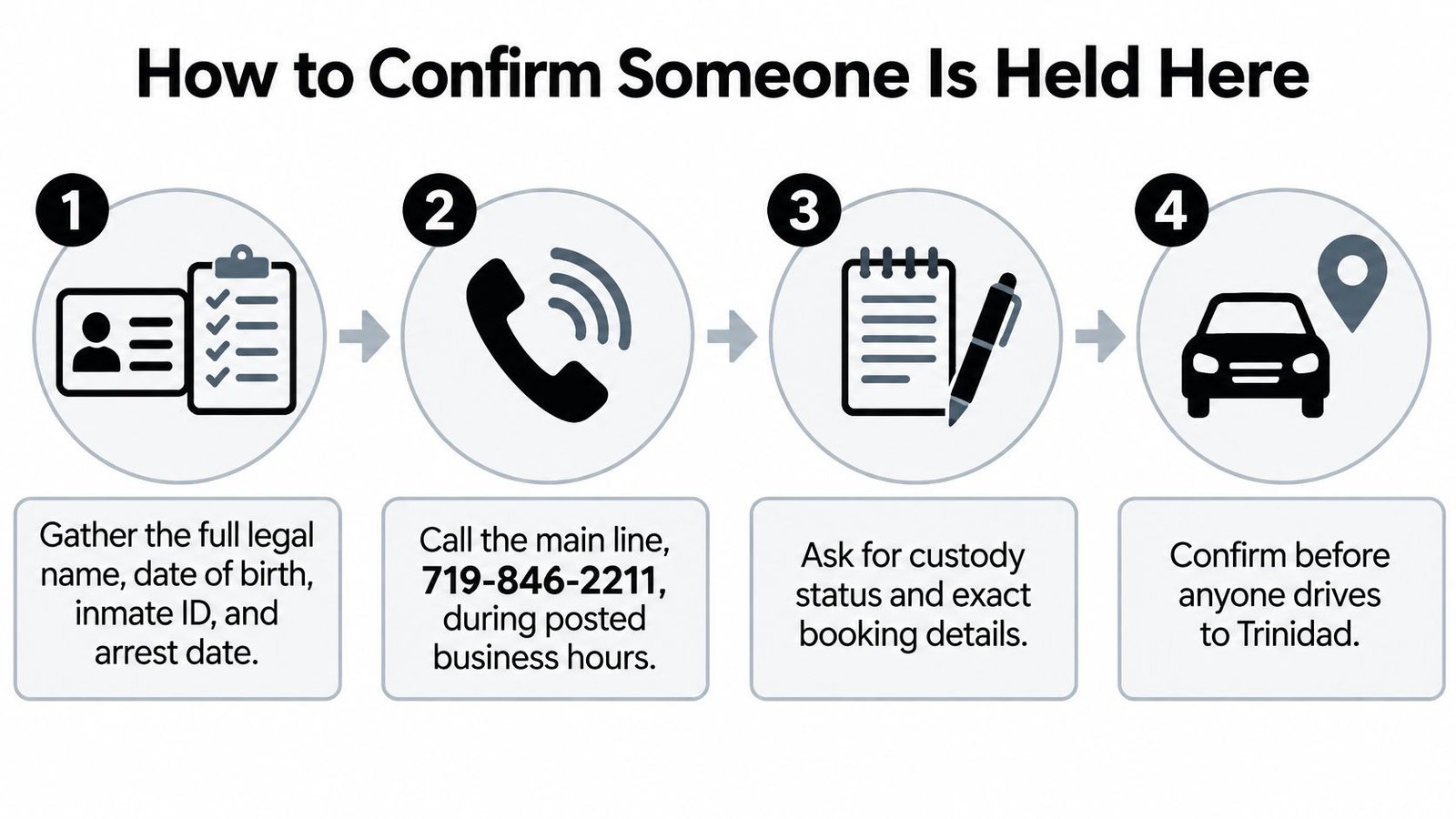
Could someone have been booked but not yet appear in an online search? Call the Las Animas County Sheriff's Office main line listed in the previous section and ask staff to confirm current custody. A phone check is the clearest way to establish whether the person is being held there before you make plans.
Have the person's full legal name and date of birth ready. An inmate ID or arrest date can also help staff find the correct record, especially when names are similar.
Ask whether the person is currently at the facility, whether intake or classification is still underway, and whether a transfer has occurred. If staff confirm custody, ask what charges, bond amount and type, and court date are recorded. These details can change as a case progresses, so base decisions on what staff confirm at the time of your call.
If staff can't find a record, check the spelling and offer any alternate names you know. Ask whether another agency or county may have handled the booking. A missing online result alone does not confirm that someone has been released or was never in custody.
Write down the time of your call and the information staff provide. You can also use the inmate locator tool to help organize a search, but confirm custody by phone before arranging travel or making payment decisions.
Visitation Rules and How to Schedule a Visit
Reported visitation rules at Las Animas County Jail
| Rule | Detail | How to verify |
|---|---|---|
| Visit length | 30 minutes | Ask at scheduling |
| Visit frequency | One visit per inmate each week | Confirm the week's slot |
| Guests per inmate | Maximum of two | Confirm the list before the visit |
| Approved visitor list | Visitor must be on the inmate's list | Ask how to be added |
| Photo identification | Government-issued photo ID required | Bring it on the day |
| Dress code | Professional, non-revealing clothing | Follow the posted guidance |
| Visit times | Differ by inmate and housing location | Call the main line before traveling |
Jail Exchange's facility listing reports 30-minute visits, one visit per inmate each week, a maximum of two guests, approved-list placement, government-issued photo identification, and professional, non-revealing clothing. These are reported rules, not a substitute for the facility's current scheduling instructions.
Get approval before making travel plans
Begin by confirming that the person has been booked and can receive a visit. Then ask how your name gets added to the approved visitor list, what information staff need, and how you'll know approval is complete.
Next, schedule the visit and confirm the check-in instructions. Ask whether your intended guest is also approved, rather than assuming family members can attend together.
Before you leave: Confirm the appointment, visitor approval, and acceptable identification with the facility.
Bring the required photo ID on the day and choose clothing that follows the facility's guidance. If you're unsure about an item, describe it during scheduling instead of waiting until check-in.
For example, a relative may have a scheduled appointment but still lack approved-list status. Treat scheduling and approval as separate questions, and begin the approval request early.
If staff refuse a visit, ask for the specific reason and the action needed to correct it. Missing approval, identification problems, and a changed appointment require different responses. Don't make another trip until staff confirm that the issue has been resolved.
Sending Mail to an Inmate Correctly
Personal mail needs the designated mailing address, not just the jail's street address. Follow the sheriff's instructions for the incarcerated person's name and inmate ID so mail can be matched to the intended recipient.
Use this sequence before sending anything:
- Confirm identity. Obtain the person's full name and inmate ID from the facility.
- Get the mailing address. Ask the sheriff's office for the current designated personal-mail destination.
- Label the recipient. Put the full name and inmate ID on the first line.
- Identify the sender. Include your return address.
- Check the contents. Ask what's permitted before enclosing anything beyond a letter.
Example address format
Incarcerated person's full name, inmate ID
Designated personal-mail address supplied by the sheriff's office
City, state, ZIP code supplied by the sheriff's office
This is a format example, not a mailing destination. Don't substitute the public counter address unless staff explicitly direct you to use it.
Name or ID errors can delay routing or cause returned mail, especially when people have similar names. Check both against your call notes and keep a record of the mailing date.
Our jail rules guide can help you organize questions about correspondence. Mail and visitation are separate contact methods, so approval for one shouldn't be taken as approval for the other.
Capacity and Population Figures Explained
The Colorado Legislative Council's 2017 county jail overview listed Las Animas County Jail with 105 rated beds and an average daily population of 55 people, equivalent to approximately 52.4% average occupancy, calculated by dividing population by capacity. At that time, its typical population was about half its listed capacity, placing it among Colorado's smaller county jails.
Rated capacity describes the listed bed capacity. Average daily population describes how many people were held on an average day during the reporting period. Neither tells you how many people are in custody today.
| Measure | What it helps explain | What it doesn't establish |
|---|---|---|
| Rated capacity | The facility's listed scale | Current staffing or usable housing assignments |
| Average daily population | Typical population during a reporting period | Today's headcount |
| Average occupancy | Population relative to listed capacity | An individual's release timing |
Historical records require similar care. The Justice Department's 1988 Census of Local Jails separately identified Las Animas County, but its historical categories shouldn't be compared directly with later average-population figures unless the definitions match.
A point-in-time count, admissions total, and daily average answer different questions. Comparing them as though they're interchangeable can create a misleading impression of growth or decline.
Our jail overcrowding guide provides broader context for capacity questions. For a current count, ask the sheriff's office what measure and reporting date it can provide.
An empty bed doesn't tell a family whether a court has authorized release.
These figures don't establish anyone's bond, charges, release date, or processing time.
Bail, Release Timing and Cosigner Checklist
Bail and release routes compared
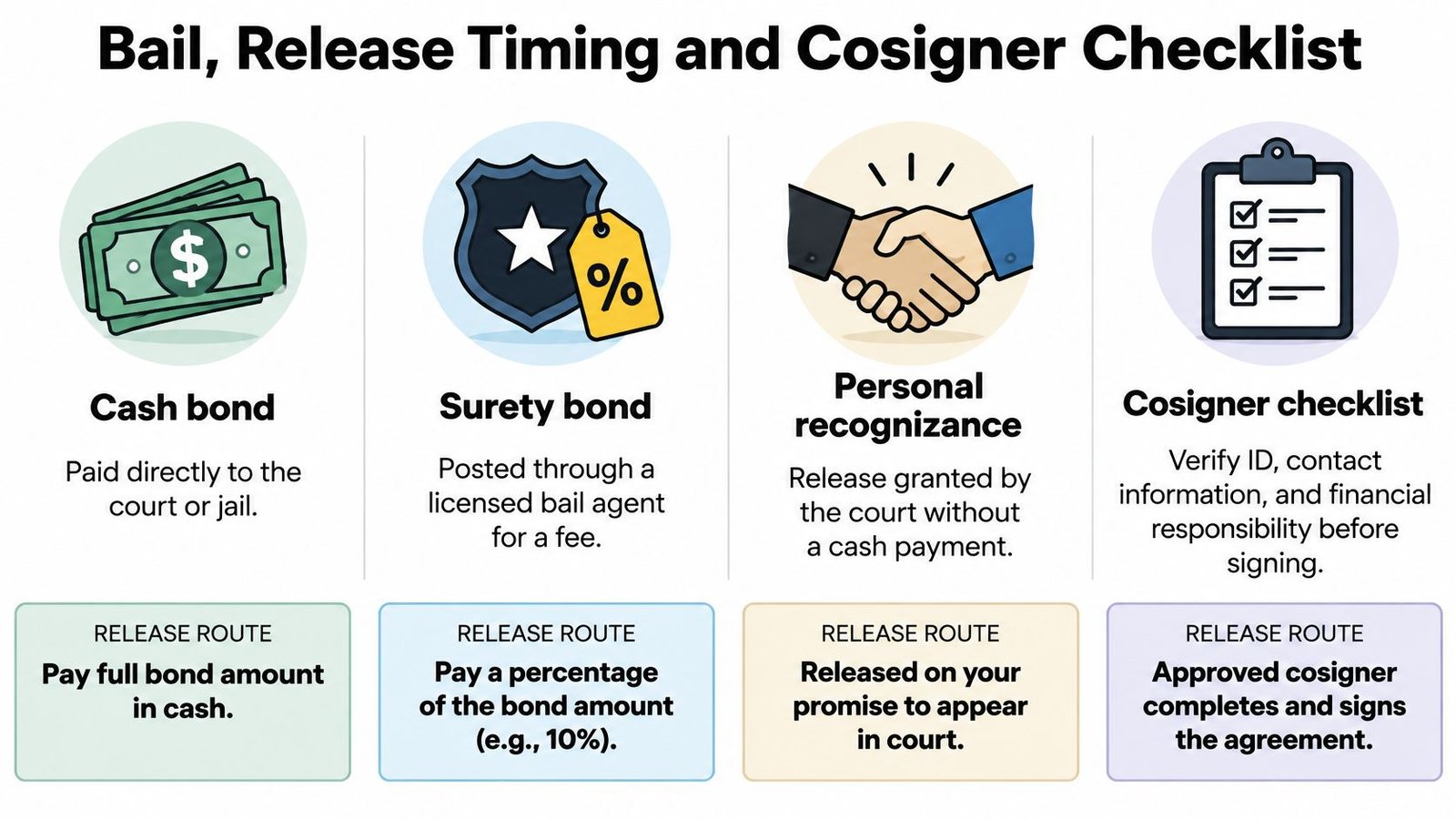
| Release route | What it means | Who usually arranges it | What controls timing |
|---|---|---|---|
| Cash bond | Full bail amount paid to the court or jail | Defendant or family | Payment verification before release |
| Surety bond | Bondsman posts the bond for a fee under contract | Licensed bail agent with any cosigner | Contract signing and posting at the jail |
| Personal recognizance | Release on a promise to appear, with no payment | Court decision | Court order and jail processing |
| Property bond | Real estate pledged as security | Property owner and court | Title and value review before release |
These routes aren't interchangeable options that every defendant can freely choose. The court's order controls the available bond type and conditions. Confirm the exact terms with the sheriff's office or relevant court before arranging money or signing documents.
A cash-only requirement, for example, is different from a bond that permits a surety. Likewise, personal recognizance requires court authorization, not a family's decision to promise that someone will attend court.
Why low occupancy doesn't predict release
A SearchSystems estimate for 2025 places the jail's average population at about 46 people against 117 rated beds, approximately 39% utilization. That's a lower estimated utilization than the legislative baseline, but it's a different source and reporting period, not proof of faster processing.
Staffing, medical clearance, warrant checks, court authorization, paperwork, and property return can still affect timing. After a bond is posted, the jail can take one to eight hours to process release, depending on staffing and how busy it is. Treat that as a planning range, not a guaranteed pickup appointment.
The Colorado jail standards state that reception-area time shouldn't exceed 24 hours without documented justification. That reception benchmark isn't a promise that someone will be released within that period, and it doesn't establish bond eligibility.
What a cosigner should confirm
- Booking identity: Match the full name, date of birth, and inmate ID.
- Exact bond terms: Confirm both the amount and permitted bond type.
- Pending appearance: Ask whether a court appearance or further order is needed.
- Accepted procedures: Establish where payment or surety paperwork must go.
- Current estimate: Request the facility's release-processing estimate after posting.
- Remote signatures: If you're outside Colorado, confirm which documents can be signed electronically and who must sign them.
Our bail schedule guide can help you understand the terminology, but the individual court order remains controlling.
Before signing as a cosigner, read the agreement's financial obligations and ask for an explanation of anything unclear. Don't equate helping someone obtain release with taking on no further responsibility.
Finally, ask the facility what the released person should bring or have available at pickup, where the pickup point is, and whether any special arrangements are necessary. The bond-route comparison can't answer those individual logistical questions.
Common Problems and How to Fix Them
An unsuccessful online search is a reason to verify the record, not a conclusion about custody. Use the symptom to identify the next concrete action.
Common problems, causes and fixes
| Symptom | Likely cause | Fix |
|---|---|---|
| Inmate not found online | Booking not yet entered or name spelled differently | Call the main line with full name and date of birth; try variants |
| Wrong jail called | Arrest location differs from custody facility | Confirm the holding facility with the sheriff's office |
| Visit request denied | Visitor not on approved list or no photo ID | Request list approval and bring government photo ID |
| Mail returned | Sent to street address, not designated mailing address | Resend to the confirmed destination with inmate name and ID |
| Release delayed | Processing, staffing, medical or court paperwork | Request the current processing estimate |
These are possible explanations, not findings about an individual case. Ask staff what applies before choosing a fix. Sending the same envelope again won't correct an address problem, and paying again won't necessarily resolve a processing delay.
Ask a question staff can answer
Replace a broad question such as why everything is taking so long with a specific one: Is the bond recorded, and is anything still required before release processing can finish? That separates a missing payment or document from work the facility is still completing.
If different relatives receive different answers, compare the dates and exact questions before assuming a contradiction. Custody status can change between calls, and staff may be answering different parts of the process.
Keep a call log: Record who answered, when you called, what was confirmed, and what action remains.
A verified phone call can often resolve a routing or record problem. If the issue remains unresolved, ask which office or staff role handles it and what information that person needs.
Related Colorado Jail and Bond Resources
Use county-specific resources only after confirming where the person is held. An arrest in one county doesn't necessarily mean detention there, and selecting a provider page by arrest location alone can send your family down the wrong path.
- Jefferson County cases: Our Jefferson County and Golden bail bond resource is relevant when the confirmed holding facility or case involves that county.
- Centennial and nearby communities: Our Centennial bail bond resource supports readers coordinating a case in that part of the Denver metro area.
- Statewide treatment benchmarks: Colorado's jail standards address humane, dignified, fair, and impartial treatment, written supervision and search policies, and appropriate medical and mental-health responses.
Those statewide standards also address reception-area limits with documented justification for exceptions. They don't set an individual's bond amount or release eligibility, which remain case- and facility-specific.
Keep everyone working from the same facts
Create a shared document containing verified contact numbers, booking details, court information, and the date of each update. Give attorneys and authorized cosigners the relevant details without circulating unnecessary personal information.
Keep statistical notes separate from case notes. County records can differ in reporting year and definition, while your family needs current answers about a particular person.
Outside resources are most useful after the sheriff's office confirms custody details. They can help explain terminology and organize next steps, but they can't replace a current facility response.
Confirm Booking Details Before You Post Bail
Before committing to payment, collect the defendant's full name, date of birth, confirmed holding facility, and bail amount. When you contact us at Express Bail Bonds, having those details ready helps us address the right booking and bond.
Confirm custody status and bond terms independently with the Las Animas County Sheriff's Office before signing any agreement. Check whether the order permits a surety bond, whether another court action is pending, and whether the information you received remains current.
Turn confirmed details into an informed decision
We cover all Colorado jails. Give us the specific facility and booking details so we can explain the applicable posting arrangements rather than having you assume every jail uses the same process.
Our process offers online application, payment, contract documents, and bond posting at most Colorado detention facilities. Electronic completion depends on the relevant facility's procedures, so confirm how the documents and posting will be handled for this case.
Before proceeding, make sure you understand:
- The agreement: What you're signing and any cosigner obligations.
- The payment: What it covers and the applicable terms.
- The court requirements: Which appearances and release conditions the defendant must follow.
- The handoff: Who will confirm posting and how you'll receive an update.
For information about fees, court requirements, and next steps, call or text us at 720-984-2245, available 24/7, or use our Colorado bail bond website. Keep the facility's custody confirmation and the written agreement together so you can make a decision based on matching facts.
Express Bail Bonds offers statewide bail assistance, online applications, payment, and electronic contract documents, with posting arrangements based on the detention facility. After confirming Las Animas County Jail custody and bond terms, visit Express Bail Bonds to discuss the next steps for the specific booking.