
It's late, your phone rings from an unknown number, and a recording tells you a family member is in a Colorado jail. You don't yet know the charge, the bond amount, or whether money is even required for jail release. That's normal, and it's exactly why you shouldn't start by paying. Start by identifying the release route, who controls it, and what has to happen before anyone walks out.
Jail Release Types and How Long Each Takes
Jail release is the point when a person leaves custody before the case ends, or when a sentence is completed, through a route a judge, an officer, or a sentencing rule allows. Most confusion comes from treating every release as the same transaction. It isn't.
A judge may require money as a guarantee the person will return to court. A judge may instead release someone on a signed promise, add supervision, or deny release until a hearing. The route decides what your family needs to do next.
Jail Release Types Compared
| Release type | Who sets it | What it requires | Typical timing |
|---|---|---|---|
| Surety bond through a licensed bondsman | Judge sets the amount | Application, premium paid, contract signed, bond posted | After the bond is posted and the jail finishes release processing |
| Cash bond paid to the court | Judge sets the amount | Full bail amount paid to the court | After payment is accepted and the jail finishes release processing |
| Personal recognizance (own recognizance) | Judge | Promise to appear, no money posted | Once the release order is processed; no published hours |
| Citation release | Arresting officer or jail | Written promise to appear on a court date | Often at or soon after booking, once the citation is issued |
| Time served | Sentence or jail credit | Sentence completed or fully credited | On the scheduled release date; no bond posted |
| Nonfinancial release with conditions | Judge | Conditions such as supervision, treatment or no-contact orders | After the judge signs the order and supervision setup is complete |
Timing for several routes isn't published as a standard number of hours for Colorado county jails. Don't let anyone fill that gap with a guess. The one confirmed Colorado window in this guide is the Jefferson County processing window described in the step by step section below.
Find your row first. The row tells you who can actually move the release forward.
Scale matters here. The Bureau of Justice Statistics report on federal pretrial release for fiscal years 2011 through 2018 found that 76% of defendants released pretrial were released without financial conditions, including personal recognizance or unsecured bonds. That federal history doesn't predict a Colorado county outcome, but it proves a useful point for families.
A bond is one route among several, not the default. In that same federal data, 79% of released defendants had conditions such as travel restrictions, substance-abuse treatment, weapons prohibitions, or employment requirements. So always ask two questions together, what's the method of release and what conditions come with it.
If you're unsure which financial route applies, review the types of bail explained for Colorado cases before you call. Then check how the judge chooses between those routes.
How a Judge Sets Release Terms in Colorado
After an arrest, booking is only the start. A person generally remains in custody until a judicial officer sets bond or orders continued detention. The judge's decision establishes the terms the jail will follow.
The 2025 Colorado Judicial Branch bond-guideline document says a sheriff generally may not release someone until a judicial officer sets bond, unless a stated exception applies. Courts must also consider an available pretrial-release report when one has been completed.
What the Risk Score Means
Colorado's statewide guidance uses risk assessments to inform pretrial-release decisions. It groups scores into three bands:
- Low risk: Scores of 1 or 2
- Medium risk: Scores of 3 or 4
- High risk: Scores of 5 or 6
The score is one piece of the decision, not a release order by itself. A lower score does not guarantee release without money, and a higher score does not automatically mean detention. The judge also considers the charge, court history, and safety concerns raised in the report or at the hearing.
A personal-recognizance bond is unavailable when the person is already at liberty on another bond in a criminal case involving a felony or class-1 misdemeanor. If this may apply, ask a lawyer or the court to confirm eligibility before relying on a no-money release.
For a plain-language explanation of the hearing, see what happens at a Colorado bail hearing. The Harris County bond hearing process concerns a different jurisdiction, so Colorado release terms should be understood through Colorado procedures.
Standard Misdemeanor Bond Values in Colorado
The Colorado Judicial Branch administrative order on pretrial intake bonding lists standard values for certain misdemeanor cases released before formal advisement, when pretrial intake authorizes release.
| Offense class | Standard bond value | Cash-only option (10%, risk score 3 only) |
|---|---|---|
| Class 1 misdemeanor | $1,000 | $100 |
| Class 2 misdemeanor | $500 | $50 |
| Class 3 misdemeanor | $250 | $25 |
| Petty offense | $150 | $15 |
The 10% cash-only option applies only to eligible arrestees whose cases involve misdemeanor charges and who receive a risk-assessment score of 3. The bond commissioner may authorize it according to the arrestee's preference.
To understand which terms may apply, confirm the charge class and risk band. The judge or authorized pretrial intake process sets the actual release terms; the listed values do not guarantee a particular bond or release route.
How to Post Bond and Get Released Step by Step
A bond can clear the financial requirement, but it does not open the jail door instantly. The process has several handoffs: the court sets the terms, the bond is posted, and jail staff complete the release. Knowing which step is underway helps families ask the right questions and avoid unnecessary trips.
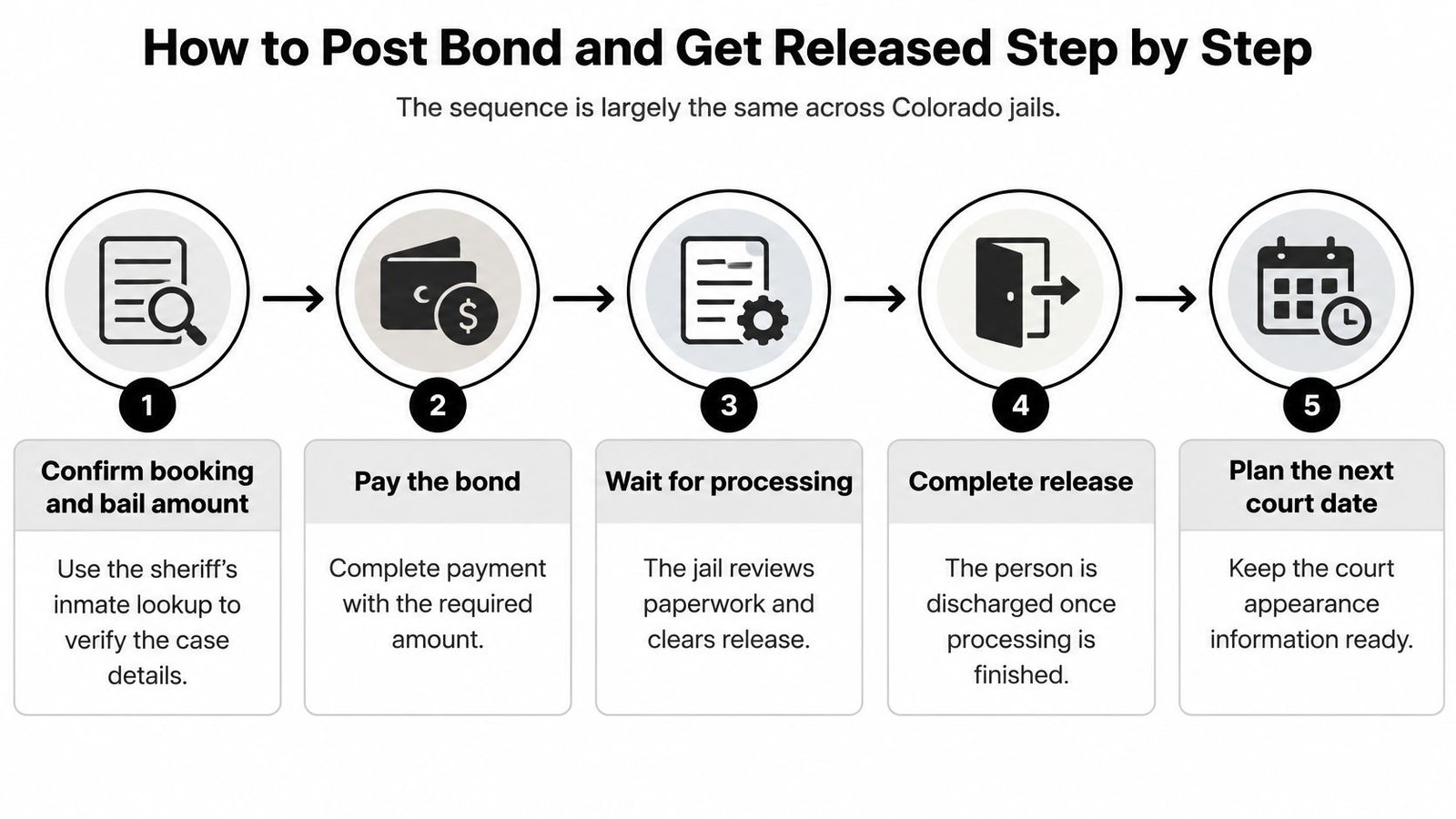
The Six Steps
Confirm booking and bail amount: Check the sheriff's inmate lookup to confirm the person is booked, verify the spelling of their name, and find the bail amount. The Jefferson County Sheriff jail information page explains that the court sets the amount and that it can be checked through the lookup. A secondhand figure may be out of date.
Gather the calling details: Before calling, have the defendant's full name, date of birth, the jail they're in, and the bail amount ready. These details help the bail agent identify the booking and begin the process.
Choose the route the judge allowed: The available route may be a surety bond through a licensed agent, a cash bond, or personal recognizance if the judge authorizes it. The court's terms determine which options apply; a bondsman cannot change them.
Complete the application and pay: For a surety bond, complete the application, sign the contract documents, and pay the premium quoted by the agent. Read the cosigner obligations before signing so you understand what you are agreeing to.
Let the agent post the bond: Once the paperwork is signed and the premium is paid, a licensed agent goes to the jail and posts the surety bond with the court clerk. Posting the bond clears the financial requirement. Jail staff still need to process the release.
Wait for processing, then verify the exit details: After the bond is posted, release processing can take one to eight hours, depending on the jail's staffing and how busy it is. People can typically expect release within two to six hours after the bail is posted, though the time of day, the specific court's processing speed, and the charges can affect the timeframe. Ask the specific jail which window applies.
Practical rule: If the expected window passes without an update, call the facility to ask whether it has received the release order. The jail needs that order to proceed.
When the person is released, confirm their name on the paperwork and check the returned property against the property list. Keep the paperwork showing the next court date. For Golden-area details, see the Jefferson County, Golden, Colorado bail information page.
Holds, No-Bond Orders and Conditions That Delay Release
Paying doesn't set the release time by itself. A posted bond clears the money requirement. The court, the jail, or another agency may still control the remaining steps, and that's where most delays hide.
Three Delays a Payment Can't Fix
- No-bond hold: When a judge sets a no bond hold, the defendant must remain in jail until their court appearance. No premium changes that order. Only the court can revisit it, which is why families researching non-bailable offenses and no-bond situations should confirm the hold status before paying anything.
- Another agency's hold: An immigration hold or a hold from another jurisdiction can keep someone in custody after the local bond is posted. Say you post bond on the Colorado case at noon, but another county has an active warrant hold. The jail can finish the local paperwork and still not release the person to the parking lot.
- Court conditions: Conditions set by the court and the bail agent after release are not optional and must be followed, such as travel restrictions, no-contact orders, or mandatory classes. If supervision intake, a protective order, or signed condition paperwork isn't complete, release can wait on that setup.
Missing paperwork causes a quieter delay. Say the bond is posted, but the release order hasn't reached the jail or a name spelling doesn't match the booking record. Staff have to reconcile the record before discharge, even though the money side is done.
We can change paperwork speed, posting speed, and how quickly errors get flagged. We can't lift a hold, rewrite conditions, or sign a release order. A judge or the holding agency controls those decisions.
Federal numbers show release isn't a simple pay-or-stay choice. The U.S. Courts pretrial services report for judicial business 2025 recorded, in Colorado's federal district during the 12 months ending September 30, 2025, 440 cases, with 124 defendants released and 316 detained and never released. Judges may approve personal recognizance, order supervision, impose conditions, or deny release based on legal factors.
Before you pay, ask the cosigner's three questions. Is there any hold, what conditions apply, and who controls the release order? Get those answers in writing when you can.
What Families Should Have Ready Before Release
Say a mother posts bond at 9 p.m. and drives home expecting a call within the hour. Her son is discharged at 6 a.m. with no ride arranged, no medication in hand, and a dead phone. Nobody did anything wrong on the bond itself, but the transition failed.
That's the gap families miss. The federal pretrial detention table for the 12 months ending September 30, 2025 is a reminder of scale, recording 34,009,941 detention days among 107,165 defendants. Federal detention isn't the same as a Colorado county jail stay, yet the lesson carries over. Release planning can't stop at the transaction.
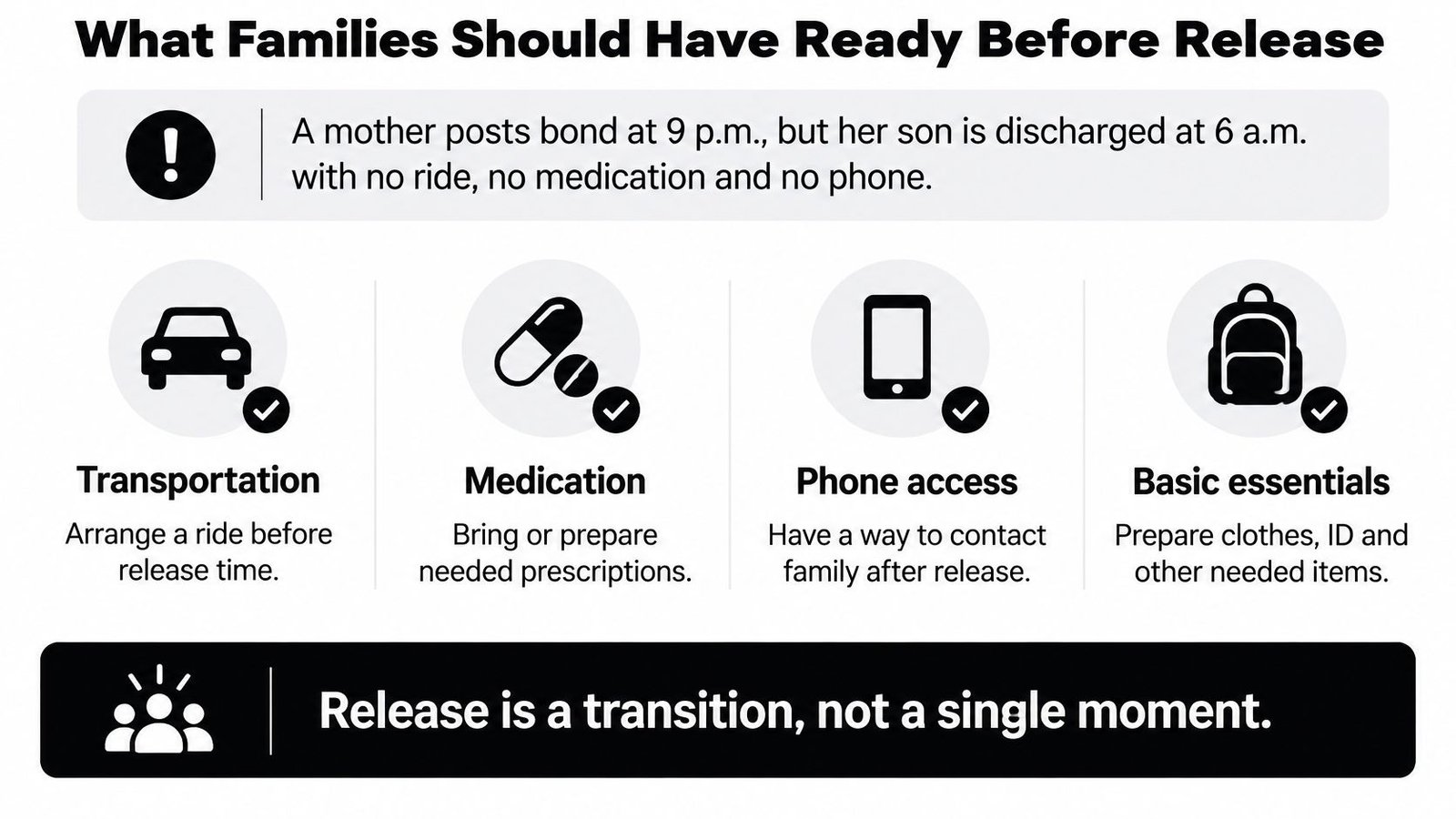
Release Readiness Checklist
Complete this during the processing window, not after the discharge call:
- Exit location confirmed: Ask the facility which door or lobby releases use and where drivers may wait. Large facilities can have separate public, booking, and discharge entrances.
- Transportation arranged: Name one driver and one backup, with the facility address saved in both phones. Plan for an early morning release, not just a convenient one.
- Medication continuity checked: Ask what medication or discharge paperwork leaves with the person and what prescription needs filling that day. Bring a written medication list if the jail medical unit asks family for one.
- Identification and property tracked: Note what ID, cards, keys, and clothing went in at booking so you can spot anything missing at discharge.
- Communication plan set: Bring a charged phone or charger, and agree on one contact name the person calls first if you're not visible outside.
- First 24 to 72 hours planned: Confirm where the person sleeps, how they reach that address, and whether any no-contact condition affects that housing choice.
Faster isn't automatically safer. A rapid discharge with no ride, no medication, and no place to sleep can create a violation risk before the first court date arrives.
Write three items down tonight, the court date, the exit location, and one contact name. Keep any required paperwork together, including documents referenced on our jail release forms page, so you're not searching your car at discharge.
After a release, our team follows up to confirm the defendant is out and gives guidance on court date compliance and bond conditions. Use that call to confirm the checklist, not just to celebrate the exit.
Staying Compliant After Release and Court Dates
Release is the start of a set of obligations, not the end of the process. Defendants differ in their likelihood of missing court or violating release terms, so courts set conditions to address each person's circumstances.

What Compliance Actually Requires
Attend every court date, including routine status hearings. Follow each condition exactly as written. Terms may include travel limits, no-contact orders, testing, treatment, classes, or supervision reporting. Review the conditions of bond that apply after release with the defendant while the paperwork is available.
Defendants must also check in regularly with their bail agent. That may mean a weekly phone call or a visit to the office. Keep the schedule in writing and follow it.
A missed hearing can lead to a warrant and bond forfeiture proceedings. If a condition is unclear, ask the bail agent or attorney before acting. For example, get guidance if a no-contact order affects a shared home or a work schedule conflicts with a curfew. Asking in advance helps clarify what the order allows.
A Routine That Prevents Most Problems
- Court dates recorded: Enter each hearing on a calendar, including the courthouse address, courtroom if listed, and arrival time.
- Reminders set: Set a reminder two days before each date and an alarm for the morning of the hearing.
- Agent check-ins scheduled: Add required calls or office visits to the calendar alongside court dates.
- Documents kept together: Store bond paperwork, conditions, and hearing notices in one folder the defendant and cosigner can find.
Consistent compliance helps the defendant remain out of custody while the case is pending. It also matters to the cosigner, whose obligation continues until the court finishes the bond. After release, the Express Bail Bonds team follows up to confirm the defendant is out and provide guidance on court-date compliance and bond conditions.
Confirm the Release Plan With Express Bail Bonds
Your next step is simple. Confirm the release route, check for holds, and start the paperwork with correct information the first time.
Call or text 720-984-2245, where we're available 24/7. It helps to have the defendant's full name, date of birth, the jail they're in, and the bail amount ready. We'll walk you through the premium, court requirements, and next steps, and confirm which documents the cosigner must sign.
Ask us directly which holds or conditions could affect timing. That answer shapes whether you should post now, wait for a hearing, or plan for a transfer to another agency. Remote signing is available, so family members don't need to travel to the Golden facility in person, and we cover all Colorado jails.
Start at Express Bail Bonds main site for statewide help. Golden and Jefferson County families can use the Jefferson County page linked above, and Arapahoe County families can review bail bonds in Centennial for local details.
Call first, then confirm the court date, exit location, and conditions before the defendant walks out.
If you need a licensed Colorado agent to confirm the bond amount, check for delays that could affect jail release, and start surety bond paperwork without an unnecessary trip, contact Express Bail Bonds now. Have the defendant's full name, date of birth, jail, and bail amount ready so we can give you a clear next step on the first call.