
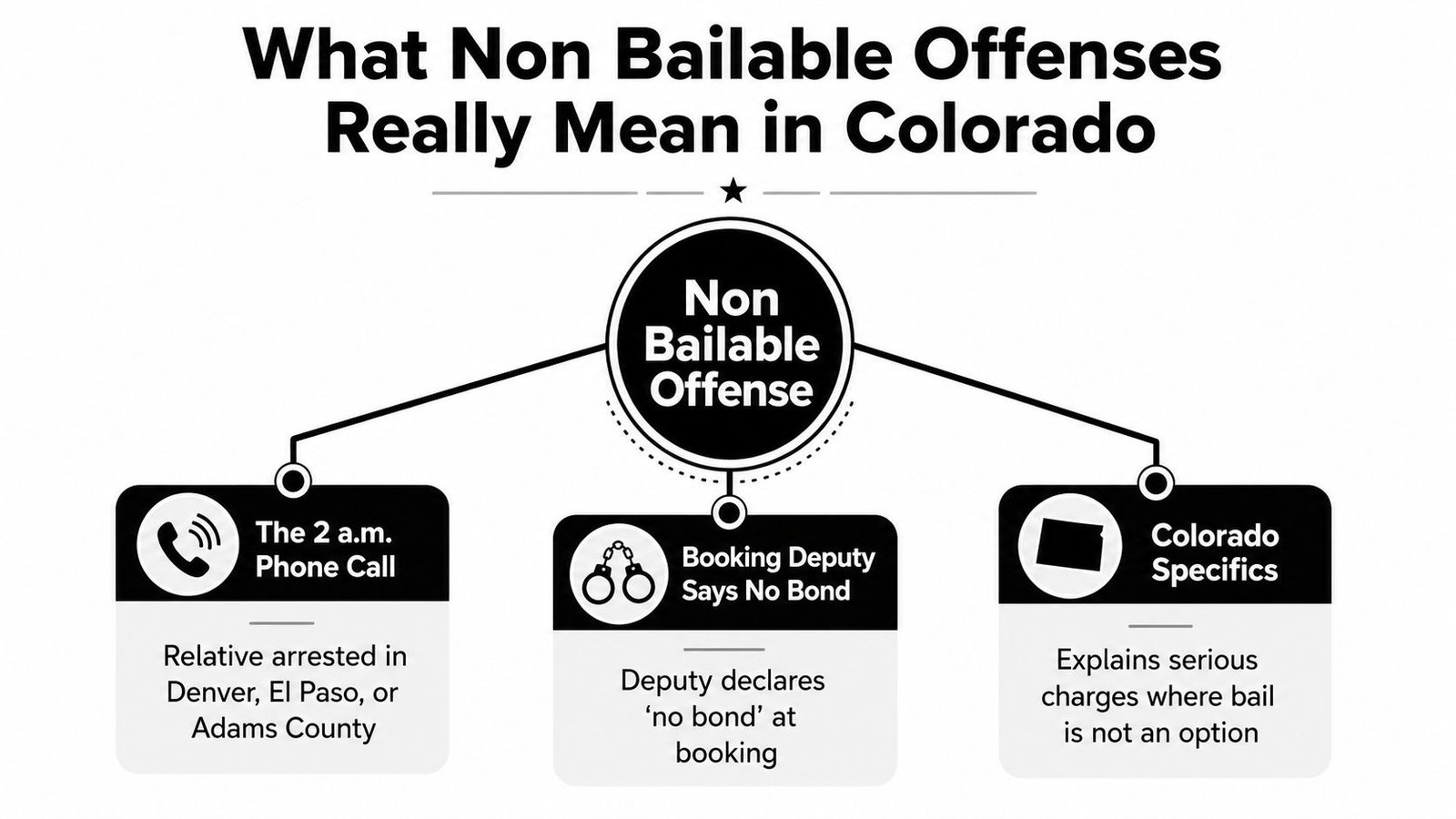
At 2 a.m., a relative calls from a Colorado jail. The booking deputy has said “no bond” or “non-bailable,” and the family is left wondering whether that means the person will stay locked up until trial. I've walked families through this same confusion after arrests in Denver, Jefferson, Adams, El Paso, and other Colorado counties.
The first thing to understand is simple: “non-bailable” is often a shorthand label, not a complete answer. Colorado law distinguishes between statutory situations where a monetary bond can't guarantee release, a bond that's technically available but financially unreachable, and a detention order based on flight or public-safety concerns. Those situations can feel identical at the jail, but the legal remedies may be different.
What Non Bailable Offenses Really Mean in Colorado
A booking deputy can record the charge, classify the person, and tell the family that no bond is available at booking. That statement usually means the jail isn't authorized to release the person through an ordinary cash or surety bond before a judge reviews the case. It doesn't mean the person has been convicted, and it doesn't necessarily mean release is impossible.
Colorado's statute uses specific circumstances to limit release on a monetary bond. A separate court order may keep someone detained after a judge evaluates flight risk, public safety, obstruction, or witness intimidation. In other cases, the court sets a bond so high that the family has no realistic way to post it. The practical result may be custody, but the legal starting point differs.
Practical rule: Ask what the paperwork says, not only what the booking desk called it.
A personal recognizance bond relies on the defendant's promise to appear, usually without paying money upfront. A cash or surety bond requires financial security, while a no-bond hold means the jail won't release the person through a standard bond process unless the court changes the order or the statutory basis for detention no longer applies.
Many legal systems use “non-bailable” to describe charges where release is discretionary rather than automatically forbidden. Courts commonly examine the seriousness of the accusation, the person's history, the likelihood of returning to court, and the risk of interfering with the case. A plain-language guide to criminal justice terms can help families decode related words appearing in booking or court documents.
Even with a serious hold, a defense attorney can request a pretrial release hearing, present proposed conditions, challenge the prosecution's evidence, and ask the judge to reconsider detention. Families can also review what no bail means in Colorado before assuming that “no bond” ends every possible path to release.
How the Concept of Non Bailable Offenses Evolved
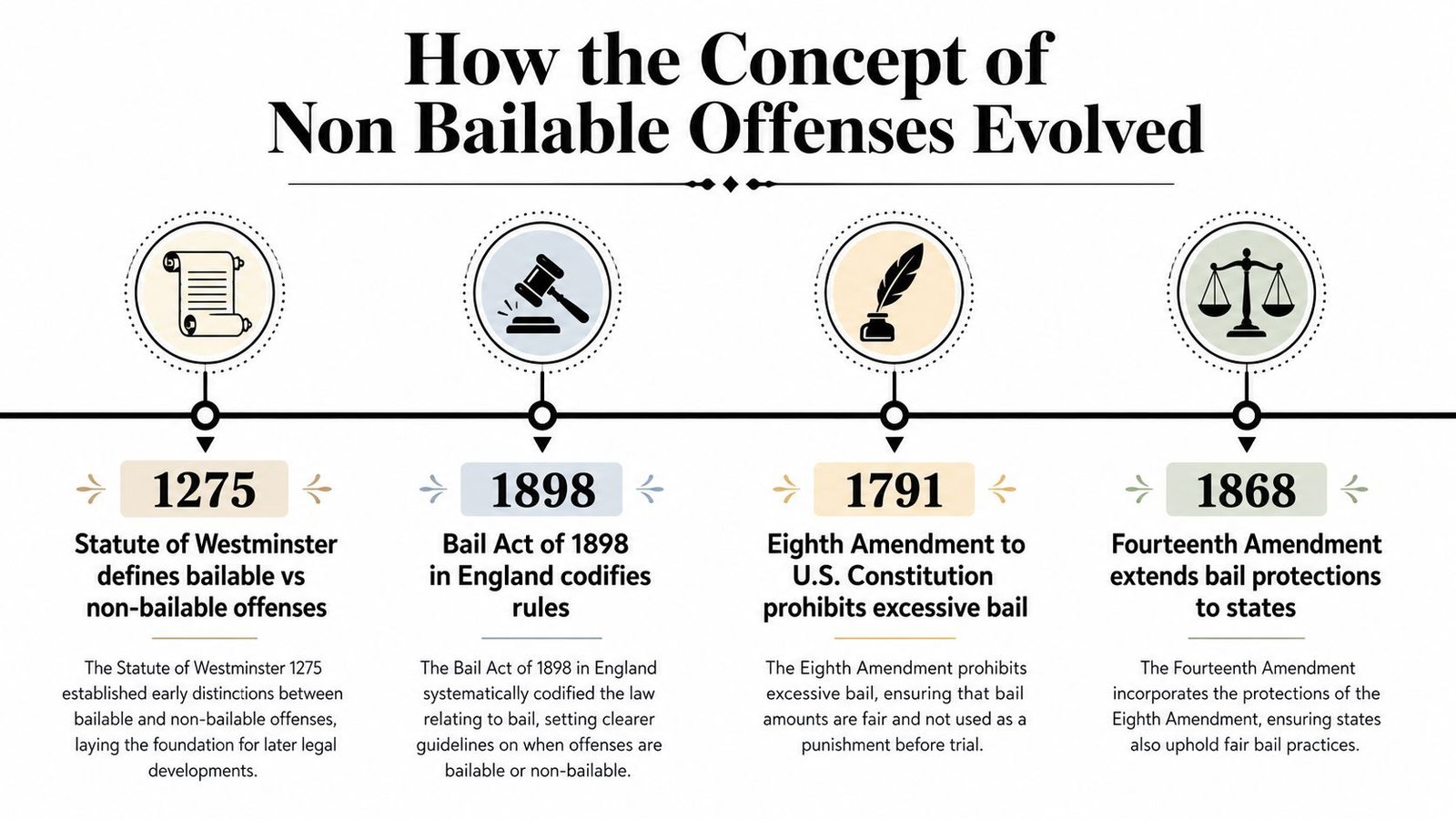
The modern Anglo-American concept of non-bailable offenses reaches back to the Statute of Westminster in 1275, which separated crimes into bailable and non-bailable categories and removed a sheriff's discretion over which crimes qualified for bail. That change mattered because it established that lawmakers could exclude certain offenses from ordinary pretrial release instead of leaving every decision to local officials. (Historical overview of bail)
England later developed more formal bail rules, including the Bail Act of 1898. In the United States, constitutional protections shaped the conversation in a different way. The Eighth Amendment addresses excessive bail, while the Fourteenth Amendment became central to applying constitutional protections to the states. Those principles coexist with statutes that permit detention in narrowly defined circumstances.
Federal law moved from a general presumption favoring bail for many non-capital offenses under the Bail Reform Act of 1966 toward broader preventive-detention authority under the Bail Reform Act of 1984. The later law allowed detention when no conditions could reasonably assure court appearance or public safety. The result wasn't one permanent national list of non-bailable charges. Instead, Congress and state legislatures created categories, exceptions, and risk-based procedures that continue to vary.
Colorado's system developed through its own statutory and policy debates, including bond-reform discussions, cash-only proposals, and pretrial reforms that changed how courts consider risk and release conditions. Those policy choices help explain why non bailable offenses are not a fixed constitutional category. Legislatures define triggers, courts apply them to individual facts, and later reforms can expand or narrow the practical meaning.
A related issue is jail capacity. The Prison Policy Initiative estimates that more than 400,000 people are detained pretrial on any given day in the United States, and that roughly 69% of city and county jail populations are held before trial. Its analysis also reports that pretrial detention has nearly quadrupled since the 1980s and driven 86% of jail population growth since 1983, with an estimated annual national cost of $13.6 billion and a median felony bail bond of $10,000. (Pretrial detention data and analysis)
Colorado families therefore need to separate the historical label from the current court order. Practical responses to jail overcrowding and pretrial detention depend on the specific charge, the defendant's record, and the judge's findings.
The Colorado Statute That Defines Non Bailable Offenses
Colorado Revised Statutes § 16-4-101 is the starting point for identifying situations where release on bail is restricted. Read in plain English, the statute focuses on capital offenses and certain serious violent-crime circumstances. It also connects detention consequences to a defendant's status, such as being on probation, parole, or bail for a prior crime of violence, or having qualifying prior felony convictions. (Colorado Revised Statutes § 16-4-101)
The statute matters because the same new accusation can be treated differently depending on what came before it. A violent charge involving a person who was free on a previous violent-crime case raises a different statutory concern from an isolated charge involving someone with no relevant record. The court still has to apply the statutory language to the facts, rather than relying only on the label printed at booking.
Translating jail language into legal language
A deputy may say “no bond,” but the family should ask four questions:
- What exact statute is listed? The booking description may be broader or less precise than the charging document.
- Is the hold statutory or court-ordered? A statutory restriction and a judge's detention finding call for different arguments.
- Has advisement occurred? The first court appearance may clarify the charge, conditions, and next hearing.
- Can counsel request review? A defense attorney can identify whether the law permits a release motion or reconsideration.
A cash-only bond requires payment in cash rather than a commercial surety bond. A surety bond uses a licensed bail bond agency to guarantee the full court-ordered amount, subject to the agency's contract and approval. A no-bond hold doesn't become a surety bond just because a family has money available.
| Statutory Category | Triggering Condition | Practical Effect at Jail |
|---|---|---|
| Capital offense | The case falls within Colorado's capital-offense provisions | Ordinary monetary release may be unavailable while the court addresses detention |
| Certain violent-crime situations | The alleged crime of violence occurred while the defendant was on probation, parole, or bail for a prior crime of violence | Booking may show a no-bond posture pending judicial review |
| Qualifying repeat felony circumstances | The charge and prior felony history meet the statutory conditions | Counsel must examine the record before assuming a bond can be posted |
| Other serious accusations | The charge is severe, but the statutory no-bail trigger may not apply | The judge may still consider conditions, risk, and public safety |
The public should also distinguish a personal recognizance bond from a release order with conditions. A judge may require no money but still impose supervision, treatment, reporting, no-contact, or travel restrictions. For families sorting out a warrant-related hold, this explanation of what a non-bailable warrant means can prevent a common mistake, treating the warrant label as the final detention decision.
Serious Charges That Trigger a No Bail Hold in Colorado
Colorado's most serious detention questions often involve the interaction between the charge and the defendant's status. First-degree murder and felony murder raise the most obvious concerns, but the family shouldn't stop at the offense name. Kidnapping, aggravated sexual assault, and certain major drug charges can require a close review of the charging statute, alleged conduct, and any sentence enhancer.
A charge can also become more restrictive when prosecutors invoke Colorado's habitual criminal provisions. C.R.S. § 18-1.3-801 addresses habitual criminal sentencing, including the commonly discussed “three-strike” provision. The existence of prior convictions doesn't automatically answer every bail question, but it can change the exposure and the court's assessment of danger and appearance.
Categories families should identify on the paperwork
| Charge Category | Typical Colorado Statute | Why It Often Means No Bond |
|---|---|---|
| Murder and capital-level allegations | Colorado homicide provisions and C.R.S. § 16-4-101 | The court must address the most serious possible public-safety and detention concerns |
| Kidnapping | Colorado kidnapping provisions | Alleged restraint or movement of another person can support heightened detention arguments |
| Aggravated sexual assault | Colorado sexual-assault provisions | The alleged violence, victim-safety concerns, and possible sentence exposure affect release analysis |
| Violent crime with supervision status | C.R.S. § 16-4-101 | A new violent allegation while on probation, parole, or bail can activate statutory restrictions |
| Large-scale controlled-substance conduct | Colorado Controlled Substances Act provisions | The charge may involve serious penalties and prosecution arguments about community risk |
| Habitual criminal allegations | C.R.S. § 18-1.3-801 | Prior felony history may increase sentencing exposure and influence detention arguments |
| Certain post-conviction offenses | Colorado post-conviction no-bail rules | A conviction can trigger a separate detention rule that differs from pretrial release |
Colorado also identifies post-conviction no-bail consequences for several serious offenses, including murder, felony sexual assault with a deadly weapon, felony sexual assault against a child under 15, felony crimes of violence, felony firearm-use offenses, possession of a weapon by a previous offender, specified child abuse, a class 5 felony domestic-violence act, and a second or subsequent stalking offense within seven years of a prior stalking conviction. (Colorado post-conviction no-bail rules)
That list doesn't mean every person accused of a serious offense automatically remains in custody through trial. It means the defense needs to determine which rule applies, at what procedural stage, and whether a statutory exception or review mechanism remains available. A sexually violent predator designation or a parole violation tied to a qualifying original offense can further complicate the analysis.
Families should write down the exact statute number, not just “felony” or “violent charge.” A defense lawyer can then compare the accusation, prior record, supervision status, and court order before anyone spends money trying to post a bond that the jail cannot accept.
Inside the Jail and Court Process for Non Bailable Offenses
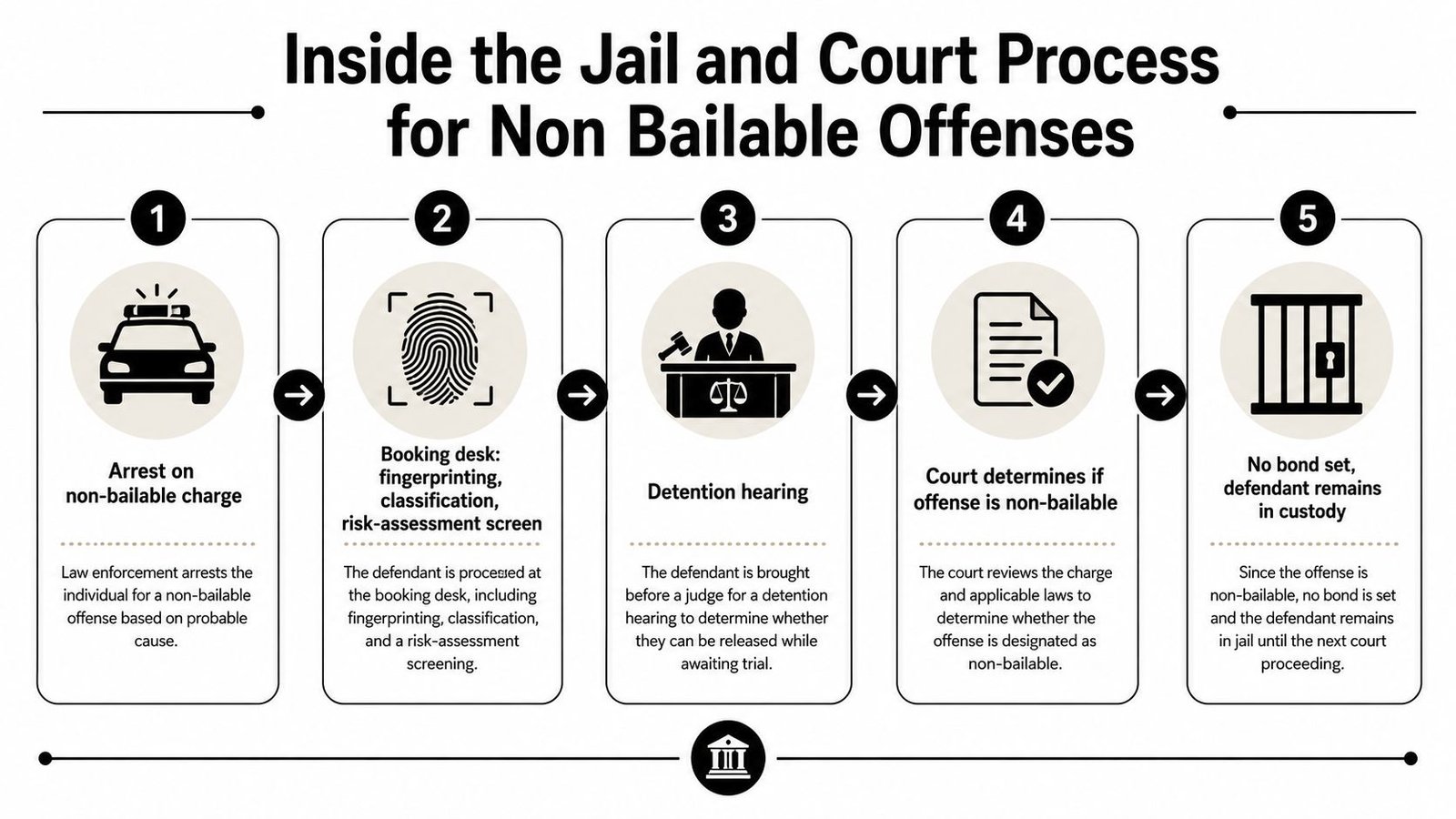
The first hours after arrest are administrative and legal at the same time. Jail staff complete identification, fingerprinting, classification, and safety screening. The classification process affects housing and custody procedures, but it doesn't decide guilt or replace the judge's detention ruling.
At the first advisement, the court identifies the charges, explains basic rights, and addresses release conditions. Colorado's criminal procedure rules govern advisement and the timing of early hearings, but the exact schedule can depend on the county, the arrest warrant, the filing status, and whether prosecutors request detention. Families should treat the first appearance as important, not necessarily as the only chance to seek release.
What the judge is deciding
The prosecution may argue that no available conditions can protect the public or ensure appearance. The defense can answer with verified information about residence, employment, treatment, family supervision, medical needs, prior court compliance, and a concrete plan for avoiding contact with alleged victims or witnesses.
The difference between a no-bond advisement and a cash or surety advisement is practical. In the second situation, a licensed agency may be able to post the bond once the family meets contract requirements. In the first, calling an agency won't bypass a statutory hold or detention order.
A county jail can only follow the release authority in its records. It can't create a bond that the judge or statute hasn't authorized.
The defense may request a bond review or reconsideration under the applicable procedure. Prosecutors can oppose release with charging information, criminal-history records, risk materials, or allegations involving dangerousness and interference with the case. The judge's decision should be read carefully because the reasons for detention identify what evidence counsel must address next.
Families often need a practical explanation of the first appearance, release conditions, and later hearings. This overview of bail and arraignment information is useful for understanding the vocabulary, while a Colorado-focused court process guide helps organize the next procedural steps.
A no-bond defendant may receive another hearing for preliminary proceedings or bond review. The timing depends on the case and court, so counsel should confirm the actual date rather than rely on a general expectation.
Comparing Colorado's Approach to Other States
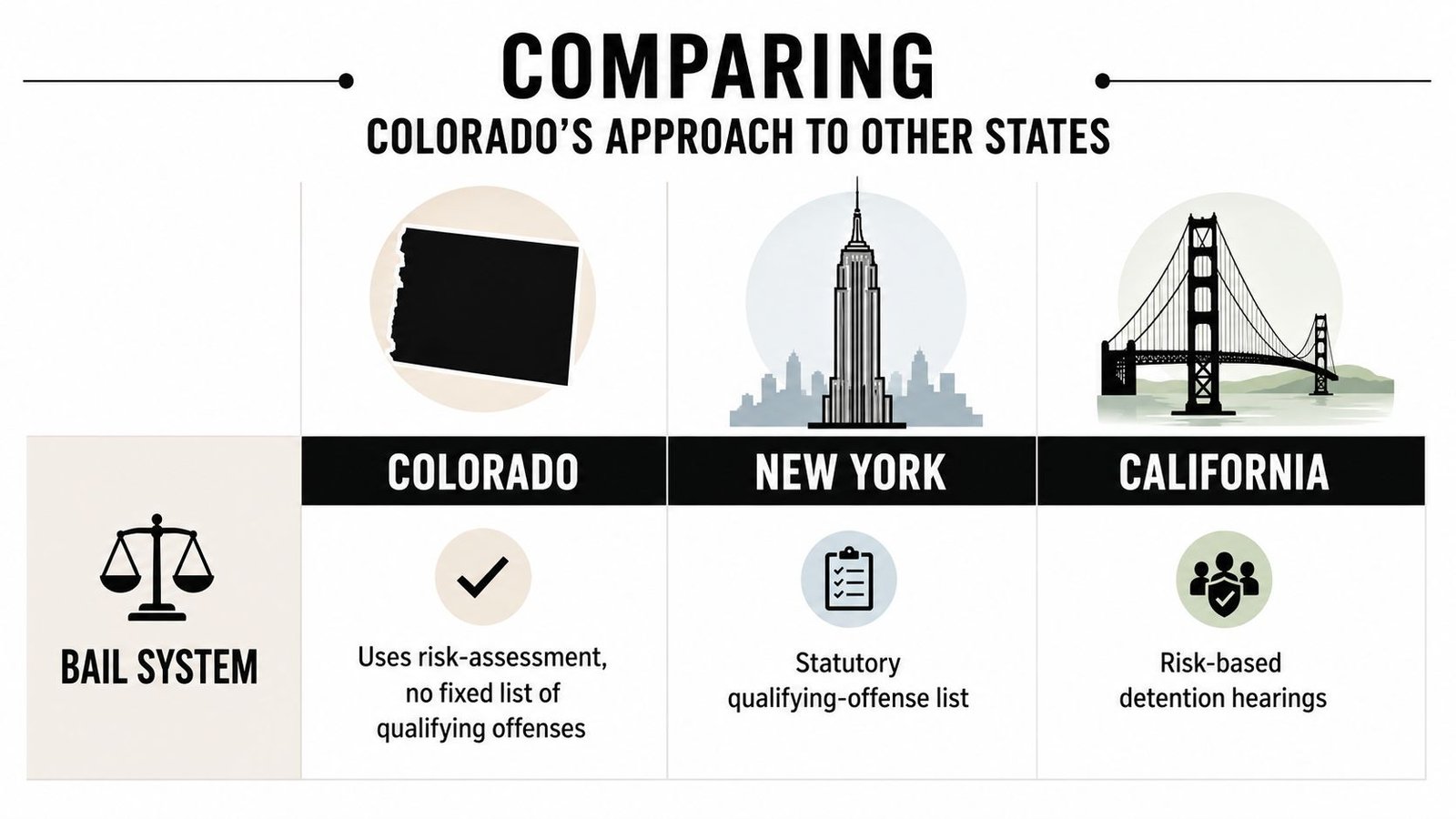
“Non-bailable” doesn't carry the same legal meaning across state lines. New York uses a statutory list of qualifying offenses, while many other charges generally default toward release on recognizance or non-monetary conditions. The New York statute shows why seriousness alone doesn't answer the bail question. Eligibility depends on whether the specific charge appears in the statutory framework. (New York Criminal Procedure Law § 530.40)
New York's reform framework also illustrates the difference between detention and conditional release. Courts may use non-monetary conditions in cases where cash bail isn't authorized or appropriate. Research concerning New York's 2020 reforms found no overall increase in recidivism after bail was eliminated for most misdemeanors and nonviolent felonies, a finding that complicates the assumption that broader access to cash bail is always necessary for public safety. (New York bail-reform analysis)
California is commonly described through risk-based detention hearings, where the court evaluates public safety and appearance concerns rather than relying only on a traditional money-bail framework. Colorado sits differently. It doesn't provide one universal public list called “non-bailable offenses.” Instead, outcomes can emerge from the combination of charge severity, statutory restrictions, prior convictions, supervision status, and judicial findings.
That difference creates a recurring problem for families who live elsewhere. A person released conditionally in one state may face a different analysis after an arrest in Colorado because the new charge and prior record interact with Colorado law. A label used by an out-of-state jail doesn't automatically transfer into a Colorado detention decision.
Recent reform debates continue to examine how states should balance individualized assessment, public safety, court appearance, and limits on cash bail. The important point for a Colorado family is narrower: the court must apply Colorado law to the actual charging document and record, not to a generic internet definition.
Practical Next Steps and Possible Remedies
A no-bond hold calls for legal action, not panic. The defense attorney should first obtain the booking information, charging document, warrant, criminal-history materials, and the written release or detention order. Those documents show whether the problem is a statutory restriction, a judge's risk finding, an incomplete filing, or a bond condition that can be challenged.
Start with the release record
Counsel may file a motion to review or modify bond conditions under C.R.S. § 16-4-103, depending on the procedural posture. The motion should answer the judge's concerns with evidence rather than general promises. Stable housing, employment, treatment compliance, family supervision, transportation, and willingness to follow no-contact or reporting conditions can all become relevant when the law permits individualized release.
A pretrial-services report may provide useful information, but families should give counsel organized records instead of sending unverified material directly to the court. Character affidavits can help explain the defendant's support network, while medical documentation may matter when detention creates urgent health concerns.
A surety bond is only an option if the court has authorized a bond and the jail accepts that form of security. Colorado bond agencies commonly describe a 15% premium with a $50 minimum, while some advertise a 10% premium on bonds of $5,000 or more with an approved cosigner. The premium is nonrefundable, and the bondsman posts the full bond amount. (Colorado bail-bond pricing information)
For families trying to understand how a court may change an amount or condition, this resource on getting bail reduced offers a practical starting point. A lawyer should also evaluate whether a habeas corpus petition under Rule 106, an appeal, or another review procedure fits the facts.
Post-conviction remedies are different from pretrial release. Appeals, sentence reconsideration, and parole eligibility may become relevant after conviction or sentencing, but they don't automatically convert a pretrial no-bail hold into a bond. Acting quickly matters because early evidence, housing plans, treatment arrangements, and witness-protection proposals are easier to organize before the case becomes more entrenched.
A Calm Checklist for Families Facing a Non Bailable Arrest
The first 72 hours are usually chaotic, but families can still work methodically. The goal isn't to argue the case over the phone. It's to give defense counsel accurate information and avoid actions that create new problems.
Tonight
- Confirm identity: Get the defendant's full name, date of birth, arresting agency, booking number, and current facility.
- Check official records: Use the county sheriff's inmate lookup rather than relying on social-media posts or secondhand messages.
- Call counsel: Ask a criminal defense attorney to identify the exact charge, hold type, first appearance, and immediate filing options.
- Protect the case: Don't contact an alleged victim, witness, or codefendant. Don't ask the defendant to explain facts on a recorded jail call.
- Write down names: Record the jail, court, division, deputy, and attorney contacts so the family stops repeating the same questions.
Tomorrow
Gather the defendant's legal history, current address, employment details, treatment records, medical information, and names of reliable support people. Organize financial documents for counsel, but don't assume money can solve a statutory hold. Ask the lawyer whether a no-contact order, medication issue, classification concern, or urgent family circumstance needs immediate review.
Within the first week
Confirm visiting hours, identification requirements, commissary procedures, and approved ways to deposit funds. Keep communication supportive and brief. Detention can worsen anxiety, depression, withdrawal, and sleep problems, so report urgent mental-health or medical concerns through the jail's established process and tell counsel.
Family reminder: You can't change a statute overnight, but you can help build the strongest possible release plan.
Make a written list of every hearing date and condition. If the judge permits review, counsel can present a clear package instead of scattered promises: housing, transportation, supervision, treatment, employment, and a plan to avoid alleged victims and witnesses.
Express Bail Bonds offers statewide Colorado surety-bond assistance, electronic application and contract processing, and guidance about fees and court requirements when a judge has authorized a bond. Visit Express Bail Bonds or call or text 720-984-2245 to discuss whether a surety bond is available for the specific release order.