A phone rings at 2 a.m., and the caller ID shows a county jail. Your family member says they need help getting out, but nobody knows whether you should ask for a bond application, a court order, an indemnitor form, or something the jail keeps behind its own counter. That confusion is normal. Jail release forms aren't one universal document. They're a paperwork bundle that connects the court, the detention facility, the defendant, the cosigner, and, when applicable, a licensed surety agent.
For Colorado families, the fastest path usually starts with identifying the correct release route, confirming the booking information, and completing every required signature before anything is submitted. A missing identifier or an unsigned agreement can leave a person in custody even after the family believes the paperwork is finished.
What Jail Release Forms Actually Are
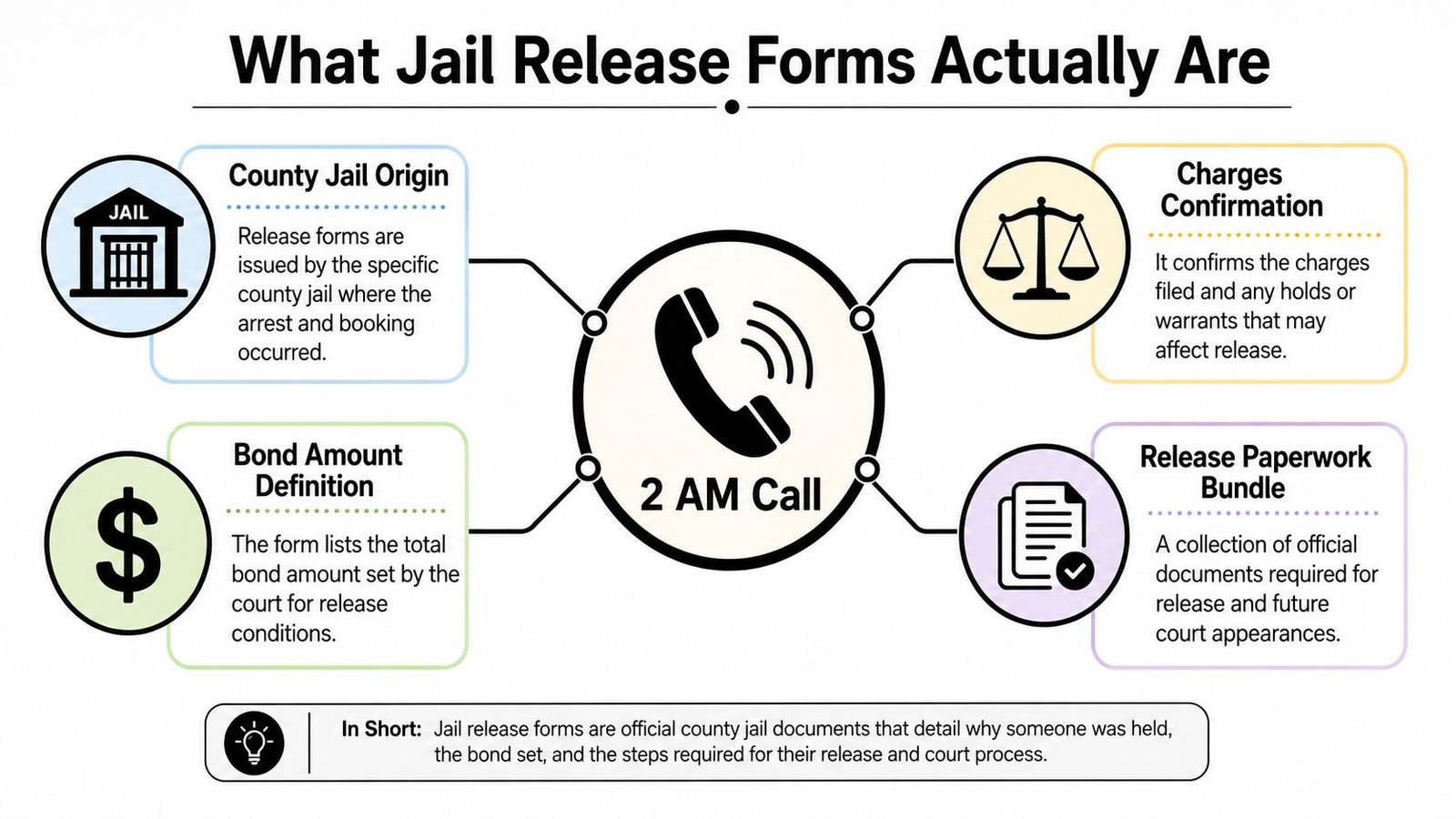
Jail release forms are the documents that turn a legal decision or a posted bond into an authorized detention-facility release. At the jail counter, that can include a surety bond application, an indemnitor agreement, a court-issued release order, and the facility's internal release authorization. Each document serves a different purpose, and the jail won't necessarily treat one as a substitute for another.
The process is formal because detention systems have to verify who is being released, under what authority, on what date, and subject to which conditions. The United Kingdom's immigration bail Form B1, used since at least October 1, 2014, is expressly designed to request release from a detention centre, immigration centre, or prison. In the United States immigration system, ICE standards identify a workflow beginning with Form I-203, the “Order to Detain or Release,” alongside forms such as Form I-220A, Form I-220B, and Form I-352. These examples show that release paperwork has become a standardized administrative milestone across systems, not an informal handoff. (UK government Form B1)
The bundle behind the phrase
A bond application gathers the facts needed to decide whether a surety company can write the bond. The surety agreement establishes the financial relationship between the agent and the people promising to meet the bond terms. An indemnitor form is signed by a cosigner who accepts specified financial responsibilities. A release order or jail authorization gives facility staff the authority to complete the exit process.
This broader understanding helps explain why families get stuck. Searching for a single “release form” may produce a court document when the immediate need is a bond contract, or a generic jail form when the court still needs to sign an order. For a plain-language overview of how bond and release expectations can differ by jurisdiction, the Law Office of Bryan Fagan PLLC on bail and bond in Texas offers useful context, although Colorado procedures control a Colorado case.
The Core Documents in a Colorado Release Bundle
A Colorado surety release bundle works best when every document answers a specific administrative question. The application identifies the people and the case. The contract defines the obligation. The court order states the authority and conditions. The jail then reconciles those materials with the booking record.
| Document | Who Signs | Purpose |
|---|---|---|
| Bond application | Defendant, applicant, or agent, depending on the workflow | Provides the booking, charge, bond, and contact information needed to begin review |
| Surety agreement | Agent and responsible contracting parties | Creates the agreement supporting the surety bond |
| Indemnitor forms | Financial cosigner or other responsible signer | Records the cosigner's obligations, acknowledgments, and signatures |
| Court-issued release order | Judge, court, defendant, and other required parties | Establishes release authority and any conditions the jail must follow |
Start with identity and case details
Use the defendant's full legal name exactly as it appears in the booking record. Add the date of birth, booking or register number when available, facility, charges, bond amount, and expected release method. A nickname or a casual spelling may seem harmless, but jail staff match fields against their system, not against a family's memory.
The bond application also identifies the applicant and the proposed indemnitor. The agent needs accurate contact information so the forms can be delivered, signed, and corrected without chasing incomplete answers.
Read the agreement before signing it
The surety agreement and indemnitor paperwork aren't just routing sheets. They describe the relationship among the agent, the person posting the bond, and the people accepting responsibility for the transaction. Cosigners should read the payment, collateral, notice, and appearance provisions and ask questions before signing.
Court paperwork is separate. Federal court materials, for example, distinguish appearance bonds, orders setting conditions of release, additional conditions, and acknowledgments of penalties. That separation illustrates the practical point for Colorado families: a court order may authorize release, while the surety documents support the bond that makes release possible. For a document checklist for the bond process, review what documents you need.
Conditions belong on the right paper
A release condition shouldn't be left to a handwritten note or a verbal promise. If the court orders supervision, reporting, travel limits, treatment, or another obligation, the responsible parties need the correct form or order reflecting it. The jail must be able to reconcile the signed paperwork with the court's instructions before releasing anyone.
County by County in Colorado
Colorado detention facilities use different release-counter procedures. The county may decide whether a surety packet can be submitted electronically, whether an indemnitor must appear in person, which signatures require notarization, and when staff process approved releases. These local rules determine which documents belong in the release bundle and whether a completed packet can move directly to review.
A family in Golden should not assume a Denver submission will follow the same path in Jefferson County. A release near Centennial also requires confirmation of the Arapahoe County process. An old PDF, a relative's past experience, or instructions from another jail can leave the current forms incomplete.
Confirm the county process before anyone travels
Call the facility or the agent handling the bond. Ask:
- Submission method: Can the surety documents be sent electronically, or must someone deliver them?
- Signer presence: Must the indemnitor appear at the jail, or can the signature be completed remotely?
- Identification: Which identification documents must accompany the signed forms?
- Release timing: Does staff process the release after approval, or only during a scheduled intake period?
The answers affect both the paperwork and the travel plan. A relative who crosses the metro area with an unsigned, missing, or incorrectly formatted document may still need to leave and return. Confirming the procedure first can prevent that wasted trip.
Use the Colorado county jail phone numbers resource to find the relevant facility contact, then verify the current instructions directly. Jail staff can confirm the correct location and intake channel. A licensed surety agent can usually collect the applicant and indemnitor information, prepare the bond documents, and send the signature packet electronically, while the jail still controls its own approval and release steps.
Match the paperwork to the location
The release bundle should be prepared for the county handling the booking. That may include the surety application, indemnitor agreement, identification copies, payment or collateral records, and any court order or condition the jail must review. The exact combination depends on the facility's intake rules.
The practical rule is simple: identify the county before completing forms. County-specific instructions can determine whether a signature is accepted remotely, whether notarization is required, and where the finished packet must go. Correct information on the wrong county workflow can still delay release.
Walking the Forms From First Call to Release
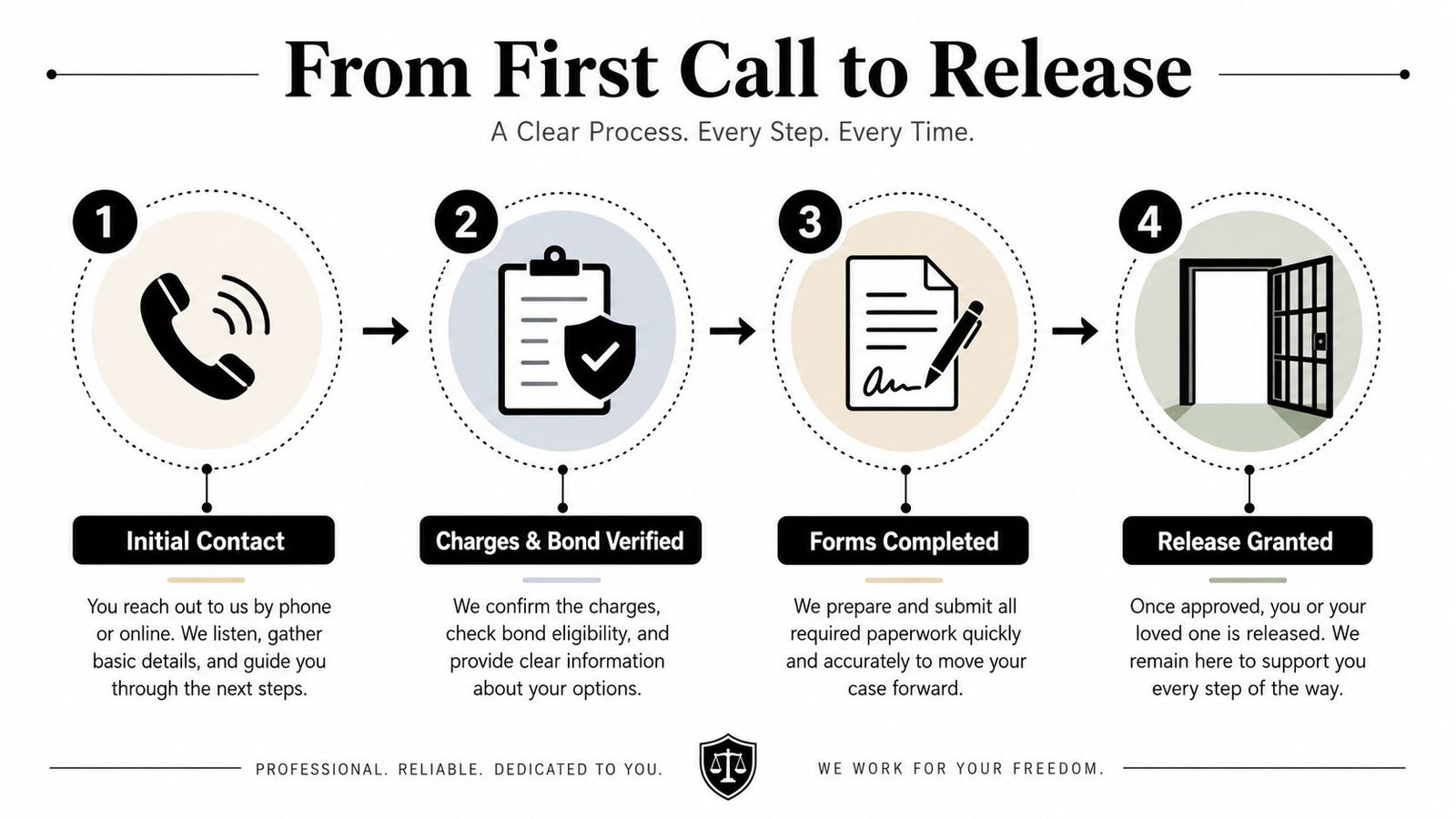
The first call should establish facts, not guesses. Confirm the defendant's full name, date of birth, facility, booking number if available, charges, and bond amount. Ask whether the bond has been set, whether a judge's order is still pending, and whether any special release conditions have been imposed.
That initial verification matters because a surety agent can't prepare a reliable packet from a nickname, an estimated bond, or a charge heard secondhand. The information on the forms needs to match the booking record and the court's current instructions.
Gather the applicant and indemnitor information
The electronic application normally captures the defendant's information, the applicant's contact details, and the proposed indemnitor's identity and financial information. The cosigner should have valid identification available and should understand what they are signing. Out-of-state relatives can often participate remotely when the agent's electronic workflow and the county's intake process allow it.
Colorado's standard premium is 15%, and bonds above $5,000 may qualify for 10% with an approved cosigner. Those rates are part of the financial discussion before contracts are signed, and collateral requirements can depend on the circumstances of the bond.
Forms can be scanned and returned electronically. If someone needs a practical way to turn paper into a transmission from a phone, this guide explains how to send scanned faxes from an iPhone. Use a secure channel supplied by the agent or facility, and don't send sensitive identification to an unverified number.
Sign, submit, and confirm
The agent reviews the packet for missing fields, compares names and identifiers, and obtains the required signatures. The completed surety contracts then go to the appropriate jail intake channel. Electronic submission can remove the need for every family member to spend hours at the detention center, but it doesn't eliminate the jail's verification process.
After submission, request confirmation that the booking record has been updated and that the facility has accepted the documents. The person in custody may still wait while staff complete internal checks, transport scheduling, property handling, or release instructions. A signed contract is not the same as a completed release.
For families unfamiliar with the roles of the court, jail, and surety company, the guide on how to bail someone out can help organize the conversation. The actual timeline depends on the county, the completeness of the packet, the court's order, and the facility's release queue. The fastest process is usually the one that reaches the jail correctly the first time.
Where Release Forms Stall or Get Rejected
Most paperwork problems are small but consequential. Jail staff compare exact fields, and a mismatch can send the packet back for correction instead of moving it toward release. Federal Bureau of Prisons materials illustrate this design by requiring matching identifiers such as name, register number, institution, release date, and release method, with a separate notice tracking the release event and arrival status. (Bureau of Prisons release authorization form)
Five problems that deserve a pre-submission check
Name mismatch: The form uses a middle initial, suffix, nickname, or spelling that differs from the booking record. Fix: copy the legal name directly from the jail or court record and ask the agent to compare every page before submission.
Missing booking or register number: The family has the defendant's name but not the identifier the facility uses to locate the record. Fix: obtain the number from the jail, attorney, or agent before sending the packet. If it isn't available, don't guess.
Unscanned identification: The indemnitor signs but fails to provide the required identification. Fix: scan a clear, complete copy and submit it with the signed forms through the approved secure channel.
Remote signing isn't enabled: A cosigner outside Colorado or outside the country tries to sign through an informal method the agent or county can't accept. Fix: confirm remote-signing availability before sending anything, then use the electronic process and identity checks the agent provides. Review the electronic signature requirements before signing.
Pending court order: A contested bail, review, or detention hearing has occurred, but the judge hasn't signed the release order or the order doesn't state the necessary condition. Fix: contact the attorney or court clerk to confirm the order's status. A surety agent can't replace a judicial authorization.
Form stage matters
Court-issued forms can be conditional and highly structured. Alberta's criminal bail form, for example, is used where release is proposed during a bail, review, or detention hearing, while U.S. federal courts separate forms for conditions, additional conditions, and penalty acknowledgments. (Bureau of Prisons court release form) The lesson applies broadly: don't use a form from the wrong stage and don't assume a bond contract cures a missing court condition.
Why a Licensed Surety Agent Simplifies the Paperwork
Handling release paperwork alone means learning the process while a family member remains in custody. The risk isn't only emotional strain. A wrong name, missing identification scan, or incomplete indemnitor signature can create another round of corrections at the jail.
A licensed Colorado surety agent brings the documents into one controlled workflow. The agent can explain which forms belong to the bond, which signatures belong to the cosigner, what identification is needed, and where the completed packet must go. That coordination is especially useful when the family is out of state or several people must sign.
Electronic processing reduces unnecessary travel
Electronic applications and contract documents let eligible applicants complete much of the transaction without waiting at a detention facility. Remote indemnitor signing can also help an out-of-state cosigner participate when the agency and county accept that method. The trade-off is that electronic processing still requires careful identity verification. Speed doesn't justify sending an incomplete or unsecured packet.
The financial terms should be clear before signing. Colorado's standard premium is 15%, while a bond above $5,000 may qualify for 10% with an approved cosigner. Families should ask about payment, collateral, refund rules, and appearance obligations rather than treating the premium as the only term that matters.
Surety is different from cash release
Express Bail Bonds is a licensed Colorado agency that handles surety bonds through electronic applications, payments, and contract documents, and it doesn't post cash-only bonds. That distinction matters because a cash-only order requires a different funding route, and a surety agent can't convert it into a standard surety transaction. Families can learn how the arrangement works through what a surety bond is for jail.
The agency serves detention facilities statewide, including Denver, Jefferson County Golden, and Centennial. The right choice still depends on the bond type, county rules, court conditions, and the family's ability to provide an approved cosigner or collateral when required.
Recap and the Fastest Path to a Colorado Release
A family calling the jail may hear “release forms” as though one paper controls the entire process. In practice, release usually involves a bundle. The required documents depend on whether the order calls for a surety bond, cash, a court order, supervision paperwork, or a combination of them.
Start by confirming the legal name, date of birth, facility, booking number, charges, bond amount, and release conditions. Then determine which route the court allows, whether a court signature is pending, and whether the jail requires a particular submission or signing method. The defendant, indemnitor, agent, court, and facility must all be working from the same information.
The bundle can include a bond application, surety agreement, indemnitor documents, court-issued order, and the facility's internal authorization. A missing signature, inconsistent identifier, or unresolved condition can hold up an otherwise ready submission.
County procedures also vary. Denver, Jefferson, Arapahoe, El Paso, and Weld facilities may differ in electronic intake, in-person requirements, and release timing. Confirm the correct facility's process before anyone drives to the jail or sends paperwork through an unapproved channel.
Keep the immediate checklist short
- Confirm the record: Match the booking information, bond amount, and charges to the person in custody.
- Confirm the route: Verify that the order permits surety and identify any court or supervision requirements.
- Prepare the signer: Have the indemnitor's identification and contact details ready.
- Complete the packet: Sign each required contract and send it through the approved secure channel.
- Confirm acceptance: Ask whether the jail matched the documents to the booking record and whether anything remains outstanding.
A licensed surety agent can consolidate much of this work into one electronic workflow. The agent can collect the application, verify signer information, coordinate contract documents, and submit a qualifying bond. That does not replace the court's order or the jail's internal release steps, but it can reduce duplicate calls, unnecessary trips, and preventable packet errors.
Express Bail Bonds is a licensed Colorado agency handling surety bonds through electronic applications, payments, and contract documents. It does not post cash-only bonds, so a cash-only order requires a different funding route. If someone is in custody, call or text 720-984-2245, email the agency, or visit Express Bail Bonds to begin the electronic process and identify the paperwork the county will accept.