
A late-night call tells you someone you love has been arrested. You're trying to find the jail, confirm the charges, understand the bond amount, and figure out how to get them released without losing hours at a detention center. In Colorado, the process can often start from home through a modern electronic surety-bond application, digital contracts, and remote payment.
The answer to how do you get a bond is structured: confirm the court's release conditions, collect the defendant's information, select a qualified surety or licensed bond agent, complete the paperwork, pay the required premium, and wait for the jail to process the posted bond. The court controls the release terms, while the agent helps you complete the surety side correctly.
Navigating the Initial Shock of an Arrest
Suppose your brother calls from custody after midnight. He knows little beyond the jail's name and the fact that a judge set bond. You don't need to drive immediately to the detention center with a folder of paperwork. A Colorado bail agent can often begin by phone or online, verify the booking information, and send documents electronically for review and signature.
That remote process matters when the cosigner lives in another Colorado county, works overnight, or is outside the state. You can start the application from a phone or computer, provide the required information, review the financial responsibility, and complete payment without treating a jail lobby as your first stop.
The basic surety-bond workflow
A reliable process follows the court's order rather than guesswork:
- Review the bail order carefully. Identify the exact bond amount and every release condition.
- Choose a qualified surety. Stable local residency and financial solvency matter.
- Gather documents. Prepare identity, address, and solvency records.
- Complete the forms and affidavit. The court or bond agent will identify the required paperwork.
- Obtain the release order. The order is forwarded to the jail for processing.
The practical surety-bond workflow also warns about a common problem, weak proof of the surety's financial capacity. Courts may reject a bond when solvency documentation is inadequate or when the proposed surety is already overextended on other cases.
Practical rule: Speed helps, but incomplete information creates avoidable delays. Start calmly, verify the order, and submit what the jail and agent actually require.
A surety bond isn't a promise that the case is over. It's a financial mechanism for satisfying a secured release condition, followed by court appearances and compliance with the judge's instructions.
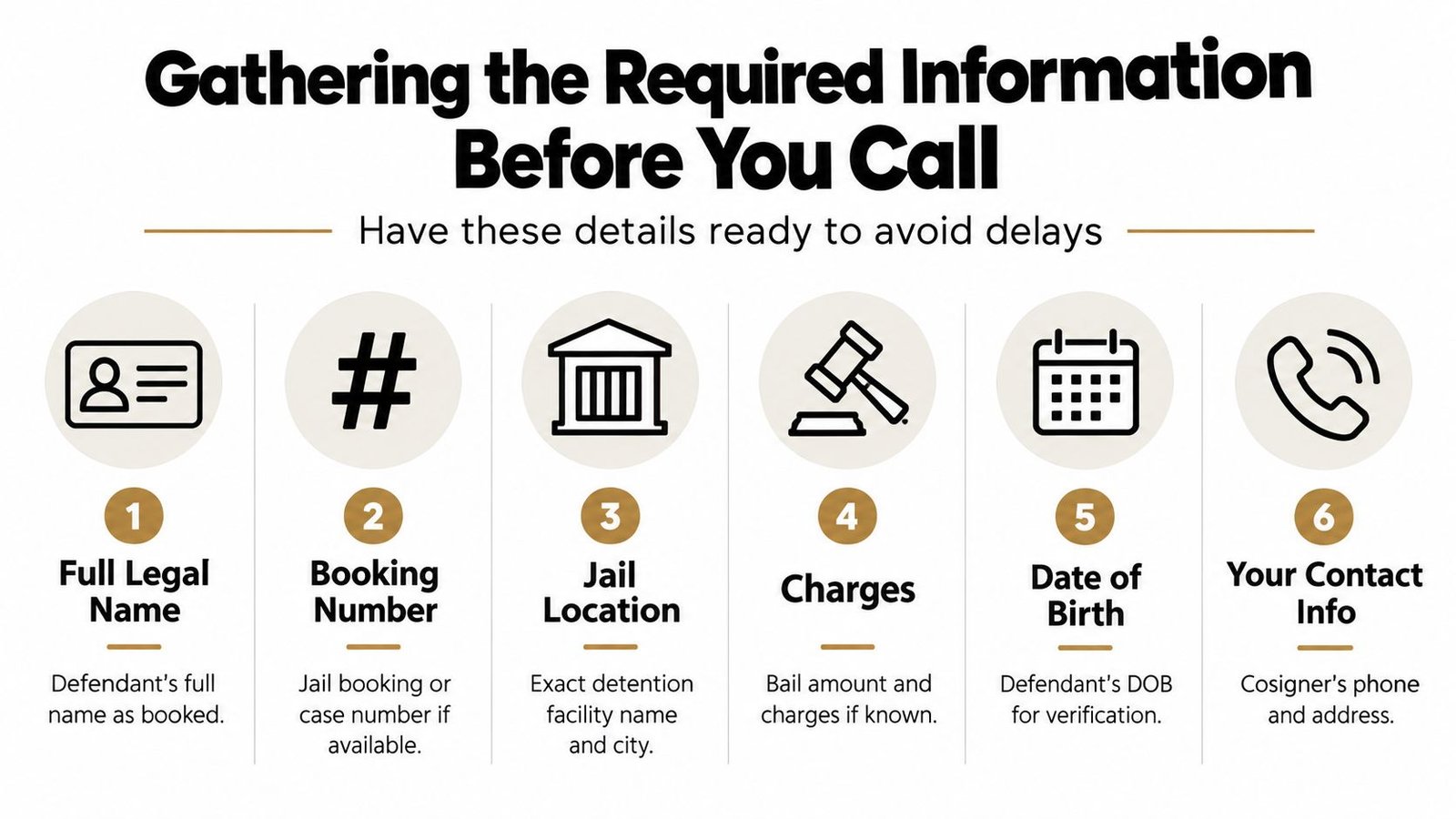
Gathering the Required Information Before You Call
The fastest phone call is the one made with the defendant's details in front of you. An agent needs enough information to locate the correct booking, confirm the detention facility, and verify whether the court has set a surety bond, cash bond, unsecured condition, or another form of release.
Have these details ready:
- Full legal name: Use the name under which the defendant was booked, including the correct spelling.
- Date of birth: This helps distinguish people with similar names.
- County and facility: State the exact jail or detention center and its city.
- Booking number: Provide it if the jail or defendant has supplied one.
- Charges and bond amount: Include the charges and amount if you know them, but let the agent verify the official record.
- Your contact information: Give the cosigner's phone number, address, and preferred contact method.
Why each detail affects timing
The full name and date of birth help an agent avoid pulling the wrong record. The county and detention facility determine which jail's procedures apply. The booking number can make verification faster, particularly when a facility has several people with similar names.
Charges also matter because the court may impose conditions beyond the monetary amount. Colorado courts can use unsecured or secured monetary conditions, and secured methods include cash, surety, real estate, or a professional bail agent, as explained in the Colorado pretrial release guidance. You shouldn't assume that every arrest can be handled with the same type of bond.
If a family member is hard to locate or you need help verifying public-record information, a SkipForge alternative to Tracers.com may help with lawful information-gathering tasks. It isn't a substitute for confirming the booking directly with the jail or agent.
Before you call, also review what documents you need so you can send identification, address records, and financial information without repeated requests.
Understanding Colorado Bail Premiums and Fees
You need the cost explained before you sign anything. In Colorado, the commercial bail-bond premium is capped at the greater of $50 or 15% of the bail amount, under Colorado's bail bond premium statute. The same law limits additional charges to specific categories, including court filing fees, actual collateral storage costs, and premium-financing charges.
A jail's processing fee is separate from the agent's premium. Arapahoe County, for example, states that a surety bond may be posted through a state-licensed bond agent, who may require a cosigner or collateral and typically charges 10% to 15% of the total bond amount. The county also lists a $10 non-refundable bond fee, payable in cash only for each bond, on its official bond information page.
Colorado Bail Bond Cost Breakdown
| Bond Amount | Standard Premium (15%) | Reduced Premium (10%)* | Jail Processing Fee Example |
|---|---|---|---|
| $5,000 | $750 | $500 | $10 in Arapahoe County |
| $10,000 | $1,500 | $1,000 | $10 in Arapahoe County |
| $20,000 | $3,000 | $2,000 | $10 in Arapahoe County |
*The reduced rate isn't automatic. Colorado bail guidance used by Denver practitioners says bonds larger than $10,000 often use a 10% premium, while smaller bonds commonly use 15%. A separate Colorado explanation says bonds over $5,000 may qualify for a 10% rate with an approved cosigner, subject to underwriting and approval. Review the specific terms in how bond pricing works before paying.
The critical distinction is premium versus collateral. The premium pays for the surety service and generally isn't treated like a refundable deposit. Collateral, if required, secures the agent against loss and should be documented clearly, including the conditions for its return.
If an agent adds broad miscellaneous surcharges, ask what legal or contractual category supports them. Don't sign a vague agreement under pressure. Request an itemized explanation of the premium, any approved fee, payment terms, and collateral obligations.
Completing the Electronic Application and Cosigner Rules
Modern bail processing replaces the old office-bound routine with a digital sequence. You speak with an agent, provide the defendant's information, receive the proposed terms, complete an online application, and review contract documents electronically. A cosigner can often participate remotely from a smartphone or computer.
Express Bail Bonds is one Colorado agency that offers electronic applications, contract documents, payments, and bond posting support through a remote process. The agent still has to verify the booking and court requirements, but the cosigner doesn't necessarily need to spend hours at the detention center.
What the cosigner is agreeing to
A cosigner isn't merely paying a fee. The cosigner provides financial backing and accepts responsibility for helping the defendant comply with the bond agreement. That can include keeping contact information current, encouraging court attendance, responding to the agent, and addressing problems quickly.
Approval depends on the agent's underwriting requirements. The cosigner may need identity and address documentation, evidence of financial stability, and an explanation of the relationship to the defendant. The agent may also request collateral when the financial profile or bond circumstances call for it.
The electronic workflow usually looks like this:
- Initial consultation: Confirm the booking, bond amount, and estimated cost.
- Digital application: Enter the defendant's and cosigner's information securely.
- Contract review: Read the obligations, payment terms, and collateral provisions.
- Electronic signature and payment: Sign the documents and pay through the available digital method.
- Bond posting: The agent submits the surety bond to the detention facility.
Review electronic signature requirements before signing. If you don't understand a clause, stop and ask the agent to explain it in plain English.
This short video gives families a visual overview of the electronic process:
Remote signing removes travel as a barrier, but it doesn't remove responsibility. The cosigner should keep copies of every signed document and know exactly whom to contact if the defendant misses an appointment, changes residence, or receives a new court notice.
Jail Posting Timelines and the Release Process
After the application is approved, documents are signed, and payment is complete, the agent posts the surety bond with the detention facility. The jail then reviews the submission, enters it into its system, checks for additional holds or conditions, and begins its release procedure.
That final stage belongs largely to the facility. Processing can vary with staffing, time of day, county procedures, the defendant's other holds, and the complexity of the release order. A bond agent can submit accurate paperwork and monitor the status, but no responsible agent should promise an exact release time before the jail completes its review.
What happens after posting
The sequence generally follows this pattern:
- Submission: The agent delivers or electronically transmits the bond documents accepted by the facility.
- Jail review: Staff verify the bond, conditions, identity, and any additional custody issues.
- Release processing: The facility completes its internal steps and prepares the defendant for release.
- Notification: The agent or family receives an update when the jail confirms progress or release.
A missing document can send the submission back for correction. An immigration hold, another case, or a court condition can also prevent release even after one bond is posted. Ask the agent whether the jail has accepted the paperwork and whether any separate hold remains.
County practices aren't identical. A local fee or cash-only requirement may apply, as the Arapahoe County example demonstrates, so confirm the facility's rules instead of relying on advice from another county.
For a clearer explanation of what happens after posting, review the Colorado release process. Keep your phone available, but don't repeatedly call the jail while staff are processing the release. Direct status questions to the agent handling the submission.
Meeting Court Requirements After Release
Release is the beginning of the defendant's responsibility, not the end of the crisis. The defendant must attend every scheduled court appearance, follow every condition in the release order, and keep the court and bond agency informed about changes that could affect compliance.
Read the order carefully. Conditions may address travel, contact with specific people, testing, treatment, weapons, reporting, or other conduct. The exact requirements come from the judge, so neither the cosigner nor the defendant should rely on assumptions based on someone else's case.
Protecting the bond after release
Put every court date on multiple calendars. Use phone alerts, a written calendar, and a trusted family member who knows the schedule. Missing court can place the bond at risk and create new legal problems.
Keep contact information current. Tell the agency promptly about a new address, phone number, employer, or detention status. Silence makes an urgent situation harder to resolve.
Treat check-ins as mandatory. If the court or agency requires reporting, follow the schedule exactly and keep confirmation records. The check-in requirements should be understood before the defendant leaves custody.
A cosigner should keep the signed contract, payment records, court orders, and agent contact information together. If paperwork must be sent to a court, this court filing methods guide offers general information about transmission options, but always follow the specific court's accepted filing rules.
Choose an agency that explains obligations before release and remains reachable afterward. A bond isn't just a transaction at the jail. It creates an ongoing need for accurate communication until the court matter and bond obligations are resolved.
Express Bail Bonds can help Colorado families start a surety-bond application remotely, complete electronic contracts, arrange payment, and coordinate posting with the detention facility. Visit Express Bail Bonds now to begin the process from home, or use its local resources for Jefferson County and Golden and Centennial when the arrest occurred in those areas.