At 2 a.m., a phone call can turn an ordinary night into a frantic search for answers. A mother hears that her son was arrested in Denver, but the arresting officer can provide only limited information. She may not know the jail, the bond amount, whether another agency has a hold, or whether posting money will result in an immediate release.
That confusion is understandable. The Colorado release process has two separate parts. First, a court decides whether and under what conditions someone may leave custody. Then jail personnel complete the administrative work required to physically release that person. A signed order or posted bond starts the process, but it may not finish it.
When the Call Comes In
The first hour matters because accurate information prevents wasted calls, wrong payments, and avoidable delays. I've seen families begin by driving to the wrong facility or trying to send money before anyone confirms the actual bond. Start with facts, not guesses.
Make these five decisions first
Confirm the arrest location. Ask the arresting agency or booking desk which county facility holds the person. A Denver arrest doesn't always mean the person remains in a Denver facility, particularly if another agency becomes involved.
Ask for the exact bond amount. Speak with the booking deputy or jail information desk and ask whether a judge has set bond. Don't rely on a friend's estimate or an old online record. The court may order a cash bond, a surety bond, personal recognizance release, or another condition.
Identify outside holds. Ask whether the person has an out-of-county warrant, parole hold, immigration detainer, or another agency's request for custody. A local bond may not overcome a separate hold.
Compare cash and surety release. Cash bail requires the family to provide the full amount directly through the court or clerk. A surety bond uses a licensed agent and usually requires a premium, a qualified indemnitor, and sometimes collateral.
Choose someone who can act immediately. The right contact should explain the amount, documents, payment, co-signer obligations, and likely jail workflow before taking money. Families can also review this practical guide on what to do when someone gets arrested while gathering information.
Practical rule: Don't ask only, “How fast can they post the bond?” Ask, “What still has to happen inside the jail after the bond is accepted?”
The release process doesn't begin at the jail door. It begins with the call, the questions asked, and the decision to verify every hold before choosing a payment path. A calm, complete intake often saves more time than rushing to post the wrong bond.
How Bail and Bonds Work in Colorado
Colorado release decisions generally fall into three practical pathways. The court may allow cash bail, where the full ordered amount goes directly to the appropriate court or clerk. It may authorize a surety bond, where a licensed Colorado bail bond agent guarantees the amount to the court in exchange for a regulated premium. Or it may grant personal recognizance, often called PR, which allows release without a financial payment while the person promises to appear and follow conditions.
A bond isn't a punishment. It is a financial promise connected to court attendance and compliance with release terms. The judge sets the conditions during an advisement or related hearing, and the jail then records the order before accepting the selected form of release.
The three pathways at a glance
| Pathway | Who Pays | Typical Speed | Best For |
|---|---|---|---|
| Cash bail | Defendant or family pays the full court-set amount | Depends on court and jail verification | Families able to provide the entire amount |
| Surety bond | Indemnitor pays a premium to a licensed bond agent | Often practical when electronic paperwork and posting are available | Families who need to preserve cash or need help coordinating release |
| Personal recognizance | No bond payment, though conditions may apply | Depends on eligibility, court action, and jail processing | People the court allows to remain free without secured funds |
The Colorado Pretrial Assessment Tool may help the court evaluate lower-risk cases, but it doesn't guarantee PR release. A judge still considers the charges, history, appearance concerns, safety issues, and legally required conditions. DUI allegations, domestic-violence matters, and repeat offenses can involve stricter requirements, so families shouldn't assume that a prior release option will apply again.
The practical distinction between bail and bond matters because the words are often used interchangeably. This explanation of the difference between bail and bond can help clarify whether the family is arranging a court payment or a surety guarantee.
The Step-by-Step Release Process
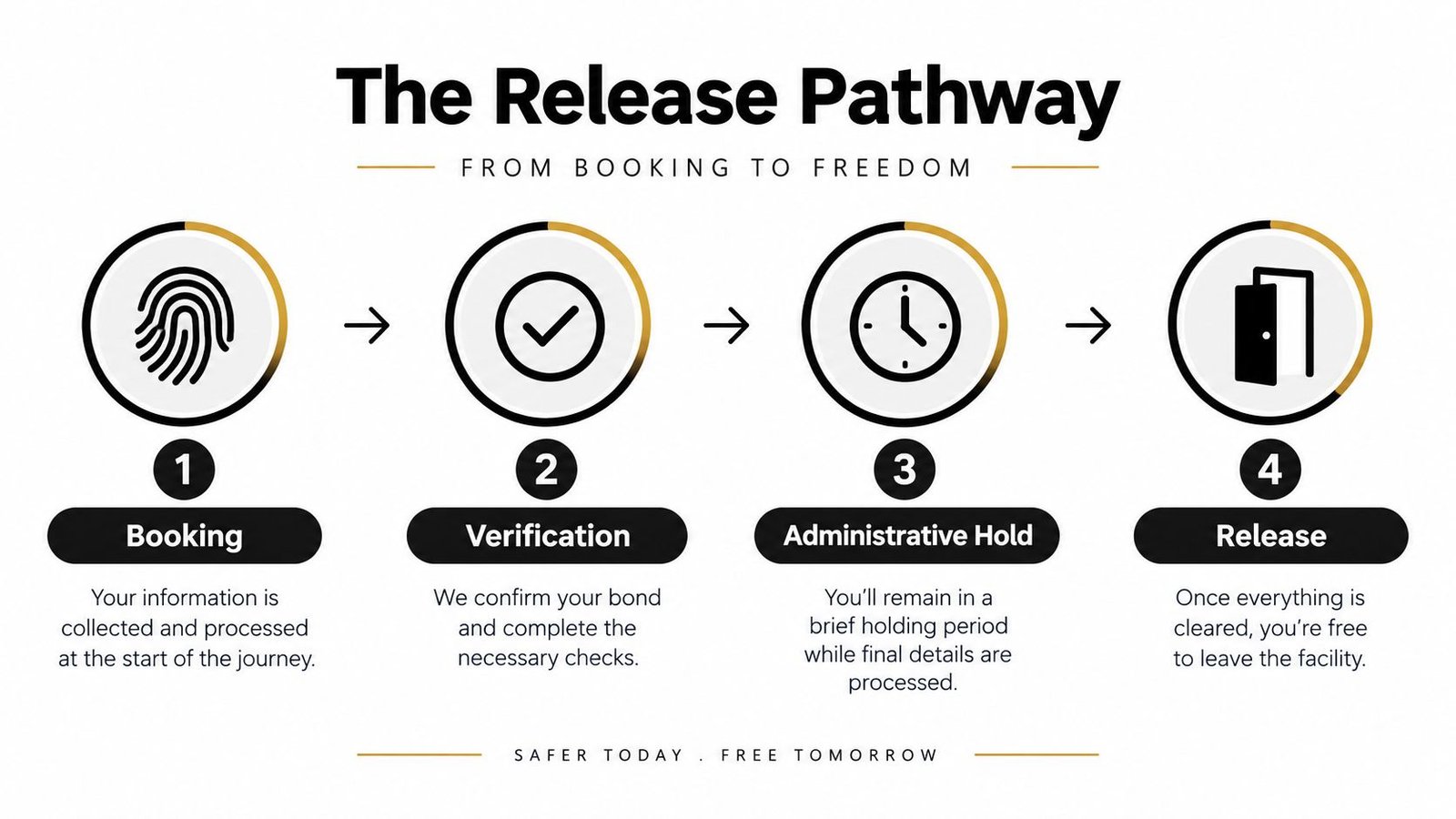
Once the court sets a release condition, the process moves from the courtroom to several jail and bonding work queues. Booking may include fingerprinting, photographs, medical screening, identification checks, and property inventory. Facility volume, staffing, and the person's medical or identification needs can make this stage take two to six hours, as commonly described in Colorado jail release practice.
What happens after bond is posted
After a surety bond is completed, the bonding office prepares and submits the bond package. The clerk or authorized jail staff may verify the power of attorney, the surety company's authority, the defendant's identity, and whether the person qualifies for that release type. Missing information can send the package back for correction.
The jail then places the submission in its verification queue. A release deputy may check:
- Other agency holds, including warrants outside the arresting jurisdiction.
- Immigration or parole restrictions, which can require separate instructions.
- Protective orders and court conditions, especially in domestic-violence cases.
- Identity and booking records, including name and date-of-birth matches.
- Medical or classification issues, where staff must confirm that release can occur safely.
The physical exit comes last. Staff return inventoried property, issue or confirm clothing, complete final signatures, and coordinate the person's departure from the secure area. A posted bond doesn't erase these steps.
Court-system data illustrate why release isn't always immediate. In felony state-court cases, about half of pretrial releases occur within one day of arrest, about three-fourths within one week, and more than 90% within one month according to the Bureau of Justice Statistics release data. The same source reports that non-financial releases were completed within a day 59% of the time, compared with 45% for financial releases, and that mean time from arrest to release increased from 8 days for bail under $5,000 to 22 days for bail of $50,000 or more.
Those figures describe broad court data, not a promise for any Colorado facility. They do show why jail-side paperwork, financial verification, and holds deserve as much attention as the court order itself.
Colorado Bail Bond Fees and Payment Options
Colorado regulates the premium a professional cash-bail agent may charge. State law caps the premium or commission at the greater of $50 or 15% of the bail furnished, making 15% the statutory ceiling for most Colorado surety bonds under the Colorado bonding-agent statute.
The calculation applies to the total bond amount, not merely to an amount the family happens to have available. The premium pays for the surety risk, application review, contract administration, bond filing, and ongoing court-tracking obligations. It generally isn't returned when the case ends because the agent's service and financial exposure begin when the bond is issued.
A family may instead post the full cash amount directly with the court. That route ties up more money at the outset, although the court may return eligible cash at case resolution according to its rules and any deductions. A surety bond usually requires less money upfront, but the indemnitor accepts contractual responsibility if the defendant fails to appear or violates the agreement.
| Bond Amount | Surety Premium at 15% | Cash Bail Posted | Refunded at Resolution | Collateral Needed |
|---|---|---|---|---|
| Court-set amount | 15% of the bond amount, subject to state rules | Full court-set amount | Depends on court disposition and deductions | Depends on underwriting |
| Larger secured bond | 15% ceiling remains the benchmark, subject to the contract and law | Full court-set amount | Depends on court disposition and deductions | May be requested |
| Cash-only condition | A surety option may not be available | Full court-set amount | Depends on court rules | Not applicable |
Colorado county information also says surety bonds may be posted through a state-licensed agent, and agents may require a co-signer or collateral. The Arapahoe County bond information page describes typical surety pricing as 10% to 15% of the total bond amount.
For bonds above $5,000, underwriting often becomes more demanding. The agent may request stronger proof of income, a larger initial payment, an approved co-signer, or collateral. Payment methods vary by office and may include cash, money orders, cards, or electronic transfers. Confirm the exact premium and contract terms before signing. This Colorado bail bond cost explanation covers the basic calculation and payment questions families commonly raise.
Documents Needed to Post a Bond
A surety application moves faster when the indemnitor has the core information ready. The indemnitor, or co-signer, is the person who enters the bond agreement and accepts financial responsibility under its terms.
Information from the indemnitor
Prepare:
- Government-issued photo identification, with a current legal name.
- Social Security number, for identity and underwriting review.
- Proof of address, such as a current utility statement or official correspondence.
- Recent pay stubs or employment verification, when requested for qualification.
- A working phone number, so the agent can reach the indemnitor about court dates or changes.
The defendant's information is separate. Provide the full legal name, date of birth, booking number, charges, and holding facility. The booking number is especially useful because similar names can create delays in locating the correct record.
The application records the indemnitor's liability acknowledgment, payment authorization, contact details, and agreement to support the defendant's appearance. Read those terms carefully. A co-signer isn't just paying a fee. That person may be responsible for the full bond exposure if the defendant fails to appear, depending on the contract and applicable law.
What commonly slows filing
Expired identification, a nickname instead of the legal name, an incorrect birth date, a missing booking number, and an incomplete address can force a correction cycle. Don't guess the bond amount or charges if the jail can confirm them.
Electronic processing can help relatives who aren't near the facility. Express Bail Bonds describes an online process using email and electronic signatures, allowing the family to start paperwork from home while another person travels toward the jail. The agent can often obtain booking details and court information independently, but the indemnitor still needs to supply accurate identification and financial information. Families can review the documents needed for a bail bond before beginning the application.
Jail Pickup Procedures and What to Expect
The defendant usually doesn't need to bring identification or money to the release window. The indemnitor handles the bond contract, while the person in custody waits for the facility to finish its checks. After bond acceptance and verification, administrative processing may take one to four hours, and it can take longer during overnight staffing periods, shift changes, or unusually heavy intake.
The final checkpoints
The release deputy typically confirms that the bond receipt is logged in the inmate management system. Staff then perform identity and warrant checks, review any medical issue connected with medication dispensed during custody, return personal property, and obtain the defendant's final signature on release paperwork.
A paid bond may not produce an exit if another agency claims custody. Common obstacles include:
- Out-of-county warrants, which may require another jurisdiction to respond.
- Immigration detainers, which can create a separate custody process.
- Parole holds, which aren't cleared by the local bond alone.
- Protective orders, court restrictions, or additional pending matters.
- Unresolved identity or medical verification, requiring staff review.
The family should keep the phone available and avoid assuming that silence means the bond failed. A coordinator or agent may be waiting for the facility to complete its queue rather than submitting a second bond that cannot change the underlying hold.
A national justice summary reported that Ontario bail cases averaged 4.1 days and 2.1 court appearances in the Ontario Court of Justice from July 2017 through June 2018, while earlier court data showed the average process taking about 4 days in 2001 and nearly 6 days by 2007, a 50% increase. The Canadian justice summary isn't a Colorado timetable, but it demonstrates how hearings, paperwork, and jurisdictional procedures can extend release beyond the initial decision.
Denver, Arapahoe, Jefferson, and El Paso facilities each control their own intake, verification, and release queues. Timing can differ by facility and circumstance, so ask for a status update that identifies the current stage, not just a general estimate.
Tips to Speed Release and Get Help Now
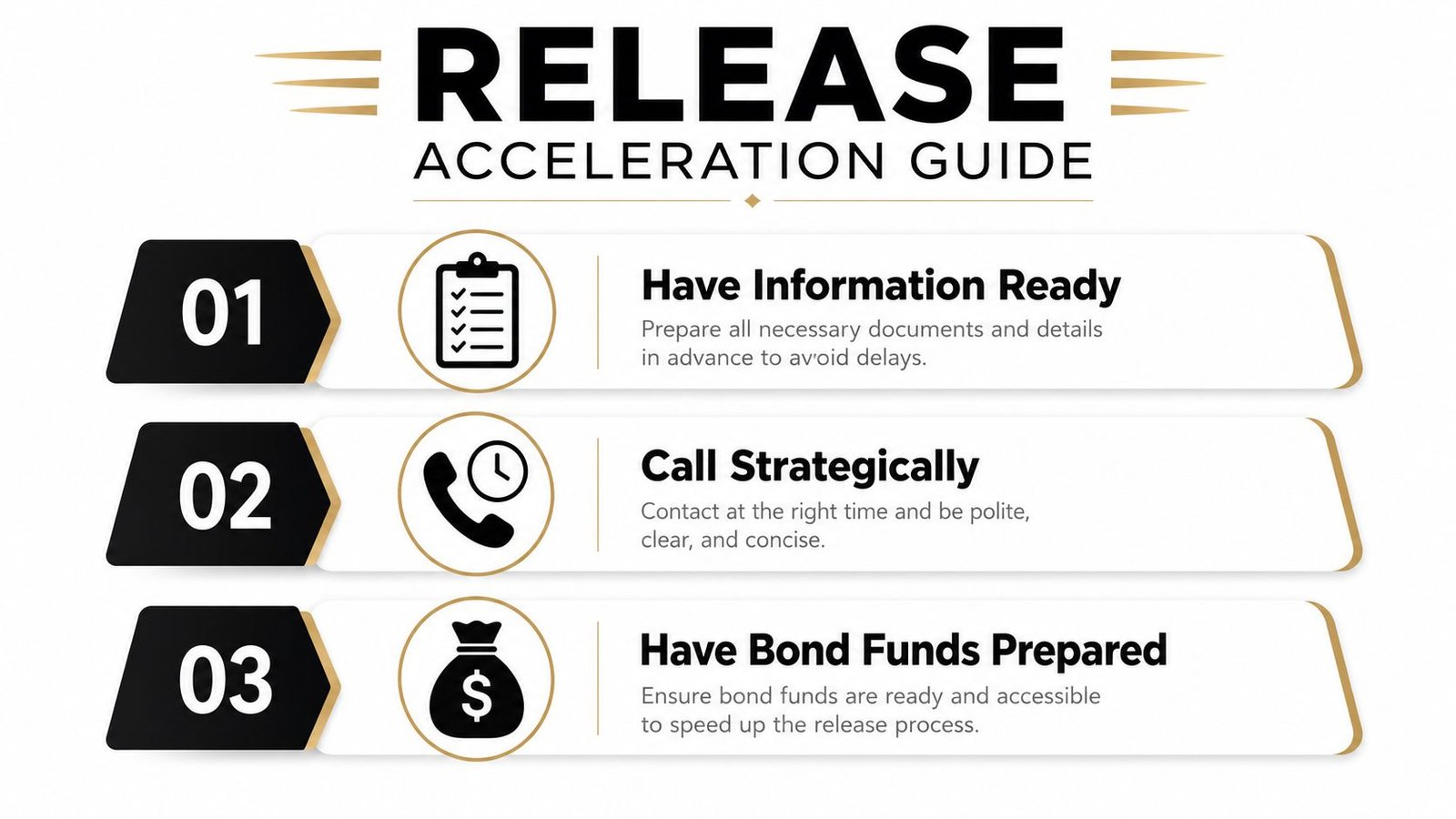
Speed comes from preparation and accurate communication, not from repeatedly calling the jail. Have the defendant's date of birth, full legal name, booking number, arresting agency, and facility ready before contacting a bonding office. Ask the jail to confirm the bond and every visible hold before authorizing payment.
Remove avoidable delays
- Call strategically: Overnight intake, shift changes, and busy booking periods can slow responses. You may not control the jail's queue, but you can provide a complete package before staff reach the file.
- Confirm the custody picture: Ask whether the person is held on a local warrant or another agency's detainer. A local bond won't clear an independent hold.
- Prepare funds and documents: Keep identification, proof of address, payment method, and co-signer information available. Missing documents cause more delay than a careful review.
- Verify the court order: Don't post cash or arrange a surety bond until you know the exact amount and release type ordered by the judge.
- Protect the case: Missing a court date can trigger bond forfeiture and create new financial and legal problems. The indemnitor should record every appearance date and condition.
A monitored jail phone isn't the place to discuss sensitive case facts. The defendant should avoid trying to coordinate complicated legal decisions through a recorded line. Instead, the family should give the bonding agent and defense attorney the verified booking information and follow their instructions.
Pretrial release also carries responsibility after the person walks out. A New Mexico baseline study found that 37% of released defendants had some pretrial failure, with higher failure rates for unsecured bond and own-recognizance releases, 43% and 41%, than for secured bonds, 34%, as reported in the New Mexico baseline measures report. The practical lesson is simple: a fast release still requires court-date reminders, condition compliance, and prompt communication when circumstances change.
If you need a Colorado on-time bail bond, ask whether the agent can begin electronic paperwork while a family member travels, post electronically at the applicable facility, and monitor the release queue after the bond clears. Those steps won't override a warrant or a jail-controlled hold, but they can reduce avoidable handoffs.
Express Bail Bonds helps Colorado families arrange licensed surety bonds, complete contracts and payments electronically, and coordinate posting with county facilities while tracking the administrative release process. Visit Express Bail Bonds or call 720-984-2245 for a 24/7 consultation, and have the booking number and exact facility ready.