In Colorado, a bail bond premium is capped at the greater of $50 or 15% of the bail amount under C.R.S. § 10-2-707. To check a first time quote, multiply the bail amount by 0.15 and compare the result with $50. The larger figure is the legal ceiling. On a $5,000 bond, that ceiling is $750.
The call may come at a bad hour, from a jail lobby payphone or a relative repeating a bondsman's quote. The person in custody cannot check the details, and the family may not yet have seen the court order that sets the bail amount.
Use the first call to ask about costs and what cosigning means. Then check the quoted premium against the legal ceiling, and ask which other charges may apply. Before signing, consider the household's financial exposure and the family's role in helping the defendant meet release conditions and appear in court. A quote is one part of the release decision, not the whole decision.
Information to Have Ready Before You Request a Quote
A bail agent prices a bond off the court's paperwork, not off the story. Every item below changes something specific in the quote or in how quickly the bond can be posted, which is why a family that collects all of it before dialing gets a usable figure on the first call instead of three rounds of questions and a callback.
The jail record and the court record are separate documents, and gaps between them cause most of the delay. The legal name on the booking sheet has to match the name the bond is written under. The bail figure has to match the amount a judge set, not what a relative heard in a hallway.
| Item | Where to find it | Why the quote needs it |
|---|---|---|
| Defendant full legal name and date of birth | Arrest paperwork or jail record | Matches the person to the jail record |
| Booking or inmate ID number | Jail booking sheet or jail inmate search | Locates the person in custody |
| Detention facility and county | Jail where the person is held | Determines the accepted posting method |
| Court name, case number and next court date | Court notice or charging papers | Confirms the appearance obligation |
| Bail amount and bond type | Court order or bond setting | Sets the premium ceiling |
| Charges listed | Charging document | Affects release conditions |
| Cosigner ID, phone and email | Cosigner's own documents | Needed to sign and to reach the cosigner |
An out-of-state relative can usually supply every one of those items remotely. Nothing in a surety bond requires standing at a counter in Colorado, and a cosigner in another state is common. What slows posting is a missing document, a bail figure that shifted at a hearing nobody attended, or a facility that won't accept the posting method the family assumed.
What to write down: every call gets a time, a name and what was said. Bond amounts change, and a quote tied to yesterday's figure is worth nothing today.
Keep one folder, paper or digital, with the booking sheet, the court notice and the cosigner's identification in it. Our guide to the documents you need for a Colorado bail bond lists the same set item by item, so you can confirm nothing is missing before you call anyone.
How to Check Your Bail Premium Quote
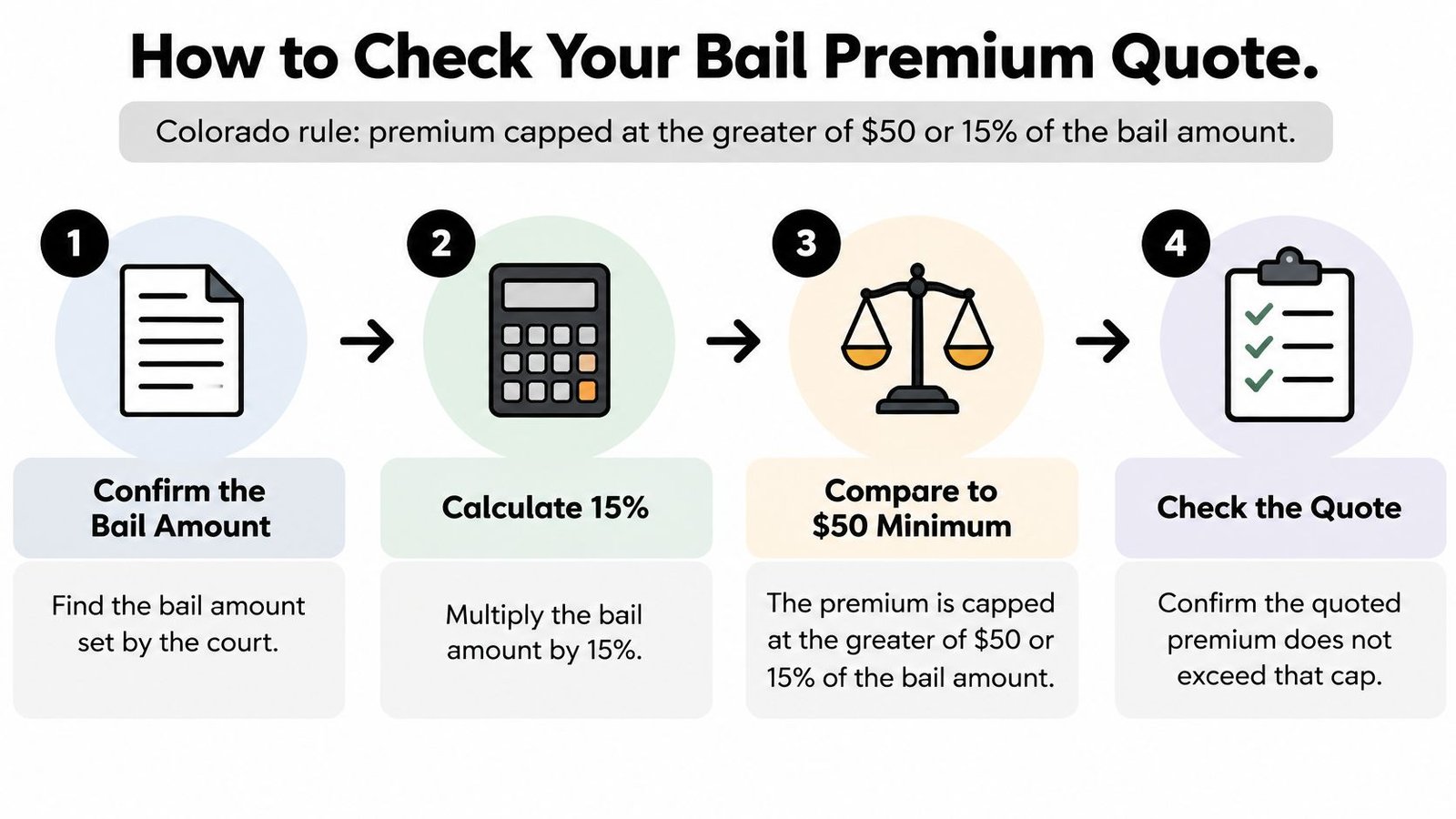
Colorado's statute on bail bond premiums, C.R.S. § 10-2-707, sets the ceiling for a surety bond: the greater of $50 or 15% of the bail amount, with no extra bond-related charges unless they correspond to permitted items such as court or law-enforcement filing costs, secure collateral storage, or premium financing. Do the arithmetic before you discuss anything else, because every other number in the conversation is measured against it.
- Confirm the bail amount from the court order. A figure relayed by phone may be from an earlier hearing, and a premium calculated on the wrong amount is wrong all the way down.
- Multiply that amount by 0.15. This is the percentage the statute allows an insurance producer to charge on the bond.
- Compare the result with $50 and use the larger figure. The dollar floor only controls on small bonds, which is why a $300 bond carries a $50 premium rather than $45.
- Ask for an itemized list of every other charge. Extras have to fall into a permitted category, and they need a receipt behind them.
- Confirm what's due at release and when. The premium is generally earned when the defendant walks out, so the timing of release carries contractual weight.
Here's the rule as a process you can run before the next phone call.
Find your number in the table rather than doing the math at 1 a.m. under pressure.
| Bail amount | 15% of bail | Maximum premium (greater of $50 or 15%) |
|---|---|---|
| $300 | $45 | $50 |
| $1,000 | $150 | $150 |
| $2,000 | $300 | $300 |
| $5,000 | $750 | $750 |
| $10,000 | $1,500 | $1,500 |
Colorado's 2025 sunset review of bail bonding works the rule through a $10,000 bond, where a bonding agent may charge up to $1,500, described as a maximum rather than a standard rate, with $50 named as the statute's minimum-dollar threshold. That framing matters. The ceiling tells you what an agency may not exceed, not what it will quote you, and collateral or other lawful requirements can vary with the individual transaction.
A quote that sits at or under the ceiling and arrives with an itemized list is a sound basis for comparison. A quote above it is a question to raise before any money moves. Our surety bond rates explainer covers how the percentage is applied in practice across Colorado counties.
Extra Charges Colorado Law Allows
The premium cap does not cover every possible charge. For first-time families, the practical question is whether each added amount has a permitted basis and a clear explanation. Colorado's allowed extra-fee categories are set out in C.R.S. § 10-2-707.
Ask the agent to identify the category for each extra charge and show how the amount was determined. Watch for:
- A flat paperwork fee. Completing the bond agreement is part of arranging the bond, not a separate service to purchase.
- An unexplained processing or service surcharge. Ask what the charge covers and which permitted category it falls under.
- A rush fee. Ask what specific allowed cost the fee represents.
- A convenience charge for card payment, texting, or an online application. Ask for its permitted basis and an itemized amount.
Pause before paying if a charge has no clear explanation. The first call with Express Bail Bonds is your chance to ask questions and get answers about costs and what it means to be a cosigner. Use that conversation to understand the quote before your household takes on a financial obligation.
Put these three questions in writing before you sign. Which permitted category does each extra charge fall under? What document supports the amount? Could the total change if release is delayed?
If paying the premium or providing collateral would require borrowing, read Colorado borrowing help from BadCreditMD before committing. A loan can leave your household with payments long after the arrest, so compare that risk with the bond's cost and the cosigner's obligations. The Colorado bail law overview provides further context on the rules that apply to bail bonds.
A useful quote makes the charges understandable before anyone signs. Treat vague or unexplained fees as a reason to stop and get answers, especially when the household is already managing calls, paperwork, and decisions after an arrest.
Release Options Besides a Paid Surety Bond
Release runs a chain. The court selects a release type and conditions, the defendant has to satisfy financial and nonfinancial requirements, and posting then depends on processing, documentation and jail acceptance. A bond quote touches one link in that chain, which is why Colorado's statewide bail research separates secured money bonds from unsecured personal-recognizance bonds and evaluates both with the Colorado Pretrial Assessment Tool (Colorado Bail Book).
Don't assume a first arrest means a walk-out on recognizance. In a federal cohort of 56,982 defendants charged in 1996, 26.7% of those with no prior arrest were ordered detained, against 38.4% of those with at least one prior arrest, according to the Bureau of Justice Statistics. Courts weigh more than a clean record, and the decision isn't the family's to make.
| Release option | Typical cost | First question to ask |
|---|---|---|
| Personal recognizance | No premium | Is a nonsecured release available for this charge? |
| Secured surety bond | Premium capped at the greater of $50 or 15% of bail | Does the bond amount match the court order? |
| Cash bond paid to the court | Full bail amount deposited, with refund under court terms | Are the refund and fee terms confirmed in writing? |
Before committing to a paid surety bond, confirm four things:
- The bond classification. Secured surety, unsecured, or cash, exactly as written on the order.
- The court's appearance and contact requirements. Dates, check-ins, and any no-contact terms.
- The facility's accepted posting method. Some jails take paperwork electronically; others don't.
- Who is authorized to sign. A cosigner who isn't on the approved list can't complete the posting.
A surety quote can be arithmetically correct and still unusable, most often because it's built on an outdated bond amount or omits a required court filing.
The script: ask the attorney or the court clerk whether a personal-recognizance or other nonsecured release is available for this charge before you pay anyone. If a secured bond is genuinely required, use the statutory calculation as your benchmark.
Ask the attorney to put the available release options in writing, including what happens if the defendant can't meet a condition. Our page on PR bonds in Colorado explains how personal recognizance works in practice.
Cosigner Duties and Financial Risk Before You Sign
The premium is the smallest number a cosigner signs up for. The signature on a surety bond is a guarantee of appearance, and a missed court date can put the bond amount itself on the line, not just the fee. Families compare quotes as if the premium were the whole cost, then discover the rest of the obligation months later.
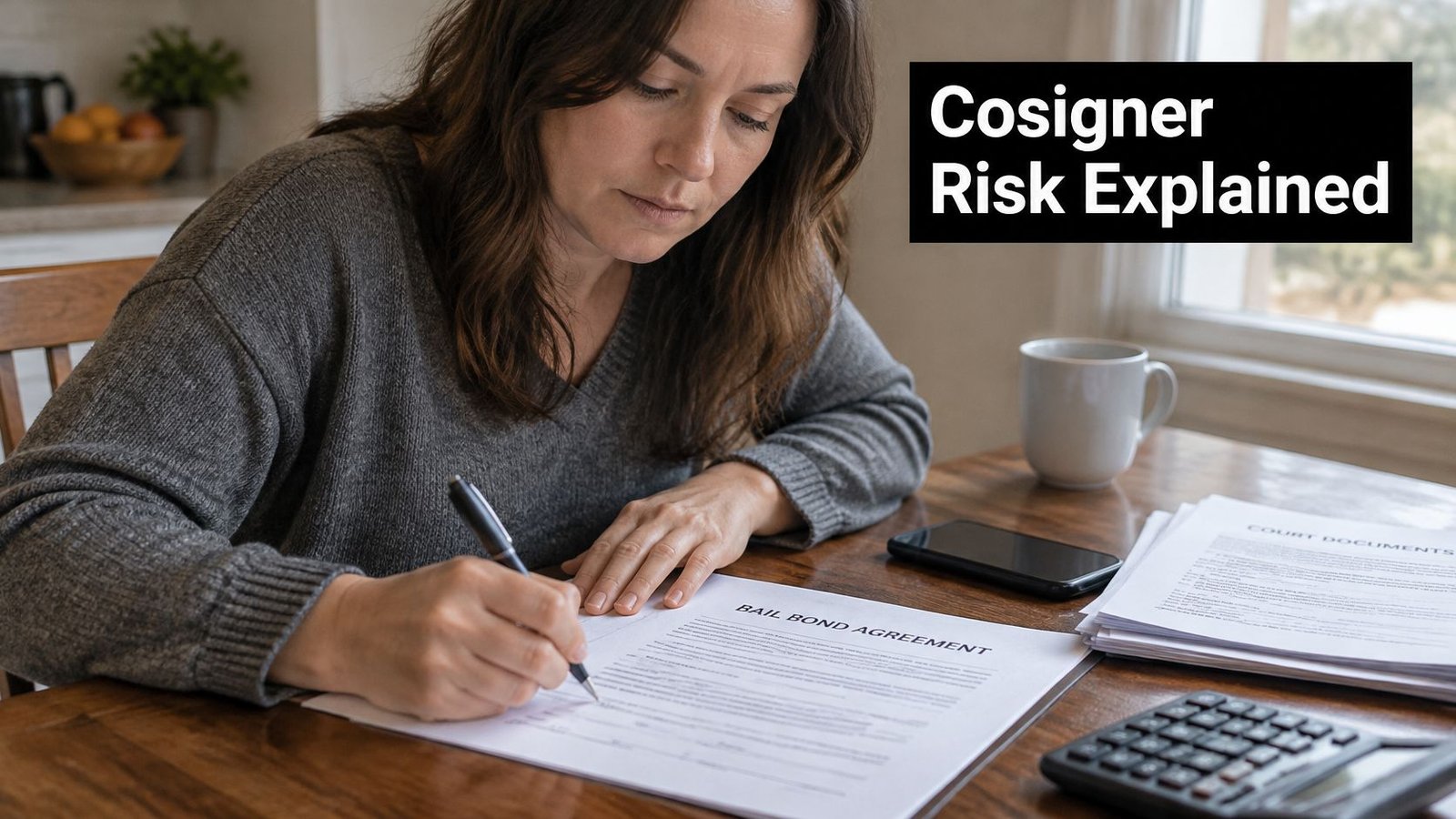
Separate four things before you sign anything. The premium is what's paid to the agency for writing the bond. Collateral is property or cash pledged and returned only under stated terms. Payment arrangements are the schedule, and a missed installment can affect the bond. The indemnity obligation is the agency's right to recover from the cosigner if the bond is forfeited.
The household stakes are documented. A 2025 University of Alberta study merged more than one million Maryland criminal cases from 2000 to 2016 with bankruptcy, foreclosure and judgment-lien records and found that pretrial custody was associated with a 30% higher probability of personal bankruptcy within three years, a 35% higher likelihood of judgment liens, and a 16% higher combined probability of household insolvency, with effects spilling over to relatives who post bail or guarantee a bond (University of Alberta). The same body of research notes that unsecured bonds can achieve comparable safety and appearance outcomes while reducing detention and financial inequity, which is another reason to ask about nonsecured release first.
Four questions to settle before signing. What collateral is required and how is it returned? What's the payment schedule? What happens to the cosigner if the defendant misses a court date? Under what conditions can the cosigner be released from the obligation?
Read the agreement with the clock stopped, and have someone outside the household read it too. Our breakdown of cosigner responsibilities goes through each obligation line by line.
What Family Members Do From Booking to First Court Date
An arrest leaves the family with two jobs at once: track the release process and keep the household's practical responsibilities covered. A 2025 University at Buffalo study based on interviews with 41 family members found that relatives spend the first days handling legal procedures, conflicting responsibilities and unclear jail information while supporting someone in custody. The study also notes that roughly two-thirds of people in jail nationally have not been convicted, so release decisions can arrive while families are still trying to understand the process (University at Buffalo).
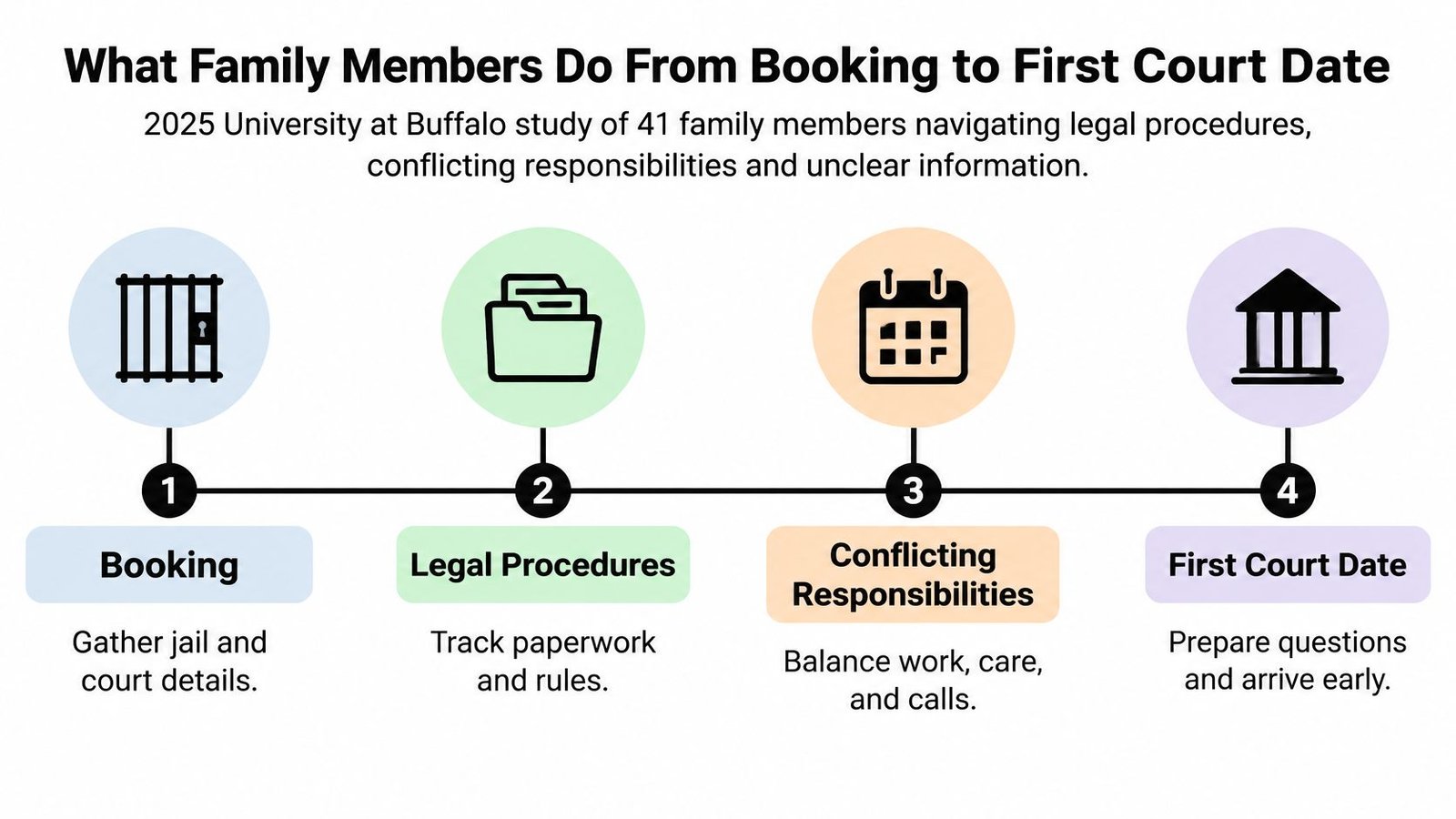
Booking. Use the jail's inmate search to confirm the facility and county. Ask jail staff who can receive updates, then record that person's name and the information they provide. One designated family member should keep the details in one place.
Quote and posting. After the court sets bond, confirm what must be paid for release and who is signing the agreement. Record the amount, keep the receipt, and note who signed. Treat the quote as one part of the release decision, alongside the household's ability to manage the cosigner's obligations.
Release. Confirm the pickup time and discharge location. Before leaving, make sure the person understands any conditions given at release. A historical Colorado study of 4,434 cases across 15 counties found that 92% of people booked were released before trial and 70% were released within 24 hours (Bureau of Justice Statistics). Families should be ready to arrange transportation and respond to instructions promptly.
First appearance. Write down the date, courtroom and arrival time. Decide who will attend, and keep the court information with the release paperwork.
After release. Help arrange transportation, childcare and any required reporting. Track no-contact orders and other conditions, and make sure the person knows what they must follow. Families can support compliance by collecting instructions from jail and court staff and sharing them clearly.
One designated note-keeper beats four people making calls. Send that person every jail and court update, then have them share a daily summary with the family.
The West Hawaii criminal defense guidance concerns arrests in Kona, not Colorado, so rely on local jail and court instructions for this process.
Request Your Quote With Everything Ready
Once you have the jail details, the bail amount from the court order, the premium ceiling, the list of permitted extras and the cosigner questions written down, you're ready to call and get a real quote. Calling earlier gets you a range and a lot of questions you can't answer yet.
The first call is the moment to ask about costs and about what it means to sign as a cosigner, before anyone commits. Ask the agent to walk through the premium calculation, every extra charge and the cosigner obligations while you have the checklist in front of you. Express Bail Bonds answers those questions on that call rather than after the paperwork.

Start with the full service overview if you want the process in one place, the Jefferson County and Golden page if the arrest happened there, or the Centennial bail bonds page for Arapahoe County postings. Call with the checklist in hand and work through it line by line.
Express Bail Bonds is a licensed Colorado agency serving every county detention facility in the state since 1988, and its agents can take an application, payment and contract electronically so a bond gets posted without a family driving to the jail. Whether the arrest happened in Denver, Golden or Centennial, the premium math and the cosigner obligations work the same way, and the agency will walk through both with you before anything is signed. Call or text 720-984-2245 with your court and jail details ready, and visit Express Bail Bonds to start the process.