Licensed surety bail bonds in Colorado are typically posted the same day, but release usually takes about two to eight hours after the bond is filed, not minutes. The fastest path is to contact a licensed agent immediately, have the defendant's information ready, complete the paperwork electronically, and allow the jail time to process the release.
Your phone rings after dinner, and a family member says someone has been arrested. You may not know the charge, the bail amount, or even which facility is holding them. The pressure is real, but panic slows decisions. Fast action bail bonds work best when you treat the first call as an information-gathering step, not as a race to send money blindly.
The practical question isn't only, “How fast can the bond be posted?” It's also, “What can be completed remotely, what still requires jail processing, and what could stop release after payment?” The answers below will help you move quickly without making an expensive mistake.
Understanding Fast Action Bail Bonds in Colorado
A fast action bail bond is a rapidly organized surety bond that helps a defendant leave custody while the case continues. It isn't an instant-release service or a way to skip booking, court requirements, or jail procedures. The agent still has to verify the defendant, confirm the bond, complete the agreement, collect the premium, and file the bond with the appropriate facility.
Start with a call to a licensed Colorado bail bond agent. Have the defendant's full legal name, date of birth, booking number, detention facility, known charges, and bail amount available if you have them. If you don't know every detail, call anyway. An agent can help identify what is missing and determine whether the jail has finished the initial booking process.
Practical rule: The earlier you verify the facility and bond amount, the sooner you can solve the right problem.
Pretrial detention creates the urgency behind these calls. More than 400,000 people are currently detained before trial, and about 69% of city and county jail populations are held before trial, according to the Prison Policy Initiative's pretrial detention research. That same source reports that the number of people jailed pretrial has nearly quadrupled since the 1980s. The figures explain why families often need a workable release process rather than general information about the criminal court system.
What a surety bond actually does
With a surety bond, a licensed bail bond company posts the full bail amount on the defendant's behalf. The customer pays a non-refundable premium for that service, and the agent may require a cosigner or collateral depending on the circumstances. This differs from paying the entire bail amount directly to the court.
The first useful resource to review is the Colorado jail release process, but don't wait to call if someone is already in custody. The agent needs accurate facts before preparing documents, and the jail must accept and process the completed bond.
Fast action means removing avoidable delays. It doesn't mean promising that the defendant will walk out immediately after a signature. A good agent explains the next action, the information still needed, and the part of the process controlled by jail staff.
Why Surety Bonds Are the Fastest Path to Release
Many families assume cash bail must be faster because it appears simpler. If the court accepts cash, they reason, why involve a bond company? In practice, a cash-only payment can require the payer to confirm the exact amount, find the correct payment channel, provide the full sum upfront, complete court or facility procedures, and wait while staff reconcile the transaction.
A surety bond changes the workflow. The licensed agent verifies the information, prepares the agreement, arranges payment of the premium, and posts the guaranteed amount on the defendant's behalf. That can reduce the amount of coordination a family must manage during an already stressful call.
Surety and cash are different decisions
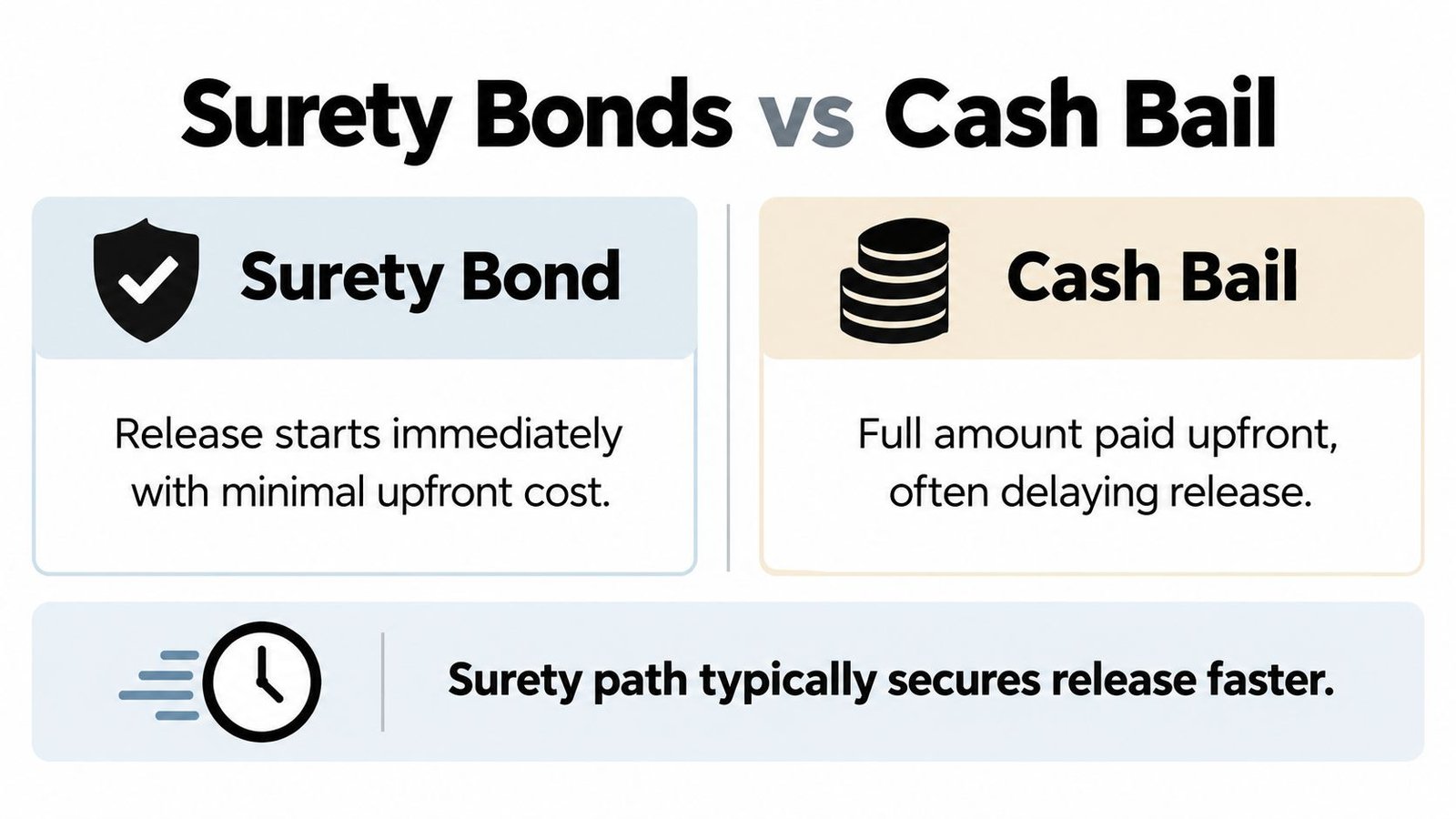
A surety bond generally requires a premium rather than the full bail amount. Cash bail may avoid a bond premium, but it requires access to the complete amount and still doesn't remove jail processing time. The right comparison is therefore not “fee versus no fee.” It is upfront liquidity, administrative work, timing, and financial exposure.
| Surety bond | Cash bail |
|---|---|
| An agent posts the full bail amount on the defendant's behalf | The payer provides the full amount directly through the accepted court or facility process |
| The customer pays a non-refundable premium | The payer commits the entire bail amount upfront |
| Electronic contracts and remote communication may reduce travel and paperwork delays | The payer may need to manage payment procedures directly |
| The bond company coordinates posting requirements | The court or jail still controls acceptance and release processing |
A surety bond isn't automatically faster in every situation. A missing booking record, an unresolved warrant, an incorrect facility, incomplete identification, or a court condition can delay either method. The advantage comes from having a professional manage the bond workflow while the family supplies accurate information promptly.
A licensed agency such as Express Bail Bonds focuses on surety bonds rather than cash-only bonds and supports electronic applications, payments, and contracts. Families can learn more about the difference between a surety bond and cash bail before deciding which route fits the case.
Documents and Requirements for Expedited Processing
The quickest application is the one that arrives complete. Before calling, gather whatever you can from the defendant's paperwork, jail messages, court records, or a family member who spoke with the facility. You don't need to delay the first call while hunting for every document, but missing basic identity information can force the agent to stop and verify details later.
Prepare these details first
- Defendant's legal name: Use the name recorded by the jail, including any middle name or suffix.
- Date of birth: This helps distinguish the correct person when names are similar.
- Booking number: Provide it if the jail has issued one.
- Detention facility: Identify the specific county jail or detention center, not only the city.
- Bail amount and charges: Share the amount shown in the jail record or court information.
- Your identification and contact details: The agent needs to know who is signing and how to reach you.
- Cosigner information: Have the proposed cosigner's identification, address, employment or income information, and contact details ready if requested.
The cosigner isn't merely a name on a form. That person accepts financial responsibility under the bond agreement and helps ensure the defendant understands and follows the court's requirements. An approved cosigner can also make the review more efficient because the agent can evaluate responsibility, contact information, and payment arrangements in one conversation.
What still takes time
Electronic signatures can handle much of the application from home, including contract review and authorization. The jail's release work is different. Staff must receive the filed bond, verify it, update the custody record, and complete their own release steps.
One legal overview places the typical post-posting release window at about two to eight hours, because jail staff still need to process the paperwork after the bond is filed. The explanation of how bail bonds work is useful for setting that expectation. Fast processing starts the clock sooner, but it can't eliminate the facility's administrative queue.
For a clear document checklist, review what documents are needed for a bond. Keep your phone nearby after submitting anything. An unanswered verification call can create a delay that no payment method will fix.
Step-by-Step Guide to Securing Your Bond
The process is usually easier when you separate tasks the family can complete remotely from tasks that belong to the agent or detention facility. That distinction prevents a common misunderstanding: signing a contract is not the same as filing the bond, and filing the bond is not the same as physical release.
Start with a phone call or text
Give the agent the defendant's name, birth date, facility, booking number, charges, and bail amount. If the person hasn't completed booking, say so. The agent can tell you whether the bond is available to post or whether the jail still needs to finish intake.
Complete the electronic application
The application collects information about the defendant, cosigner, residence, employment, finances, and the proposed payment arrangement. Read each field carefully. A typo in a legal name or an incorrect facility can send the application into a verification loop.
Send identification and supporting information
The agent may request identification for the signer and cosigner, proof of address, employment details, or financial information. Use secure electronic channels supplied by the agency. Don't email sensitive documents to an unverified address or send money before you know who is handling the transaction.
Review and sign the surety agreement
The agreement explains the premium, payment terms, responsibilities, collateral requirements, and court-appearance obligations. Ask about anything you don't understand before signing. The bond application process should leave you knowing who is responsible for each next step.
Process the payment and post the bond
Once the application is approved and payment is arranged, the agent files the bond with the jail or detention facility. Remote technology helps most at this stage. You may be able to complete the contracts and payment from home, while the agent handles the posting procedure without requiring you to spend hours at the detention center.
Wait for facility release processing
After filing, jail staff still control the physical release. The usual post-posting window is two to eight hours, as noted earlier. During that period, keep your phone available, avoid repeatedly changing transportation arrangements, and ask the agent whether the facility has accepted the filing.
The most effective workflow is orderly rather than frantic. Confirm the facts, respond quickly to document requests, sign only after reviewing the terms, and understand that the final handoff depends on jail staff.
Colorado Pricing, Premiums, and Cost Expectations
Urgency can make unclear pricing harder to challenge. Before signing, request the premium, each permitted additional charge, and the payment schedule in writing. Colorado law caps a bail bond premium at the greater of $50 or 15% of the bail amount and limits separate charges to specific categories, including court filing fees, secure collateral storage, and premium financing. The Colorado premium statute sets the governing framework.
Ask for a written calculation based on the amount of bail furnished. The premium pays for the bond service and is generally non-refundable once the bond is executed. Collateral is separate. It may be returned after the case is resolved and the bond is exonerated, subject to the agreement and the court's action. For a clearer breakdown of premium, collateral, and related charges, review how bond pricing works.
Remote contracts and electronic payment can reduce delays, but they do not change the amount the law or the agreement requires. Confirm the total before sending funds, especially if a family member is signing from another location.
The cosigner can affect the upfront amount
Colorado bail-bond pricing information states that bonds of $5,000 or more may be written at a 10% premium when an approved cosigner is available, according to Colorado bail-bond pricing information. Approval is not automatic. The agent still evaluates the cosigner and the particular bond.
Ask whether an approved cosigner changes the premium available for this bond. Do not assume the reduced rate applies just because the bail amount meets the threshold. Confirm eligibility, required documents, payment timing, and collateral terms before signing.
Questions worth asking before payment
- What is the exact premium? Request the dollar amount and the rate used.
- Which additional charges apply? Ask for an explanation of every filing, storage, or financing charge.
- Is collateral required? Confirm its form and the conditions for its return.
- When is the premium earned? Ask when it becomes non-refundable.
- What does the cosigner accept? Make sure the signer understands appearance and payment responsibilities.
A written quote cannot guarantee release speed. It does show whether the cost is clear before the bond is posted. Compare the complete terms, not only the first figure mentioned during a rushed call.
Working with a Trusted Colorado Bail Bond Agent
A reputable agent should answer the practical questions directly: Is the bond available to post? What information is missing? Which documents can be signed remotely? What happens after filing? Experience with Colorado detention facilities matters because agents must work within the procedures of the specific facility, not an abstract statewide process.
Express Bail Bonds is a licensed Colorado agency based in Denver, serving detention facilities statewide since 1988, with applications, payments, and contract documents available electronically and assistance by call or text at 720-984-2245. Its stated service model is available 24/7, which matters when an arrest happens outside ordinary office hours.
For a case in Jefferson County, use the Jefferson County and Golden bail bond service page. Families dealing with an arrest in Arapahoe County can also review the Centennial bail bond service page. Local facility information helps you confirm where to direct the first call and what details to gather.
A useful agent won't promise release in minutes. They'll explain what can happen immediately, what depends on the jail, and what obligations continue after release. That plain answer is more valuable than a dramatic speed claim.
The short video below provides another way to understand the service and release process.
Call 720-984-2245 or send a text with the defendant's name, facility, and booking information so an agent can verify the bond and start the electronic paperwork. Keep your identification and cosigner details ready, and ask for the written premium before you authorize payment.
Express Bail Bonds offers 24/7 Colorado surety-bond assistance, electronic contracts and payments, and guidance through jail filing and post-release requirements. Visit Express Bail Bonds now to start the fast action bail bond process with the defendant's facility and booking details ready.