You've signed the bond, the jail has accepted the paperwork, and your family is still waiting for the phone call that says, “He's walking out.” That gap can feel alarming, especially when nobody can give you an exact minute. In Colorado, discharge from jail is usually a controlled process involving jail records, verification, court requirements, property, medical procedures, and the final release handoff.
A signed bond starts that process. It doesn't always mean the person has physically left the facility. Understanding what happens next helps you ask better questions, prepare for the pickup, and avoid mistaking an ordinary jail delay for a new legal problem.
Why Discharge Is Not the Same as a Bond Being Posted
A family can do everything right, sign the bond, hand over the paperwork, and still spend the next few hours staring at the phone. That waiting period is where a lot of panic starts. A posted bond changes the person's legal status, but the jail still has its own release steps before anyone walks out.
That gap matters. Families often hear “the bond was posted” and expect the door to open right away. In practice, the bond usually gives the jail authority to move the release forward. It does not mean every check is finished, every signature is in place, or every internal clearance has been completed.
Jails track release events with more detail than a family sees from the lobby or parking lot. Records may note the release date, release type, time served, credited jail time, offense, sentence information, and prior custody history. The Bureau of Justice Statistics' National Corrections Reporting Program shows why that distinction matters. A bond release, a transfer, a sentence completion, and a parole-related discharge can all end with someone leaving a facility, but they are recorded as different outcomes for different reasons.
Practical rule: Treat the signed bond as permission for the jail to begin its release workflow, not as proof that the workflow is complete.
The waiting period works like a relay. One handoff leads to another, and one unfinished item can slow the whole release even when the bond itself is valid.
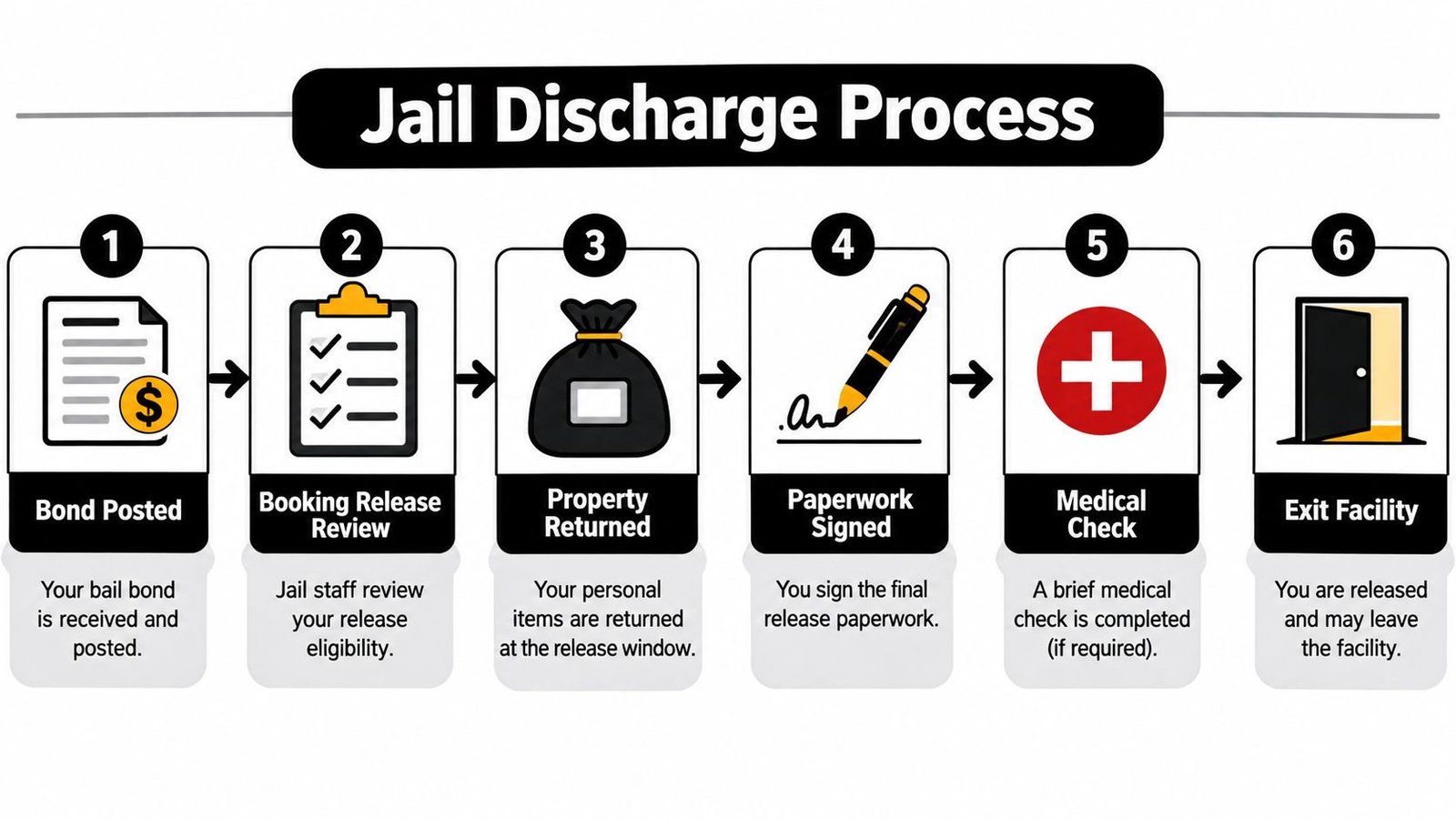
- The bond is accepted and entered into the jail or court system.
- Jail staff verify identity, booking status, and release authority.
- Staff check for holds, warrants, conditions, and required acknowledgments.
- The jail finishes property, medical, and paperwork procedures.
- The person is released through the facility's designated exit process.
If a family wants a clearer read on what is happening, it helps to ask better questions. Instead of asking only whether the bond was posted, ask whether the jail has completed all release checkpoints and whether anything outside the bond is still holding the person. This guide to what happens after bail is posted can help families tell the difference between a bond problem and an ordinary discharge delay.
How the Jail Discharge Process Actually Works
The process varies by facility, but the same basic checkpoints appear across Colorado. The bonding agency can prepare and submit a surety bond. The jail, sheriff, court, and other agencies control the remaining release decisions and procedures.
The visible checkpoints
Booking and identity review come first. In Denver, the sheriff's department states that bond can't be posted until fingerprints have cleared and the person has been fully booked into jail. If booking isn't complete, a family may believe the bond is ready while the facility still cannot accept it.
After the bond is signed by all required parties, Denver generally releases inmates within a two-hour window, according to the Denver Sheriff's Department's court services guidance. That is a general window, not a promise of an exact departure time. Staffing, verification, medical clearance, transportation, or another hold can affect the actual timing.
The jail then checks the release authority and the person's record. A sheriff release may move differently from a court release. A historical Bureau of Justice Statistics study of 4,434 bookings across 15 Colorado counties found that 92% of defendants were released before trial, with more than 77% of those releases under bond. The study also found that 70% of cases were discharged within 24 hours, but the underlying data came from 1983 through 1985, so those figures aren't current guarantees. Its useful lesson is that the releasing authority and jail-side processing can influence timing. See the BJS study of pretrial release practices in Colorado.
What happens before the exit
Staff may review warrants and external holds, return personal property, complete a medical check, prepare release paperwork, and explain court conditions. These tasks don't always happen in a perfectly visible order, and the family may receive no update during a routine handoff.
Ask for the status of the checkpoint, not just an estimated time. “Has the bond been entered?” and “Has the release review cleared?” produce more useful answers than repeatedly asking whether the person is out yet.
Families can use the Colorado jail release process overview to organize those questions. If the bonding agency says the bond is complete, ask whether the jail has acknowledged it. If the jail says the person is still pending release, ask whether the issue is booking, paperwork, a hold, medical clearance, property, or a court requirement.
Types of Release That Count as Discharge
A family will often hear one word, “released,” and assume it always means the same thing. At the jail, that word can cover several very different outcomes. The line on the paperwork matters because it tells you what kind of discharge happened and what still follows the person after they walk out.
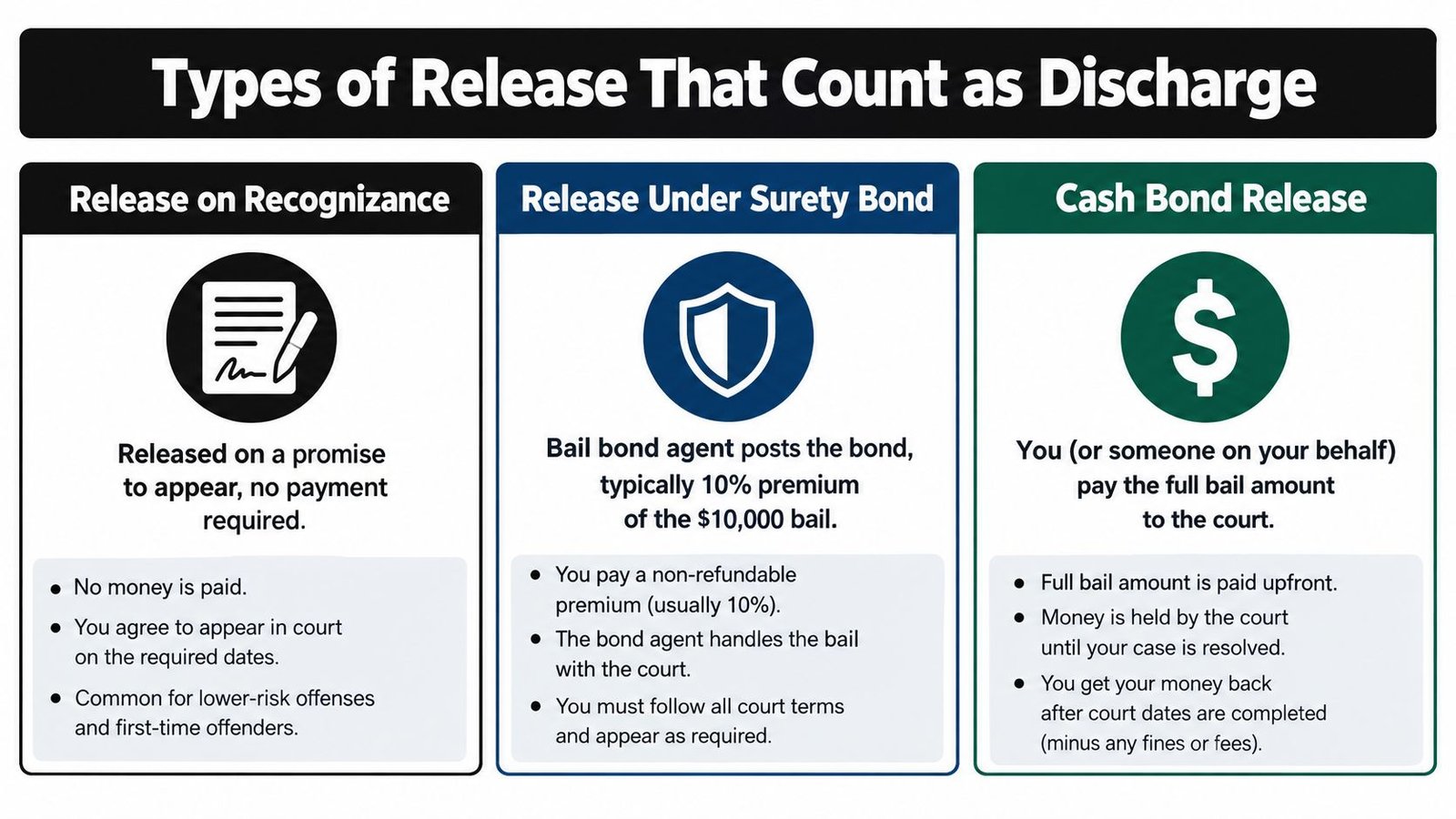
The three bond-related release types people run into most often are release on recognizance, surety bond release, and cash bond release. Release on recognizance means the court allowed the person out on a promise to appear and follow conditions, without a surety company posting bond. Surety bond release means a bonding agency posted or arranged the bond under the court's terms and the bond contract. Cash bond release means money was paid directly under the court or jail's rules.
Those are not the only ways someone can leave a jail. Other discharge categories can look similar from the outside, even though they mean something very different:
- Sentence completion: the person leaves because the jail time or custody period is finished.
- Dismissal or case-related release: the case or charge no longer supports detention, though that does not automatically mean every other matter is resolved.
- Transfer: the person exits one facility but stays in custody because another county, state, or agency is taking over.
- Parole-related discharge: a custody or supervision event ends under parole authority, based on that record.
That distinction matters in the anxious gap after a bond is signed. A signed bond can lead to discharge, but discharge can also happen for reasons that have nothing to do with bond. Families who do not check the actual release category can misunderstand where their person is going next, whether another agency is involved, or what conditions start the moment they are out.
Colorado's bond framework also helps explain why “discharge” is only part of the story. Courts set bond and conditions to help secure appearance in court and protect people or the community. A person can be physically discharged and still leave under active rules such as supervision, stay-away orders, travel limits, or other conditions.
Read the release paperwork closely. One line can tell you whether the person is going home under bond conditions, finishing a sentence, or being transferred instead of returning home.
Paperwork, Identification, and What You Bring to the Jail
The pickup can fail even after the legal work is complete if the person arriving at the jail isn't prepared. Facilities commonly require identification from the person collecting the defendant, and staff may limit access to designated release areas. Call the facility before driving over and ask about its current pickup instructions.
Bring:
- Government identification: The person picking up the defendant should carry valid identification. A relative without acceptable ID may not be allowed through the release process.
- A charged phone: The defendant may need to contact family, counsel, a probation office, or a treatment provider.
- Transportation: Confirm who is driving and where the jail releases people. Don't assume the person will leave through the same entrance used for visitation.
- Weather-appropriate clothing: Ask whether clothing was collected at booking and whether it will be returned with property.
- A way to secure property: Wallets, keys, identification, and medication may be returned through separate procedures.
Denver provides a useful example of why timing matters. Fingerprints must clear and booking must be complete before bond can be posted, and the sheriff generally describes release after the bond is signed as occurring within a two-hour window. The family should still expect the jail to handle its own records, property, medical, and exit procedures.
Ask the release staff for the written material the defendant is entitled to receive, including any release summary, court-date notice, bond conditions, protection-order information, supervision instructions, and property receipt. If the defendant can't explain the next hearing date or a condition after leaving, the family should contact the court or attorney directly rather than guessing.
The Colorado jail release forms resource can help families think through the documents they may need to discuss. Keep every paper together, photograph pages if appropriate, and write down the names of the people who provide information. A folder at home is more reliable than trying to reconstruct instructions from memory during a stressful evening.
Holds, Warrants, and Other Reasons Discharge Is Delayed
A signed bond can be valid for the current case while another issue prevents physical discharge. The delay may involve the same jail, another county, a state agency, or a court requirement. That's why the family should ask whether the person has an external hold, not only whether the bond was accepted.
Common questions include:
- Is there an out-of-county warrant or pending case?
- Does another jurisdiction need to decide whether it will take custody?
- Is there an immigration detainer or another agency notification?
- Is a parole or probation hold active?
- Has booking, fingerprinting, or identity verification finished?
- Has the court required a protection-order acknowledgment?
- Does the person need to complete a waiver or medical procedure before release?
Colorado administrative guidance requires felony arrestees to complete and sign a waiver of extradition as a condition of bail before release. The statewide bond-and-release order identifies cash and surety as the two principal monetary mechanisms. These requirements can create another paperwork checkpoint after the financial arrangement is complete. Review the Colorado bond and release administrative order.pdf) for the governing language.
Sobriety can also affect timing. An arrestee visibly under the influence of drugs generally can't be released under the bond schedule for 16 hours or until the person is no longer visibly impaired, whichever period is longer. That is a jail-side release restriction, not a bonding-agency decision.
Protection-order requirements may create a court delay as well. Colorado judicial guidance identifies cases in which the defendant can't be released on bond before mandatory protection-order terms have been stated in court and acknowledged both orally and in writing. It also identifies categories in which bond isn't available under Colorado law, including first-degree murder when proof is evident or the presumption is great, along with certain serious weapons and violence-related cases. The Colorado bond guidelines provide the relevant judicial guidance.
Use the Colorado warrant-checking resource to prepare questions, but don't treat an online search as a complete custody determination. The jail and court can confirm which issue controls the release.
The First 24 Hours After Discharge From Jail
The car ride home can feel like the finish line, but it's often the first point at which practical problems become visible. The defendant may leave with limited notice, no reliable transportation plan, and incomplete access to medication, identification, property, food, or a place to sleep. Families should prepare those basics before the release call arrives.
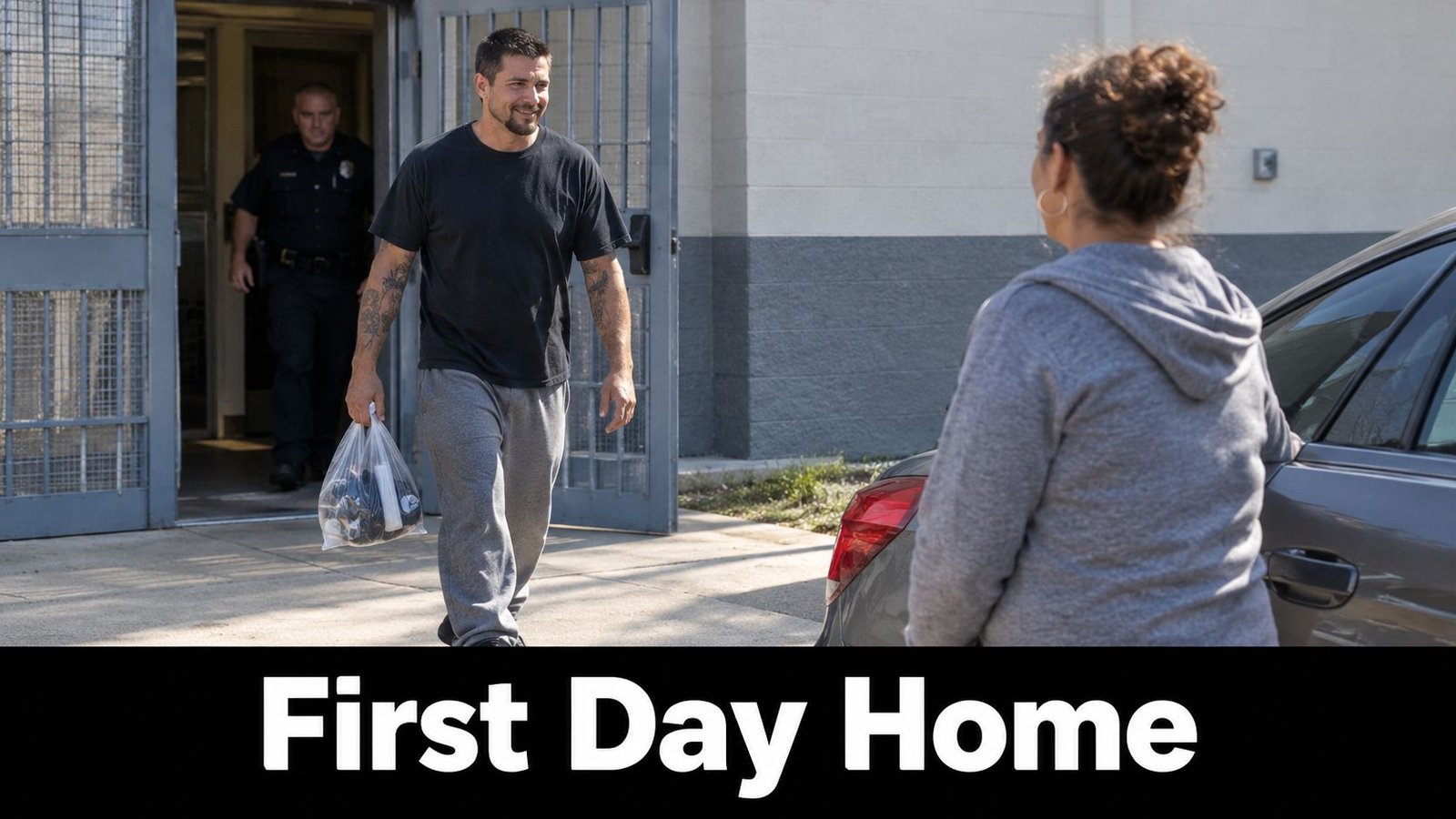
A practical first-day plan might look like this:
- Pick the person up at the facility's designated release location.
- Confirm that identification, property, and release papers came back.
- Get food, water, weather-appropriate clothing, and any urgent medication.
- Review the next court date and every written condition.
- Contact the attorney, supervision officer, treatment provider, or court when required.
- Keep the evening quiet enough for the defendant to rest and understand what happens next.
Medication deserves special attention. A 2025 study of mental-health practices across correctional facilities found that discharge planning was generally limited to medications and community-resource lists. Most facilities supplied only a short medication supply, typically seven days, with reported ranges from two to 30 days, and most didn't directly connect people to follow-up medical appointments. Those findings are summarized in research on community-supervision information sharing and release coordination.
For families trying to build a safer handoff, guidance on structuring aftercare transitions from Addiction Resource Center LLC offers a useful way to organize health, transportation, housing, and communication needs. The jail may provide some instructions, but the family should confirm where the next dose will come from and who will arrange follow-up care.
The first night also deserves a conditions review. A person can violate a stay-away order, miss a required check-in, or travel somewhere prohibited just because nobody explained the paperwork clearly. Before bed, place the release documents in one location and write down the next action, the responsible agency, and the deadline.
Court Obligations and Conditions That Continue
Discharge ends detention. It usually doesn't end the case. The defendant may still have a court appearance, bond conditions, supervision requirements, protection-order terms, treatment obligations, or restitution issues. A family member who hears “released” and assumes “finished” can unintentionally help create a missed deadline.
Colorado's release framework centers on two questions: will the conditions reasonably assure the defendant's appearance, and will they protect people or the community? Those goals can lead to conditions such as:
- Stay-away requirements: No contact with a protected person or location.
- Travel restrictions: Limits on leaving a geographic area.
- Supervision: Reporting or monitoring controlled by a designated agency.
- Court attendance: A specific appearance remains mandatory even after release.
- Conduct conditions: Rules tied to the concern identified by the court.
The agency controlling each obligation may differ. The court controls the case and court dates. A supervision department may control reporting. A protection-order term may be enforced through the court and law enforcement. The bonding agency can explain the bond contract and posting process, but it doesn't replace the court, jail, attorney, or supervision officer.
Get written discharge papers and verify the next hearing directly with the court or defense attorney. Don't rely only on what a family member remembers from a phone call, especially if the person was released after a long detention period or received several documents at once.
The safest assumption is simple: the person is out of jail, but the legal obligations are still active until the court or responsible agency confirms otherwise.
Practical Checklist and When to Call a Colorado Bail Bondsman
Use this checklist while the bond and discharge are moving:
- Confirm booking: Ask whether fingerprinting and full booking are complete.
- Confirm bond entry: Ask whether the jail has accepted and entered the bond.
- Check for holds: Ask directly about warrants, detainers, probation or parole holds, and other jurisdictions.
- Prepare pickup: Bring valid identification, transportation, a charged phone, and suitable clothing.
- Collect documents: Request release paperwork, court information, conditions, and a property receipt.
- Plan the first night: Arrange food, medication, a safe place to stay, and communication.
- Verify obligations: Confirm the next court date and identify every agency requiring contact.
A Colorado bail bondsman can be useful when the family doesn't understand a surety bond, when a cosigner is coordinating from another state, or when electronic applications, payments, and contract documents would make the posting process easier. Ask what the agency controls and what remains with the jail. No bonding agency can guarantee the jail's final discharge time.
For county-specific preparation, families can review Jefferson County and Golden bail bond guidance or Centennial bail bond information. The guide to using a bail bondsman can also help a first-time cosigner understand the documents and questions involved.
Express Bail Bonds is available 24/7 at 720-984-2245 for families arranging a Colorado surety bond. The agency can explain required documents, cosigner steps, and the expected posting process, while the jail and court retain control over final discharge timing.
Express Bail Bonds can help families arrange a Colorado surety bond, complete documents remotely, and understand what happens after the bond is posted. Visit Express Bail Bonds to start the process or get guidance while you're waiting for the jail to complete discharge.