
Your loved one just walked out of a Colorado jail, and the paper in their hand isn't a suggestion sheet. It's a court order. If the judge gave them a condition of release, the rules start now, and the family has to treat every line like it matters, because it does.
That's the part people miss at 2 a.m. They think release means the hard part is over. It isn't. Release usually means the person is out, but now they're living under rules that can shape where they go, who they call, whether they can work, and whether they stay free while the case is pending. If those rules are too strict, too vague, or impossible to follow, the case gets messy fast.
What a Condition of Release Means
A family gets home from jail, lays the paperwork on the kitchen table, and asks the same question every night asks, what does all this mean? The short answer is simple. A condition of release is a court-ordered rule that lets someone stay out of custody while the case keeps moving.
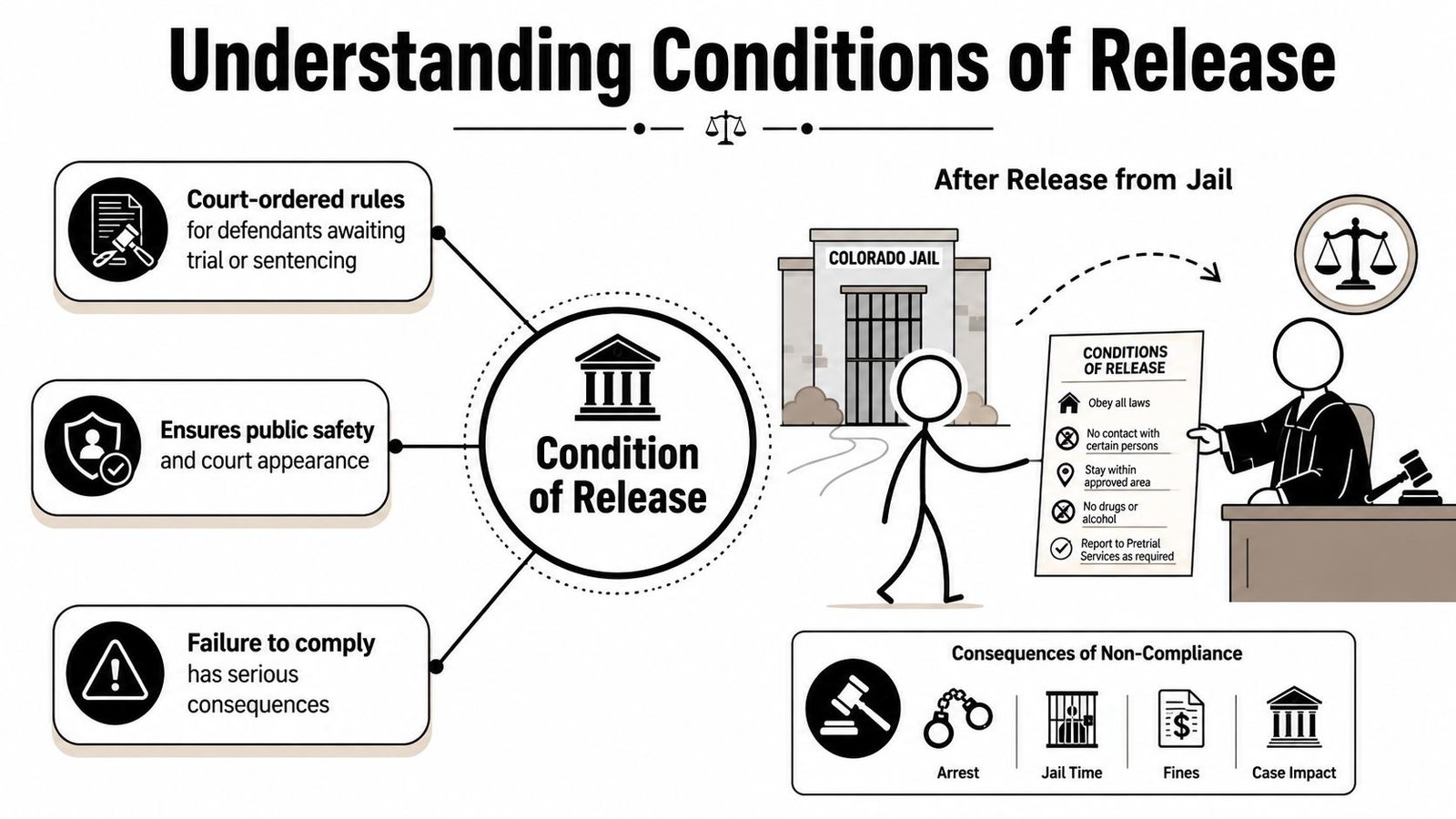
The practical answer is harder. These rules are not friendly reminders. They are binding instructions, and the court can revoke release, tighten the order, or put the person back in custody if they are ignored. Federal law requires a judge to use the least restrictive conditions that still reasonably assure appearance and safety, and it lists tools like third-party custody, reporting, travel limits, no-contact orders, curfews, weapons bans, and treatment requirements 18 U.S.C. § 3142. Colorado families need to understand the same basic idea. The order is built around risk, not convenience.
Practical rule: If the paper says the court ordered it, the person has to follow it exactly, even if it feels minor or unfair.
Federal pretrial data show how common nonfinancial release is. A Bureau of Justice Statistics report covering fiscal years 2011 to 2018 found that 76% of released federal defendants were released without financial conditions, and 22% were released at their initial court appearance BJS federal pretrial release report. That matters because release conditions often focus on behavior, movement, and supervision, not just money. For a plain-English explanation of the release process itself, see what is pretrial release.
The family's job is to read the order line by line and treat every term like it matters. A check-in date, a curfew, a travel limit, or a no-contact rule is not optional. Missing one condition can turn a workable release into a violation fast.
Common Colorado Release Conditions and What They Require
Colorado judges set release conditions to control risk and keep the case moving without locking someone up longer than necessary. Some orders are light. Others can make normal life feel like it is built around court rules, ride schedules, and constant reminders. The person on release needs to know exactly what the order says, not what they hope it means.
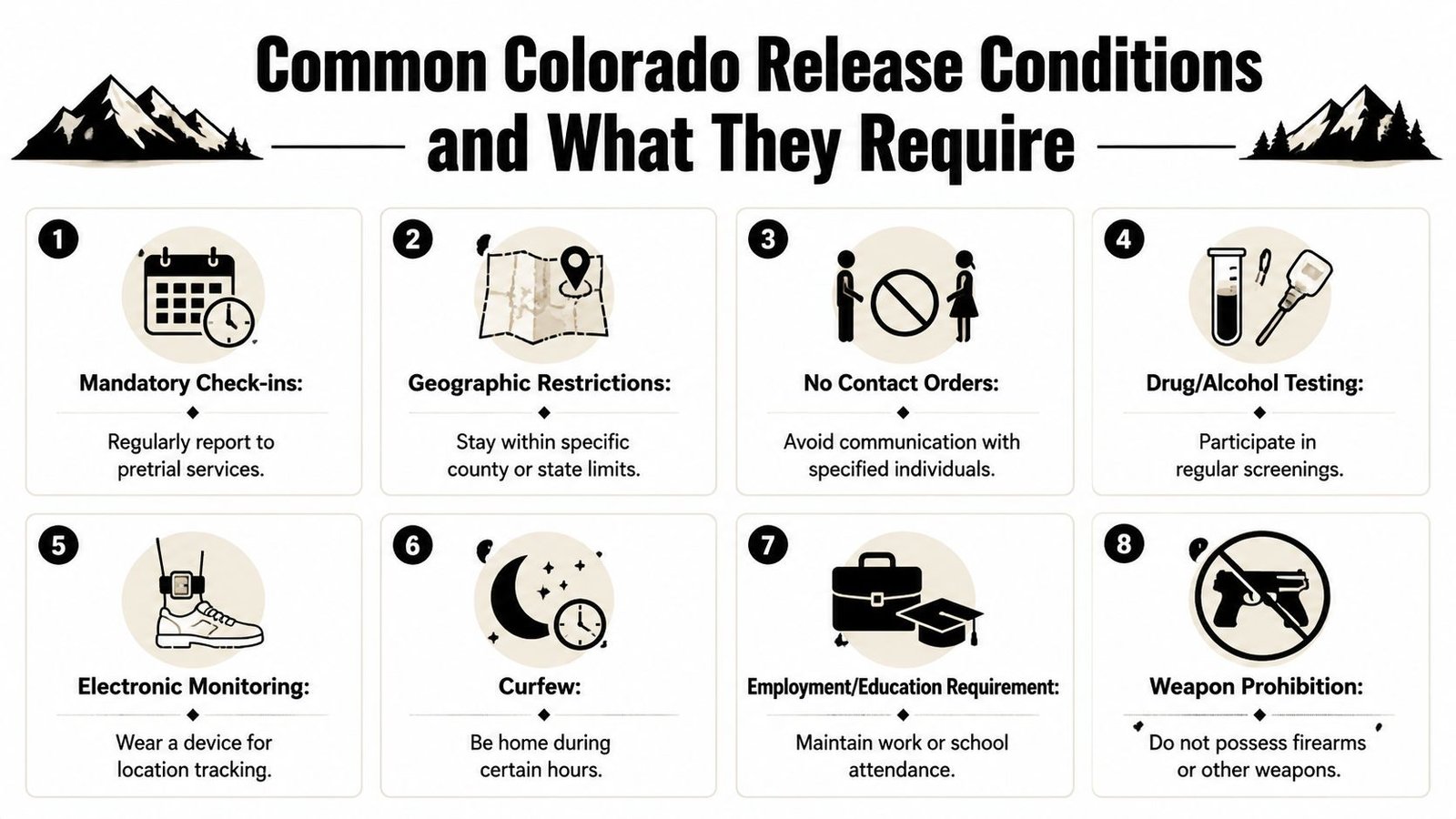
The conditions families run into most
Colorado courts commonly use reporting, travel limits, no-contact orders, curfews, treatment, and other restrictions that show up in release orders across the country. The release-condition matrix guide explains why courts pair different condition sets with different risk levels, and Colorado orders often follow that same logic release-condition matrix guide. Virginia's statute gives a clear example of how detailed these orders can get, with rules that can include employment, education, no-contact, curfews, testing, home incarceration, and GPS tracking Virginia Code Title 19.2, Chapter 9. The burden is real because people have to live inside these rules every day.
- Mandatory Check-ins: The person has to report to pretrial services or another supervising office on schedule. Miss one, and the case can turn ugly fast.
- Geographic Restrictions: The court may keep someone inside a county or state, which means no casual trips, no surprise family travel, and no work runs across the line.
- No Contact Orders: The person must avoid direct, indirect, and sometimes digital contact with named people.
- Drug or Alcohol Testing: Testing can be random or scheduled, and a missed test is often treated seriously.
- Electronic Monitoring: A device can track movement, and tampering creates a bigger problem than a late arrival.
- Curfew: The person has to be home during set hours, which can collide with shifts, childcare, or transportation.
- Employment or Education Requirement: The court may want proof that the person is working or actively enrolled.
- Weapon Prohibition: Firearms and other weapons are off-limits.
If a DUI or substance-related charge is part of the case, families should pay attention to treatment and evaluation orders right away. A practical outside reference is this substance abuse evaluation after a DUI page, because it shows how courts often tie release terms to counseling, screening, and follow-through.
Some people are released on a promise to come back, which is why the terms matter so much. A plain explanation of release on own recognizance helps families understand why a person can walk out without posting money and still be under strict conditions.
A condition that looks simple on paper can become the hardest part of the case once the person has to live it every day.
What Happens When Release Conditions Are Violated
A violation is not a warning the court ignores. It can turn a manageable case into a custody problem fast. Judges do not need a long pattern before they act. One missed check-in, one unauthorized contact, one failed test, or one skipped appearance can be enough to trigger a warrant or a review hearing.
The Bureau of Justice Statistics federal pretrial release report shows that release conditions are monitored and that violations can lead to revocation or other sanctions BJS federal pretrial release report. That is the pressure point families need to understand. A condition only works if the person follows it, and courts enforce the order quickly when they think the risk has gone up.
The usual fallout
A court may answer a violation by issuing a bench warrant, tightening restrictions, revoking release, or holding the person until trial. Federal guidance says the defendant must comply with a condition not to commit any federal, state, or local crime while on release, which is part of the basic release framework DOJ Criminal Resource Manual 26. If the violation involves new conduct, the court can treat it as a fresh danger signal, not just a paperwork mistake.
Common violation scenarios include missing a test, arriving late to supervision, crossing a travel boundary without permission, contacting a protected person, or ignoring curfew. Families get burned when they treat those rules like minor paperwork. A person may think, “I was only a few minutes late,” but the court may hear, “This person cannot follow simple rules.”
Missed communication is not a defense when the order says call, report, or appear.
If the order is hard to follow, improvise less and communicate more. Get the lawyer involved and ask the court to change the terms before the next violation happens. That is the right time to use bail bond violation guidance, because waiting until after the warrant drops is a bad plan. Judges have broad discretion, and once trust is damaged, the next order usually gets tighter.
The smartest families react early. If transportation breaks down, work hours change, or a no-contact term starts colliding with real life, the lawyer needs to know right away. Silence is what turns a fixable problem into a custody hearing.
Financial Versus Non-Financial Conditions and How Bail Bonds Fit In
A release order can hit a family in two very different ways. Sometimes the pressure is money. Sometimes it is the daily grind of reporting, testing, curfew, travel limits, or monitoring. A parent may be trying to keep a job, arrange childcare, and still make every check-in on time. That burden is where a lot of families start to fall apart.
What the two categories look like
Washington's criminal rule shows one way a court can structure a bond, including a cash deposit of up to 10% of the bond amount, with the deposit returned if the defendant complies or forfeited after a violation Washington CrR 3.2. Virginia's release rules show the broader range courts can require, including employment, curfew, drug and alcohol testing, GPS tracking, and home incarceration Virginia Code Title 19.2, Chapter 9. Canada's parole framework adds the same kind of day-to-day load, with mandatory reporting, law-abiding conduct, weapon restrictions, and disclosure of changes in family or finances Parole Board of Canada conditions of release.
Here is the practical split.
| Condition Type | Examples | Typical Requirements |
|---|---|---|
| Financial | cash bond, surety bond, deposit | money posted or secured through a bondsman |
| Non-Financial | check-ins, curfew, no-contact, testing, travel limits | daily behavior and supervision rules |
Colorado families also need to know that release is not handled the same way everywhere. The National Conference of State Legislatures notes that financial conditions remain a separate pretrial category, and states use different tools to set them NCSL pretrial release financial conditions. That matters because the bond solves only one part of the problem. It gets a person out, but it does not erase the rules that come with release.
If a family needs a surety bond, the clean comparison is cash bond vs surety bond. The money side is the part people understand first. The harder part is the routine after release. That is where families get squeezed, because the defendant still has to live under every condition while keeping work, family, and transportation together.
One more outside example helps if the case is in another state. This guide on secure release after arrest in Texas shows the same split between bond money and release terms. Different state, same problem. The person has to post what is required, then follow the conditions without slipping.
Practical Steps for Staying Compliant and Requesting Modifications
The hardest release orders are the ones that collide with ordinary life. A night shift, no car, two kids, an unstable phone plan, or a long drive to supervision can turn a simple condition into a daily problem. Families need a compliance plan on day one, not after the first warning.
Build a system that cannot rely on memory
Start with the calendar. Put every check-in, test, hearing, and reporting deadline into the phone and keep a paper backup too. Pick one person in the family to track the details if the defendant is overwhelmed, because missed details are how violations start.
Then document everything. Save screenshots of messages, ride receipts, testing slips, work schedules, and appointment confirmations. If the person shows up on time, write it down. If transportation fails, keep proof. Courts take documented effort more seriously than vague explanations.
- Understand Your Conditions: Read the order out loud if you have to, because confusion does not protect anyone.
- Maintain Open Communication: Tell the attorney and supervising office when something changes.
- Document Everything: Keep records of every appointment, test, and contact.
- Address Conflicts Proactively: Bring up work, childcare, or travel conflicts before they cause a missed obligation.
- Seek Legal Counsel for Modifications: Ask the court to adjust terms that cannot be followed safely.
- Adhere to All Deadlines: No check-in, test, or hearing should be treated casually.
The release-condition matrix guide supports this kind of customized thinking, because conditions are supposed to fit risk instead of being handed out automatically release-condition matrix guide. The same logic applies when a condition becomes unworkable. Courts can modify release terms when the defense brings a concrete alternative and proof that the old condition is too hard to follow.
If the financial side is the problem, start with how to get bail reduced. If the problem is bigger than money, the lawyer has to make the request through the court and support it with documents, not complaints. Families can also get the paperwork moving faster through Express Bail Bonds when a surety bond is part of the answer and the case cannot wait for a long jail visit.
A court listens when the family shows a real plan. Bring the schedule, the proof, and the fix. That is what helps.
Key Takeaways and Next Steps for Colorado Families
A family in the middle of release paperwork does not need theory. It needs a clear plan that keeps the person out of more trouble. A condition of release is a court order, and it stays in force until the judge changes it or the case is over. Families should treat every rule on that order as real, because release often depends on staying compliant, not just showing up once.
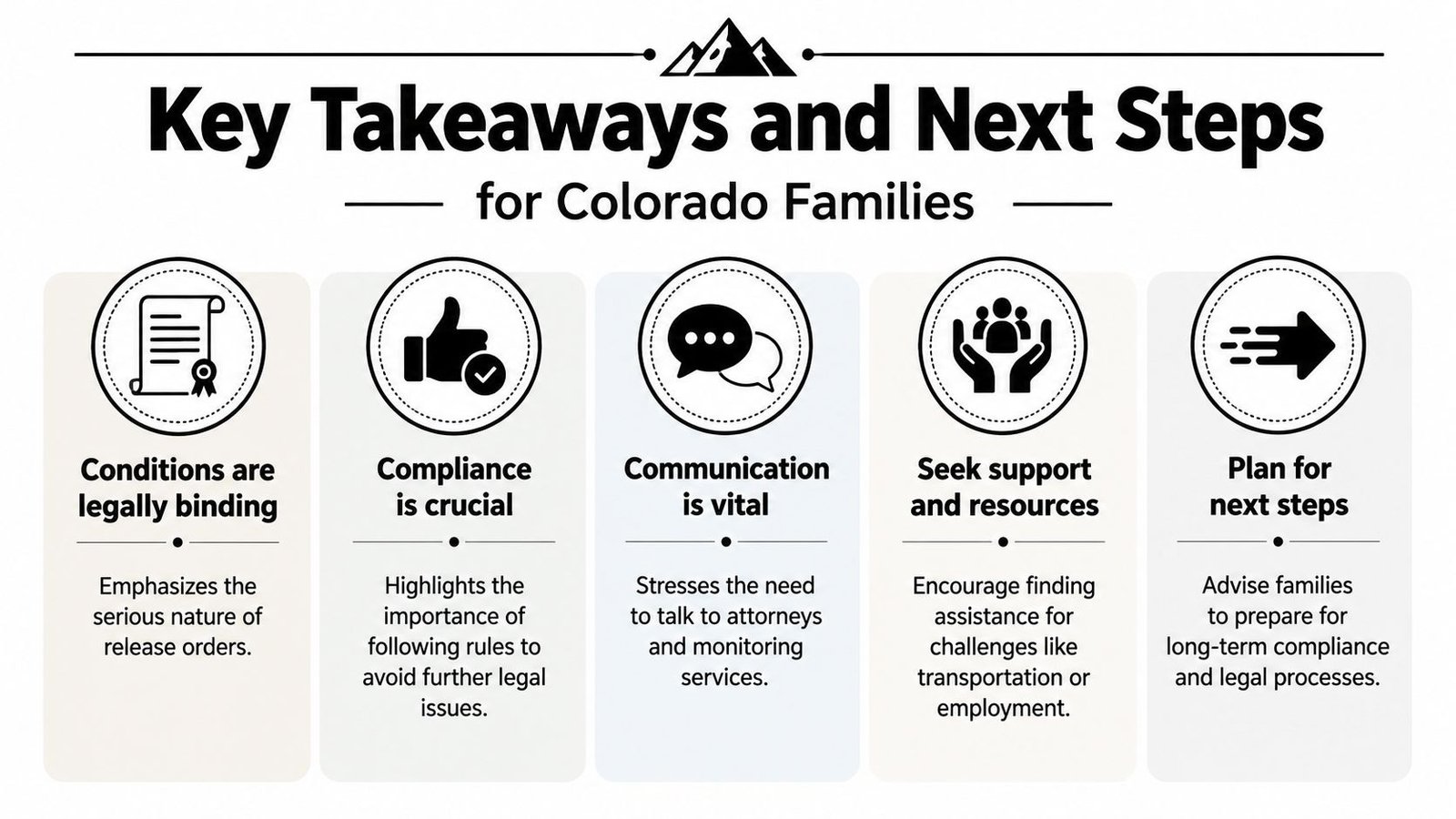
What to do right now
- Read the order tonight: Check for check-ins, curfews, no-contact terms, testing, and travel limits before the night gets away from you.
- Set alarms and backups: Use more than one reminder, and make sure someone else can spot a missed call, test, or court date.
- Tell the lawyer about obstacles early: Transportation, work, childcare, housing, and phone access problems can turn into violations fast if nobody raises them.
- Keep proof of compliance: Save texts, receipts, appointment slips, test results, and any written confirmation that shows the person followed the order.
- Ask for help before a violation: Courts usually listen better before a rule is broken. Once the violation happens, the room gets smaller.
Families also need to build the case for a change if the order is not workable. Bring the schedule, bring the documents, and bring a real fix, because that is what gives the court something it can approve. If money is the problem, start with how to get bail reduced. If the problem is bigger than money, the lawyer has to file the request with support, not excuses.
If a surety bond is part of the answer and the family needs action fast, Express Bail Bonds Jefferson County and Express Bail Bonds Centennial can help get the bond process moving while the rest of the plan gets sorted out.
Frequently Asked Questions About Release Conditions
Can release conditions be changed after the person gets out? Yes. The defense can ask the court to modify conditions that are too strict or unworkable, but the request should be specific and supported by documents. What happens if someone misses a court date? The court can issue a warrant and tighten the case fast. How long do release conditions last? Usually until the court changes them or the case is finished. Can the person travel out of state? Only if the order allows it or the court approves it. What does a cosigner do? A cosigner helps secure the bond, but the person released still has to follow every condition on the order.
If your family is staring at release paperwork right now, don't guess at it. Use Express Bail Bonds to get help with the bond process, ask the hard questions about the order, and keep one bad night from turning into a bigger custody problem.