
A late-night arrest call scrambles everything. One minute you're asleep, and the next you're hearing a bail amount that sounds impossible for your family to handle.
That first number feels final. It usually isn't.
In Colorado, a high bond often leads families to the same urgent question: how to get bail reduced without wasting time, making the wrong move, or saying something in court that hurts the case. The practical answer is that bail reduction usually works best when three people are aligned early: the attorney, the family, and the bail bond agent who understands how release logistics work once a judge changes the amount.
The Shock of a High Bail Amount and Your First Steps
The first hours matter because families tend to do one of two things. They panic and start calling everyone they know for money, or they freeze and wait for the court to somehow fix it on its own.
Neither approach is the best first move.
Start by getting basic facts in order. Confirm where your loved one is being held, what the listed charges are, what type of bond was set, and when the first court appearance will happen. If you're still trying to understand the basic sequence after an arrest, what happens after you get arrested is a useful starting point.
What families should do in the first few hours
- Write down the case details: Jail location, booking name, date of birth, charges, bond amount, and court date.
- Stop guessing about affordability: If the amount is out of reach, treat bail reduction as a serious option right away.
- Get defense counsel involved early: Nationwide analyses say requests filed by an attorney succeed around 50% of the time, while pro se requests succeed less than 10% according to this bail reduction overview.
- Begin collecting proof of stability: Employment records, proof of residence, and names of family members who can appear in court.
Practical rule: The worst time to start gathering proof is after the hearing has already been set.
Families often think the only issue is money. In court, money is only part of the story. Judges want to know whether the person will come back to court and whether release creates a safety concern. That means your first steps should focus on building a clear, credible picture of stability, not just saying the amount is too high.
Understanding the Grounds for Bail Reduction in Colorado
A bail reduction request isn't just a plea for mercy. It's an argument built around risk, stability, and fairness.
Colorado judges don't reduce bail because a family is understandably upset. They reduce bail when the defense gives them a concrete reason to believe the original amount is higher than necessary to secure appearance and protect the community.
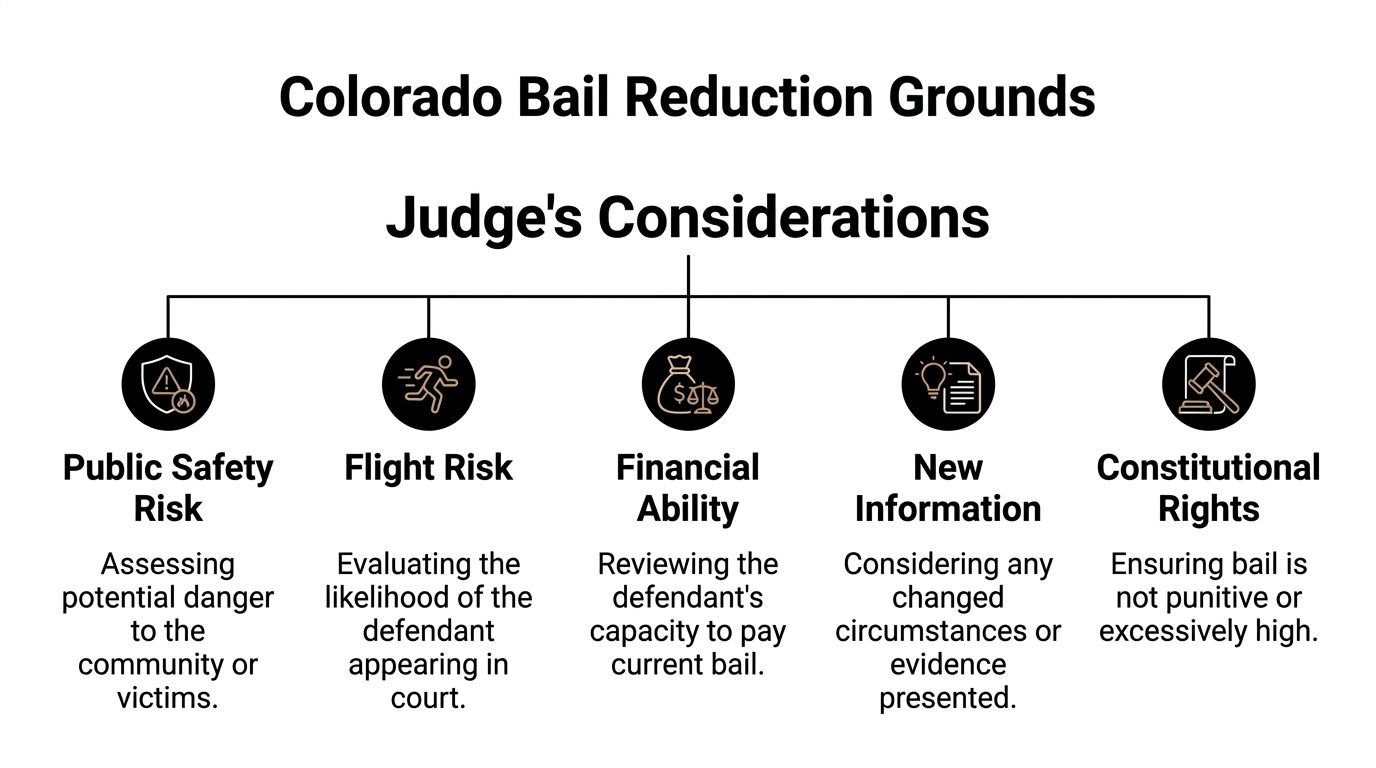
Community ties matter because they reduce perceived flight risk
Judges look for anchors. A local job, children in school, a long-term residence, a spouse or parents nearby, and documented responsibilities all tell the court the person has reasons to stay and appear.
This is one of the strongest parts of many successful motions. Data shows that in 70 to 80% of successful hearings, the defendant proved strong community ties and financial hardship, and an employed defendant with verifiable pay stubs can receive a bond 25 to 40% lower than an unemployed peer, according to Nolo's discussion of lowering bail.
That doesn't mean you walk in and say, "He has family here." It means you prove it.
- Residence proof: Lease, mortgage statement, or utility bill
- Employment proof: Recent pay stubs, employer letter, work schedule
- Family proof: Marriage records, birth certificates, school records, caregiving responsibilities
- Community support: Letters from clergy, coaches, employers, or longtime family friends
Financial hardship must be documented
A family saying "we can't afford this" is common. A family showing why the current amount is unrealistic is stronger.
Useful proof includes:
- Income records
- Tax returns
- Bank statements
- Monthly expense summaries
- Evidence of dependents or medical costs
The point isn't to create drama. The point is to show that the current amount functions as detention, not a reasonable condition of release.
Courts respond better to documents than emotion. Emotion explains the crisis. Documents explain why the bond should change.
The charge still matters
Some families assume a reduction is automatic if the person has no money. It isn't. The judge will still weigh the allegations, any prior record, and whether the case involves violence, threats, weapons, or a pattern of failing to follow court orders.
That trade-off is real. A person with stable work and family ties can still face resistance if the prosecution argues the conduct shows danger or a serious likelihood of nonappearance. The defense has to meet that concern directly.
New facts can change the picture
A reduction request gets stronger when the defense can present information the court didn't have at the initial setting. That might include updated employment verification, a treatment enrollment, corrected criminal history information, or proof that the family has a stable address and transportation plan.
If you're helping gather that material, don't rely on memory. Organize every record by date and source.
For families who want to better understand how lawyers organize statutes, cases, and supporting materials before a hearing, this guide on how to conduct legal research gives a practical look at the process.
Constitutional fairness still matters
Bail isn't supposed to be punitive. The defense can argue that the current amount is more restrictive than necessary under the circumstances, especially where the person has substantial ties and limited means.
In some cases, the better outcome isn't a lower cash amount at all. It may be a personal recognizance release or another less restrictive condition. If you're trying to understand that option, what does released on recognizance mean explains how that type of release works.
Preparing and Filing a Powerful Bail Reduction Motion
Most weak bail reduction efforts fail before anyone enters the courtroom. They fail because the defense doesn't have documents, the family brings vague promises instead of proof, or everyone waits too long to get organized.
The strongest motions usually look simple from the outside because the preparation happened first.

Start with the attorney's argument, then build the file around it
Defense attorney analyses say the process typically starts with a motion filed after arraignment citing factors from Stack v. Boyle (1951). They also note that at the initial hearing, presenting a clean record of past court appearances can boost the chances of success by 30 to 50%, and if relief is denied, a formal motion with new evidence is the next step, as explained in this overview of securing a bond reduction.
That means your family should ask the lawyer a direct question: What facts do you need from us to support the motion?
Usually, the answer falls into four buckets:
- identity and residence
- employment and finances
- support letters and witness availability
- court compliance history
The document checklist that actually helps
Some paperwork carries real weight. Some just creates a thicker folder.
| Document Category | Specific Examples | Why It Helps |
|---|---|---|
| Identity and residence | Driver's license, lease, mortgage statement, utility bill | Shows a stable address and local ties |
| Employment | Pay stubs, employer verification letter, work schedule | Proves routine, accountability, and income |
| Financial hardship | Tax returns, bank statements, expense list, dependent costs | Supports the claim that current bail is unaffordable |
| Family responsibilities | Birth certificates, school records, caregiving notes | Shows strong local obligations |
| Character support | Letters from employer, clergy, coach, mentor, relatives | Reinforces non-dangerousness and reliability |
| Court compliance | Prior case records showing appearances, absence of FTA history | Helps the lawyer argue low flight risk |
| Treatment or program entry | Intake confirmation, counseling enrollment, rehab placement | Can show structure and changed circumstances |
What makes a support letter useful
A good letter is specific. It says how the writer knows the defendant, for how long, what responsibilities the defendant handles, and why the writer believes the person will return to court.
A bad letter says only that the person is "a good guy."
Use letters from people who can be identified and, if necessary, contacted. Employers are often especially helpful because they can verify a position, schedule, and the consequences of missing work.
A short employer letter with a real job title and a return-to-work date often carries more weight than a long emotional letter from a friend.
The family's role is evidence, not argument
Families sometimes hurt a good motion by trying to become courtroom advocates. Usually, the better move is to help the attorney present a clean packet and, if asked, appear as calm proof of support.
That means:
- Don't interrupt the hearing
- Don't argue with the prosecutor
- Don't exaggerate facts
- Don't hide bad facts from the lawyer
If there was a missed court date in the past, the attorney needs to know. If there was a job loss, the attorney needs to know that too. Surprises are expensive in a bail hearing.
Filing details matter more than families expect
Even when the motion itself is strong, delays happen because signatures are missing, exhibits aren't organized, or a document wasn't submitted in a format the court accepts. Families who want a plain-English primer on the mechanics of filing court documents may find that process easier to follow after reading a practical guide.
Your attorney handles the legal filing. Your job is to make that filing stronger and faster by delivering clean records, accurate names, and reachable witnesses.
If a hearing is coming up, how to prepare for court hearing can help family members understand what to wear, how early to arrive, and how to avoid common mistakes.
What to Expect at the Bail Reduction Hearing
A bail reduction hearing is usually shorter than families expect, but every minute counts. The courtroom may feel formal and fast, especially if the judge has a crowded docket.
That pace makes preparation matter even more.
Who will be speaking
The judge leads the hearing. The defense attorney argues why the current amount should be lowered or replaced with less restrictive conditions. The prosecutor argues for keeping the bond where it is, or for conditions the state says are necessary.
The defendant may speak in some situations, but that decision should come from counsel, not family pressure. In many hearings, the lawyer's presentation does more good than an emotional statement from the defendant.
What the judge is likely weighing in real time
The hearing's outcome depends heavily on risk factors. A history with more than two prior failures to appear can increase the odds of denial to 80%, while having family or an employer present in the courtroom can improve success by as much as 35%, according to this bail reduction analysis.
That tells you what the room is really about. The judge isn't deciding whether the family is sincere. The judge is deciding whether release at a lower amount is manageable.
In Jefferson County, Golden, or any other Colorado court, the exact flow may vary a little, but the practical rhythm is familiar:
- the case is called
- defense states the request
- supporting facts are presented
- prosecution responds
- the court rules, or asks a few questions first
If you want a closer look at that process, what happens at a bail hearing gives a helpful overview.
A short video can also make the courtroom feel less abstract before you walk in:
How family members can help without saying much
The best family presence is steady and respectful. Arrive early. Dress cleanly. Silence your phone. Sit where instructed. If the lawyer has asked an employer, spouse, parent, or other supporter to appear, that visual support can reinforce the argument that the defendant is tied to the community.
What hurts:
- eye-rolling
- whispering during argument
- reacting visibly to the prosecutor
- speaking to the judge without permission
Courtroom demeanor won't rescue a weak motion, but poor demeanor can distract from a strong one.
After the Hearing Navigating a Successful Reduction or Denial
The ruling comes down, and now the case becomes practical again. Families need to know what to do in the next hour, not just what the legal theory was.

If the judge grants a reduction
First, confirm the exact new bond amount and any added conditions. Don't rely on what you thought you heard from the gallery. Get the number and conditions from the attorney or court paperwork.
Then figure out what type of release was ordered:
- Surety bond: A bail bond company may be used
- Cash-only bond: Full cash is required
- Personal recognizance or supervised release: The person may be released without a surety payment, but conditions still apply
Families often assume a reduction means immediate release. Sometimes it does. Sometimes there are processing delays, holds, or additional paperwork. Stay in contact with the jail, the attorney, and the bond agent handling the release logistics.
If the court adds electronic monitoring
A growing issue in current cases is whether the judge will trade money conditions for supervision. In reform-minded jurisdictions, judges are often willing to reduce bail by 30 to 50% when release is paired with house arrest or GPS tracking, and those programs have shown an 85% compliance rate, according to Vera's discussion of incarceration reduction and supervision trends.
That can be a workable outcome, but families should think through the daily reality before celebrating. Electronic monitoring can affect work schedules, childcare, transportation, and who is allowed in the home. If the judge orders it, treat the conditions like a contract. Small violations can become big problems.
If the motion is denied
A denial isn't always the end of the story, but it does mean the current record didn't persuade the court. The next move depends on why the request failed.
Sometimes the problem is missing evidence. Sometimes the charge itself drives the result. Sometimes the defense needs changed circumstances before asking again, such as program enrollment, corrected information, or stronger documentation.
Good questions to ask the lawyer after a denial:
- What argument did the judge reject
- Was there a specific concern about danger or appearance
- Is there new evidence worth developing
- Should the focus shift to posting the current bond instead
If you're sorting through payment questions after a ruling, is bail refundable explains one of the most common points of confusion families have after court.
The practical trade-off families should understand
A lower bond helps, but it doesn't erase responsibilities. Release usually comes with court dates, restrictions, and a need for strict follow-through. Families who worked hard to secure a reduction should also be ready to help the defendant keep every appearance, save every court notice, and avoid new trouble.
The release isn't the finish line. It's the start of the next stage.
FAQ Your Questions on Lowering Bail in Colorado Answered
Can we ask for a bail reduction more than once
Yes, sometimes. Whether a second request makes sense depends on whether anything meaningful has changed.
Judges usually want a real reason to revisit bond. Strong examples include new records, corrected facts, treatment enrollment, or changes in the charges. Filing the same argument again without new support usually doesn't help and can make the request look weak.
How long does the process take
There isn't one fixed timeline. Some requests are raised early, and others take longer because the lawyer needs records, witness letters, financial documents, or a better hearing date.
What families can control is speed of preparation. If the attorney asks for pay stubs, tax records, or a landlord letter, send them quickly and in readable form. Delay on your side often becomes delay in court.
What if we can't afford a private attorney
If private counsel isn't possible, ask immediately whether the defendant qualifies for appointed counsel. Families shouldn't assume they have to handle a reduction request alone.
That matters because attorney involvement makes a real difference in outcomes, as noted earlier in the article. Even when funds are tight, getting legal representation lined up early usually gives the family a stronger position than trying to improvise.
Does the type of charge affect the chances of getting bail reduced
Absolutely. Judges weigh the allegations heavily, especially if the case involves violence, threats, weapons, vulnerable victims, or a record that suggests ongoing risk.
That doesn't mean a reduction is impossible in a serious case. It means the defense has to work harder to answer the court's concern directly, often with stronger conditions, better documentation, and a cleaner release plan.
Should family members come to court
Often, yes, if the attorney agrees. A calm family presence can help show support and stability.
But not every family member belongs in the courtroom. Bring the people who present well, follow directions, and may be useful to the defense narrative, such as a spouse, parent, employer, or another stable supporter. Leave out anyone who may create conflict or react badly under stress.
What should we bring on the day of the hearing
Bring copies of anything the attorney requested, plus identification, a notebook, and contact information for employers or other supporters. Dress conservatively and arrive early.
Don't bring stacks of unrelated papers. Organized, relevant records are better than volume.
Can the judge lower bail and still impose conditions
Yes. A lower amount doesn't always mean fewer restrictions.
A judge may reduce the financial burden while also ordering supervision, no-contact provisions, treatment, drug testing, travel limits, or electronic monitoring. Families should listen carefully to every condition because release can unravel fast if those rules are ignored.
What's the biggest mistake families make
They focus only on the number. The better question is: What facts will persuade the judge that this person can be released safely and will return to court?
When families shift from panic to proof, they usually make better decisions. They gather cleaner records, support the attorney more effectively, and avoid wasting precious time on arguments that won't move the court.
If you need fast help after a bond reduction is granted, contact Express Bail Bonds for 24/7 statewide Colorado service. Families in Jefferson County can also review local help through Golden and Jefferson County bail bond support, and Arapahoe County families can use Centennial bail bond assistance. To see what other clients say, read the Express Bail Bonds Google reviews here and more client reviews here. If you're dealing with an urgent release issue, call or text right away so you can get clear next steps without losing more time.