A call from a county jail at 2 a.m. rarely sounds like a policy debate. It sounds like a sister asking, “How do we get him out?” Her brother was arrested after a fight outside a Denver bar, and the booking deputy wants to know whether the family can post bond. She has no idea what the amount means, whether cash bail reform changed the process, or whether calling a bail agent is still an option.
The panic is practical. Will he lose his job if he stays in jail? Does the family need to find the full bond amount? Will the court treat him fairly if he can't afford it? Those questions sit at the center of the modern pretrial system, in Colorado and across the country.
The answer depends on the charge, the court's release decision, the person's history, and the conditions attached to release. This guide follows the path from the first jail call to a release decision, explaining what cash bail reform changes, what it doesn't change, and what a Colorado family can do next.
The Phone Call That Starts It All
The sister's first instinct is understandable. She wants to know the price, find the money, and get her brother home before morning. But a bond sheet isn't always a simple invoice. It may reflect a cash bond, a surety bond, a personal recognizance release, supervised release, or a court order holding the defendant without release.
That distinction matters because cash bail reform doesn't mean every person walks out without conditions. In a risk-based system, the judge still decides whether release is appropriate and may impose supervision, monitoring, reporting, treatment, or other requirements. A serious allegation can still lead to a high bond or detention, even when the system tries to avoid using money as the only measure of risk.
Practical rule: Don't guess what the bond means from a phone message. Ask the jail, defense counsel, or a licensed bail professional to explain the exact bond type and every condition.
The family's immediate questions should be concrete:
- What is the bond amount and type? Confirm whether the court set cash-only, surety, personal recognizance, or another form of release.
- Has the first hearing happened? The judge may change the initial booking decision after hearing from the defense and prosecution.
- Are there separate holds? A warrant, protection order, probation matter, or another jurisdiction can affect release.
- What must the defendant do after release? Missing a court date or violating a condition can lead to a new hearing and possible detention.
Families can call a Colorado bail bonds professional while they gather those answers. The agent can't replace a defense lawyer or promise a particular court result, but can explain the surety-bond process, identify documents, and clarify what the family may need to sign.
The emotional fear is real: that someone will remain in jail only because the family cannot produce a number on a bond sheet. Cash bail reform grew from that concern, but the practical question remains local and immediate. What did this judge order, what risk did the court identify, and which release path is available right now?
What Cash Bail Reform Actually Means
Cash bail is the traditional arrangement in which a court sets a dollar amount and requires payment to secure release before trial. The defendant or another person may pay the court directly, depending on the bond rules. If the court accepts a surety bond, a bail agent posts a guarantee instead of the family depositing the full amount with the court.
Risk-based release starts with a different question. Rather than asking whether the defendant can afford a set amount, the court considers factors such as public-safety concerns, the likelihood of appearing in court, the seriousness of the allegation, prior court history, and available community support. The result may be release without money, release with supervision, electronic monitoring, or detention when the court finds that conditions can't manage the risk.
A useful analogy is a debit terminal versus medical triage. Cash bail can make release turn on whether the family has enough funds or access to credit. Risk-based release asks what the court knows about the person's circumstances and what safeguards are needed, much as triage sorts care by need rather than by a patient's bank balance.
What happens at the hearing
A pretrial hearing usually brings several people into the decision:
- The defendant appears before the judge, in person or through a video connection.
- The court reviews the allegations and available history, including prior cases, warrants, and court appearances.
- Defense counsel argues for release, often presenting employment, family, residence, treatment, or other stabilizing information.
- The prosecution addresses risk, including safety concerns, alleged victims, criminal history, or possible interference with the case.
- The judge selects the least restrictive workable outcome, or orders detention where the law and the facts support it.
The timing and exact procedure vary by jurisdiction. A family should ask what hearing is scheduled, who represents the defendant, and whether the court can reconsider the initial bond.
Reform didn't eliminate the idea of bail in every jurisdiction. It shifted the emphasis in systems that adopted a risk-based model, especially for cases where supervision or a promise to appear can address the court's concerns. A plain-language explanation of the release process is available in this guide to what pretrial release means.
How We Got Here From Money Bail to Risk-Based Release
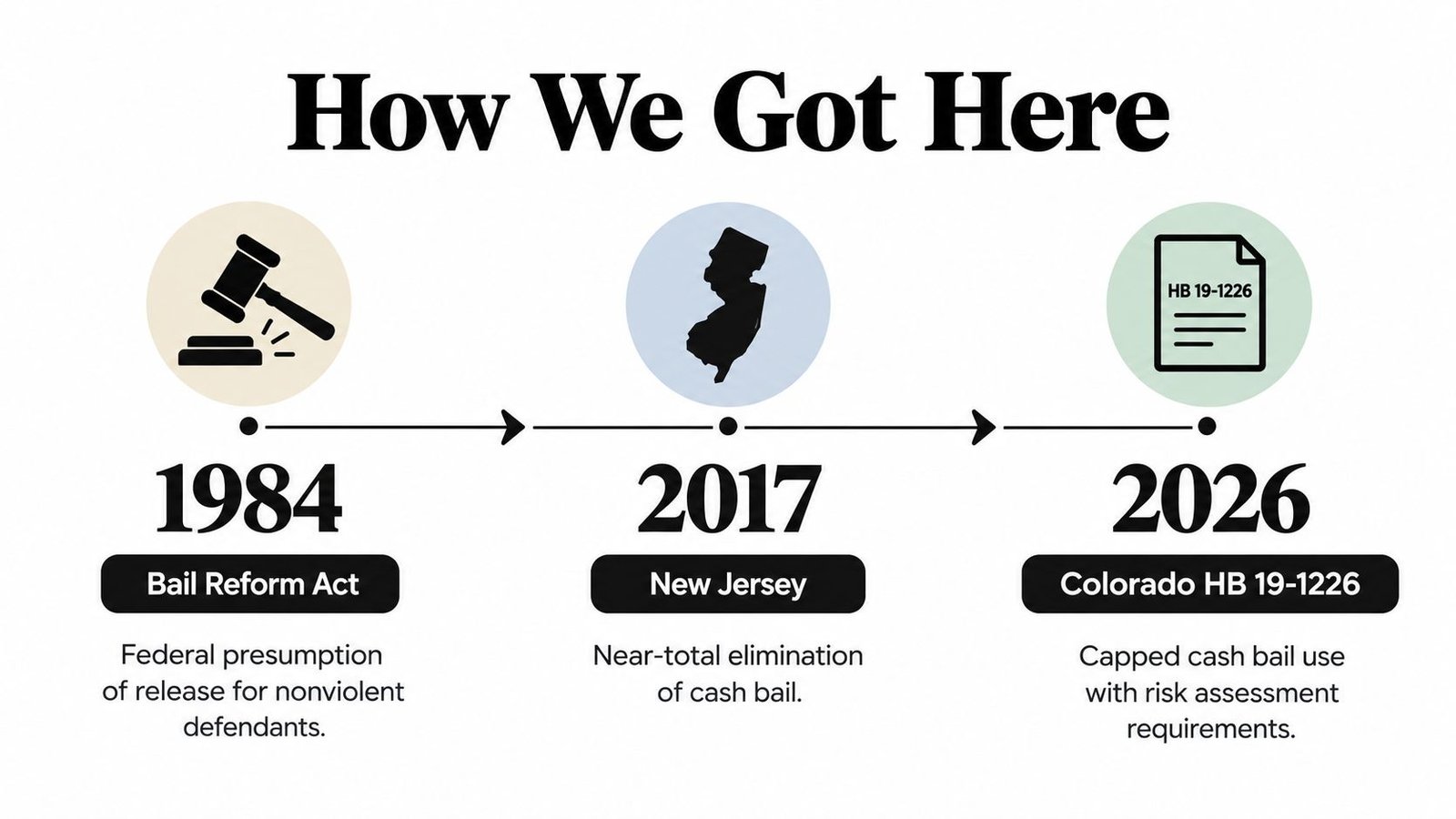
The national shift began with concern that release decisions were becoming tied too closely to money. After the federal Bail Reform Act of 1984, the share of defendants held at some point before trial rose from 40% to 50%, average time held rose from 50 to 53 days, and violations of release conditions rose from 5% to 7%, according to the Bureau of Justice Statistics discussion of the federal law. The same source describes a pretrial population of more than 400,000 people detained nationally and says the number of people held pretrial in jail had nearly quadrupled since the 1980s.
Those figures help explain why the issue became more than a question about payment methods. A person who remains jailed before trial can lose work, housing, childcare, and bargaining power, even though the case hasn't ended. A person with money may leave on the same charge while a poorer person waits for the next hearing.
New Jersey became the most prominent state example of a different approach. The state passed reforms in 2014 that took effect in 2017, replacing money bail with a risk-based release system. In the years after enactment, the number of people awaiting trial in jail fell by 40%, while violent crime declined by 5% in 2017, compared with a 1% national decline that year, as summarized by Third Way's analysis of New Jersey cash bail reform.
Why the hearing design matters
The lesson isn't that every state copied New Jersey. Illinois and other jurisdictions changed their own procedures, while courts and legislatures continued debating detention, supervision, and financial conditions. Colorado developed its own framework rather than adopting one national template.
The most important practical change is the decision rule. A court should focus on whether a person presents a meaningful flight or safety concern and whether conditions can manage it. A high bond by itself doesn't explain why detention is necessary, and a low bond by itself doesn't prove that release is safe.
Families should also be cautious with broad historical claims. Reform is not one switch that turns cash bail off nationwide. It is a collection of statutes, court rules, hearing practices, supervision programs, and local interpretations. The relevant question is always what the court in the particular county can order today. Families can learn more about the role of a pretrial risk assessment before discussing the available options with counsel.
Cash Bail Surety Bonds and Risk-Based Release Compared
Three pathways can look similar from outside the courthouse but work very differently for a family.
Cash bail requires the defendant or a supporter to provide the full amount directly to the court or jail. The money may be returned at the end of the case if the court's requirements are satisfied, although local rules and deductions can affect the result. The immediate problem is access. A refundable deposit can still be impossible for a working household to produce on short notice.
A surety bond uses a bail agent's guarantee. The family pays the agent's premium and may provide collateral or a cosigner, depending on the bond and the agent's underwriting. The court receives the agent's promise to pay if the defendant fails to comply with the bond, while the family avoids depositing the entire bond amount with the court.
Risk-based release doesn't depend primarily on a payment. The court evaluates the defendant and may order personal recognizance release, reminders, supervision, monitoring, or detention. The defendant and family still have responsibilities, even when no financial condition applies.
| Pathway | Who Pays | Refundable? | Court Focus |
|---|---|---|---|
| Cash Bail | Defendant or family pays the court or jail | Often potentially refundable, subject to court rules and case compliance | Whether the required deposit is posted and conditions are met |
| Surety Bond | Family or cosigner pays a bail agent's premium | The premium generally isn't treated like a court deposit; collateral depends on the agreement | Whether the agent's guarantee satisfies the bond order |
| Risk-Based Release | No payment may be required, though supervision can involve obligations or costs | Not applicable in the same way as a cash deposit | Flight risk, public safety, history, and workable conditions |
Reading a bond example
Suppose a booking record lists a 60-40 bond. The first step is to ask what the two numbers represent in that court's schedule. Don't assume the family can choose a surety bond unless the court has authorized that form.
A 60-30-20 bond may involve a surety option, but the family should confirm the court's terminology and ask an agent to explain the financial responsibility before signing. With a 60-15 bond and high flight risk, the judge may focus less on the amount and more on whether supervision, monitoring, or detention is necessary.
Money isn't returned by a bail agent in the same way a qualifying court deposit may be returned. The agent is paid for taking on the surety obligation, and the cosigner remains responsible for ensuring that the defendant follows the release terms. A clear explanation of these distinctions is available in this comparison of cash bonds and surety bonds.
Where Cash Bail Reform Stands in Colorado in 2026
Colorado hasn't eliminated cash bail altogether. Its framework limits when financial conditions should be used and directs judges to consider less restrictive options first. The policy shift is associated with HB 19-1226 and Colorado's bond statutes, but a person arrested in Colorado still needs to read the actual order entered in that case.
The basic question at a Colorado hearing is whether the court can manage the identified risk without requiring money. A judge may consider the charge, alleged harm, criminal history, prior failures to appear, community ties, residence, employment, substance-use concerns, and the defendant's ability to follow conditions. Defense counsel may offer a residence, a responsible third party, treatment, reporting, or another concrete plan.

What a Colorado family should expect
Colorado courts can still set bonds in serious cases, including allegations involving violence, when the judge finds that financial or other conditions are necessary. Risk assessment tools may inform the process, but they don't replace the judge's legal decision or the defense lawyer's advocacy.
Pretrial hearings are generally expected within 48 hours under the framework described in the requested Colorado guidance. The exact timing can depend on the arrest, booking, weekends, holidays, court availability, and the existence of another hold. A family should confirm the hearing time rather than relying on a general estimate.
This short video offers another way to think about the Colorado pretrial process before a family speaks with counsel or a bail professional.
A Denver arrest may involve one set of local procedures, while Jefferson and Arapahoe Counties may use different jail systems, calendars, forms, or communication channels. The legal principles may overlap, but the practical steps don't always look identical. A family can use Colorado pretrial services information to understand the agency's role, then ask the jail or attorney for the case-specific instructions.
Separating the Soft-on-Crime Myth From the Evidence
The phrase “soft on crime” treats release as if it means the court has stopped managing risk. That isn't what risk-based release means. A judge can release someone with strict conditions, or detain someone when the law and evidence support detention.
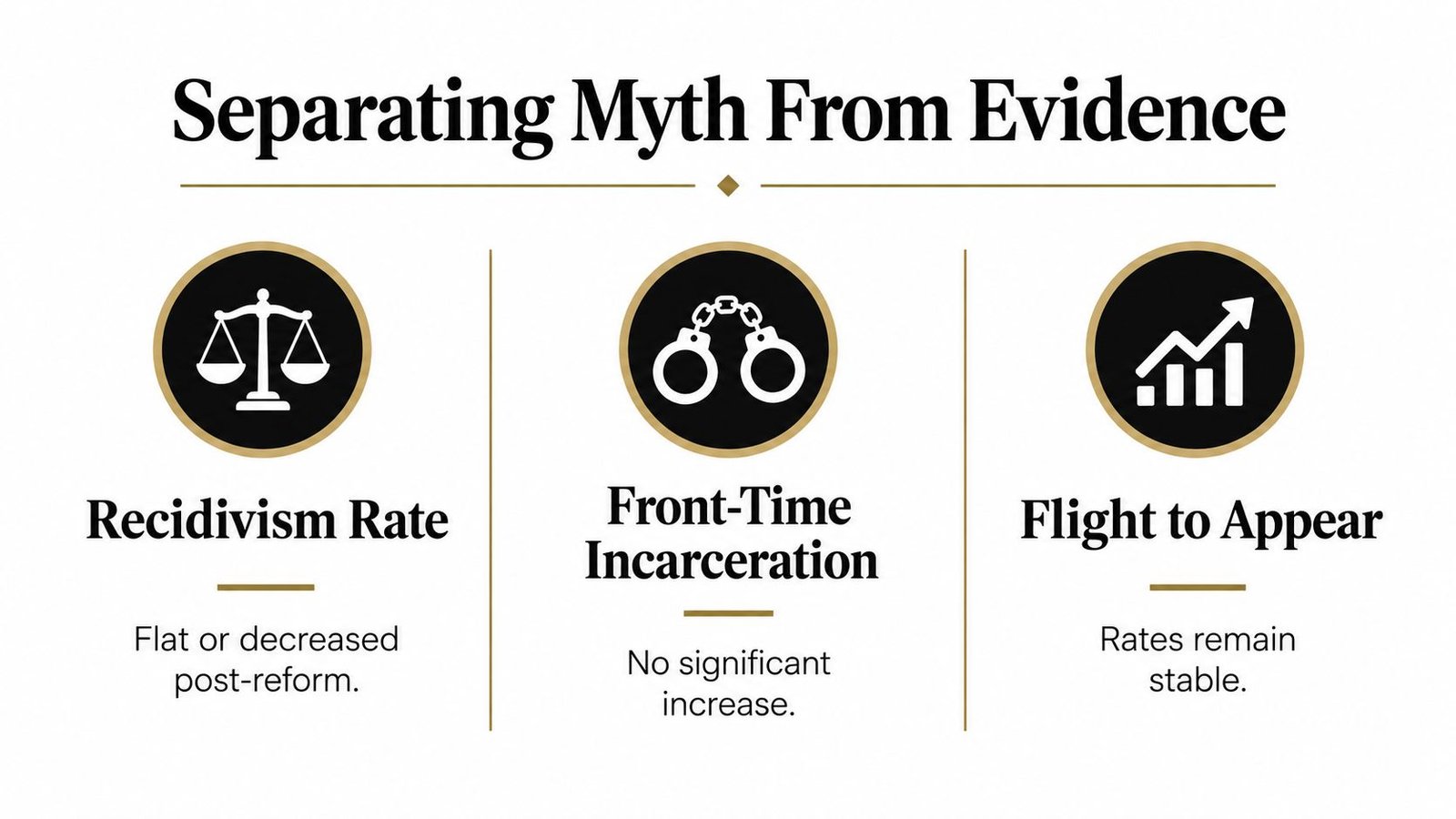
The available evidence also doesn't support the simple claim that reducing money bail automatically increases crime. A 2024 Brennan Center analysis summarized by Drexel University found no statistically significant relationship between bail reform and crime rates across 33 U.S. cities. A separate review of Chicago, Houston, Philadelphia, and New Jersey found no marked change in violent or nonviolent crime after reforms.
New Jersey provides a more specific example. A study summarized by Stanford Law School found that the state's detained pretrial population fell from 8,899 in 2015 to 4,976 in 2019, and that about 38% of the pre-reform pretrial population had been jailed solely because people couldn't afford bail. The same summary reported that the reform reduced the pretrial jail population without increasing gun violence, as described in Stanford Law School's account of the research.
What the evidence doesn't prove
These findings don't prove that every release decision is safe or that every reform works perfectly. Individual defendants can violate conditions, miss court, or face new allegations. A court still needs reliable information and a meaningful way to respond when the release plan fails.
The strongest argument for reform is narrower and more practical. Money measures access to funds, not risk by itself. A court should identify the concern, choose a condition that addresses it, and explain why detention is necessary when no condition will work.
A separate review of release practices reported a shift from bail releases toward intensive supervision, including electronic monitoring and active court monitoring. The share of booked cases released on bail fell from 21% to 14%, while intensive pretrial supervision rose from 15% to 29%, and overall pretrial release increased by 11%, according to the study summary in Wiley Online Library. That is not blanket release. It is a change in the tools courts use to manage people awaiting trial.
A Practical Guide for Getting Someone Released
The first day after an arrest feels chaotic because several tasks happen at once. The family needs information from the jail, legal advice from defense counsel, and a clear explanation of any bond option before signing a financial agreement.
Start with the release facts
Call the detention facility and write down the booking number, charges, bond amount, bond type, hearing time, and any hold that could prevent release. Ask whether the defendant has already seen a judge and whether a lawyer has entered the case.
Then contact a 24/7 licensed Colorado bail agent if the court allows a surety bond. Ask direct questions:
- What type of bond is this? Confirm that the agent can post the specific bond ordered by the court.
- What will I pay? Ask about the premium, payment schedule, cosigner requirements, collateral, and refund rules in writing.
- What happens if the defendant misses court? Learn how notices, surrender, and recovery obligations work.
- Can the court release the person another way? Ask about personal recognizance, supervised release, monitoring, or a later bond review.
- What must happen before posting? Confirm signatures, identification, jail acceptance, and any required court paperwork.
An agent can explain the bond transaction, but only the court can set or change the release conditions. If the family needs legal advice about the charges, defenses, or whether to accept a condition, contact a defense attorney.
Gather useful documents
A family can prepare materials that help the attorney or agent understand the defendant's situation:
- Identification: Government-issued identification for the defendant, cosigner, and anyone signing documents.
- Residence information: A Colorado address, lease, utility record, or written confirmation of where the defendant will stay.
- Work records: Employer contact information, schedule, or other evidence of a stable job.
- Support details: Names and contact information for people who can help with transportation, reminders, treatment, or supervision.
- Court information: Copies or photographs of the bond sheet, hearing notice, and any protection or no-contact order.
Families handling paperwork remotely may benefit from an administrative resource such as a virtual legal assistant to organize records and communications. That support doesn't provide legal advice, but it can help keep documents and deadlines in one place.
Before signing: Ask who is financially responsible, what collateral is required, and what happens if the defendant violates a condition.
At the hearing, the judge may ask whether the defendant has a safe residence, a way to attend court, and a workable plan for complying with restrictions. The family should not contact an alleged victim or discuss case facts publicly. Save every notice, attend every hearing, and report changes in address or phone number to the lawyer and supervising agency.
The goal isn't to promise a particular result. It is to replace panic with verified information, a documented plan, and a clear understanding of the court's order.
What Comes Next for Families and the System
Cash bail reform will continue to develop through legislation, court decisions, county practices, and public debate. Some jurisdictions are reducing reliance on money conditions, while others are reinforcing detention or preserving cash bail for broader categories of cases. A 2026 review by The Bail Project found that few states require judges to record or explain detention decisions, fewer guarantee counsel at detention hearings, and some constitutional changes reinforce money bail rather than constrain it.
That implementation gap matters to families. A law can promise risk-based decision-making, but the hearing still needs counsel, timely review, written reasons, and conditions that address the actual concern. Without those safeguards, a person may still face detention without understanding why or how to challenge it.
The remaining use of money bail also deserves attention. Recent research summarized by the Advancing Pretrial Policy and Research review reported that higher initial bond amounts significantly increase detention. In New York case-processing data, median cash bail amounts rose sharply from 2019 to 2024, while posting rates fell from 21% to 9% at arraignment and from 36% to 19% within five days. Reform can reduce money-bail use overall while leaving some defendants facing higher amounts when cash bail remains available.
For a family in Denver, Jefferson County, or Arapahoe County, the immediate plan is more useful than a national argument:
- Confirm the order. Get the exact bond type, amount, hearing time, and conditions.
- Call early. Speak with defense counsel and a licensed Colorado bail agent when a surety bond is available.
- Prepare proof. Gather identification, residence, employment, and supervision information.
- Follow every condition. Court dates, no-contact orders, monitoring, reporting, and travel limits all matter.
- Track changes. Ask counsel about new local policies or legislative changes that could affect serious-charge eligibility.
In Cook County, Illinois, reform data illustrates why families and policymakers should examine actual operations rather than slogans. From the effective date of the reform through early October 2026, 94% of defendants released before trial were not charged with a new violent or person crime, more than 80% were not charged with a new misdemeanor or felony, and, among more than 177,000 defendants released before trial, 85% made their scheduled court dates, according to the Chicago Tribune's report. Those results don't decide a Colorado case, but they show why release conditions, court access, and supervision deserve closer attention than the label attached to a reform.
If someone you care about has been arrested in Colorado, Express Bail Bonds can explain the surety-bond process, required documents, payment arrangements, and next steps for eligible bonds. Contact a licensed agent early, confirm the court's conditions, and use the available guidance to move from an urgent jail call toward a clear release plan.