
You're probably looking at bail bond agent jobs because a normal desk job doesn't appeal to you. You want work that matters, work with pressure, work where decisions have consequences. Maybe you've handled collections, insurance, sales, dispatch, corrections, or crisis-heavy customer service, and you already know you can stay calm when everyone else is rattled.
That instinct can serve you well in this business. But bail work isn't TV. It isn't all courthouse swagger and late-night arrests. It's licensing, underwriting judgment, phone calls at bad hours, contract discipline, and the kind of personal accountability that can wreck an unprepared person financially and emotionally.
The Reality of Bail Bond Agent Jobs
A lot of people come into bail bond agent jobs thinking they're signing up for action. Some of that exists. A late-night jail call comes in, a family is scared, somebody has to sort out indemnitors, paperwork, release timing, and risk in a hurry. If you work the file correctly, you help a defendant secure release and help a family regain some footing. If you work it poorly, you inherit a problem that can keep getting worse.
This job sits at the intersection of finance, investigation, and human stress. You're not just posting bonds. You're evaluating whether a defendant is likely to appear, whether the cosigner understands the obligation, whether the paperwork is clean, and whether the story you're hearing holds up.
Nationally, this isn't a fringe line of work. The United States bail bond industry includes about 15,000 licensed bail bondsmen issuing roughly $14 billion in bail bonds annually and serving about 2 million people each year, according to career data cited by Bounty Hunter Edu.
What the job really feels like
Some days feel administrative. You verify identities, review forms, coordinate with detention facilities, and chase missing details that can delay release.
Other days are pure judgment.
- A worried mother calls at midnight: You need empathy, but empathy can't replace underwriting.
- A defendant sounds convincing: That doesn't mean the file is safe.
- A cosigner wants to rush through documents: Slow them down. A rushed signature today can become a dispute tomorrow.
Practical rule: If you can't explain the obligation clearly to the cosigner, you shouldn't write the bond.
People who last in this business learn one lesson early. You are dealing with urgent human situations, but urgency doesn't excuse sloppy decisions. That's the line that separates a professional agent from a liability.
Your Step-by-Step Path to a Colorado Bail License
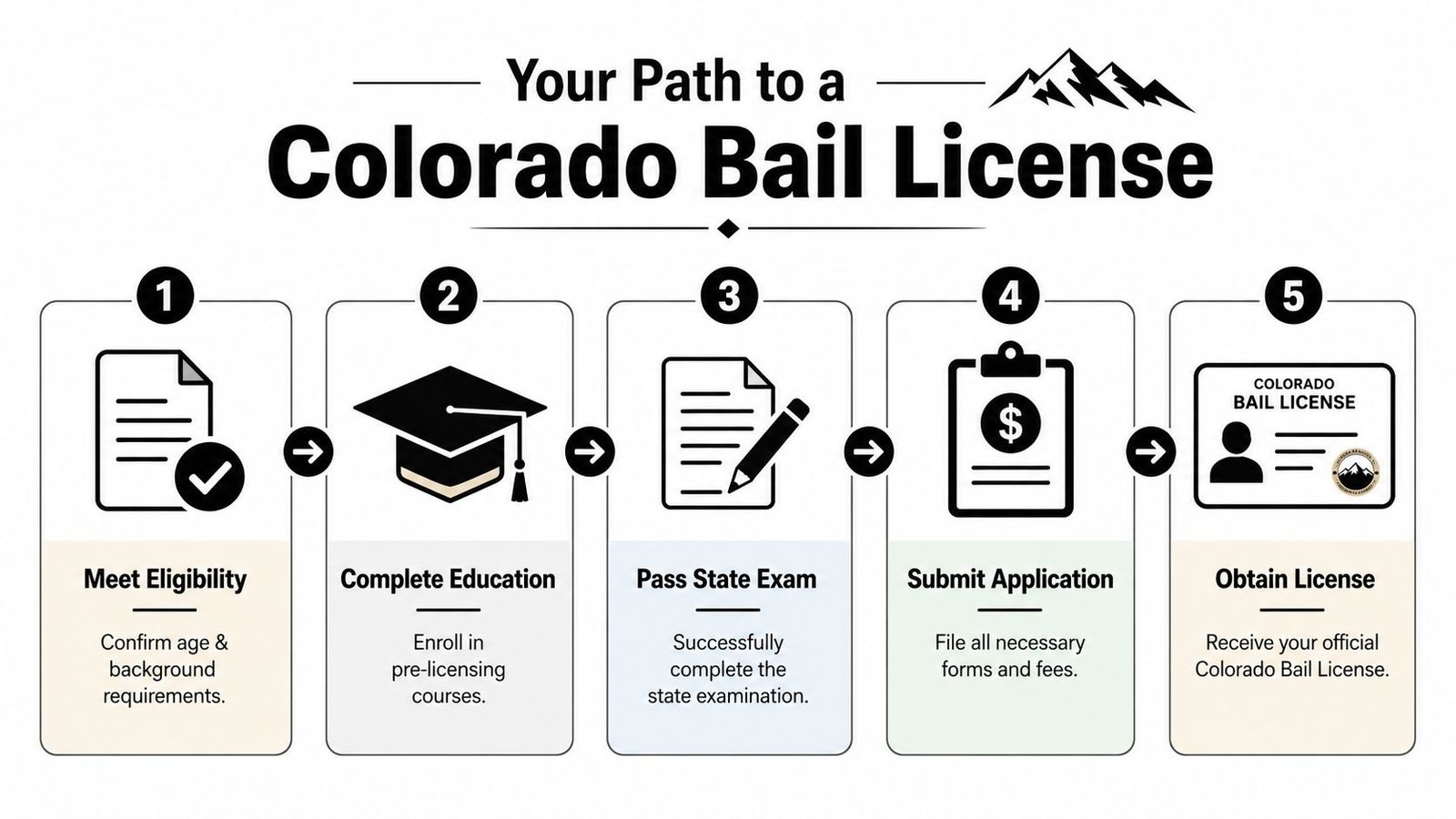
It is 1:15 a.m. A family wants their son out before morning, and a new agent thinks passing a test is what qualifies someone to handle that call. Colorado does not work that way. Before you can write business legally, you need the right license, the right training, a clean background review, and an appointment with a surety that trusts you not to create losses.
Start with the license Colorado actually requires
In Colorado, you need a Colorado Bail Bonding Agent Producer License with the proper authority. You also need to pass the licensing exam with a score of 75 or higher, and that passing score stays valid for one year, as outlined in this Colorado licensing overview.
That requirement weeds out people who assume they can get hired first and learn compliance later. In Colorado, bail work is regulated insurance business tied directly to criminal procedure. If your paperwork is wrong, your understanding is weak, or your deadlines slip, the problem is not academic. It can cost you your license, your appointment, or your agency relationship.
Complete the education and training before you expect an appointment
Colorado requires bail bond agents to hold an insurance producer license with Casualty line authority. Before a bail insurance company can appoint you to write bail business, you must complete at least 8 hours of bail bonding education and 16 hours of bail recovery training, according to Urban Bail Co's Colorado licensing summary.
New agents miss the appointment issue all the time. They study for the exam, pass it, and then realize a license alone does not put them in business. A surety has to be willing to back your work. That means they are looking at more than whether you can pass a test. They care whether you understand indemnity, collateral, documentation, forfeiture exposure, and how your decisions affect their money.
Here is the sequence I tell people to follow:
Confirm you meet the state's eligibility standards
Your background needs to hold up under review. Bail agents handle money, contracts, and high-risk clients. Regulators and sureties both care about that.Finish the required Colorado education
Learn the legal side and the business side together. If you treat pre-licensing education like trivia, you will struggle once real files hit your desk.Take the state exam through Pearson VUE
Go in prepared. The exam is not the hardest part of this career, but failing it is an early warning that you are not taking the work seriously enough.Complete fingerprints and the background process
Colorado requires fingerprints and a photo for the background check process, and applicants must pay a $71 fee to the Colorado Division of Insurance, as noted in this Colorado bail bondsman requirements guide.Get appointed by a bail insurance company
This is the step that turns a license into actual earning ability. Without an appointment, you are licensed on paper and sidelined in practice.
If you want a practical overview that ties the licensing steps to the actual job, review this guide on how to become a bail bondsman.
After you've reviewed the paperwork side, it helps to hear the process explained visually.
Understand the renewal burden before you start
Getting licensed is the front gate. Staying licensed is part of the job.
In Colorado, bail bondsmen must complete 24 hours of continuing education every two years to maintain licensure, as noted earlier in the Colorado materials already cited above. Good agents build that into their calendar the same way they track court dates, indemnitor files, and payment records.
The people who struggle in this trade usually don't fail because they're lazy. They fail because they underestimate compliance, timing, and detail.
Treat licensing like an operating system. Keep copies of every document. Track renewals before they become emergencies. Use checklists. The agencies that last in Colorado do this well, and the more modern shops, including tech-forward operators like Express Bail Bonds, build those habits into their daily workflow instead of relying on memory and last-minute scrambling.
Day-to-Day Operations and On-Call Demands
The daily rhythm of bail bond agent jobs surprises most newcomers. The public imagines nonstop jail runs. However, the work is more layered. The work swings between urgent calls, contract review, defendant screening, jail coordination, and constant interruptions.

A midnight call can be emotionally intense, but your actual task is procedural. You gather facts, identify who will indemnify the bond, assess whether the file is workable, and decide whether the case fits your agency's standards. Then you document everything cleanly enough that nobody has to reconstruct the deal later.
What your shift actually includes
A working bail agent's day usually includes a mix of the following:
- Client intake: talking with defendants, family members, attorneys, or cosigners who are often upset and short on patience.
- Risk screening: reviewing employment, residence stability, family ties, and whether the proposed cosigner is credible.
- Contract execution: making sure signatures, disclosures, payment terms, and responsibilities are spelled out correctly.
- Facility coordination: communicating with jails and detention staff so posting doesn't get delayed by missing information.
- Court follow-up: tracking appearances and dealing with problems before they turn into forfeiture exposure.
The hardest adjustment for new agents isn't the paperwork. It's that the work doesn't stay inside business hours. The phone can ring on weekends, holidays, and in the middle of dinner.
You are not a cop
This misunderstanding causes more bad career decisions than it should. Bail agents are private contractors with limited authority derived from contract law, not general law enforcement, and any authority to pursue a defendant who skips bail is legally distinct from police work and restricted by state law, as explained in this discussion of whether bail bond agents are cops.
That means you need to understand boundaries.
| Role | What it involves |
|---|---|
| Bail bond agent | Underwriting risk, writing bonds, managing indemnity, and handling compliance around court appearance obligations |
| Law enforcement | Enforcing criminal law generally, investigating crimes, and making arrests under governmental authority |
If you want a badge, pursue law enforcement. If you want to operate as a regulated private professional inside a high-pressure justice-adjacent business, this field may fit.
A modern agency also expects stronger tech habits than older job descriptions suggest. Today's workflow often includes remote applications, electronic documents, and digital communication rather than hours of physical paperwork moving from desk to desk. That changes the skill set. The strongest agents are part underwriter, part communicator, part process manager. If you want a closer look at that recovery side of the field, read about the bail enforcement agent job.
Finding Bail Bond Agent Jobs in Colorado
It is 11:40 p.m. in Denver. A family wants someone to answer the phone, explain indemnity without fumbling, and decide whether the file is worth the risk before the jail window closes. That is the job an owner is hiring for. Colorado agencies do not bring people on because they sound interested. They hire people who can protect the company's license, cash flow, court relationships, and reputation at inconvenient hours.
Job boards can help, but they are rarely the whole market in Colorado. Good openings often get filled through referrals, industry contacts, and direct outreach to active agencies. Owners talk to defense lawyers, court-adjacent professionals, former agents, and surety contacts. If your name comes up, it needs to come up for the right reasons.
Where serious candidates actually look
Start with agencies that are visibly active across Colorado, not offices that look half-asleep online and disappear after business hours. A modern shop should show signs of organized operations, electronic document handling, quick communication, and clear county coverage. That matters because the business has changed. Clients expect speed, and owners expect agents to work accurately inside that speed.
Before you contact anyone, study how strong agencies present themselves and what clients value in the best bond companies. You are not copying their marketing. You are learning how a serious operation signals trust, availability, and control.
Then get specific:
- Look for active Colorado coverage: Multi-county agencies usually expose new agents to more file types, more court schedules, and more substantive underwriting decisions.
- Check whether the office uses current systems: Express Bail Bonds is a good example of the direction the business has gone. Faster intake, digital communication, and remote document flow are now part of the actual job, not a bonus skill.
- Ask who trains new people: A weak office throws a rookie at the phone and hopes sales ability covers bad judgment. A good office reviews files, explains why a bond was written or declined, and teaches pattern recognition.
- Pay attention to how the office communicates: Sloppy intake usually means sloppy files. Sloppy files become expensive lessons.
What to watch for in an employer
A bad agency can teach habits that hurt you for years. I have seen new agents get pushed to chase premium first and ask risk questions later. That works right up until a defendant misses court, the cosigner disappears, and the office starts looking for someone to blame.
Watch how the owner talks about the business. If every sentence is about volume, commission, and “closing,” keep your guard up. The better owners talk about indemnitors, paperwork quality, county procedures, collections, forfeiture exposure, and why some deals need to be declined.
Local knowledge matters too. Colorado is not one uniform market. Booking patterns, release timing, and customer expectations shift from county to county. A capable agency understands those differences and staffs accordingly, even if it serves clients through a centralized, tech-forward process.
How to approach an agency owner
Come in prepared. Owners can tell within two minutes whether you are chasing adrenaline or trying to build a profession.
Lead with facts. State where you are in the licensing process. State the experience that transfers well, whether that is sales, collections, legal support, dispatch, repossession support, corrections, or client intake. If your background is sales-heavy, review advice on crafting an effective sales resume so you can frame persuasion, follow-up, and objection handling in a way that sounds disciplined instead of flashy.
Then ask questions that show judgment:
- How do you decide a new agent is ready to write files with less supervision?
- What file errors cost the office money most often?
- How much of the week is client communication, paperwork, collections, and court follow-up?
- What happens when an agent wants to write a bond and the owner disagrees on the risk?
That conversation gets attention. It tells an owner you understand the true offer. The advertised income may sound attractive, but the work is commission-based, mistake-sensitive, and tied to personal accountability. In Colorado, the agencies worth joining know that. You should too.
Preparing Your Resume and Acing the Interview
A generic resume doesn't work in this field because a bail agency isn't hiring “a people person.” It's hiring someone who can handle money, pressure, confidential information, frightened families, and ugly consequences when things go wrong.
Your resume needs to translate your past experience into bail relevance. If you've worked in sales, collections, insurance, repossession support, dispatch, customer service, corrections, or legal support, you may already have useful habits. The key is showing how those habits carry over.
What agencies actually want to see
Focus on transferable strengths that matter in a bond office:
- Sales judgment: Can you communicate clearly and get a hesitant cosigner to understand an obligation without overselling it?
- Risk awareness: Have you worked in environments where one bad decision could cost real money?
- Documentation discipline: Can you keep records clean enough that another person can step into the file and understand it instantly?
- Emotional control: Can you stay steady when a family is upset, demanding, or embarrassed?
If your background is sales-heavy, studying examples on crafting an effective sales resume can help you frame persuasion, follow-up, and objection handling in a way that sounds professional rather than flashy.
What to remove from your application
Don't submit a resume packed with vague buzzwords. “Hard worker,” “team player,” and “excellent communicator” tell an owner nothing.
Replace them with real statements about responsibility. Mention client-facing crisis work. Mention cash handling or contract work. Mention regulated environments. Mention schedule flexibility if you mean it.
“I can work nights” isn't impressive unless you also show you can make disciplined decisions when you're tired.
Interview answers that land well
An owner will often test your judgment more than your charisma. Expect questions that don't have neat textbook answers.
A few examples:
- What would make you decline a bond?
- How would you handle a cosigner who seems confused but wants to move fast?
- What does confidentiality mean in a family crisis?
- Can you stay available when your plans get interrupted?
The best answers show restraint. Agencies don't need cowboys. They need adults. If your interview style feels dramatic, pull it back. Calm, clear, accountable people last longer in this trade.
Understanding Compensation Risk and Earning Potential
This section deserves careful review. Bail work can pay well, but it does not pay well just because you have a license. This is not ordinary salaried employment. It is a commission-driven business built on judgment, volume, collections discipline, and risk tolerance.
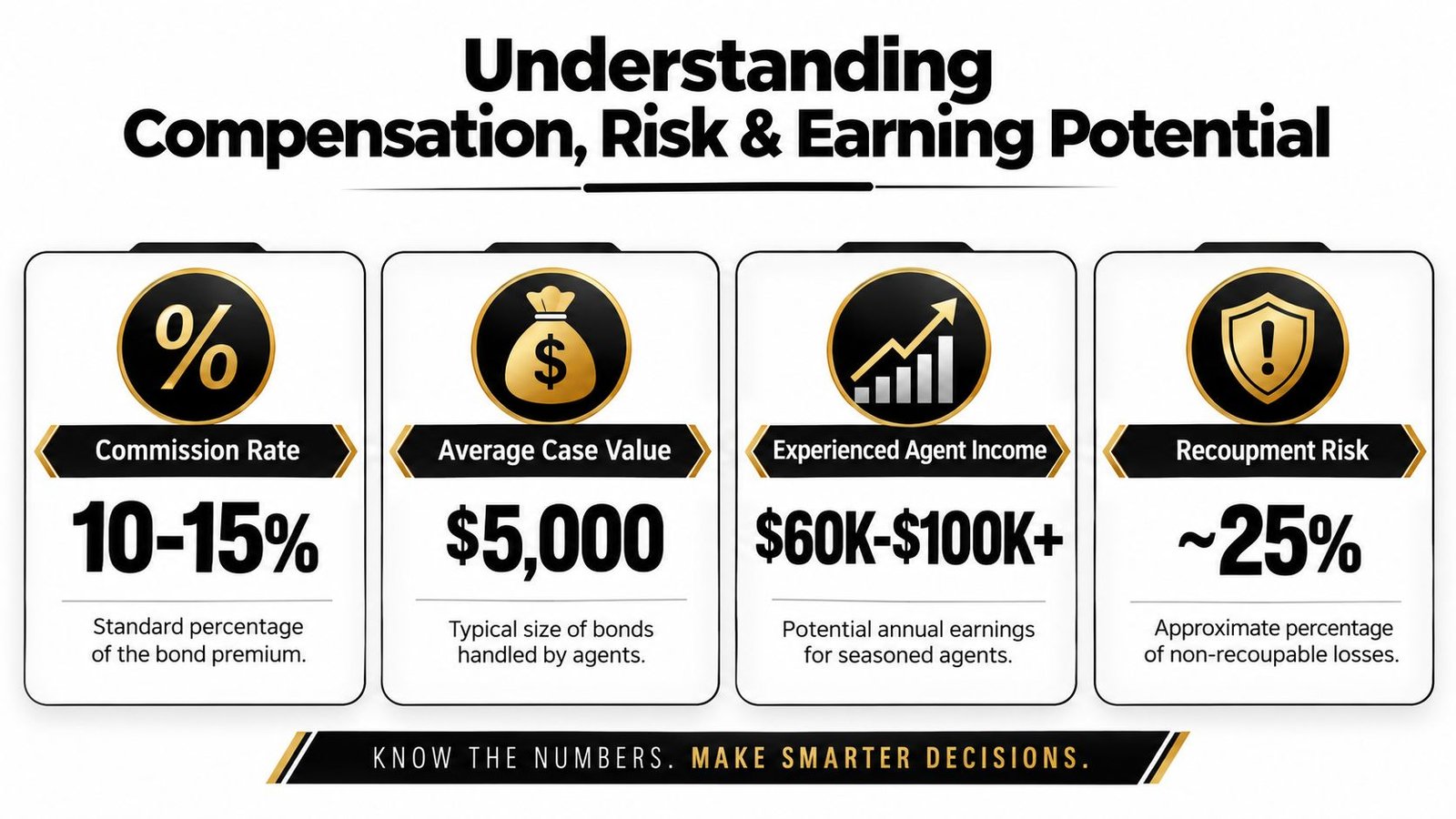
National compensation data shows a median annual wage of $67,856 in 2025, with entry-level agents often around $25,000 while top performers exceed $150,000, according to this bail bondsman pay scale breakdown. That same source explains the core model clearly. Agents earn by writing bonds and retaining the 10 percent to 15 percent premium, while remaining liable for the full bond if the defendant fails to appear.
What the premium means in real life
In Colorado, the standard premium is often 15 percent, and for larger bonds an approved cosigner can sometimes help secure 10 percent pricing through a surety-style structure, as described in the publisher information provided for Express Bail Bonds.
That sounds attractive on paper, but paper income isn't the whole story. You don't just collect a premium and walk away. You are taking responsibility for what happens next.
Why bad underwriting wipes out good income
The worst mistake new agents make is confusing revenue with profit. Premium collected is not the same thing as safe money. If a defendant skips court, the file stops being a sales win and turns into a risk event.
A separate industry discussion notes that the most common pitfall is underestimating skip risk, and that poor verification around employment, residence stability, and family ties can lead to forfeiture exposure where the agent may owe the full bond amount if recovery fails within the statutory window, as outlined in this analysis of bounty hunters and skip recovery compensation.
That's why veteran agents look boring to newcomers. They ask repetitive questions. They insist on documents. They slow down families that want instant answers. They aren't being difficult. They're protecting the file.
| Income factor | What actually drives it |
|---|---|
| Bond volume | More qualified files usually means more commission opportunity |
| Risk selection | Writing weak files can erase gains from stronger ones |
| Cosigner quality | A reliable indemnitor changes everything |
| Follow-up habits | Court reminder discipline and file management reduce preventable problems |
The income spread is real
Some people never move beyond survival-level earnings because they never build referral relationships, never improve file quality, and never develop the patience to say no.
Others become strong earners because they do three things well:
- They screen aggressively
- They communicate expectations clearly
- They build referral trust with attorneys and repeat contacts
For a useful primer on the basic business model, review how bondsmen make money.
Salary talk often hides the hardest truth
Job ads can make this field sound more predictable than it is. That's a problem. The compensation numbers are real, but the path to those numbers is uneven and personal. A disciplined agent may build a solid book of business over time. A careless agent can generate activity without building stability.
One more reality check matters here. Some descriptions of the job emphasize flexible schedules and independence. That can be true. But flexibility in bail work often means your calendar belongs to the phone, the jail, the court date, and the file.
High earning potential in this field doesn't come from excitement. It comes from consistent judgment under pressure.
If you're attracted only to the upside, you're not ready. If you understand that income and liability travel together, you're starting to think like an owner.
Is a Bail Bond Career Right for You?
Colorado gives you a clear legal path into the business, but the state can't tell you whether you're built for the daily pressure. That part is personal.
You'll need the temperament to work odd hours without getting sloppy. You'll need the backbone to tell a desperate family “no” when the file doesn't make sense. You'll need enough humility to follow procedure even when you think your instincts are right. And you'll need enough integrity to remember that every rushed shortcut can become someone else's legal and financial problem.
Ask yourself a few blunt questions.
The self-test that matters
- Can you stay calm when people are panicking?
- Can you separate sympathy from underwriting?
- Can you handle a regulated profession where details matter every day?
- Can you live with income that depends on performance and judgment?
A lot of people are interested in bail bond agent jobs. Fewer are suited to them. The people who usually do well are steady, skeptical, organized, responsive, and hard to rattle.
If the recovery side of the profession interests you, learn the distinction before you romanticize it. This overview of what bounty hunters are and how they work is a good place to separate myth from the actual role.
If you read all of this and still feel pulled toward the work, that's a good sign. Start the licensing process properly. Learn the legal boundaries. Build your judgment before you chase volume. In this business, patience at the beginning saves pain later.
If you need fast, professional guidance from a Colorado agency that has served detention facilities statewide since 1988, contact Express Bail Bonds. Their team handles surety bonds with an efficient electronic process, and you can review local service coverage in Jefferson County and Centennial.