You're usually not thinking about a bail contract when the phone rings at 3 a.m. You're thinking about a loved one in a jail booking room, a tired deputy, and somebody asking for a cosigner before release can move forward. If that's where you are right now, the first thing to know is simple, co-signing a bail bond is not just a favor, it's a written financial promise with real consequences.
That matters because the person in custody is often still legally presumed innocent. The Brennan Center for Justice estimates that roughly two-thirds of the approximately 750,000 people held in U.S. jails are awaiting case resolution and have not been convicted Brennan Center for Justice report. In plain language, families are often asked to step in before the case is even resolved, and that's exactly why the contract deserves a careful reading.
A lot of online explainers stop at “you promise they'll show up.” That's too thin. In Colorado, the paper you sign can decide who owes money, who controls collateral, and how long the obligation lasts. If you need practical help while you're gathering your thoughts, find a law firm answering service can be useful when your own attorney office is closed and you're trying to coordinate calls fast. For release timing and the basics of the jail side of the process, you can also review the jail release process.
When a Colorado Arrest Turns Into a 3 a.m. Phone Call
The call usually doesn't come with much context. A sister in Texas hears that her brother was booked into a Denver-area jail, a parent in another state is told a bondsman needs a cosigner, and nobody on the line is sure what “signing” means. The clock is moving, and the family wants the fastest path to release without making a mistake they can't unwind later.
That urgency is real, but the paperwork doesn't disappear just because the arrest happened overnight. A co-signer isn't signing a sympathy form, they're stepping into a legal role that sits inside the bond itself. The smart move is to slow the moment down enough to read the contract, ask about liability, and confirm what happens if the defendant misses court.
Practical rule: if the request sounds rushed, ask for the indemnity agreement before you agree to anything. The fastest way to help is still to understand what you're signing.
A Colorado family often gets only a few moving parts at once, the jail, the bond amount, and the name of the producer who's willing to post the surety bond. What they need next is a plain explanation of who owes what, and under what conditions. That's where the rest of this guide earns its keep.
If you've never dealt with a release before, the moving pieces can feel tangled. The bond company may post the bond, the court sets the conditions, and the cosigner signs a separate promise to back the deal. A clear overview of the sequence is available in the Colorado release flow, but the contract still decides the risk.
The key point is this. A bond can help get someone out of jail quickly, but the signature that helps make it happen can also create lasting financial exposure. Families don't need legal jargon right now, they need a clean map of the obligation.
What Co-Signing a Bail Bond Actually Means
A surety bail bond is a three-party arrangement, the court sets the conditions, the licensed bail-bond producer posts the bond, and the defendant is the person whose appearance is being guaranteed. The cosigner, also called an indemnitor or obligor, becomes the fourth party in practical terms because they sign a contract promising to stand behind the defendant's compliance.
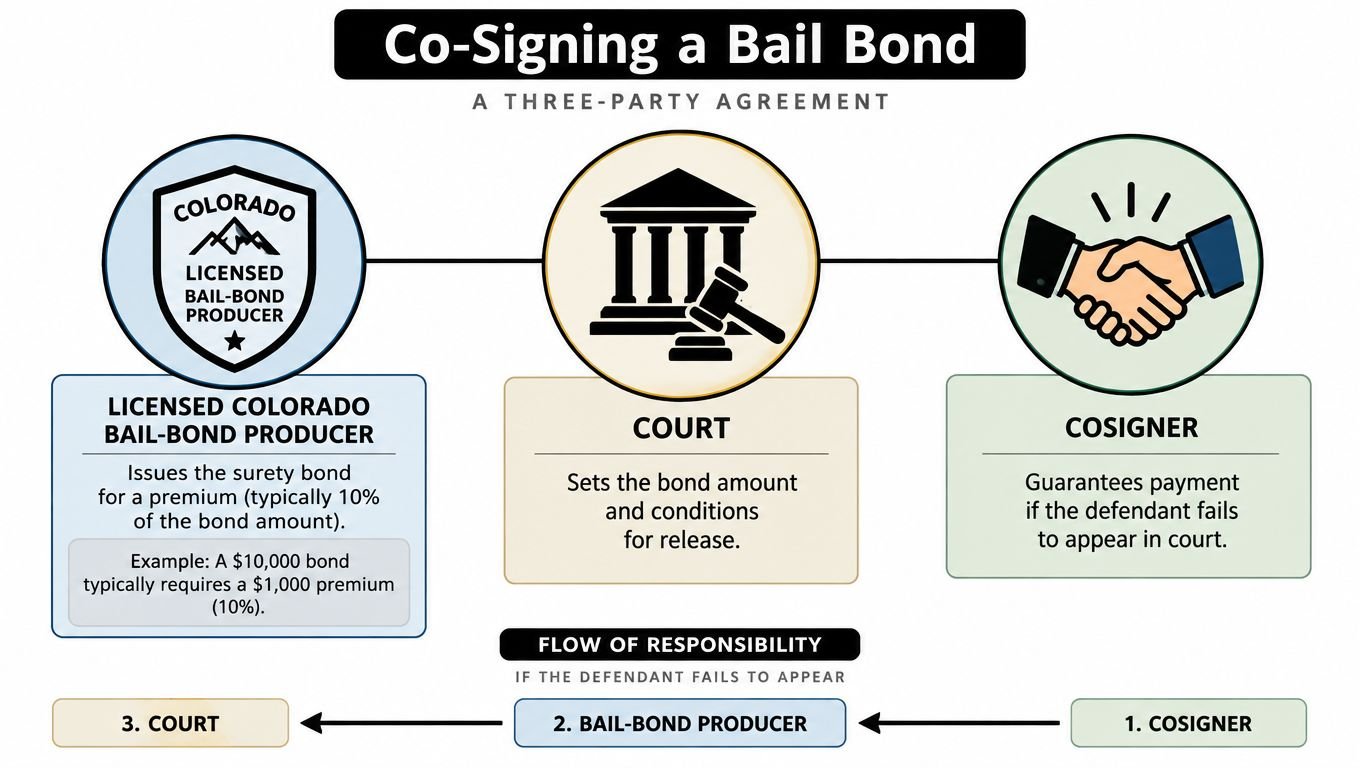
The cleanest way to think about it is like a financial guarantor on a loan. The bondsman is the one extending the credit to the court, but they want a second layer of security before taking that risk. The cosigner's signature says, in effect, “if the defendant doesn't meet the court's terms, I accept the contractual fallout.”
That's why the cosigner is not usually paying the full bail amount upfront. The producer posts the surety bond, and the family pays the premium and accepts the contract terms. The court gets the security it asked for, and the cosigner gets the responsibility that comes with helping obtain release.
Colorado's bail system developed in a setting where monetary bail became increasingly central. In large U.S. counties, judges assigned monetary bail to 53% of felony defendants in 1990 and 72% by 2009 Minneapolis Foundation report. That shift helped make cosigners more common, because more families started needing a financially qualified person to help secure release.
A cosigner's signature is not a character reference. It is a contract that puts personal assets, income, and credibility behind the defendant's appearance.
If you want a plain-language companion while you compare documents, Ticket Shield bail assistance offers another example of how the role is explained in practice. The important thing is to keep your eye on the legal function, not the label.
By the end of the signing, the family should be able to answer one question clearly, who is promising what to whom. If that answer is fuzzy, the paperwork isn't ready yet.
Cosigner Liability Under Colorado Law
Colorado law sets a ceiling on what a licensed insurance producer may charge for a bail bond premium. The producer may not charge more than the greater of $50 or 15% of the bail amount Colorado insurance producer statute. That premium is the entry fee for the bond, not the limit on what a cosigner may owe if the case goes sideways.
Here is the math in plain English. If the bond is $20,000, the premium would be $3,000 under the statutory cap above. If the defendant then misses court and the bond is forfeited, the exposure can move far beyond that premium, because the cosigner's promise can reach the bond amount itself, plus court costs, recovery expenses, and other losses.
Colorado's rules matter because the cosigner is not just promising to be careful or supportive. The signed indemnity agreement creates a real contractual obligation, and the bond can be forfeited without the kind of separate civil lawsuit many families expect. That means the paperwork can become active fast, often before anyone has time to sort out assumptions about who pays what.
What the contract can put at risk
A cosigner should read the contract as a list of possible liabilities, not as a receipt for a one-time fee. Depending on the case and the agreement, exposure can include the full bond amount, court costs, interest, and recovery expenses if the bond is forfeited, which is why the signature matters so much Prison Policy bail report. That risk can also extend to collateral, so the paperwork should spell out who controls it, what triggers a claim, and when it comes back.
The same caution applies to the indemnity form itself. If you want a Colorado-specific summary of the promises a cosigner makes, review cosigner responsibilities. Read it alongside the actual contract, because the form is where the obligation lives. The same rule holds for every line that mentions repayment, recovery costs, or collateral release.
Bottom line: the premium buys the bond, but it does not cap the debt if things go wrong.
Who Qualifies as a Cosigner in Colorado
A bondsman isn't looking for the most anxious person in the room. They're looking for someone who can be identified, documented, and trusted to stand behind the bond if something goes sideways. That usually means a valid government ID, a verifiable address, and enough income or assets to make the promise meaningful.
The relationship to the defendant matters too. Close family members are often the first people who come forward, but the key question is whether the cosigner can be reached, verified, and held accountable under the contract. If the person signing can't prove who they are or can't explain how they'd handle the financial risk, the application usually stops there.

Colorado families also run into the question of remote signing. Out-of-state cosigners can sometimes complete the process electronically, but they still need to be able to verify identity and complete the indemnity paperwork accurately. The process may be remote, but the obligation is just as real as if they were sitting at the counter.
A practical pre-screening list helps avoid wasted time:
- Government ID: bring a current ID or a clear electronic copy so identity can be verified.
- Income or assets: be ready to explain how you could handle the obligation if the bond is forfeited.
- Relationship to the defendant: have a straightforward explanation of why you're the right person to sign.
- Contactability: make sure the agency can reach you quickly if court dates change.
- Documents: gather anything related to collateral, employment, or prior paperwork before you call.
For a Colorado-specific checklist, the cosigner requirements page is a useful companion. It's better to learn early that you don't qualify than to sign halfway through a rush and regret it later.
The short version is this. A qualified cosigner is someone the producer can verify, the court can rely on, and the family can reach if the defendant's case starts moving in the wrong direction.
Collateral a Colorado Cosigner Can Be Asked to Pledge
A Colorado cosigner can walk in expecting to sign paperwork and leave with a clear obligation, then discover the contract also asks for property as backup. That backup is collateral, and it can include cash, a vehicle title, a lien on real estate, or another item the agency can hold if the bond goes bad. The key question is simple: what exactly is being tied to the bond, and what happens to it if the case ends without a forfeiture?
The answer should be written down before anyone agrees. Collateral is only safe to hand over if the paperwork shows who keeps it, how it is recorded, and what proof is required before it is released. If that detail is missing, ask for it.
| Collateral Type a Colorado Cosigner May Be Asked to Pledge | How It Is Documented | Typical Release Trigger |
|---|---|---|
| Cash | Receipt and bond records | Court exoneration or case closure with formal release |
| Vehicle title | Title paperwork and lien paperwork | Surrender, discharge, or exoneration |
| Real estate interest | Recorded lien or related deed paperwork | Formal release after the bond is exonerated |
| Savings or account funds | Written agreement and account hold paperwork | Bond discharge and documented release |
| Jewelry or valuables | Inventory list and receipt | Return after liability ends and records confirm release |
Many families get caught off guard here. The collateral does not automatically come back when the defendant gets out of jail. It stays attached to the bond until the liability ends in writing, which is why Colorado cosigners should keep copies of every receipt, lien record, and indemnity document they sign.
A practical way to prepare is to read a plain-language overview of bail bond collateral before the meeting. That will not replace the contract, but it helps you ask sharper questions about what the agency is asking you to pledge.
Collateral is backup for the bond, not a separate favor. Treat it like property that can stay tied up until the case is formally over.
For out-of-state cosigners, the paperwork may be handled electronically or through notarized forms, but the risk does not change. If the bond is still active, the collateral is still tied to it. If you sign, make sure you know exactly which document releases your property and who is responsible for getting that release issued.
How the Colorado Court Calendar Affects Cosigner Exposure
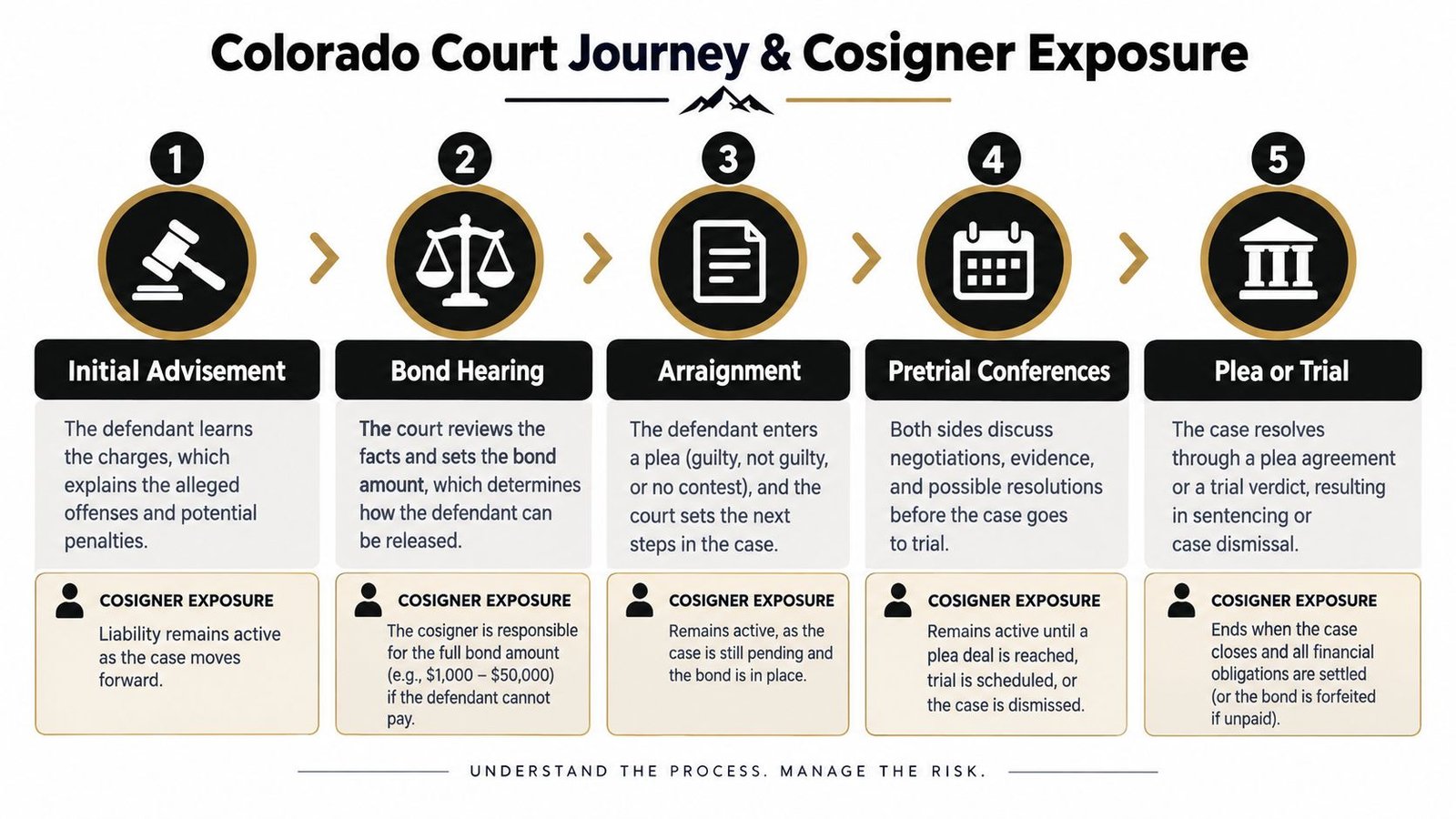
The first court date is often the easiest to overlook and the most expensive to miss. Once you sign, the defendant's court calendar becomes tied to your risk, because every required appearance is a condition of the bond. If the defendant does not show, the court can forfeit the bond, and the cosigner may be left dealing with the fallout.
Colorado court cases usually move through initial advisement, bond hearing, arraignment, pretrial conferences, and then plea or trial. Each step is another point where the defendant has to appear or comply with what the court orders. Until the case ends or the bond is formally discharged, the cosigner's exposure stays in place.
Colorado law gives a surety a few ways to end that liability, through payment of the forfeiture judgment, surrender of the defendant, or a court order Colorado surety release statute. If no forfeiture judgment has been entered, the bond also has a three-year endpoint after posting, unless the court extends it for good cause or a forfeiture judgment already exists Colorado bond endpoint statute.
That means the safest habit is simple:
- Keep the court dates together: one calendar, one place, no scattered text threads.
- Check the dates yourself: do not rely only on the defendant saying they remember.
- Call the agency early: if the defendant goes quiet or starts missing appointments, notify the bonding agency right away.
- Keep the paper trail: save the signed agreement, payment records, and discharge confirmation.
Colorado's Judicial Branch notes that a bondsman may require a cosigner and collateral, and that a failure to appear can put cash, real estate, or other pledged property at risk. Colorado Judicial Branch types of bonds That is why the calendar matters so much. A missed date can put the bond, the paperwork, and the pledged property at risk at the same time.
The practical lesson is plain. Read the court notices, keep track of every appearance, and act fast if the defendant starts drifting off the radar.
Common Cosigner Myths That Lead to Costly Surprises
A cosigner who hears “it's just a signature” is hearing the wrong story. In a Colorado bail bond, the signature sits inside an indemnity contract, which is the document that spells out who pays, what gets pledged, and what happens if the defendant misses court.
The first myth is that liability is capped at the premium. The premium is only the fee to post the bond. The cosigner can still be on the hook for the full bond amount and related losses if the defendant fails to appear, as shown by the statutory premium cap covered earlier.
The second myth is that cosigning is private in any practical sense. Colorado requires the agreement to be written, signed, and dated, and the producer must keep the records for years after discharge. That paper trail is part of the deal, not a formality.
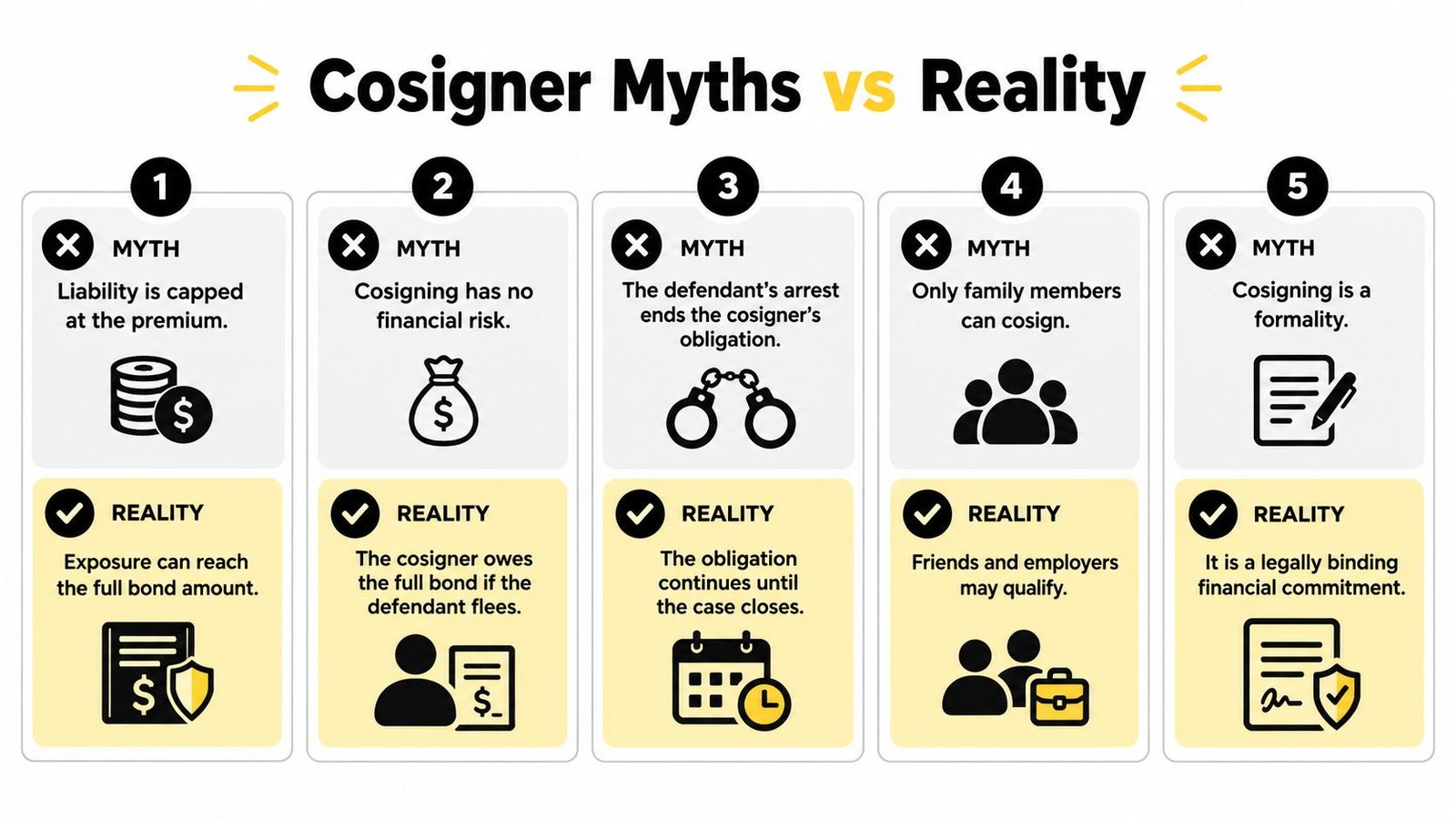
The third myth is that there is no paperwork beyond the bond itself. In reality, the file can include indemnity agreements, bonds, receipts, and related documents, and those records must be retained for years after discharge and return of collateral or satisfaction of the note. That tells you the transaction is treated like a serious financial obligation, because it is one.
The fourth myth is that the bond is over once the criminal case feels over. The legal obligation ends only when the bond is formally exonerated or otherwise released under the law, not when the family is done talking about it. For a cosigner, that matters because collateral release follows the legal status of the bond, not family assumptions.
The fifth myth is that collateral comes back the moment the defendant walks out of jail. Jail release and bond discharge are separate events. If you want property returned, the bond status has to be clear and the release has to be documented.
For a plain-English refresher on the role itself, the what is a cosigner page is a useful cross-check.
The safest assumption is that every signature, receipt, and lien matters until the bond is formally closed.
Families repeat these myths because they sound reassuring. In a bail bond, reassurance is cheap and liability is not.
A Cosigner's Pre-Signing Checklist and Next Steps
Before you sign anything, read the full indemnity agreement, not just the signature page. The promise you are making lives in the fine print. Check the premium, the payment schedule, and every line about collateral, because Colorado requires the producer to give a written, signed, and dated agreement before accepting payment Colorado insurance producer statute.
Keep copies of the full file. Save the signed bond, the indemnity agreement, receipts, collateral records, and proof that the bond was posted or later discharged. Colorado requires bond producers to retain those records for three years after discharge and collateral return or satisfaction of the note, so your own folder should stay together at least that long Colorado Judicial Branch types of bonds.
A good checklist keeps pressure from steering the decision:
- Read every page: know who owes what and when.
- Document collateral: photograph titles, cash, jewelry, or anything else you pledge.
- Confirm release terms: get the return conditions for collateral in writing.
- Calendar all court dates: write them down the same day you sign.
- Save the full file: keep every paper together until the bond is formally closed.
Colorado also gives cosigners a clear timing rule if the bond is not posted after payment or a signed payment contract. If the bond is not posted within 24 hours after the producer receives full payment or a signed payment contract, the producer must refund all money received, release liens, and return collateral within seven days after receiving good funds Colorado refund and collateral rule. That is the kind of deadline you want in your hands before any cash or property changes hands.
If you want help reviewing the paperwork, call Express Bail Bonds at 720-984-2245 or start at Express Bail Bonds. Ask for the contract, ask how collateral is handled, and do not sign until those answers are clear.