
At 2 a.m., your phone rings and a frightened voice says, “I've been arrested. Can you bail me out?” You may not know the jail, the charge, the bond amount, or whether the person can be released at all. Searching “bail you out” in that moment produces definitions, advertisements, and general advice, but not always the next action you need.
Stay calm and collect facts before sending money or signing anything. In Colorado, the right path depends on the detention facility, the bond type, the court's release conditions, and whether a licensed surety agent can post the bond. This guide follows the process from the first call through release and the obligations that continue afterward.
The First Hour After an Arrest in Colorado
The first call rarely contains enough information. A caller might know only that a spouse or adult child was taken somewhere in Denver or the surrounding area. Before discussing payment, identify which county detention facility has custody. A person can be arrested in one city and held in a county facility, or booked under information that differs from what the family heard at the scene.
Ask the person calling, if possible, for their full legal name and date of birth. Then confirm the jail location, booking number, charges, and whether a bond has been set. Jail staff and a bondsman will usually need those details to locate the correct record and determine what the facility will accept.
A practical information checklist
Write the details down in one place:
- Full legal name: Use the name recorded by the jail, including any middle name or suffix.
- Date of birth: This helps distinguish the correct person from others with similar names.
- Facility and county: Confirm whether the person is at a Denver, Jefferson, Arapahoe, Douglas, Weld, El Paso, or another county detention facility.
- Booking number: Give this to the jail and the bond agent whenever available.
- Charges and bond status: Find out whether bail has been set, whether the bond is cash-only, and whether additional holds or conditions appear.
- Decision-maker: Choose one person to gather documents, speak with the agent, and track the release.
Booking and bond updates don't always appear immediately. Fingerprinting, photographs, records checks, medical screening, and charge entry can delay the first reliable bond information. Calling repeatedly in a panic usually doesn't make the jail move faster. Calling with the correct identity and facility information does make it easier for the right person to answer your questions.
Practical rule: Don't promise the defendant a release time until the jail confirms the bond and the agent confirms that the paperwork is complete.
Keep a defense attorney in the loop when the charges are serious, when a hold appears, or when the family believes the bond is too high or the conditions are unworkable. For a plain-language checklist covering the immediate response, review what to do when someone is arrested.
If you need a licensed Colorado bond agency to explain the surety option, Express Bail Bonds lists a 24/7 call and text line at 720-984-2245. The rest of this guide explains what “bail you out” means, which payment method fits, what a cosigner accepts, and what happens after the bond reaches the jail.
What Bail You Out Actually Means When Someone Is in Jail
The phrase “bail you out” has more than one meaning. People use it to mean paying bail so someone leaves custody, rescuing someone from trouble, escaping an uncomfortable situation, or making an aviation parachute jump. The dictionary entry for “bail you out” reflects that ambiguity, while arrest-related guidance usually assumes the legal meaning.

In an arrest situation, the legal meaning is narrower. Someone pays money directly, provides a guarantee through a surety bond, or satisfies court-ordered release conditions so the defendant can leave custody while the case continues. Bail isn't a finding of guilt, and posting a bond doesn't end the criminal case. It creates a path out of jail with obligations attached.
Three release paths in Colorado
Cash bail means the defendant or another payer delivers the full amount accepted by the facility. The jail or court holds the money under its rules, and the payer carries the burden of providing the entire amount upfront.
A surety bond uses a licensed bond agent. The agent guarantees the full bond to the court or detention facility, while the person arranging the bond pays a premium and may provide a cosigner or collateral. The premium compensates the agent for the guarantee and is generally not returned just because the case ends favorably.
Release without financial bail can involve recognizance or other non-financial conditions. The court may require a promise to appear, monitoring, reporting, travel limits, or other restrictions. A person can therefore ask “Can you bail him out?” when the actual answer is that the court may release him without a money bond, or that the defendant first needs a court decision about conditions.
Those alternatives matter because bail systems increasingly use conditions such as GPS monitoring, recognizance, and other non-custodial options instead of requiring money in every case. California reporting in 2026 described most defendants as potentially eligible for release without bail except for certain serious charges, while Canada's 2026 Bail and Sentencing Reform Act addresses consequences for violating interim release conditions. Those developments aren't Colorado rules, but they show why the first question should be, "What release condition did the court set?" not "How much money do we need?"
This short video offers another explanation of the phrase and the legal process:
Once the jail confirms the mechanism, use the phrase precisely. You may need to pay cash bail, arrange a surety bond, or ask counsel about release conditions. That distinction prevents a family from paying an agent when the jail requires cash only, or assuming that a premium covers every cost associated with release. For the difference between being released and having a bond remain active, see what happens after posting a bond.
Cash Bail vs Surety Bonds and Which Path Fits
The cash-versus-surety decision is financial, not merely procedural. Cash bail requires the full bond amount at the jail or court. A surety bond requires a premium to a licensed agent, along with approval of the person guaranteeing the obligation and any collateral the agent requires.
Colorado law sets a pricing ceiling for a bail bond premium at the greater of $50 or 15% of the amount of bail furnished. Under that rule, a $10,000 bond can carry up to a $1,500 non-refundable premium, and the premium pays for the agent's guarantee rather than for release itself. See Colorado's premium statute for the legal benchmark.
Cash Bail vs Surety Bond in Colorado
| Factor | Cash Bail | Surety Bond |
|---|---|---|
| Upfront payment | The payer provides the full bail amount accepted by the facility. | The payer provides the premium and satisfies the agent's approval requirements. |
| Refundability | The money may be returned under the court or jail's rules after required appearances and case resolution. | The premium is non-refundable because it pays for the guarantee. |
| Paperwork | The payer follows the facility's cash-payment process and identification requirements. | The defendant, cosigner, or payer completes an application, contract, and possibly a power of attorney. |
| Collateral | The court or facility controls the cash held as bail. | The agent may require collateral or a cosigner to secure the risk. |
| Forfeiture risk | The person who posts cash can lose funds if the defendant fails to meet the release requirements. | The agent faces the bond obligation, while the cosigner may become responsible under the signed agreement. |
| Best fit | A payer has the full amount available and accepts that funds may remain tied up. | The full bail amount isn't realistically available, but the family can pay the premium and meet underwriting requirements. |
Cash can make sense when the bond is manageable, the payer has the entire amount available, and preserving refundability matters more than liquidity. It can be a poor choice when using that money would disrupt rent, payroll, medical expenses, or household needs. A cash payer also needs to understand the facility's refund process rather than assuming money returns immediately.
A surety bond is often the practical route when the full amount isn't available. The trade-off is straightforward: the family pays less upfront than the full bond, but the premium doesn't come back, and the cosigner remains exposed to the agreement's requirements. The agent may also ask for collateral, especially when the bond amount or circumstances create greater financial risk.
The cheapest option on paper isn't always the safest option for the household. Compare the money tied up, the money lost permanently, and the responsibility someone is signing.
Some agencies, including Express Bail Bonds, don't post cash-only bonds. If the jail lists a cash-only requirement, contact the facility or defense counsel about the accepted payment method and make a separate cash plan. If the jail accepts a surety bond, an agent can explain the premium, documents, and approval process before anyone signs. The practical distinctions are also laid out in this cash bond versus surety bond comparison.
Contacting a Bail Bond Agency and Getting the Process Started
A rushed call still deserves clear answers. Before signing, confirm that the agency is licensed to write Colorado surety bonds, operates when the jail is open or processing releases, and will give you a written explanation of the premium, payment terms, cosigner obligations, collateral, and other permitted charges.
Have the core information ready:
- The defendant's full legal name and date of birth
- The jail and county
- The booking number, if available
- The charges
- The bond amount and bond type
- The caller's contact information and relationship to the defendant
The agent should first verify the bond with the facility. Then the agent can quote the premium, determine whether a cosigner is needed, review collateral, and send the application and contract documents. A professional caller won't promise that a bond guarantees release if another hold, court order, or facility issue could prevent it.
Questions worth asking before you agree
Ask these questions plainly:
- What is the total premium, and which portion is non-refundable?
- Is a cosigner required?
- What income, identification, residency, or property information will underwriting need?
- Is collateral required, and how is its release handled after the bond obligation ends?
- Can the paperwork and payment be completed remotely?
- Does the agency post at this particular detention facility?
- What happens if the defendant misses court or violates a condition?
- Who is available after release if the court date changes?
A mother living outside Colorado may receive a call from her son in Jefferson County and assume she must fly to Golden, locate the jail, and sign documents in person. A remote surety process may allow her to provide identification, complete contracts, and make payment electronically, subject to the agent's approval and the facility's procedures. For local information, she can review the Jefferson County and Golden bail bonds page and contact the agency through Express Bail Bonds.
A bondsman also needs reliable communication with the defendant and cosigner. A disconnected phone, incomplete address, or missing signature can delay posting after the family believes the process is finished.
For agencies and legal teams that need to improve how people find urgent criminal-law services online, these Transactional LLC legal SEO tips provide useful context on matching service information to search intent. That same principle applies to a bail call. A clear answer to “what do I need right now?” is more useful than a page filled with broad promises. For a step-by-step overview of working with an agent, see how to use a bail bondsman.
Cosigners, Collateral, Fees, and Payment Options
The cosigner isn't merely a person who pays the premium. The cosigner signs an agreement tied to the defendant's appearance and may accept financial responsibility if the defendant fails to meet the bond requirements. Read the contract carefully, especially provisions addressing missed court, surrender, recovery expenses, collateral, and payment defaults.
A practical cosigner usually has verifiable identity, stable finances, and a willingness to remain reachable. Colorado ties can help an agent assess responsibility, but approval depends on the agency's underwriting and the facts of the bond. A cosigner should never sign just because the defendant promises everything will be fine.
Arapahoe County's official bond information says a licensed surety agent may require a cosigner and/or collateral, and that the premium is typically 10% to 15% of the total bond amount. Review the Arapahoe County bond information alongside the actual contract you receive.
What the household may need to provide
- Identification and contact details: The agent needs to know who is signing and how to reach that person.
- Financial information: Income, employment, residence, or other information may support approval.
- Collateral: Property, a vehicle interest, or another accepted asset may be required when the agent determines the risk warrants it.
- Payment method: Agencies may accept electronic payment, cards, or an agreed financing arrangement, subject to their terms and any processor charges.
The standard Colorado premium is commonly 15%, and an approved cosigner may help secure a 10% premium on bonds over $5,000 through agencies that offer that arrangement. Confirm eligibility and the exact amount before signing, because a reduced rate isn't automatic and approval remains case-specific.
The premium is the cost of the surety guarantee. It isn't a deposit held for return when the criminal case ends, so a dismissal, acquittal, or favorable resolution doesn't ordinarily make the premium refundable. Collateral is different. Ask when it will be released, what documents are needed, and whether any balance or unresolved appearance issue can delay its return.
Payment plans can make the premium manageable, but they create a continuing obligation. A credit-card payment can also involve a processor charge set by the payment channel or county. Don't rely on a verbal estimate. Ask for the total amount due today, the installment schedule, and the consequence of a late payment.
Use the Colorado bail bond cosigner guide before accepting the role, and discuss questions with the agent and a defense attorney where legal advice is needed.
Posting the Bond Online and County Jail Logistics
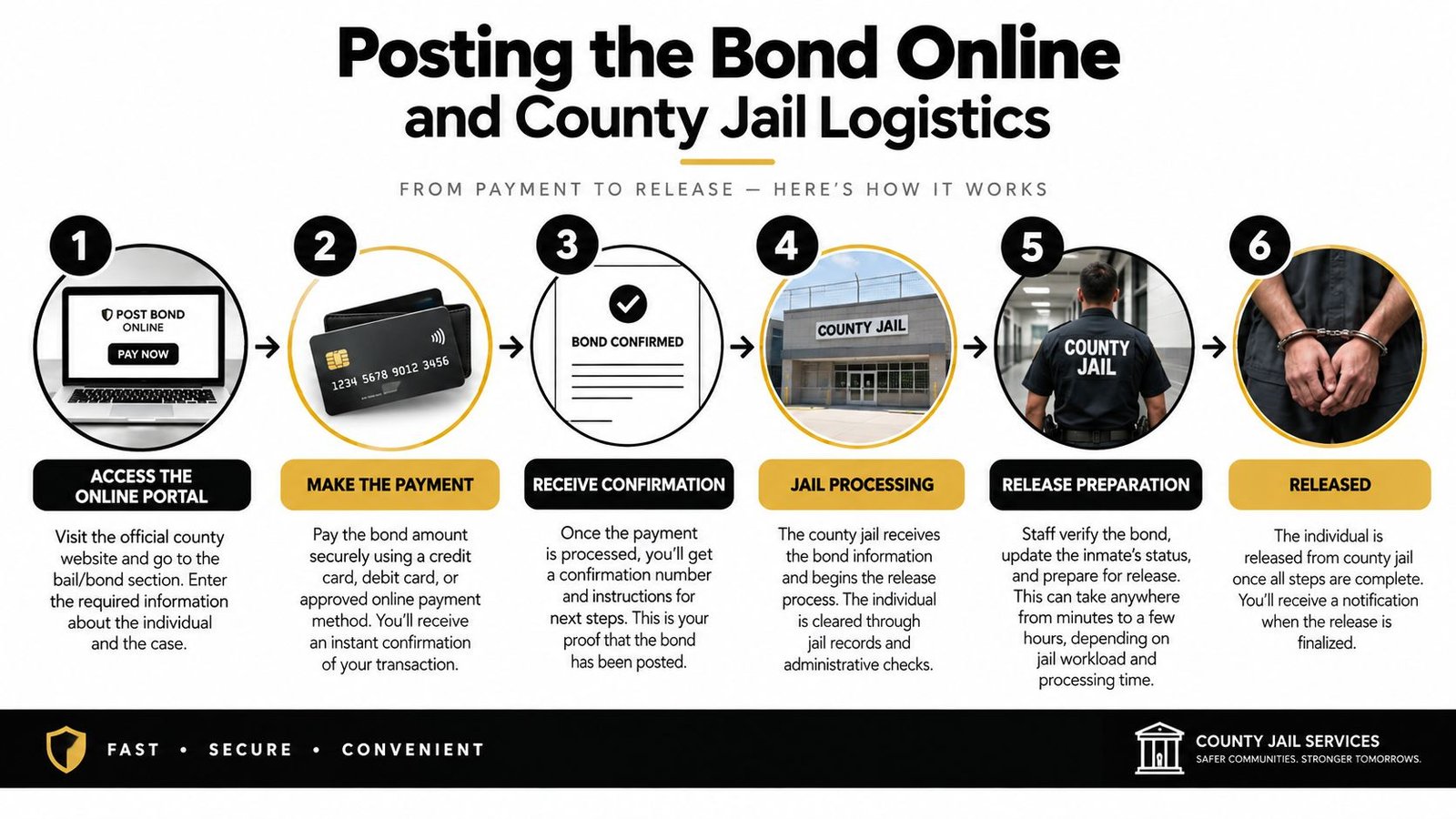
Colorado bail release increasingly involves a phone or laptop rather than a trip to the detention center. A cosigner may submit an application, upload identification, sign contracts electronically, authorize the bond, and pay through an approved online channel. The agent then files or posts the surety bond with the facility, where jail staff begin their own verification and release work.
Remote processing doesn't mean instant release. The agent can finish the bond documents while the jail still needs to verify the filing, complete internal checks, and prepare the defendant for discharge. County procedures differ, and a bond accepted at one facility may require a different submission route at another.
The release clock starts with the facility's rule
Larimer County states that, for an online bond, the release timeline begins when the defendant, surety, or third-party payer submits payment or electronically files a power of attorney. The county also states that bond-related fees aren't required to secure release on a money bond. Those details appear in Larimer County's notice of legal rights.
That means the relevant starting point isn't necessarily the moment a family member begins an application. It is the point identified by the county's process, after the required submission or electronic filing reaches the proper system. Ask the agent when the bond was transmitted and ask the jail what remains before release.
Pitkin County reports that all surety bonds must be posted through its eBonds online portal effective February 27, 2026, and that its credit-card processor charges a 2.9% fee on the overall bond amount. Confirm the current county procedure before paying, because a processor fee and a bond premium are separate items.
County searches and local instructions
Use the county's official inmate search, sheriff information, or court records tools to verify custody and court information for Denver, Arapahoe, Jefferson, Douglas, Weld, and El Paso. A search result can lag behind a booking update, so call the facility when the online record doesn't answer whether bail is set or what bond types are accepted.
Keep screenshots or confirmation emails for the application, payment, and electronic filing. If the defendant has an out-of-county warrant, another hold, or a release condition that still needs a judge's action, posting the bond may not resolve every custody issue. Remote paperwork saves travel, but it doesn't remove the jail's legal and administrative steps.
Families in the Centennial area can also review Centennial bail bonds information when confirming which process applies to the local facility.
Pitfalls to Avoid and What Happens After Release
The most expensive mistake is choosing a bond method before confirming what the jail accepts. A cash-only bond can't be solved by submitting a surety application, and an online application won't overcome a separate hold or a court condition that hasn't been addressed.
Cosigners create a second risk. Signing without understanding the guarantee can expose a family member to financial consequences if the defendant disappears, misses court, or stops communicating. Ask for the contract in a readable form and don't treat collateral as a formality.
Errors that cause avoidable trouble
- Assuming online means immediate: The agent may complete the submission while the jail still processes the release.
- Losing the court information: Put every date, courtroom, address, and reporting instruction in a shared calendar.
- Ignoring release conditions: A defendant may need to follow no-contact, travel, monitoring, reporting, or other orders.
- Failing to update contact details: Tell the agent and attorney about changes to phone number, address, employment, or transportation.
- Waiting after a problem: If a court date cannot be met or a condition may have been violated, contact defense counsel immediately rather than hoping the issue disappears.
Court attendance is the central obligation. In large urban-county felony cases, the Bureau of Justice Statistics reported an 18% failure-to-appear rate for defendants released on commercial bail bonds, while other reviews place FTA rates at under 10% to 25% to 30%, depending on jurisdiction and offense type. The figures are discussed in this review of bail and failure to appear. They don't predict what one defendant will do, but they establish the practical point: posting bond doesn't eliminate appearance risk.
Release is the start of the responsibility, not the end of the process.
Before the defendant leaves, confirm the next court date in writing and make sure they know every condition. Keep the agent's contact information, the contract, payment records, and the attorney's details together. If the defendant misses a date, contact the attorney and bond agent promptly. Waiting can turn a manageable scheduling problem into a warrant, renewed custody, or a bond forfeiture dispute.
Express Bail Bonds helps families arrange Colorado surety bonds with remote applications, electronic contracts, payment options, and bond posting at participating detention facilities. Call or text 720-984-2245 for help identifying the correct next step, or visit Express Bail Bonds when someone needs clear guidance on how to bail you out of a Colorado jail.