
Pretrial Services Colorado is a state-mandated risk assessment and supervision program, and it shapes the judge's bond decision right after booking. In many cases, the first question isn't “Can this person go home?” so much as “What conditions make release workable?”
A family gets that call, nobody's had sleep, and the detention center phone tree starts eating time. One county may move fast with an assessment, another may lean more heavily on bond paperwork, and that gap can decide whether your loved one sleeps in a cell or at home before first court.
Why Pretrial Services Colorado Matters on Arrest Night
The hardest part of an arrest is that everything feels urgent, but the system still runs on a sequence. Booking comes first, then the court looks at bond, and in between those steps pretrial services can gather information, screen risk, and recommend release conditions that a judge may use. Colorado law gives the chief judge in a judicial district authority to order that evaluation for a bond-eligible person, and the program can advise the court on bond eligibility, release information, and conditions (Colorado pretrial services statute).
For families, that means the call from jail is not just about “posting bond” in the abstract. It's also about timing, because the assessment and the bond hearing are tied together, and the earlier the court gets reliable information, the sooner release can happen. Colorado's statewide reform work also set a formal expectation that each district complete a pretrial release assessment process within 24 hours of admission to a detention facility, which tells you this is treated as an operating deadline, not a loose suggestion (SB20-161).
What that looks like in real life
A parent in another state might be waiting on paperwork while the defendant is still being screened. A spouse might be trying to figure out whether a surety bond, a personal recognizance release, or supervised release conditions are the fastest path. In that moment, pretrial services is the quiet bridge between booking and the first real release decision.
Colorado's system matters because it touches a large share of the local jail population. A 2019 report from the Colorado Commission on Criminal and Juvenile Justice said about 63% of people in local jails are pretrial and estimated pretrial services cost about $5 to $20 per day per person (CCJJ annual report). That's why this process isn't a side issue. It's the core of how quickly someone gets back to work, family, and court preparation.
Practical rule: If the first court date is still ahead, every hour spent waiting for the right release decision can matter more than the charge label alone.
The Role of Pretrial Services in Colorado
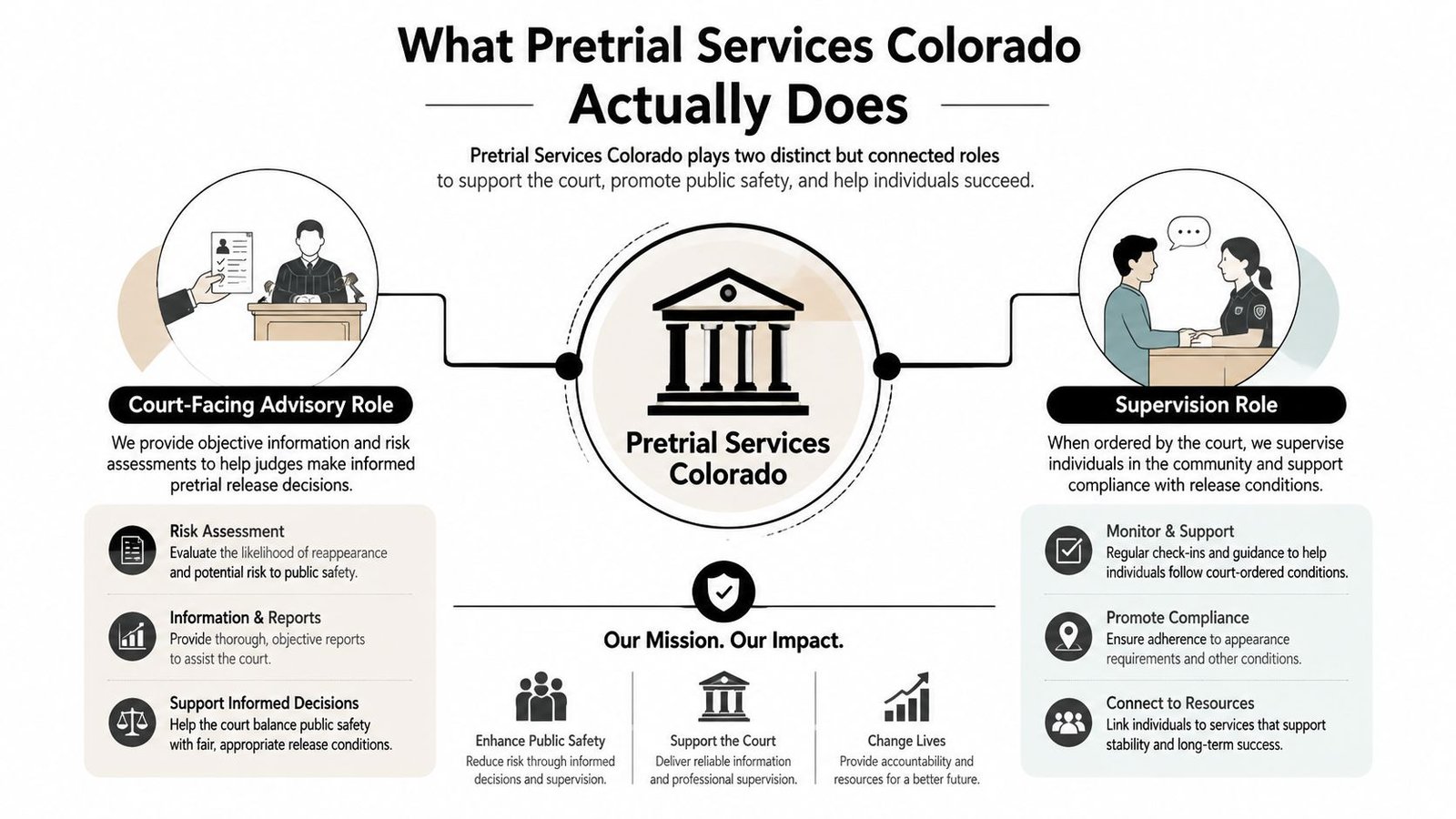
A family gets the call after arrest, and the first question is usually simple, who decides whether the person waits in jail or goes home with conditions. In Colorado, pretrial services helps answer that question in two ways. It gives the court information before release, then it may supervise the person after release if the judge sets conditions.
The court-facing part
Before anyone is released, pretrial services may screen the person and prepare information for the judge. Colorado law allows the program to help the court make a bond decision and to recommend release conditions under the statute (Colorado pretrial services statute). That report does not replace the judge. It gives the judge a clearer picture than a short hearing alone usually provides.
Families often blur pretrial services and bond court together. They are separate. The court uses the information, but the judge still makes the release decision.
The supervision part
If release is granted, pretrial services may keep track of compliance. That can mean check-ins, sobriety expectations, testing, and other court-ordered terms. Colorado law also lets programs use different levels of community-based supervision to reduce unnecessary pretrial detention (Colorado pretrial services statute). In plain terms, the office does not only watch from the sidelines. It helps manage the risk that comes with release.
County practice adds another layer. A person in Denver may see a different supervision setup than someone in Mesa or El Paso County, even though the statewide framework is the same. That is why families need to ask two questions at once, what does the judge want, and what can this county administer.
Colorado also moved counties toward a shared pretrial structure through SB20-161 (SB20-161). That law pushed counties to build pretrial services programs and use an approved risk assessment tool, while still leaving local offices room to run day-to-day supervision differently.
Why the distinction matters
A pretrial interview can lead to a recommendation. A release plan can include conditions. A supervision plan can keep someone in the community while the court stays informed. Those steps are not the same, and families do better when they choose the right one first.
For example, a surety bond may get a person out faster in one county, while supervised release conditions may be the better fit in another case if the judge is worried about contact, testing, or check-ins. If you want a plain explanation of how release works before the first court date, this guide to pretrial release in Colorado is a useful place to start.
Risk Assessment and Eligibility in Practice
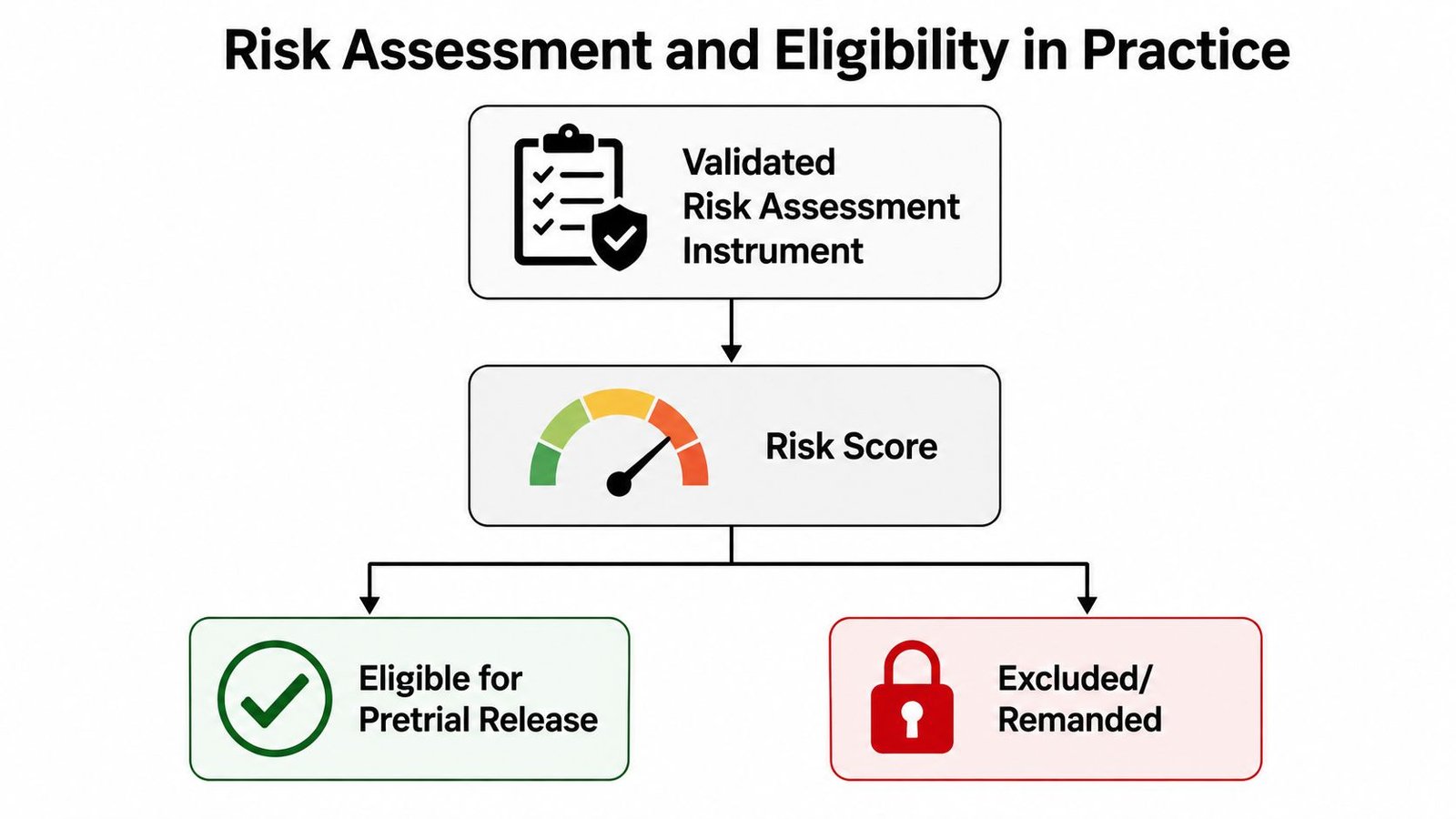
A person gets arrested in Colorado, the jail starts the paperwork, and the next question is whether release can happen before the first court date. That decision usually turns on a validated risk assessment instrument, which helps the court look at two separate risks, missing court and safety in the community. Colorado uses structured tools and charge-based decision rules so the result is more consistent than a snap judgment.
Eligibility isn't the same as release conditions
A defendant can qualify for release and still leave jail with rules attached. That is the part families sometimes miss. The assessment helps the judge decide whether the case fits personal recognizance, supervised release, or a surety bond with added conditions.
Colorado's earlier pretrial release patterns show why speed matters. A Bureau of Justice Statistics description reported that 92% of booked offenders were released prior to trial, over 77% of those released were under bond, and 70% of analyzed cases were released from detention within 24 hours (BJS Colorado pretrial practices). It also reported an average pretrial detention length of 14 hours for those released within the first week, and in an analysis of 967 cases, only 16 defendants were rearrested for felonies before trial.
A plain-language look at how Colorado pretrial risk assessment works helps families see why this step matters so much. The score is not the final answer, but it often shapes the first release recommendation the court sees.
County resources change the experience
The statewide framework does not play out the same way everywhere. The strongest Colorado source on county variation said only 12 of 22 judicial districts had pretrial services at one point, and even where programs existed, consistency and victim information sharing were limited (Colorado Bail Book). That is the part families feel on the ground.
Two people can face similar charges and still get different release conditions because one county has more staff, more screening capacity, or more supervision options than another. Denver, Mesa, and El Paso County can all work from the same statewide framework, yet the release path can look different once the local office gets involved.
So the practical question is not only what the score says. It is also what this county can do with that score, and how quickly it can do it.
Supervised Release Options and Surety Bonds Working Together
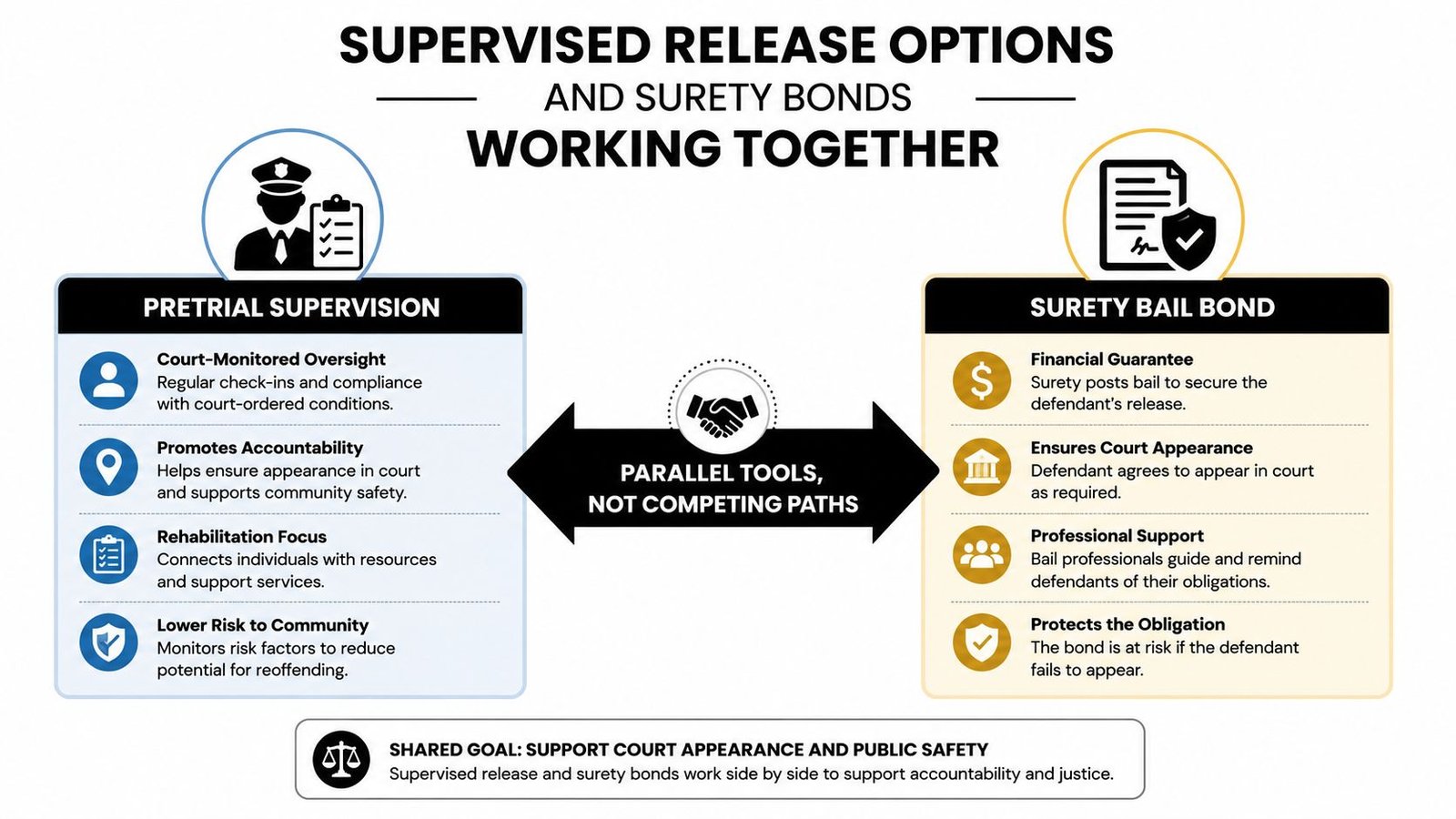
Pretrial supervision and a surety bond are not rivals. They're different tools that can run at the same time, and that's where families get tripped up.
Three release tracks people confuse
A person may be released on personal recognizance, which means the court trusts the person to return without a financial bond. A person may be released with pretrial supervision, which adds reporting, testing, or travel rules. Or a person may be released on a commercial surety bond, where a bondsman posts the bond and the defendant still follows the court's conditions.
The key point is that supervision can sit on top of bond. Colorado law explicitly requires reporting that separates cases released on a commercial surety bond, cash or property bond, and personal recognizance, alongside pretrial supervision (Colorado pretrial services statute). That reporting structure exists because the state treats these as overlapping release mechanisms, not one identical category.
Why families should think in parallel
If the judge wants a bond posted quickly, the family may need to move on the bond first. If the court also wants supervision, pretrial staff may still be involved after release. That means a surety bond can get someone out, while pretrial services handles the day-to-day conditions that come with that release.
A helpful way to think about it is this, the bond opens the door, and supervision sets the rules for what happens after the door opens. If the family waits on the wrong lever first, release can stall.
Read about how a surety bond works in Colorado
How Counties Run Pretrial Services Across Colorado
County practice still matters under a statewide framework. Denver handles volume differently than Jefferson County, and families feel that difference right away.
| County | Program Location | Defining Feature | Contact |
|---|---|---|---|
| Denver | City pretrial services program in the Department of Public Safety | High-volume supervision, with an average daily pretrial supervision population of 2,369 and 8,712 felony cases processed in 2017 (Denver pretrial services) | Denver city pretrial services page |
| Jefferson County | Jefferson County Courthouse, 100 Jefferson County Parkway, Suite 1500, Golden, CO 80419 | Courthouse-based office, Monday through Friday, 7:30 AM to 5:00 PM (Jefferson County pretrial services) | Courthouse office |
| El Paso County | County pretrial and jail-adjacent workflow | Often discussed as a hybrid intake and release environment in local practice | County jail and court channels |
| Arapahoe County | County-supervised release track | Program design has continued to evolve with statewide reform | County court channels |
| Mesa County | County reform example referenced in statewide reform work | The county has been part of reform-era measurement and comparison efforts | County court channels |
What the table means in practice
Denver's scale shows a system built for heavy volume and mixed case types, not just the occasional high-risk file. Jefferson County's posted office hours point to a courthouse-based workflow that families can plan around if they know where to go and when to ask questions. Other counties can feel less centralized, which leaves families doing more legwork to learn whether pretrial services is involved and what office is handling the next step.
County differences also shape the first phone call. A family may need jail information, bond instructions, and court timing at the same time, and the fastest path is often the county detention facility or court line. A county jail phone numbers guide can help people start with the right jail and avoid calling the wrong office.
The practical takeaway
Do not expect every county to use the same release rhythm. Some counties publish fuller pretrial rules and have a clearer public workflow. Others move through a thinner administrative process, so the family has to ask more questions to find out how release, supervision, and court reporting are being handled.
Conditions You Can Expect on Pretrial Supervision
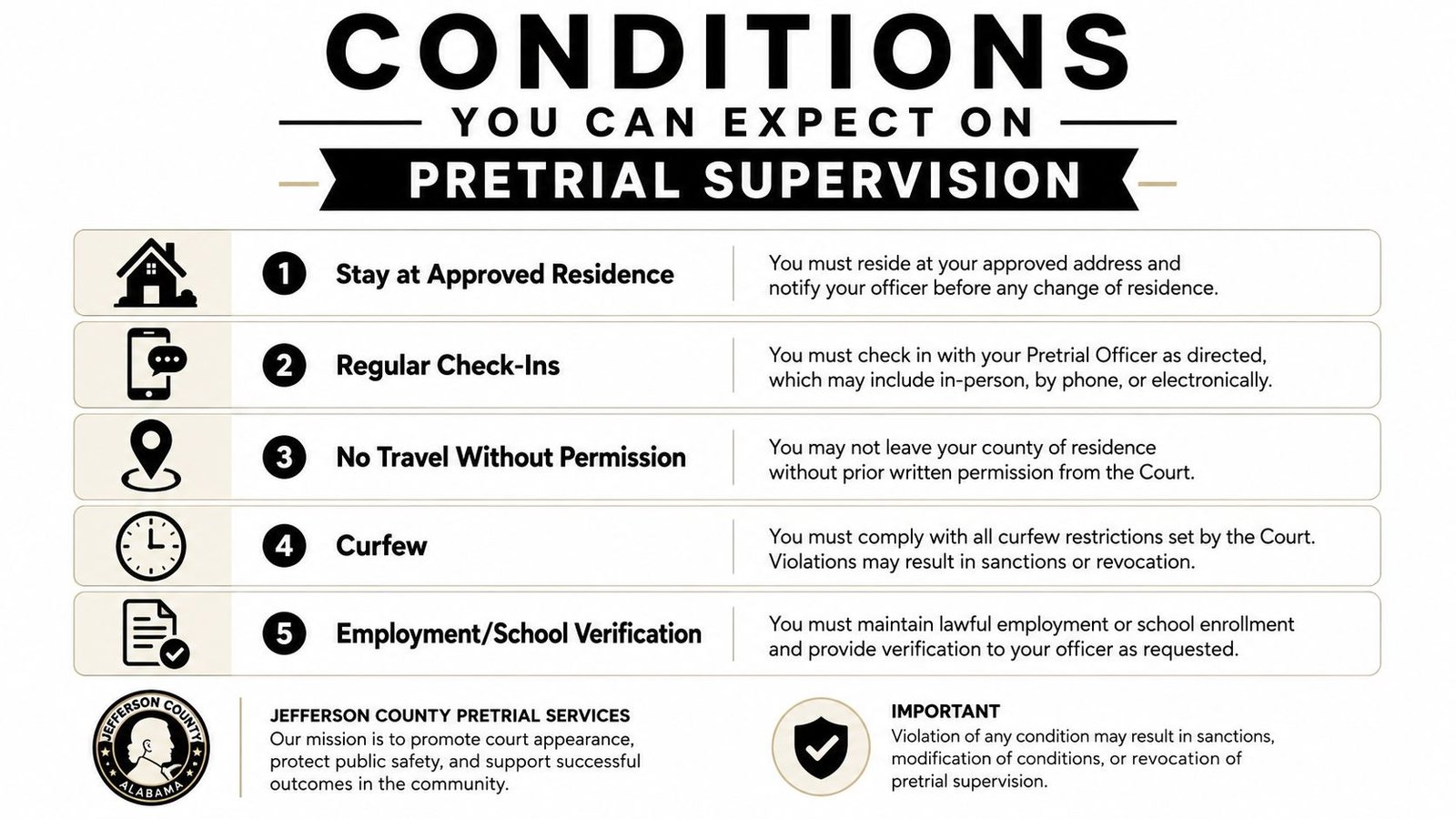
A person released on pretrial supervision usually steps into a short list of rules that shape daily life right away. In Jefferson County, that can mean staying away from drugs and alcohol, asking before leaving Colorado, paying supervision fees if the court orders them, attending every court date, submitting to urinalysis testing, and checking in on schedule. Families can also use a quick review of common bail conditions in Colorado to compare what they are hearing from the court with what often shows up on release paperwork.
The day-to-day reality
Those rules sound straightforward on paper. They become a lot harder once someone is trying to hold a job, get children to school, and make it to court without missing a beat. A missed check-in can turn into a warrant. A failed drug test can lead the judge to revisit release and bond conditions.
That is why defendants should keep a clean paper trail from the start. Save text confirmations, write down appointment times, and keep proof of travel approval if the court allows a trip outside the state. If questions come up later, the person on supervision needs more than a verbal promise that they meant to comply.
The family should also watch for county-specific differences. Some courts are strict about reporting windows and test schedules, while others make the reporting process easier to understand for people who stay organized. A Jefferson County family may hear one set of instructions from pretrial staff, while a different county may handle the same issue through a jail, court clerk, or another local office.
Keep the record tight
If a condition is in writing, treat it like a court order from day one. Families that keep receipts, appointment times, and test results in one place are usually in a better position if there is a dispute.
The same habit helps when legal help is part of the picture. A family trying to line up a bond, court paperwork, and supervision requirements can save time by using the guide to hiring criminal defense support while they organize signatures and documents.
What Families and Defendants Should Do Next
Start with the jail. Confirm where the person is being held, then ask whether a pretrial assessment has already been set or completed. If the county uses pretrial services, the interview and bond recommendation can shape the judge's decision, but the family still needs the bond plan ready in case release can happen faster through surety.
If you have an out-of-state cosigner, get the basics lined up early, identification, contact information, employment details if needed, and a phone that can handle electronic paperwork. Colorado release can move quickly once the judge is ready, and families lose time when they start searching for signatures after the hearing has already been set.
A good outside reference for families coordinating legal help is this guide to hiring criminal defense support, especially when the lawyer, bond agent, and family all need the same paperwork at the same time.
Simple rule: Call the detention facility, line up the bond, and ask about pretrial conditions in the same window of time. Waiting on one piece while ignoring the others usually slows release.
Key Takeaways and Getting Help Today
Pretrial Services Colorado is a court-connected system that uses a 24-hour assessment framework, helps judges decide release conditions, and supervises some defendants after release. It works alongside a surety bond, not instead of one, and county practice still changes how fast those steps happen.
If you need a local starting point, use the county channel that matches where the arrest happened. Jefferson County readers can compare release conditions with courthouse-based supervision, and Centennial families often need a fast electronic bond path that fits around work and travel. For statewide help that matches Colorado's release process, start with Express Bail Bonds and move the paperwork while the court is still making its first decision.
Express Bail Bonds helps Colorado families handle surety bonds with electronic paperwork, payment, and contract documents, which can save time when a defendant is waiting on release conditions. If you need help in Jefferson County, Centennial, or anywhere else in Colorado, visit Express Bail Bonds and get the release process moving now.