
If you find someone in an inmate search, have you confirmed where they are, whether they can leave, or what happens to their court case? Those are different questions, and a single roster entry rarely answers all of them.
Searching for Canon City inmates means separating state prison records, county jail bookings, and court records. A useful result identifies the person and the system holding their record. A reliable decision requires another step: checking what that record confirms, when it was checked, and which office can answer what remains unresolved.
Canon City Facilities and Custody Levels at a Glance
| Facility | Custody level | Notes |
|---|---|---|
| Arrowhead Correctional Center | Level II, minimum-restricted | State correctional institution, not a county booking facility |
| Four Mile Correctional Center | Level II, minimum-restricted | Minimum-restricted placement within the Cañon City cluster |
| Fremont Correctional Facility | Level III, mixed custody, minimum to close | Opened 1958; switchboard 719-269-5002 |
| Colorado Territorial Correctional Facility | Level III, medium custody | Oldest CDOC prison; opened 1871; about 150 acres |
| Colorado State Penitentiary | Close custody and administrative management | Serves close-custody and administrative-management populations |
| Centennial Correctional Facility | Maximum-security operations | Includes specialized treatment beds |
The Canon City-area CDOC facilities by custody level table separates the institutions and custody functions identified in the Colorado Department of Corrections facility directory. Read it as a map of which doors exist. Which door a person is behind, and under what status, is a question the directory alone cannot answer.
For the details in the table, CDOC's Fremont Correctional Facility page records its 1958 opening and switchboard at 719-269-5002. The Colorado Territorial Correctional Facility page identifies that institution as CDOC's oldest prison, opened in 1871, occupying approximately 150 acres within a 20-acre secure perimeter staffed by six towers.
Why the city name isn't enough
Cañon City isn't one inmate-holding institution. A Level II minimum-restricted placement and a close-custody assignment describe very different situations, and neither one answers the questions families usually ask first: whether a court case is still pending, whether bond applies, or when release could happen. Custody level says how CDOC manages a person. It says nothing about where that person's case stands.
Placement can also change. Transfers, medical needs, and reclassification all move people between these facilities, so a record showing someone at one address is a snapshot of the day it was pulled, not a permanent location.
Fremont Correctional Facility and Fremont County's detention facility are different institutions. The similar names make them easy to confuse, particularly when a relative remembers only that someone is in Fremont. For local jail and bond context, the Fremont County and Canon City resource can help separate the county route from the state prison route. It doesn't replace confirmation from the institution holding the person.
Prepare an identity sheet
Gather the person's full legal name, date of birth, and CDOC identification number, if known. Add the last known institution, custody classification, and any transfer information. Each field does different work: name and date of birth establish identity, while classification and transfer history describe status. Mixing the two is how a lookalike record sends a family to the wrong office.
Mark missing fields unknown rather than filling them from a similar-looking record. When an attorney or family needs help organizing records or preparing administrative paperwork, Hire Paralegals offers that kind of support, separate from official custody verification.
How to Locate a Person Step by Step
The phone numbers and mailing addresses used below appear in the contact section. Check each against the county's or CDOC's own listing on the day you use it, especially the county roster address and detention number, which haven't been independently confirmed here against an official county source.
Use this visual as an identity-and-location checklist before contacting staff.
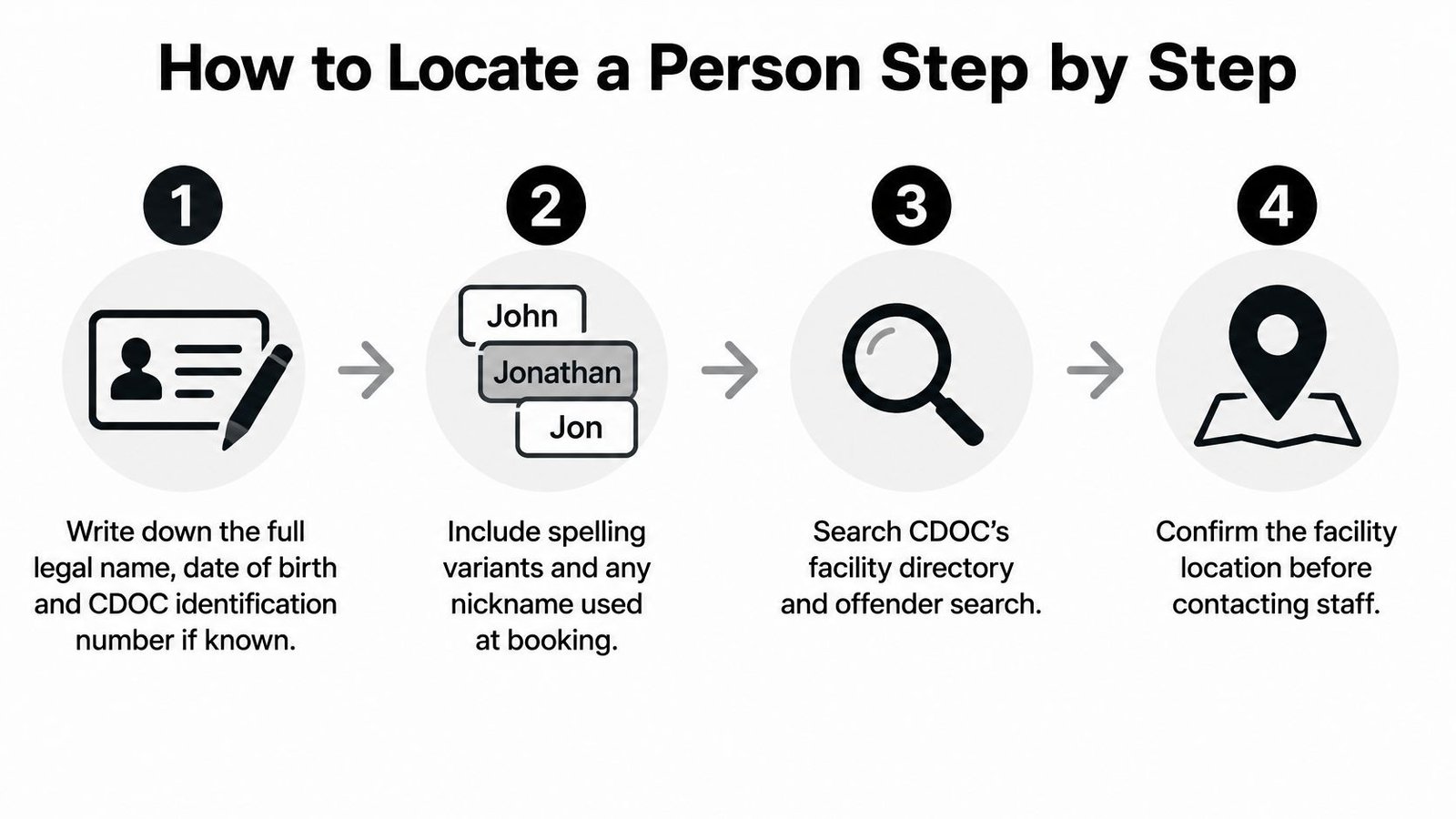
Search in a deliberate order
Write down the identifying details. Start with the full legal name, date of birth, and CDOC identification number if available. Include spelling variants and any nickname used at booking, but don't make a nickname your only search. The reason is simple: a familiar family name may not match the name entered into an agency's system.
Check CDOC's directory and offender records. Use the directory to identify the institution and the offender search to look for the person. These serve different purposes: a facility page describes a prison, while an individual record concerns a person. The common mistake is treating a list of Cañon City prisons as proof of someone's current location.
Check the county custody system when a jail booking is possible. Search the Fremont County roster by name or booking number. Don't assume a state search covers every recent arrest. Our inmate locator resource can help you organize the search route, but confirm the result with the responsible agency.
Call when the county result is missing or ambiguous. Use the detention contact below after verifying it against the county listing. Ask whether the person is booked, the booking date, and whether a release date is listed. Explain which identifiers you have rather than asking staff to identify someone from a common surname alone.
Contact the named state prison if CDOC identifies one. Use that institution's switchboard or approved mailing contact. Ask whether it remains the right office for the person and whether a transfer affects your next step. Don't send property or make travel plans solely because an older document names that prison.
Verify the court side separately. Identify the court handling the charges and check its case record for hearings, conditions, and case status. If entries conflict, ask the clerk how to obtain the controlling order. The court's own case lookup and orders, not the roster, control dates and conditions.
Keep a search log
For every check, record the facility, custody status, date checked, and source. Add the booking or CDOC number associated with the result, so another relative doesn't accidentally follow a different person's record.
The embedded video is an additional viewing resource, not a substitute for agency confirmation.
Reading Search Results Without Being Misled
An empty roster doesn't establish that no arrest occurred or that no case exists. It establishes only that your search didn't return a matching record in that system at that time.
The Fremont County jail information guide describes custody searches separately from continuing court records. Treat it as public search guidance, and verify its county contact information against the county's official listing before relying on it.
What a search result means and what to check next
| Result | What it means | Next check |
|---|---|---|
| No record found | Name absent from that system on that date | Try spelling variants, then call the facility |
| Name match, different date of birth | Probably a different person | Compare date of birth and ID number before acting |
| Projected release date | An estimate that can change | Confirm with the facility before travelling |
| Charges listed at booking | Intake charges, not a court outcome | Check the court record for later filings |
A person may not appear immediately after arrest because booking and publication take time. A search can also fail because you're using the wrong spelling, jurisdiction, or custody system. None of those possibilities should be converted into a conclusion without checking.
A matching name presents the opposite problem. It looks reassuring, but a shared name isn't enough to establish identity. If the birth date differs, stop and resolve that difference before sharing the record, paying money, or arranging transportation.
Practical rule: A roster is a dated snapshot, not a final answer about someone's legal situation.
Separate intake information from court decisions
Booking charges describe what was recorded during intake. They aren't a conviction, and later court filings may differ. Use the court docket and orders to understand what the court is currently considering.
Likewise, a projected release date shouldn't become an unconfirmed pickup appointment. Ask the facility whether the entry remains current and what event the date represents. A release from one custody record may require more explanation before you know where the person is.
The same identity discipline applies outside jail searches. VolunteerBadge's guide to reviewing flagged volunteer screening results is a separate resource for understanding screening records, not authority on Colorado custody or bond eligibility.
Before acting on a result, obtain a second source appropriate to the question. Facility staff can clarify custody; the court can clarify hearings and conditions. Record the date of each check, and preserve the distinction between what the screen displayed and what an office confirmed.
Contacting the Right Office in Canon City
Canon City operates two separate custody systems, and confusing them sends callers in circles. Fremont Correctional Facility is a state prison run by the Colorado Department of Corrections. The Fremont County Detention Facility is the county jail. Each works like a different landlord: an office can only answer for the people under its own roof, so the first task is matching your question to the system that holds the person.
For someone housed at the state prison, the Fremont Correctional Facility page lists a mailing contact of P.O. Box 999, Cañon City, Colorado 81215-0999 and a switchboard at 719-269-5002. Use those contacts for residents of that prison only, not as a general number for everyone held in the county.
Contact points by question
| Office | Contact | Use it for |
|---|---|---|
| Fremont Correctional Facility | P.O. Box 999, Cañon City, CO 81215-0999; 719-269-5002 | Mail and inmate questions for that prison |
| Fremont County Detention Facility | 100 Justice Center Road, Canon City; 719-276-5555 | Roster gaps, jail bookings, and ambiguous results |
| Colorado Department of Corrections | CDOC's official website and facility directory | Facility identification, custody classification, and statistics |
| Court handling the case | Clerk's office identified on the case paperwork or court's official website | Court dates, bond conditions, and case status |
Match the question to the office
A prison switchboard routes questions about that institution only. A county detention office answers booking and roster questions for the jail. The court clerk can pull case records and orders, though staff generally will not interpret what an order means for your situation.
Start the call with the person's legal name and any identification number you have, then keep questions narrow:
- Current placement: Is this institution currently responsible for the person?
- Classification: What custody classification can staff confirm?
- Transfer status: Has a transfer occurred, and if so, which institution should answer the inquiry now?
- Mail and property: What procedure is in effect before you send anything?
Keep these questions separate from release planning. Confirm where the record sits first, then identify the office responsible for the next decision. When a booking location changes between counties, a reference such as this county jail phone number resource can help organize the right contacts.
Write down the staff member's name, date, time, and answer for every call. Phone answers have limits, so pair them with official written information when it exists. If two offices give conflicting answers, ask which office or document can resolve the discrepancy instead of choosing the answer you prefer.
Custody Status, Release and Court Obligations
Finding the person is a location task. Planning release requires understanding the status attached to that record and the conditions imposed by the court.
VINE/VINELink is a free custody-status and release-alert service. Treat an automated alert as a reason to verify what changed, not as proof that someone has physically left a facility or completed every legal obligation.
Custody status terms and what each one confirms
| Status | What it confirms | What it does not confirm |
|---|---|---|
| Located | Person appears in a custody system | Release, bond, or case outcome |
| Bond posted | A bond was accepted | Physical release or resolved charges |
| Released | Custody record shows release | Court obligations are complete |
| Transferred | Moved to another facility | Release timing or case status |
| Court case pending | Case is still open | Current custody location |
Administrative records aren't always synchronized. Colorado correctional reporting warns that fiscal-year figures can be preliminary and change when agencies receive later release information. That warning concerns reporting figures, but it reinforces a practical habit: reconfirm time-sensitive information before acting.
Bond availability must be checked against the booking record and court requirements. A cash-only restriction or another condition can affect the available route. A licensed surety bond is an option only when the person's booking permits it, and posting bond doesn't end the criminal case.
Turn an alert into a verified plan
Before arranging travel or committing money:
- Confirm custody: Ask the facility what the status means for this person.
- Record timing: Note the release time given, and whether staff describe it as confirmed or anticipated.
- Check conditions: Obtain the applicable court requirements and next hearing information.
- Prepare identification: Confirm what identification a cosigner may need.
Our jail release guide offers additional process context. For a case outside Colorado, use that jurisdiction's rules instead. The Law Office of Bryan Fagan's explanation of your rights during an NC arraignment concerns North Carolina and shouldn't be applied as Colorado procedure.
Suppose a cousin in another state finds a CDOC record marked Released and assumes the case is closed. The custody entry confirms a change in that record only. In this example, the court docket still shows a pending case, a hearing, and bond conditions.
The checklist separates those facts before anyone travels or pays. One office answers whether the person remains in its custody; the court record answers what obligations continue.
Visitation, Mail and Video Visit Requirements
Being a relative doesn't automatically make someone an approved visitor. Under the Colorado DOC visiting application requirements, visitors must apply, provide qualifying identification, and maintain approved status; approved visitors receive an automatic background check every year, and those who haven't visited for one year are removed and must reapply.
Prepare the application and identification together so mismatched details don't delay review.
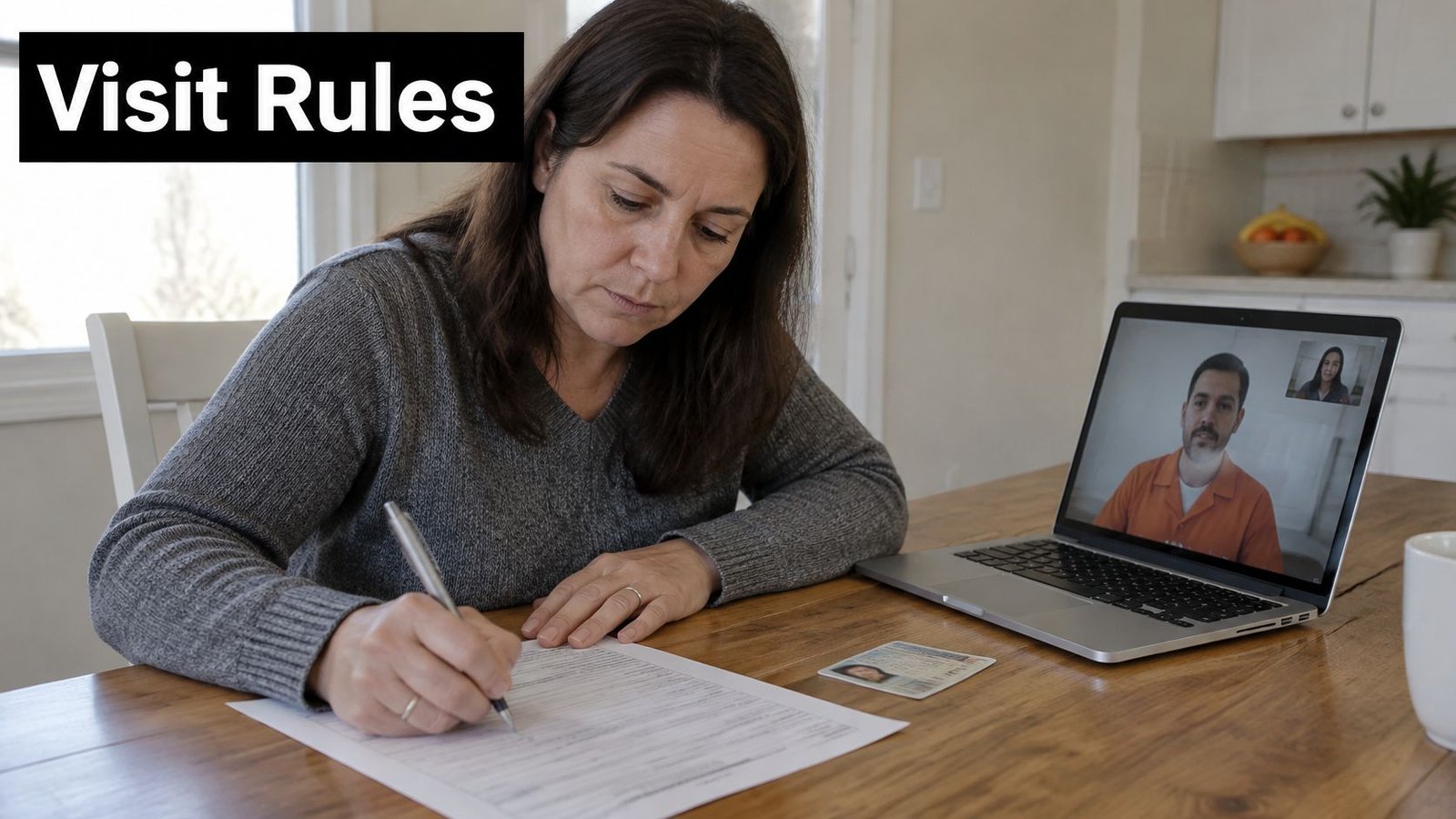
Visitor approval checklist
- Complete the application: Submit the required visitor application rather than assuming a family relationship provides access.
- Check your identification: Provide a valid, unexpired government-issued photo ID whose address matches the application. A mismatch may lead to denial.
- Keep approval current: Calendar an annual status check and keep your identification current. Don't assume an older approval remains usable.
- Watch for inactivity: If you haven't visited, confirm whether you remain on the visiting list before booking travel.
- Approve every video participant: Everyone appearing in a video visit must have approved-visitor status, not just the account holder.
A video call isn't an exception to visitor screening. Don't allow an unapproved friend or relative to join the screen on the assumption that a brief appearance won't matter.
Confirm mail procedures before posting anything
Ask the facility for its current CDOC mail procedure before addressing an envelope. Confirm which identifying details must appear, which enclosures are allowed, and whether the listed institutional mailing address is the correct destination for that type of correspondence.
The visitation application page doesn't establish those mail rules. Don't use it as authority for envelope formatting, photographs, packages, or property, and don't copy another institution's requirements.
If you're unsure, call the switchboard in the contact section and request the current written procedure. Our jail rules resource provides general orientation, but the receiving facility's current instructions govern what you send.
Approval to visit isn't permission to send any item you choose.
Colorado DOC sets its visitation requirements, and procedures can change. Check the applicable facility instructions before each new arrangement.
Searching Other Colorado Counties Instead
A Canon City search won't establish whether someone was booked in Denver, Jefferson County, or Arapahoe County. A missing result should prompt a jurisdiction check, not an increasingly broad search for people with similar names.
The right route follows the booking location, while the court record follows the case. Those locations may not be identical.
Compare the local routes
| Search route | When to use it | Local resource |
|---|---|---|
| Golden and Jefferson County | Paperwork identifies a Jefferson County booking | Jefferson County and Golden information |
| Centennial and Arapahoe County | Paperwork identifies an Arapahoe County booking | Centennial and Arapahoe County information |
We serve jails in Jefferson County, Arapahoe County, Denver, and throughout Colorado. That coverage doesn't establish where a particular person is held; the booking location still needs confirmation.
Use a jurisdiction test
Ask these questions before choosing a county roster:
- Arresting agency: What agency is named on the arrest paperwork?
- Court caption: Which court appears on the charging documents?
- Booking location: What facility is printed on the arrest notice or release paperwork?
If those answers point to different places, contact the agency to confirm the booking location. Don't assume the arresting agency's city is also the place of detention.
When someone moves from a county jail into CDOC custody, the office answering placement, mail, and visitation questions changes. That movement doesn't by itself tell you whether a court matter has concluded. Search the appropriate custody system for location and the relevant court record for the case.
Once you've identified the correct jurisdiction, repeat the roster-and-contact process using that county's official resources. Carry forward the person's identifiers, but replace the old facility details rather than treating them as current.
Confirm Your Next Step Before You Act
Before making a payment or arranging a pickup, identify the next fact you need. You may need confirmation of the institution, an explanation of a release entry, or the court's current bond conditions. Those questions require different records.
Use this order:
- Establish location and status through CDOC or the appropriate county custody system.
- Verify the entry with the facility, especially if you're planning travel or relying on a recent change.
- Confirm court conditions before deciding whether a bond transaction is appropriate.
A verified location is the starting point for a decision, not permission to skip the remaining checks.
Bring the record, not an assumption
Have the person's full legal name, date of birth, facility, and booking number ready. If a field is unknown, say so. A partial but accurate identity sheet is more useful than a complete sheet containing guesses.
We are a fully licensed Colorado bail bonds agency, licensed by the Colorado Division of Insurance. We offer online application, payment, and contract documents, with bond posting at most Colorado detention facilities. Electronic processing can help relatives coordinate from another state without travelling to Colorado.
Bond eligibility for each booking depends on the court and the booking record. We'll confirm whether the person can be bonded and whether we serve the booking facility before discussing fees or paperwork. No agency can turn a roster result into a guarantee of eligibility or a completed court case.
Keep the custody confirmation and court information together when you contact us. That lets the conversation focus on the actual booking rather than a search result that may concern another institution or an earlier status.
Express Bail Bonds offers a free consultation to help you understand the bond questions attached to a confirmed Colorado booking. Call or text 720-984-2245, or visit Express Bail Bonds, with the person's full name, date of birth, facility, and booking number ready.