It's late, and you're a sister in Phoenix whose brother was just booked in Denver. You're holding your phone, switching between five jail websites, and trying to work out whether paying someone now will really get him released. Before you send money or upload identification, you need to know which part of the bond application process can move forward and which part still rests with the jail or court.
Bond Application Process at a Glance
Bond application is a gated workflow, not just a payment. The agent needs a verified defendant, an eligible bond order, complete signatures, and an authorized place to deliver the executed bond. Paying before those pieces line up doesn't remove the missing requirement.
Aurora and Denver both require completed booking and fingerprint clearance before posting. A fast application still doesn't guarantee release: the court's order, separate holds, and the defendant's continuing court obligations remain decisive. The Bureau of Justice Statistics overview of pretrial release also distinguishes financial bail from recognizance and other release conditions.
Application stages and where each one stalls
| Stage | What usually stalls it | Quick check |
|---|---|---|
| Booking and fingerprint clearance | Name spelled differently in the jail system | Search the roster by full legal name and date of birth |
| Bond type and amount | Court order unclear or missing | Pull the court paperwork before starting |
| Identity and case selection | Second case or hold blocks release | Ask the jail and court about other holds |
| Cosigner details | Missing employer or residence information | Have documents ready before opening the form |
| Premium payment | Wrong payee or declined card | Confirm the payee and method before paying |
| Return hearing date | Date never written down | Save the next court date and location |
Ask a precise question when you call: What is the next unresolved requirement? That gets you further than repeatedly asking how soon someone will get out.
Practical rule: Keep application approval, bond posting, and release confirmation separate. They're different milestones.
Express Bail Bonds offers a fully electronic option for applications, payments, and contracts, with call or text assistance available 24/7 at 720-984-2245. This is procedural guidance, not legal advice; questions about changing a court order belong with defense counsel.
Choose Your Bond Path Before You Apply
Bond paths compared
| Bond path | What it requires | Who it fits | Watch for |
|---|---|---|---|
| Surety bond through an agency | Premium of 15%, or 10% with an approved cosigner on bonds over $5,000, plus a signed agreement | Families without the full amount in cash | Premium is nonrefundable; no cash-only bonds |
| Cash bond | Full bond amount paid to the court or county | Families who can pay the full amount | Confirm refund terms before paying |
| Property bond | Unencumbered equity of 1.5 times the bond amount, documents, and prior court approval | Owners with sufficient equity | Lien released only after bond release |
| Personal recognizance | Court order with no money required | Defendants the judge trusts to appear | Release must be stated in the order; no premium |
The surety pricing shown is the agency's stated offering, not an automatic entitlement to a reduced rate. Confirm the written quote before signing.
For property bonds, Colorado Judicial Branch guidance requires unencumbered equity equal to 1.5 times the bond amount, so a $20,000 bond requires $30,000 in equity. Gather valid identification, Colorado property records, current mortgage information, and recording payments; after bond release, the owner takes the Release of Deed of Trust to the county Public Trustee to request lien removal.

Let the order determine the route
If the order authorizes surety, start the application. If it requires cash or property, confirm those terms first rather than assuming an agency can substitute its bond.
The Colorado judicial bond schedule order requires prior written approval for property bonds and a bond appearance within two weeks, preferably at the next first-appearance docket, for people released under that schedule. Don't assume a schedule replaces the defendant's actual order.
For a plain-language terminology comparison, Fiscella Law explains bail versus bond. If paying the premium immediately isn't possible, ask about premium financing and get the repayment terms in writing; if no workable option exists, contact defense counsel or pretrial services about court-authorized alternatives.
Documents to Gather Before You Apply
Gather records by person, not by whichever relative happens to have a screenshot. The applicant, defendant, and cosigner may be different people, and mixing their addresses or phone numbers creates avoidable review questions.
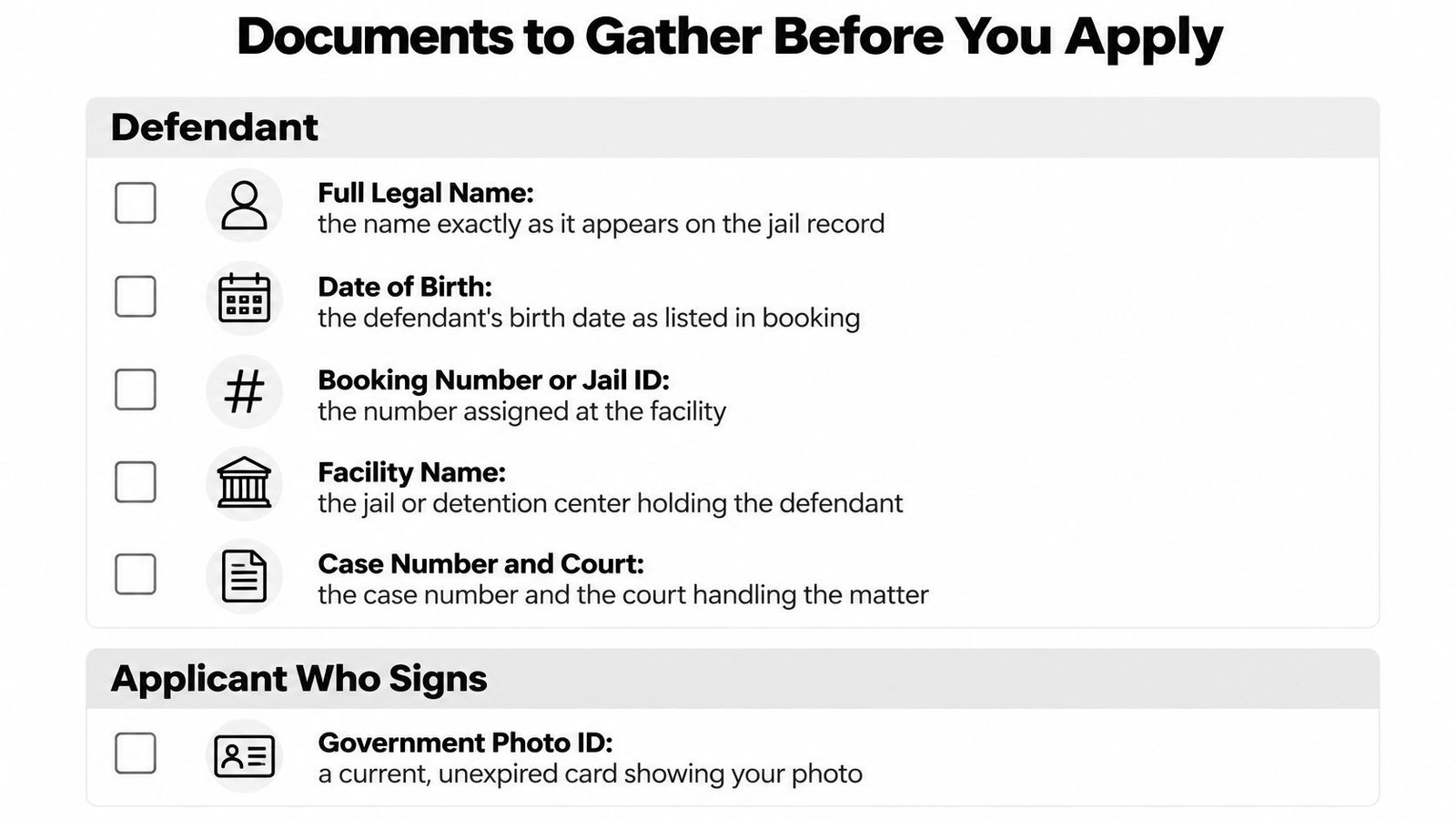
Defendant and signing applicant
- Defendant identity: Full legal name and date of birth exactly as recorded by the jail. Flag a spelling discrepancy rather than using a different version without comment.
- Booking details: Booking number or jail ID and the name of the facility currently holding the defendant.
- Case information: Case number and court handling the matter. Keep separate case records separate.
- Applicant identification: Current government photo ID, with every edge visible and the text readable.
- Applicant contact details: Working phone number, email, home address, and years at that address.
- Applicant employment: Employer name and job title, with contact details ready if requested.
Cosigner, remote relative, and shared records
- Cosigner records: Photo ID, residence and employer details, and identity information requested for the agency's background review.
- Payment information: A payment card or bank information for the premium, supplied only through the verified payment process.
- Out-of-state preparation: A fully legible ID scan, proof of address, and a phone or computer capable of completing an electronic signature.
- Court order: A readable copy showing bond type, amount, and release conditions.
Agencies may request additional documents after reviewing the application. An employment gap, an address mismatch, or an unclear ID image needs an explanation, not a guessed answer entered to make the form submit.
The agency's document preparation checklist can help you organize the file. Property bonds require their own property and mortgage documentation rather than just this surety-application packet.
Have the defendant's booking details and court order open before you start typing. Don't rely on information passed through several relatives.
Keep identity documents in a private folder while gathering them. Use the secure-transmission checks below before sending them anywhere.
How to Submit the Application Step by Step
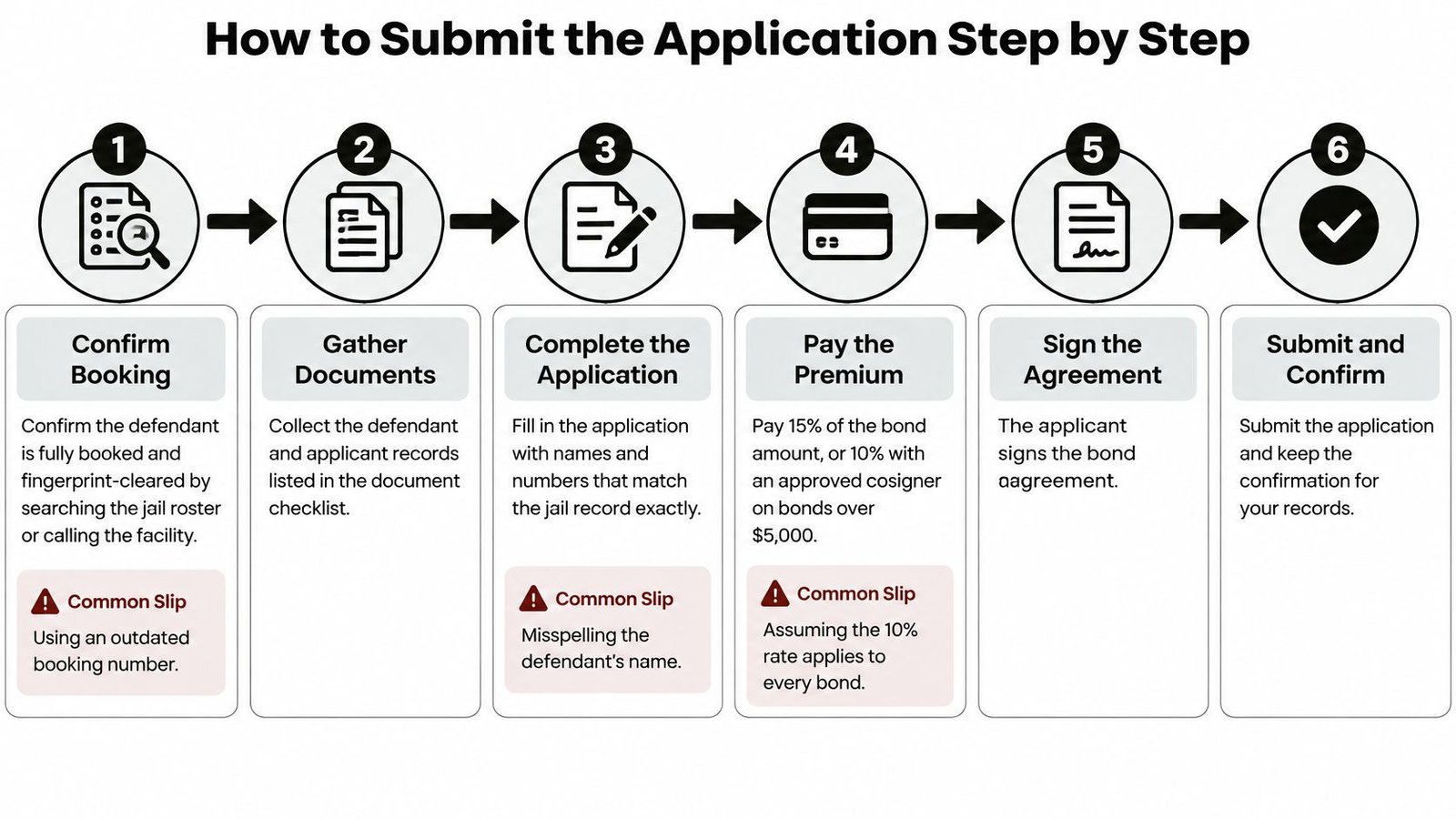
Follow the sequence rather than trying to solve everything through the payment screen. Aurora's official bond procedure requires completed booking and fingerprint clearance, selection of the defendant and case, and attention to additional cases or holds that may prevent release.
Verify the record before completing the contract
Confirm booking status. Search the jail roster or call the holding facility to confirm that booking and fingerprint clearance are complete. Calling immediately after arrest may produce no usable booking record yet; that isn't a problem an application fee can fix.
Read the bond order. Get the amount, bond type, and conditions from court paperwork rather than a verbal estimate passed between relatives. A correct amount attached to the wrong bond type still sends you down the wrong path.
Ask about every hold and case. Ask the jail and court whether another warrant, hold, or case could prevent release. Don't assume that resolving the charge you know about resolves the defendant's entire custody status.
Open the online application and select the case. Start through the agency homepage and match the defendant's identifying details to the case number. Selecting the person without selecting the matching case can leave an otherwise complete application unusable.
Enter applicant and cosigner information separately. Supply accurate residence, employment, and contact details for each person whose information is requested. Don't copy the defendant's address into every field merely because the family shares a mailing address.
Sign, pay, and confirm delivery
Review the agreement and obtain every required signature. Use the online contract-signing process after reading the financial responsibilities and asking about unclear terms. A signature from the applicant doesn't replace a required cosigner's signature.
Pay the quoted premium and keep the receipt. Confirm the authorized payment method and payee before submitting payment. A declined card or incomplete transfer means you need payment confirmation, not another application.
Confirm transmission of the executed bond. Ask whether the completed bond has been sent to the authorized facility or court. An application-submission email alone doesn't establish that posting has occurred.
Record the return hearing. Save the date, time, location, and any appearance instructions in a shared calendar. Don't rely on a relative remembering what an agent said during a stressful call.
For example, suppose an Aurora family submits its paperwork late in the evening but notices the case-selection field is blank. Checking that field before treating the submission as finished allows the agent to match the documents to the correct case instead of stopping for clarification.
For Jefferson County matters, use the Golden jail and court resource page to locate relevant local information. Confirm the holding facility rather than choosing a county page solely from the defendant's home address.
Premium, Fees and Payment Options Explained
Two families can apply on the same $7,500 bond and pay different amounts, because the reduced cosigner rate depends on the bond amount and an approval, not on asking for it. Read the table before any money moves.
Premium by bond amount with and without a cosigner
| Bond amount | Standard premium (15%) | Premium with approved cosigner (10%) | Difference |
|---|---|---|---|
| $1,000 | $150 | $150, reduced rate not applicable | $0 |
| $5,000 | $750 | $750, reduced rate not applicable | $0 |
| $7,500 | $1,125 | $750 | $375 |
| $10,000 | $1,500 | $1,000 | $500 |
| $20,000 | $3,000 | $2,000 | $1,000 |
| $50,000 | $7,500 | $5,000 | $2,500 |
The agency states a standard premium of 15% of the bond amount, with a reduced 10% rate available above a threshold once a cosigner is approved; confirm current terms through its surety bond rates information. The $5,000 row stays at the standard rate because the reduced cosigner rate applies only above that threshold, and approval isn't guaranteed.
Separate the premium from the financial exposure
The premium pays for the surety service. It isn't refundable court-held cash, so a favorable outcome doesn't produce a refund, and the quoted premium isn't necessarily the limit of the cosigner's contractual exposure.
Applications stall here in a predictable way: a family sends the premium while a booking hold or an unclear court order is still unresolved, then expects release to follow payment. Payment clears the financial step only. Ask for an itemized explanation of any charge added on top of the quoted premium before paying it, and don't treat an unexplained administrative charge as part of the premium.
Keep agency payments and county money bonds distinct
Electronic agency payment belongs to the surety application. A direct money-bond payment to a county follows that county's authorized process, and the agency doesn't post cash-only bonds. Sending money to the wrong payee is one of the slower mistakes to unwind, because an agency cannot redirect a county payment and a county cannot apply an agency receipt to a money bond.
Under Denver's legal-rights guidance for posting bond, a $10 bond fee and a credit-card processing fee of up to 3.5% may be treated as debt after release if the payor elects not to pay them at bonding. Denver prohibits other bond-related fees, including kiosk fees and cash, check, or money-order surcharges, and directs payments to the holding county rather than the defendant. Paying those charges at bonding closes them out; deferring them carries the debt past release.
Before paying, ask:
- Premium: What is the final quoted premium?
- Added charges: What does each additional charge cover?
- Refund rule: Which payments are nonrefundable?
- Payee: Who receives this payment, and through which verified channel?
Cosigner Requirements and Remote Verification
A cosigner signs the bond agreement and shares contractual responsibility for the defendant returning to court. It's not merely permission to use a credit card, and it shouldn't be treated as a character reference without financial consequences.
If the defendant misses court, forfeiture and a new arrest warrant can follow. A surety may also have to respond in a show-cause proceeding; ask the agent to explain what the agreement requires from you if that happens.

Approval is a review, not just a signature
Identify the proposed cosigner, provide the requested identity, residence, and employment information, and wait for agency approval before assuming the quote is final. The approved cosigner then signs electronically; reduced pricing requires both the applicable bond amount and approval.
For relatives elsewhere, the agency's out-of-state cosigner guidance helps clarify remote processing. Release can still carry court-imposed conditions, as reflected in the federal judiciary's pretrial-services reporting, although federal procedures don't determine a Colorado state case.
Protect yourself with an independent verification routine:
- Verify contacts: Call the jail and court using numbers from their official websites, not an unsolicited text or advertisement.
- Verify the order: Ask for written confirmation of the bond type and amount.
- Verify costs: Obtain every fee and refund rule in writing.
- Protect identification: Use a verified secure upload rather than plain email.
- Keep records: Save every signed agreement and payment receipt.
- Confirm remaining conditions: Ask what the defendant must do after posting.
Suppose a sister in Texas receives a text from someone claiming to be a bondsman and demanding a wire transfer. Calling the jail independently can expose an incorrect custody claim or bond amount before she sends money; she should separately verify the agency and payment instructions, too.
Verification protects the cosigner. A legitimate transaction should withstand an independent callback.
Electronic signatures and online payment can shorten paperwork handling. They can't control jail intake, separate holds, or medical clearance.
Timelines for Jail Release and How to Speed It Up
Release timing by situation
| Situation | Typical wait | What drives it |
|---|---|---|
| Booking not finished | Cannot post yet | Fingerprint clearance and full booking |
| Bond signed and transmitted | Generally released within about two hours | Facility release process, under Denver guidance |
| Hold, warrant or second case on file | No reliable estimate until the barrier is resolved | Hold must be cleared before release |
| Overnight or weekend booking | No fixed estimate | Jail intake and court availability |
| Missed court date | Forfeiture and a new warrant may follow | Failure to appear |
| Case reaches final disposition | Bond released when court requirements are satisfied | Premium not refunded |
The Denver Sheriff Department's court-services guidance describes release generally occurring within a two-hour window after all required parties sign the bond. That isn't a statewide guarantee, and the clock doesn't start with your first phone call.
Make the next contact useful
The frustrating gap is often between what a family believes is complete and what the facility has in fact received. Ask for the status of the specific missing action rather than another broad release estimate.
- Call prepared: Give the full legal name and booking number.
- Stay reachable: Keep your phone charged and answer expected jail or agent callbacks.
- Plan pickup: Confirm the facility's release location before driving.
- Set reminders: Put the return hearing in a calendar with alerts.
- Keep the cosigner available: Make sure required follow-up questions won't sit unanswered.
- Record confirmation: Ask when release was confirmed and who provided that update.
The agency's bail-processing timeline guide provides additional planning context. For Arapahoe County matters, consult the Centennial bail-bond resource page and verify the actual detention facility.
Express Bail Bonds offers electronic applications, payments, and contract signing, with agents available to help identify what's still needed before posting. Call or text 720-984-2245 at any hour, request the team's verified email contact if you prefer email, or visit Express Bail Bonds to start your application with the defendant's booking details and court order ready.