
The call usually comes when the house is quiet. A family member answers, hears a tired voice from a county jail, and starts asking questions in the wrong order: What happened? Where are they? How much money do we need? Can they come home tonight?
The first question that controls almost everything is simpler: is the charge bailable or non-bailable? That classification affects who can authorize release, whether a judge must hear the request, what paperwork a family member may need, and how quickly the person might leave custody. It doesn't decide guilt, and it doesn't replace advice from a criminal defense lawyer, but it gives the family a practical map.
If you're dealing with an arrest in Colorado, start by confirming the facility, booking information, and listed charges. The guide on what to do when arrested can help you organize those first urgent steps. For a different perspective on the paperwork and money involved, the explanation of bail vs bond in Cook County is also useful.
When the Phone Rings at 2 A.M.
The kitchen light is on, the phone is still warm in your hand, and nobody in the family has the full story. One person says the arrest happened outside a bar. Another says it involved a traffic stop. The person in custody may have only a few minutes to speak before the call ends.
Then the questions arrive all at once.
“Can someone pick him up?”
“Do we need cash?”
“Why won't the officer tell us the bond?”
“Does non-bailable mean he can't get out?”
Those questions are understandable. Families often hear a charge name before they hear the release classification, and a familiar charge can still be handled differently depending on the governing law, the schedule, the jurisdiction, and the facts recorded by police.
The first facts to write down
Before calling several people or sending money, record:
- Full legal name: Use the spelling shown on the booking record.
- Date of birth: This helps distinguish people with similar names.
- Facility: Identify the county jail or detention center, not just the city.
- Charges: Ask for the exact wording, not a family member's shorthand.
- Booking number: The jail may use it to locate the record quickly.
- Bond information: Ask whether an amount and release method have been set.
The label non-bailable sounds final, but it usually describes the route to release, not a permanent ban on release. A bailable offence generally moves through a right-to-bail process once the required bond or surety is furnished. A non-bailable offence generally requires a court to assess the matter before release can occur.
That distinction matters in the next few hours. A relative who assumes “non-bailable means no bail” may give up too early. A relative who assumes every arrest can be solved at the station may lose time waiting for a release that requires a hearing.
What Bailable and Non Bailable Offence Really Mean
A bailable offence comes with a clearly marked exit. Once the required bond, surety, or other conditions are met, release is generally a right. The police officer or court completes the formalities, rather than deciding from scratch whether the accused deserves to go home. For a plain-language walkthrough, see this guide to the meaning of bailable.
A non-bailable offence places that decision in a judge's hands. The charge does not create a permanent bar to release, but the court may examine the seriousness of the allegation, flight risk, possible interference with witnesses or evidence, and the accused's personal circumstances. Non-bailable therefore means discretionary bail, not “bail is impossible,” as explained in this overview of bailable and non-bailable offences.
Where the severity line usually falls
Across widely used South Asian criminal procedure formulations, bailable offences are generally treated as the less serious category. They often involve punishment of less than three years or a fine only. Non-bailable offences are commonly associated with punishment of three years or more, including offences carrying life imprisonment or death. The severity boundary is described in this explanation of the severity boundary.
A family should not classify a charge by guessing its possible punishment. The controlling answer usually comes from the applicable schedule or another governing law. That schedule matters because it identifies whether release is a right or a matter for judicial discretion, as described in this discussion of schedule-based bail classification.
Examples commonly listed in South Asian legal formulations include theft, hurt, mischief, defamation, and simple assault among bailable offences. Murder, rape, dacoity, and kidnapping are commonly listed as non-bailable. These examples provide orientation only. The actual schedule and the law governing the arrest control the answer.
Bail is not the same as a finding of innocence
Bail answers one immediate question: should the accused remain in custody while the case continues? It does not decide whether the person committed the offence. After release, the accused may still need to attend court, avoid contact with a protected person, or follow geographic restrictions.
A plain-language bail or bond definition can help families understand the money and promise involved. In practice, the next question is often who can sign, which surety is acceptable, and whether the jail or court will accept that form of security. Those details can determine whether a relative gets released promptly or waits while paperwork is corrected.
Keep bailable and non-bailable separate from labels such as cognizable and non-cognizable. The latter terms concern police arrest and investigation powers. They do not, by themselves, answer whether bail is automatic.
The historical distinction has deep roots. The English Statute of Westminster in 1275 formally separated offences presumed bailable from those treated as unbailable, while earlier practice had already treated some serious offences, including homicide and forest offences, differently. The principle later influenced common-law systems in the United States and South Asia, including the U.S. Judiciary Act of 1789 and the Federal Bail Reform Act of 1966, as described in this historical account of bail classification.
Side-by-Side Comparison of the Two Categories
The fastest way to orient yourself is to compare the practical route, not just the label. A bailable classification usually points toward release once the required terms are satisfied. A non-bailable classification points toward a judicial decision first, even though the court may still grant bail.
| Offence Category | Right to Bail | Who Decides Release | Who Can Sign Bond | Common Examples |
|---|---|---|---|---|
| Bailable offence | Bail is generally a matter of right once conditions are met | Police officer in charge or court, depending on the applicable procedure | The accused, an approved surety, or another permitted bond provider | Theft, hurt, mischief, defamation, simple assault |
| Non-bailable offence | No automatic right, but bail may still be granted | A competent court exercises discretion | The accused or an approved surety if the court permits release on bond | Murder, rape, dacoity, kidnapping |
| Colorado charge requiring local review | Depends on the charge, bond setting, and Colorado procedure | Jail staff may process an available bond, or a court may set or modify terms | A licensed surety, qualifying cosigner, or another method accepted by the court and jail | DUI, simple assault, burglary, first-degree assault |
The examples in the first two rows reflect commonly used South Asian classifications, while the Colorado examples show why a family shouldn't translate a charge label from one legal system directly into another. DUI, simple assault, burglary, and first-degree assault don't carry one universal bail treatment everywhere. The local court record and bond information control.
What “who can sign” means in real life
A surety is not merely a person who hands over money. A surety or cosigner may agree to help secure the defendant's appearance and may need to complete identity, contact, financial, or collateral paperwork. The jail, court, and bonding agency determine what documents are acceptable.
Families often search for a quick answer about non-bailable offenses. The important takeaway is that the classification tells you which decision gate comes first. It doesn't by itself tell you the final bond amount, the exact conditions, or whether a commercial surety bond is available.
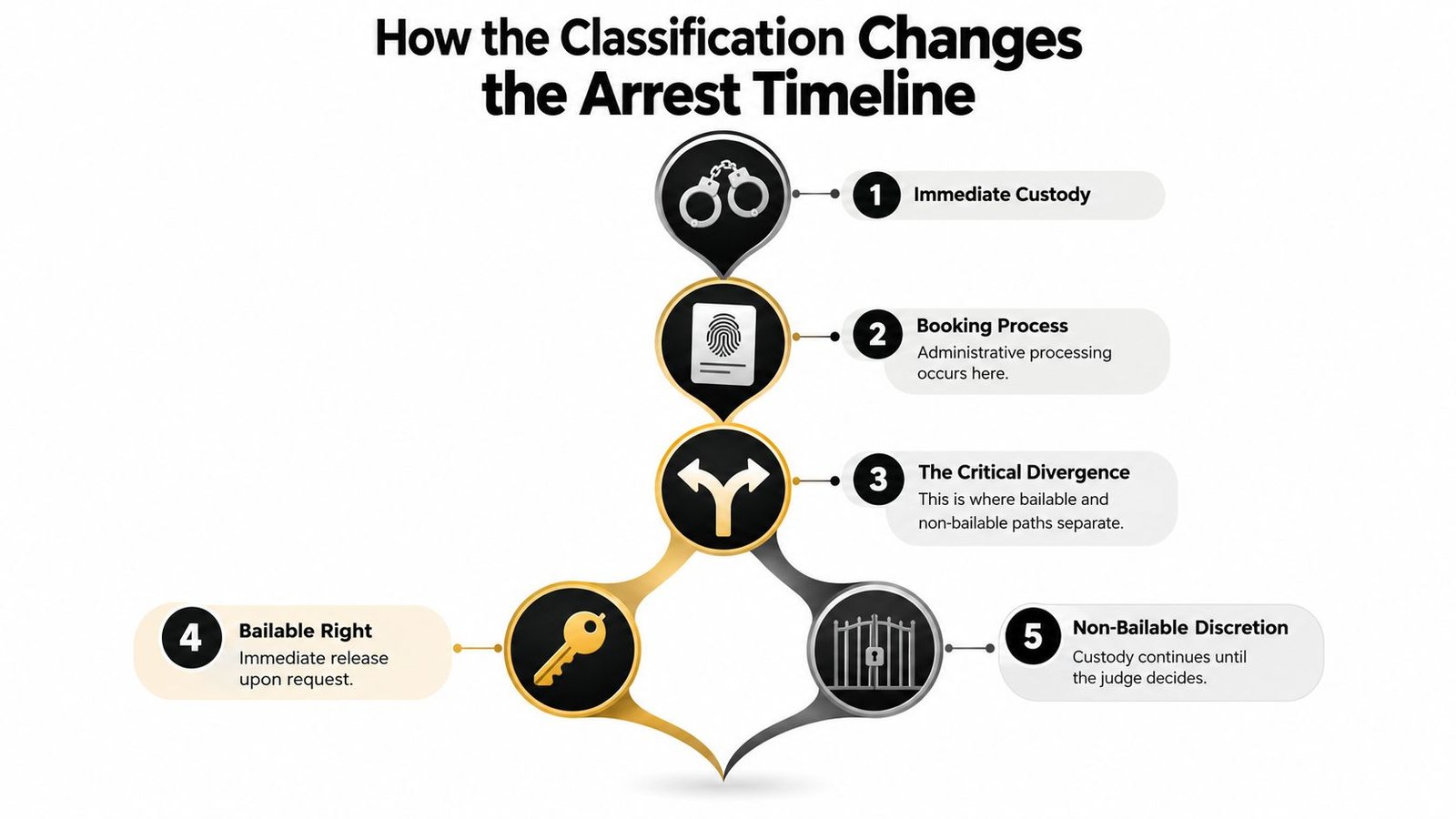
How the Classification Changes the Arrest Timeline
An arrest feels like one long emergency, but the process has separate checkpoints. The family can make better decisions by treating it as a clock with a fork in the middle.
The first hours
At the start, officers take the person into custody. Booking follows, which can include identification, photographs, fingerprints, property inventory, health questions, and entry of the alleged charges into the detention system. A family may not receive a useful answer during this stage because the jail is still processing the person.
The first major fork is classification:
- Bailable route: If the charge carries a right to bail and the jail has the required bond information, the person may move toward release after the bond or surety is properly furnished.
- Non-bailable route: The person generally needs judicial review. The court may examine the allegation and release concerns before setting terms.
- Information check: A probable cause affidavit, arrest report, or charging document may help explain why the person was held and what the court will review.
Police FAQ material describes a common South Asian procedure in which a person accused of a non-bailable offence is typically produced before a judicial magistrate within 24 hours, while a person in a bailable matter may be released on bond or surety when prepared to furnish it. The exact rules in Colorado depend on the local facility and court.
When the clock reaches court
A first appearance or bond hearing gives the court an opportunity to address the accusation, probable cause, counsel, and conditions. The defense lawyer may ask for release, a lower bond, or less restrictive terms. The court may impose conditions such as a no-contact order, travel limits, reporting requirements, or electronic monitoring.
A bailable case can still stall if paperwork is incomplete, the bond hasn't been entered, identity verification is pending, or the facility has a processing backlog. A non-bailable case can take longer because no one at the jail can replace the judge's discretionary decision.
For a clearer explanation of the point at which a court sets or confirms bond, consult when bail is set.
The video below offers another visual explanation of the arrest and bail process.
What This Looks Like in a Colorado Jail
A Colorado family usually encounters the classification through a detention facility's screens, forms, and release queue rather than through textbook language. At a county facility such as one serving Denver or El Paso County, staff may complete intake, record personal property, issue jail clothing, verify identity, and enter the charge and bond information into the system.
The person may wait through several administrative steps even after a bond amount appears. That doesn't necessarily mean the bond was denied. It may mean the jail is completing classification, medical screening, records checks, or release processing.
How a surety bond fits
Colorado's standard surety premium is 15%, according to the publisher's stated service information. For bonds over $5,000, Express Bail Bonds often secures 10% with an approved cosigner, also according to the company's stated information. Families should confirm the exact premium, fees, collateral terms, and approval requirements before signing anything.
A surety bond normally involves a licensed bail agent guaranteeing the bond to the court or jail. The family or cosigner pays the premium and may provide collateral when the bond size or risk assessment requires it. Collateral should be described in writing, with the parties understanding what documents prove ownership, what happens if conditions are breached, and how the arrangement ends.
Practical rule: Ask for the total cost, every required document, and the collateral terms before authorizing a bond.
When relatives live elsewhere
Out-of-state relatives can lose time by assuming everyone must appear at the jail in person. In many situations, a licensed Colorado agency can provide electronic applications, payment processing, and contract documents, subject to facility and case requirements.
A remote family member should designate one point person. That person can collect the defendant's details, speak with the agent, track missing documents, and keep relatives from sending conflicting instructions. Electronic processing kiosks and online paperwork may reduce unnecessary travel, but release still depends on the jail's own queue and approval procedures.
Express Bail Bonds says it serves Colorado detention facilities statewide and coordinates electronic processing and bond posting. Families should still verify the current facility requirements and whether the specific bond can be posted through a surety.
Three Myths That Trip Families Up
Myth one says non-bailable means no bail ever
That is the most damaging misunderstanding. Non-bailable means bail isn't automatic. A competent court can still grant release after considering the allegation, the available information, the person's circumstances, and the risks connected with release. Legal summaries emphasize this distinction between “not a right” and “never available” in their explanations of discretionary bail for non-bailable matters.
A family may hear “non-bailable” from a booking officer and assume the person must remain jailed through the entire case. The more accurate response is to ask whether a bond hearing is scheduled, whether counsel is involved, and what the court needs to decide release.
Myth two says only the defendant can post
The defendant often can't handle the logistics from inside a detention facility. A family member, friend, attorney, or licensed surety may help complete the bond process, depending on the jurisdiction, the bond type, and the facility's rules.
For example, a relative in another state may provide identification and sign documents electronically while a local agent coordinates with the jail. That doesn't make the relative responsible for every aspect of the criminal case, but it can make the release process possible when the defendant has no access to money, records, or a telephone long enough to manage it.
Myth three says cash is the only route
Cash is only one possible release method, and it isn't always the method a family wants or can use. Depending on the court and facility, options may include a personal bond, a surety bond, or a property-backed arrangement. The available choices vary, and some agencies don't handle cash-only bonds.
A Colorado family might hear that a cash payment is required, while the jail record permits a surety bond. Another family might assume a surety agent can solve every problem, when the court has imposed a condition that requires a hearing first. Verify the bond type, amount, and conditions before making an irreversible payment or pledging property.
Your Family Playbook and When to Call Express Bail Bonds
Start with facts, not rumors. Get the defendant's full legal name, date of birth, booking facility, booking number if available, and exact charges. Ask the jail or court whether a bond has been set, what type it is, and whether the person is waiting for a hearing rather than just waiting for payment.
Assign one family coordinator
One calm point person prevents duplicated calls and contradictory instructions. That person should keep a written log of every conversation, including the name of the jail employee, attorney, bondsman, or court contact and the next promised step.
For an out-of-state family, prepare the following:
- Identity details: Full name, date of birth, current address, and booking information.
- Charge information: Exact charge names and the county handling the case.
- Payment method: A way to pay the applicable premium and approved fees after confirming the total.
- Cosigner information: Contact details and identification for the person helping with the bond.
- Collateral records: Ownership documents or other records requested by the bonding agency.
- Attorney contact: The criminal defense lawyer's name and phone number, if one has been retained.
The bond application process can involve online forms, identity checks, contract signatures, payment, and communication with the detention facility. A licensed Colorado agent can explain which steps apply to the specific bond and whether electronic completion is available.
Understand the handoff
When a surety bond is approved, the agent posts it through the applicable process. The jail then reviews the filing, completes its release checks, and returns the defendant's personal property. The person should leave with information about the next court date and the conditions of release.
Release isn't the finish line. The defendant must follow every condition, attend each required court appearance, avoid prohibited contact, and keep the court or lawyer informed of address changes. A violation can lead to new custody problems, so the family should read the release paperwork carefully instead of relying on a hurried verbal summary.
Use this short checklist when the emergency call comes:
- Confirm the facility
- Record the exact charges
- Ask whether bail is set
- Find out whether a hearing is required
- Choose one family coordinator
- Gather identification and booking details
- Confirm the bond type and total cost
- Ask about electronic signing
- Contact a defense lawyer for legal advice
- Save every release condition and court date
Express Bail Bonds states that it provides 24/7 Colorado bail bond assistance, electronic applications and contracts, and coordination with detention facilities. Its agents can explain the surety process and Colorado-specific paperwork, but legal questions about the charge, defenses, and hearing strategy belong with a criminal defense lawyer.
If your family is trying to determine whether a bailable or non-bailable classification affects release in Colorado, contact Express Bail Bonds with the defendant's full name, birth date, facility, and charges ready. Visit Express Bail Bonds to begin the surety bond process, or review local assistance for Jefferson County in Golden and Arapahoe County in Centennial while an agent helps coordinate the next step.