
You've just received a call from a county jail. Someone close to you has been arrested, bail has been set, and you need to know two things immediately: how much release will cost and how quickly a bond can be posted. Searching for “bail bonds quotes” can produce plenty of numbers, but a headline percentage doesn't always reveal what you'll sign, pay, or secure with a cosigner.
A useful quote should identify the bond amount, the premium, any legally permitted additional charges, and the requirements for payment, collateral, and release. In Colorado, the quote is also shaped by a statutory ceiling, so the number isn't just whatever an agency decides to negotiate.
What a Bail Bonds Quote Actually Means
A bail bond quote is the agency's written or verbal estimate for arranging a surety bond. It usually starts with the nonrefundable premium, then identifies any additional charges that may lawfully apply. It isn't the same as the court's bail amount, and it isn't necessarily the same as every financial obligation connected with the case.
Colorado law places a ceiling on what an insurance producer may charge for a bail bond. Under Colorado's statutory bail-bond pricing rule, the producer may charge no more than the greater of $50 or 15% of the bail furnished. The law also limits pass-through charges connected to actual filing or collateral-storage costs.

That distinction matters when you're under pressure. A quote should separate the premium from any other expense instead of presenting one unexplained total. Ask the agent:
- What is the premium? Confirm whether it's nonrefundable and how it relates to the bail amount.
- Which extra charges apply? Ask whether filing, collateral storage, or financing costs are included and why.
- What must be paid before posting? A payment plan may change the upfront amount without changing the total premium.
- Is a cosigner or collateral required? These requirements affect whether the agency can approve and post the bond.
- Where will the bond be posted? The detention facility and court venue can affect paperwork and timing.
Practical rule: A fast quote is useful only when you understand what it covers. Don't compare two numbers until both agencies have explained their premium, conditions, and additional charges.
Getting a quote promptly is usually more valuable than spending hours searching for the lowest headline figure. A clear agency can tell you whether the case is eligible for a surety bond, what documents are needed, and whether a cosigner can complete the process remotely. That information helps your family make a decision without confusing the court's bail with the bond company's service fee.
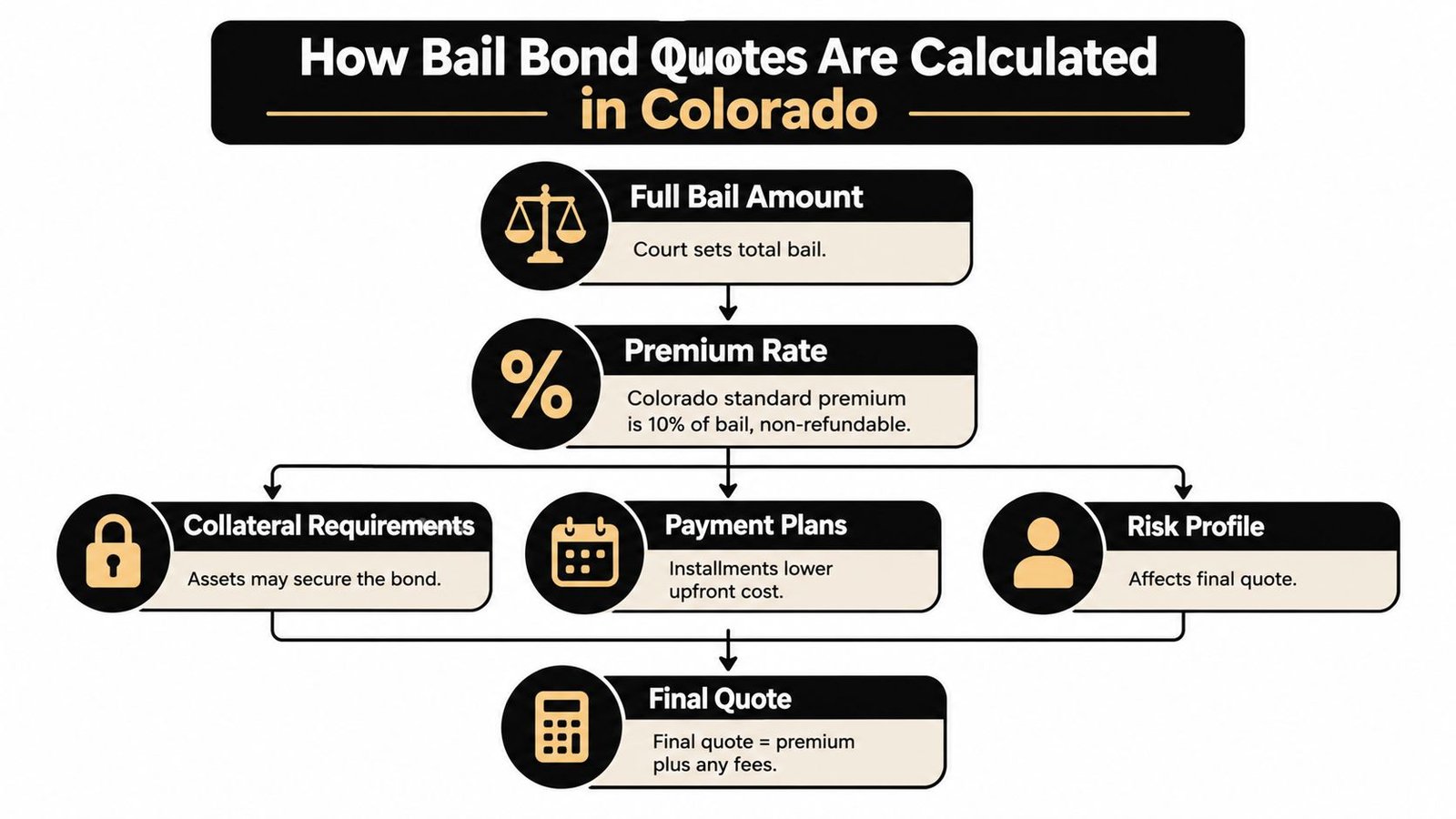
How Bail Bond Quotes Are Calculated in Colorado
The calculation begins with the amount of bail furnished by the court. The agency then applies the legally permitted premium structure and reviews whether any allowable expenses are incurred. Colorado's rule is important because it limits both the premium and the circumstances in which additional charges can be added.
The statutory ceiling is the greater of $50 or 15% of the bail furnished, and Colorado restricts extra fees to specified categories, including court or law-enforcement filing fees, actual collateral-storage costs, and premium financing fees, as described in the Colorado bail-bond statute. A producer can't add an unexplained administrative amount just because the situation is urgent.
The main calculation inputs
A transparent quote normally reflects four practical inputs:
- The court-set bail amount. The bond amount determines the starting point for the premium calculation.
- The venue and bond type. A state bond, federal bond, or another court-specific arrangement may follow different rules.
- The payment arrangement. Financing can change the amount due immediately, while the agreement should identify the total obligation.
- The security package. A cosigner or collateral may be required before the agency accepts the risk.
Colorado's structure shouldn't be confused with pricing in other states. The California Department of Insurance explains that the court sets the bond amount and that the common consumer cost is 10% of the bond plus actual, necessary, and reasonable expenses. Florida consumer guidance lists 10% for state bonds and 15% for federal bonds, while New York uses a tiered maximum that begins at 10% for smaller bonds and steps down to 8% and 6% for higher tiers. Those differences show why an agent needs the exact state, venue, and bond type before quoting.
| Fee Type | Allowed |
|---|---|
| Bail-bond premium | Subject to Colorado's statutory ceiling |
| Court or law-enforcement filing fee | Only when actually applicable |
| Collateral storage | Only for actual storage costs |
| Premium financing fee | May apply when financing is used |
| Unexplained processing or administrative charge | Not automatically permitted |
For a fuller explanation of the relationship between the bail amount, premium, and other charges, review how bond pricing works. The agency should be able to explain the quote in plain language before you authorize paperwork.
Key Factors That Change Your Quote
Two families can receive different practical terms even when they're calling about similar bail amounts. The reason is underwriting. A bail agency is evaluating whether the bond can be safely posted, whether the financial agreement can be completed, and whether someone responsible will help ensure the defendant appears in court.
The bond amount remains the starting point. A larger obligation can lead the agency to ask for stronger financial support, a larger upfront payment, collateral, or more than one responsible signer. A smaller bond may involve a simpler approval process, but the agency still needs accurate identity and booking information.
The charge and case circumstances also matter. Serious allegations, an uncertain booking status, or a history of missed court appearances can make approval more involved. Don't assume that a low advertised percentage will apply before the agent reviews the actual case.
Why the cosigner matters
A cosigner, also called an indemnitor in many bail agreements, accepts important financial responsibility. The cosigner may need to provide identification, confirm contact information, sign the contract, make payments, and help ensure that the defendant follows release requirements.
Colorado Judicial Branch guidance explains that a bondsman may require a co-signer and/or collateral to secure the bond, making approval more than a paperwork formality. The Arapahoe County bond guidance likewise says a surety bond may be posted through a state-licensed agent and that an agent may require a co-signer or collateral, with charges typically described as 10% to 15% of the total bond amount.
That creates a real trade-off. A strong, available cosigner may make the application easier to approve and can reduce the need for collateral. Without one, the agency may require additional security or decline the arrangement.
What to compare beyond price
A cheaper-looking quote isn't automatically the better choice. Compare:
- Transparency: Does the agent explain every charge and obligation?
- Approval requirements: Is a cosigner needed, and can that person sign electronically?
- Collateral terms: What property is accepted, how is it documented, and when can it be released?
- Posting capability: Can the agency handle the specific detention facility?
- Responsiveness: Can someone answer questions while booking information is still changing?
Use surety bond rates as a starting point, but ask for a case-specific quote before making a payment.
Sample Bail Bond Quote Calculations
A calculation becomes easier to understand when you separate the face amount of bail from the premium paid to the agency. The court sets the first figure. The bond agency uses the applicable legal and underwriting rules to determine the second, then explains any permitted additional expenses.
Commercial bail fees are commonly a nonrefundable premium of about 10% of the bail amount, according to reporting on the financial cost of commercial bail. The same source gives a practical example: a $50,000 bond can require $5,000 up front when the premium is about 10%. That payment is for the bond service and generally isn't returned just because the criminal case later ends favorably.
| Bond Amount | Typical Premium Range | Notes |
|---|---|---|
| Smaller bond | About 10% as a common commercial reference point | Confirm Colorado's applicable ceiling and any minimum charge |
| Mid-range bond | Apply the quoted premium rate to the court-set amount | Ask whether payment terms change the upfront amount |
| $50,000 bond | About $5,000 at a 10% premium | This example illustrates premium only, not every possible obligation |
| Larger bond | Request a case-specific quote | Collateral, cosigner strength, and venue may affect approval |
These examples aren't a substitute for a written quote. Colorado's statutory ceiling and permitted additional charges still control the transaction. An agency should identify whether an expense is a premium, a filing charge, a collateral-storage cost, or a financing fee.
The most common mistake is comparing only the amount due today. A low down payment may reflect financing rather than a lower total cost, and collateral may create a separate risk for the person signing the agreement. Ask for the total amount, payment schedule, collateral conditions, and consequences of missed payments in writing.
Have the complete case details ready before requesting the quote. The defendant's full legal name, date of birth, booking location, booking number, and charge information help the agent avoid quoting the wrong person or facility. If one detail is unknown, say so rather than guessing. An incorrect name or booking location can delay the paperwork when the jail is ready to process the bond.
For a more detailed explanation of the premium itself, see this guide to surety bond premiums.
How to Request a Fast Electronic Quote
Start by collecting the information the agent needs. You don't have to solve every part of the case before calling, but accurate booking details reduce back-and-forth and help the agency identify the correct facility.
Prepare this information:
- Defendant's full name: Use the spelling recorded by the jail.
- Date of birth: This helps distinguish people with similar names.
- Booking number: Provide it if the detention facility has issued one.
- Jail location: Identify the county and facility, not just the city.
- Charge information: Share the charges and the bail amount if they're available.
- Cosigner details: Have the potential signer's name, contact information, and identification ready.
Use the right questions on the first call
Ask whether the quote is for a surety bond, whether the agency can post at that detention facility, and what must happen before posting. Confirm the premium, the amount due immediately, the payment schedule if financing is available, and whether collateral is required.
A Colorado bail-bond writer must meet licensing and appointment requirements. The Colorado Judicial Branch guidance on types of bonds states that the person must be licensed as an insurance producer with casualty authority and appointed to write business with a bail insurance company. It also identifies 8 hours of bail-bonding education and 16 hours of bail-recovery education for preappointment training.
Express Bail Bonds offers statewide Colorado surety-bond service, electronic applications, payments, and contract documents, with assistance available by call or text. Its process is designed for families, attorneys, and remote cosigners who need to complete paperwork without spending unnecessary time at a detention center. Requesting an online surety bond quote gives the agency the information needed to review the case.
A digital process doesn't remove the jail's role. The detention facility still controls booking, bond acceptance, and release processing. Electronic paperwork can reduce avoidable travel and document delays, but it can't guarantee a particular release time.
The following video provides another visual explanation of the service process.
Before sending money, confirm the agency's identity and read the agreement. Don't rely on a text message that gives only a total price. You should know who is posting the bond, what you're signing, what happens to collateral, and how the defendant's court obligations affect the agreement.
Next Steps After You Receive a Quote
Read the quote from top to bottom before authorizing the bond. Confirm the bail amount, premium, upfront payment, payment schedule, and any additional charge. If the agency mentions filing, storage, or financing costs, ask why the charge applies and whether it's included in the written agreement.
Then confirm the security requirements. Ask whether a cosigner is needed, whether collateral will be accepted instead of or in addition to a cosigner, and what documents each signer must provide. Don't assume that approval is complete until the agency confirms that the paperwork and payment have been accepted.
Use this sequence:
- Verify the case details. Check the defendant's name, booking location, bail amount, and charges.
- Review the agreement. Make sure the premium and obligations are clear.
- Prepare identification and payment. Gather documents for every required signer.
- Ask about posting status. Confirm when the bond will be submitted and whether the jail has accepted it.
- Record court requirements. The defendant must follow every release condition and attend every scheduled court appearance.
Families dealing with a Jefferson County detention facility can review the Jefferson County and Golden bail-bond service page. Those seeking help near Arapahoe County can use the Centennial bail-bonds page. Local information can help direct your call to the right facility and service area.
When you're ready to arrange payment, review the available ways to pay a bail bondsman. Keep copies of the quote, contract, payment receipt, collateral documents, and every instruction the agency provides.
If you need a clear Colorado bail bonds quote, Express Bail Bonds can help review the bond amount, explain the premium and security requirements, and complete eligible paperwork electronically. Contact the agency by call or text with the defendant's booking details so you can move from uncertainty to an accurate, jurisdiction-specific release plan.