The phone rings late, and now you're trying to figure out where your person is, whether they're in Arapahoe County jail, and what you can do before the night gets worse. Start with the official lookup, but don't stop there. A name on a screen is only a snapshot, and the fastest way to waste time is to treat it like the final answer.
The arapahoe county jail inmate search in colorado is useful because it points you to the current custody picture, not because it solves everything. If the result shows a bond, a charge, or a housing location, that's your cue to verify identity, confirm where the person is held, and check what release step is still missing. If you're trying to sort out who called you, a caller ID guide like Gini Help's caller ID guide can help you handle the first part of the scramble without guessing.
When the Phone Rings at 2 A.M. an Honest Guide
If you're reading this in a panic, keep it simple. First, confirm the person's full legal name and date of birth. Second, use the official county detention record, not a third-party site that might be outdated, incomplete, or flat wrong.
Arapahoe County has a long detention history, and that matters because the system you're dealing with is large and active, not a tiny local holding cell. The county says its detention center has been operating for decades, has expanded over time, and now handles a substantial inmate flow each year. That means the search result is a working record inside a moving system, not a permanent statement about where someone will end up. For that reason, I tell families to treat the lookup as the starting point, then immediately verify the booking details and current custody status through the sheriff's office.
Practical rule: if the result doesn't match the person's DOB, booking date, or case number, don't assume you found the right inmate.
The fastest next step is to move from “is this the right person?” to “where are they being held, and what's the release path?” That's the part most search pages don't explain well. A record can show up, disappear, or change fast because booking, transfer, release, and court movement all happen inside the same day.
When you need a trusted place to compare the official information against a practical release path, keep the county lookup open and use Express Bail Bonds's Arapahoe County booking page as a cross-check for what families usually ask next. That's not a substitute for the jail record. It's a way to stop guessing and start verifying.
Using the Arapahoe County Inmate Lookup Tool
Start with the sheriff's official detention system and match the custody location before you trust the result. Arapahoe County lists the detention and automated-information number as 720-874-3500, and the facility address is 7375 South Potomac Street in Centennial, Colorado. If the record does not line up with that county system, treat it as incomplete.
Search by the person's exact legal name, then read every field on the result. Booking date, charge information, bond amount, and court setting are all current detention details, not a release promise.
No result does not mean released. The person may not be booked yet, may be in another facility, or may have moved out of the county system. If the screen is partial or unclear, call the detention division and compare the entry with the person's full identity.
Don't rely on a name-only search. That is how families confuse two people with similar names.
Use the county phone number when the online record leaves you unsure. If you want a second point of reference for how to read a booking entry, use the Arapahoe County jail booking guide alongside the county record, not instead of it.
Why the Search Result Is a Time-Sensitive Snapshot
Arapahoe County's detention numbers explain why the lookup changes so fast. The facility was built in 1986 with an intended capacity of 386 inmates, and county updates have reported average daily populations of 860 and 920 people, with a modernization project budgeted at approximately $46.4 million (Arapahoe County detention update). Those numbers tell you something important: the system runs under pressure, and people move.
That pressure affects how a record appears. A person can be booked, transferred within the jail, moved for medical or behavioral-health reasons, released after bond, or sent to court and then returned. When a jail is running above its original intended size, the database can reflect a current status that's already changed by the time a family member sees it.
What that means for families
- Housing changes happen fast. A search result may not reflect the person's current cell assignment.
- Bond info can change. A listed amount doesn't guarantee release has already started.
- Court movement matters. Someone can be temporarily off-site and still remain in county custody.
- A no-result search isn't proof of freedom. It can also mean the booking hasn't fully posted yet.
Colorado's county-jail reporting framework also matters here because the state expects quarterly facility and inmate reporting. That's useful for public oversight, but it also shows why a single lookup is best used for current custody status, not for reading long-term jail trends.
The bottom line is simple. Use the lookup for what it's good at, current status, then verify the rest through the jail.
A Verification Protocol That Closes the Match Gap
One matching name is not enough. Start with the full legal name, date of birth, booking date, and booking or case number. The booking or case number is the cleanest confirmation because the jail assigns it to one person only.
Check the identity in layers
- Full legal name exactly as it appears on the record.
- Date of birth to separate similar names.
- Booking date if you have it, because timing rules out bad matches.
- Booking or case number when the jail shows it.
If those details do not line up, keep searching or call the detention division.
A name-only match causes trouble fast. Spelling changes, aliases, common names, and quick transfers can point you to the wrong person. I have seen families assume they found their person, then discover they were looking at a different inmate with a similar record.
After booking, custody status can shift. Bond, housing location, holds, and release eligibility can change after the first entry appears. If the record still feels thin, recheck the spelling, allow for booking delay, and verify directly with the sheriff's detention staff. That beats trusting one screen.
Cross-Referencing the County Jail and the State Prison Locator
A county jail search and a state prison locator serve different records. Colorado's prison locator covers the state prison system, and it does not include county jails, federal prisons, or community-corrections facilities (CDOC locator guidance). So a county booking will not show up there, and a sentenced CDOC commitment will not appear in the county jail record.
Start with the county jail lookup if the arrest happened in Arapahoe County and the person is still likely in local custody. Use the state locator only after the case has moved beyond the county jail stage or you have been told the person was sentenced to CDOC custody.
If a name vanishes from one system, check the other system before you assume release. A transfer, a completed booking, or a record update can explain the gap.
For a second reference point that helps you stay out of the wrong system, a statewide inmate locator reference gives you a practical comparison tool. The official custody record still matters most. Use the right system first, then verify the status where the person is held.
Adding Colorado VINE for Automated Custody Notifications
Colorado VINE gives you a second layer of custody alerts. County sheriffs operate it, participating county jails post updates through VINELink or the toll-free COVINE number, 1-888-263-8463, and the service is free (Colorado VINE guidance). It's useful when you want updates without constantly refreshing the jail record.
That said, coverage is limited to participating county jails. If you can't find a person in VINE, that doesn't prove release, transfer, or anything else. It only means the system didn't return a usable custody notification.
Use VINE the right way
- Enroll after you confirm the jail record. That keeps the notifications tied to the right person.
- Keep your contact details current. Alerts are only as good as the phone or email you register.
- Verify release conditions separately. Bond, warrants, protection orders, and court dates still belong in the jail or court record.
VINE is a status alert, not a legal decision. It won't tell you whether the jail has accepted a surety, whether a bond is ready, or whether a release hold exists. Use it as backup, not as your only source.
If you need the county phone numbers that families usually call after setting up notifications, this contact page is a straightforward reference.
Scheduling Visitation After You Confirm Custody
A confirmed custody record comes first. Visit scheduling comes after. Arapahoe County limits remote visits to people held in the Arapahoe County Detention Center, and it will not set up visitation for someone housed elsewhere. That is the part families miss when they rely on a partial lookup result.
Start with the jail record, then book the visit through the county's system. Visitors need an account, they choose the inmate, and they pick an open time. At check-in, the jail will ask for valid identification, such as a current driver license, military ID, passport, or Mexican Matricula Consular identification. The visitor also has to be on the approved list.
Keep the rules tight.
- Two visitors per session is the limit.
- Anyone under 18 must be with an adult.
- Arrive about 15 minutes early so check-in does not cut into the visit.
- Plan on roughly 30 minutes for the visit itself.
A scheduled visit does not mean release is close. Families confuse those two things all the time. A visit only confirms access to the detained person, not bond status or release timing.
If you need the practical visitation basics before you book, use this jail visitation guide. Then verify custody again in the county record before you make the drive.
Funding an Inmate Account Through TouchPay
A confirmed jail record is only half the job. If the person is inside Arapahoe County, inmate-account money is handled separately from bond, and families need to get that part right the first time. The county lists deposit options through lobby kiosks at the Detention Facility's Visitation Center or Front Lobby, online deposits, and an automated telephone system. For TouchPay, the facility site ID is 280112, and the county says funds are generally available within 24 hours or less (Arapahoe County inmate account services).
Use the inmate's jail ID number, or the person's full name and date of birth. The lobby kiosks take cash, Mastercard, Visa credit cards, and Visa debit cards. That helps with canteen money, phone use, and other inmate expenses, but it does nothing for release.
Keep the payment type separate
- Inmate account deposits cover facility spending.
- Bond payments satisfy a court or release requirement.
- One does not replace the other.
TouchPay customer service and the automated deposit line are deposit channels, not bond-release channels. If the goal is a surety bond, send the money through the proper release process. Putting funds in an inmate account will not move a bond case forward.
Once the account is funded, the next money question is the bond itself, which the post-search checklist below covers.
From Bond Posted to Person Released the Post-Search Checklist
A bond showing up in the search result is not the finish line. Families usually care about the gap between “bond posted” and “person out the door,” and that gap is where mistakes happen. Arapahoe County says a qualifying release on a money bond generally must happen within six hours after the bond is set and the jail is notified that the bond is ready. The county also says electronic-monitoring setup can allow a hold of up to 24 hours, and supervisory release conditions alone do not justify delay (Arapahoe County charges and bonds guidance).
Start with the bond type, because that tells you what release path applies. Then verify the amount, confirm the jail has logged the readiness notice, and ask whether the person is back at the facility after court. If the answer changes at any step, stop and recheck the record before you assume the release is stuck.
What I verify first
- Bond type. Personal recognizance, cash, or surety each follows a different path.
- Bond amount. Make sure the number matches the current record.
- Jail notification. Confirm the jail knows the bond is ready.
- Return from court. Check whether the person has come back from a court appearance.
- Release delay reason. Ask whether there is a new hold or only processing time.
The county says booking, bond, and other fees do not need to be paid to secure release on a money bond. That is where families waste time and money. Pay the required bond amount, then verify that the jail has the notice in hand.
If the person is still inside after the bond is posted, work the problem from the top of the list. The notification time matters. So does the bond type. So does any added hold. For a posted-bail situation that still has not turned into release, this posted-bail support page gives a useful next check against the detention record.
Quick Reference Workflow and Trusted Colorado Contacts
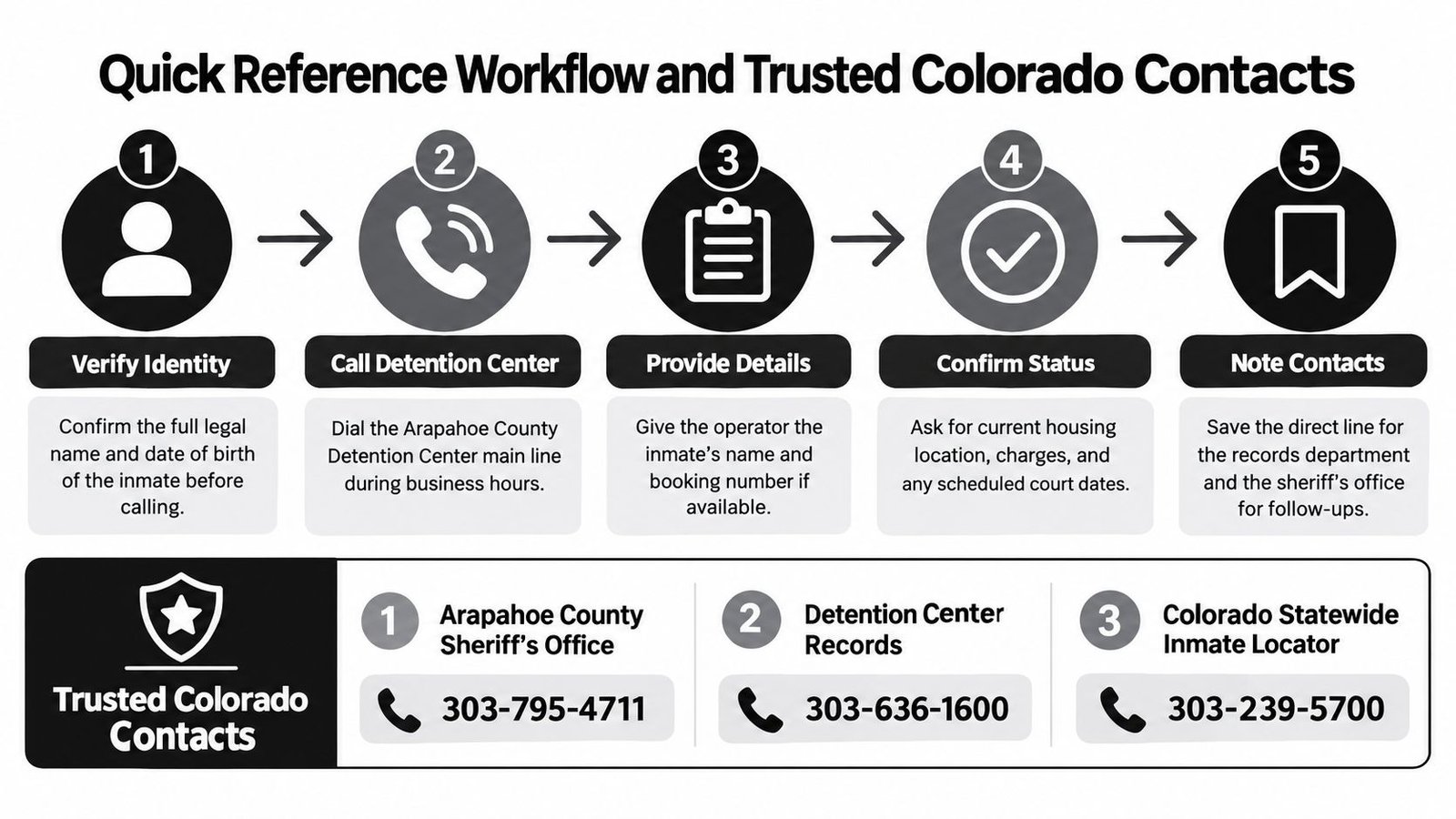
A late-night call goes better when you keep the order straight. Start with the full legal name and date of birth, then use the official county detention line at 720-874-3500 to verify custody. After that, separate the record check, visitation, inmate spending, and bond status instead of treating them like one problem.
| Channel | Identifier |
|---|---|
| Confirm custody | County detention and automated-information line, 720-874-3500 |
| Verify location | Arapahoe County Detention Facility, 7375 South Potomac Street, Centennial, Colorado |
| Check visitation eligibility | County visitation system, pre-approved visitor account |
| Add inmate funds | TouchPay detention facility site, 280112 |
| Get automated custody alerts | VINELink or COVINE, 1-888-263-8463 |
| Surety-bond help | Express Bail Bonds |
| Centennial service info | Centennial service page |
Use the county search first, then VINE if you want automated alerts, then visitation only after custody is confirmed. TouchPay is for inmate spending, not bond posting. If the person is not in Arapahoe County custody, stop forcing the county record to explain a different jail or court hold.
A location-first check prevents false “not found” conclusions. Confirm the jail, confirm the bond, and confirm whether the person has returned from court before you tell a family the next step. That is the cleanest way to close the gap between a search result and an actual release.