Yes, a cosigner can help a defendant with bad credit get a Colorado bail bond approved, but only when the cosigner's own credit, employment and residence pass review. The cosigner also owes the full bond amount if the defendant misses court, so on a $30,000 bond, the exposure is the entire $30,000, not a share of it.
A phone rings at 11 p.m. Someone you love is in a Denver or Jefferson County jail, bail has been set, and the family group chat is moving faster than anyone can think. You have decent credit. The defendant does not. Everyone turns to you because you're the one with the steady job, the lease or the mortgage, and the bank account that doesn't make people nervous.
Will a cosigner help with bad credit in that moment? Usually yes, and that's exactly why you need to understand the trade before you sign. A bail bond cosigner is not a character reference. You become the second person legally on the hook for the defendant's court appearances, and the agency will evaluate your finances as closely as it evaluates the defendant's charges and flight risk.
Short Answer for Colorado Bail Bonds
The short answer for a Colorado bail bond is yes, a cosigner can rescue a weak application. The useful answer is that the cosigner's own profile becomes the application. Approval typically involves a credit and background check on the cosigner, and we look for stable employment, established residency such as home ownership or a long rental history, and a decent credit score. The defendant's bad credit doesn't disappear. It stops being the only file on the desk.
A cosigner with good credit and a shaky job is often a harder case than a cosigner with average credit and a long tenure at the same employer. The Consumer Financial Protection Bureau's guide to cosigning makes the same point in lending terms: an applicant is more likely to be approved when an additional repayment guarantee is provided, but the lender can still reject the file for insufficient income, excessive debt, recent bankruptcy, unstable employment, or loan-specific rules. Bail underwriting follows that logic. Your signature helps, but it doesn't erase the defendant's record or guarantee approval.
The table below turns that into a verdict by profile. Read the row that sounds most like you, then read the one right below it. Most cosigners land between two rows, and the weaker row is the one the agency will test.
Likely bail bond outcome by cosigner profile
| Cosigner profile | Cosigner strength | Likely outcome |
|---|---|---|
| Stable job, owns a home, decent credit score | Strong | Approval likely on standard terms |
| Stable job, long-term rental history, average credit | Solid | Approval likely, with more questions from the agency |
| Good credit but new or unstable job | Weak on income | Approval uncertain; collateral possible |
| Weak credit, no stable income | Weak | Usually declined without collateral |
| Very high bail amount or high flight risk | Secondary to bond size | Collateral likely required |
The verdict changes with three variables
Your stability is the first variable. A verified job, a local address and a clean recent payment history matter more than a score alone. The second is the bond size. A small bond and a large bond are different conversations, even with the same cosigner. The third is the defendant's flight risk. Prior missed court dates, out-of-state ties and the nature of the charge can push an otherwise approvable file toward collateral or denial.
Express Bail Bonds works Denver, Jefferson County and the Centennial area, and our statewide service overview explains how the process runs from the first call to release. The agency's answer depends on your file, not on optimism.
What a Cosigner Really Promises
Think of a cosigner as the second key to the same door. A reference letter says you're a good risk. A cosigner hands the agency a second person who can be pursued if the door doesn't open on time. The cosigner signs the bail bond contract and pays the premium, and that signature is a legally binding promise that the defendant will show up for every required hearing.

By signing, you aren't vouching for the defendant's character. You're agreeing to answer for their appearance. The agreement is a contract between you and the bail company, not a private arrangement between you and the defendant. That distinction matters when something goes wrong.
The key point: The bail bond agreement is a contract between the cosigner and the bail company. If the defendant doesn't appear, the company looks to you, not to the defendant's promises.
The Consumer Financial Protection Bureau's cosigner page describes the same arrangement in student lending: the cosigner generally has equal financial responsibility and a legal obligation to repay the debt, and it cites a 2019 survey finding that 25% of cosigners made at least one payment because the primary borrower failed to do so. Bail bonds aren't student loans, but the lesson carries over. A cosigner can help someone get out of jail while taking on real repayment risk.
What you are actually signing
Your duties continue after the defendant walks out of the detention center. Keep in regular contact with the defendant, remind them of upcoming court dates, and call the agency immediately if the defendant moves or changes a phone number. Don't assume your responsibility ends when the defendant appears at the first hearing. It lasts until the case ends and the bond is discharged.
If you've cosigned a mortgage, cosigner release options for homebuyers explains how removal works once the primary borrower qualifies alone. Ask whether any similar release exists on a bail bond, in writing, before you sign. Our cosigner responsibilities guide covers the ongoing duties in more detail.
Before you sign, get three answers:
- How many hearings are expected? A case with several court dates needs a reminder system, not memory.
- What happens if the defendant moves? You must update the agency, and the answer should be in the contract.
- Who do I call if a court date is missed? Get a direct number and use it the same day, not the next week.
How Credit and Background Checks Decide Approval
The agency's decision is mostly about you. That's the part families miss when they ask will a cosigner help with bad credit and expect the answer to turn on the defendant's score. Your credit, your employment, your address and your background are the safeguards the agency can evaluate.
Approval typically involves a credit and background check on the cosigner. We look for stable employment, established residency such as owning a home or having a long-term rental history in the area, and a decent credit score. A perfect score with unverifiable income is a weak file. A mid-range score with a long employment history and a mortgage is often a stronger one.
What the file looks like before approval
Cosigner criteria checked before approval
| Criterion | What the agency checks | Why it matters for bad credit |
|---|---|---|
| Credit score | Cosigner's credit score and history | A decent cosigner score can carry an application the defendant's score would sink |
| Credit and background check | Both run on the cosigner before approval | A background concern can override a good credit score |
| Employment | Stable, verifiable income | Cosigner must be able to cover the full bond if needed |
| Residence | Home ownership or long-term rental in the area | Shows the cosigner can be reached and will stay local |
| Contact details | Current phone number and address | Missed updates can cause trouble later in the case |
Credit score is a threshold, not a personality test. In 2023, Credit.com reported that most lenders expect a cosigner to have a credit score of at least 670. That's a general lending benchmark, not a bail agency rule, but a cosigner who clears it gives the agency less reason to hesitate.
The Consumer Financial Protection Bureau's auto loan guide explains why a second strong profile moves a file: a borrower with a low, limited, or nonexistent score may receive a significantly lower interest rate with a cosigner who has good or excellent credit, because the lender relies on that person's profile when pricing risk. Bail agencies don't set interest rates, but they do decide whether to require collateral and whether to approve at all.
Approval isn't guaranteed. The CFPB guide notes underwriting can still consider income, debt-to-income ratio, employment, collateral, loan amount, and minimum credit standards. A background concern can override a good score. Income that can't be verified can sink a clean credit report. A recent bankruptcy or heavy existing debt can push the file toward collateral or denial. Our cosigner credit check guide explains what we review and what to bring.
Prepare the paperwork before you call
- Pull your own credit report. Look for late payments, collections or a bankruptcy you'll need to explain.
- Gather recent pay stubs. A written job letter helps if your income includes overtime or tips.
- Bring a lease or property deed. You're proving you're rooted in the area, not passing through.
- Explain any employment gap. A short written timeline is better than a surprised answer on the phone.
- Check your contact details. The phone number and address you give will follow the case.
Practical rule: If you couldn't cover the full bond from savings or liquid assets, say so early. The agency needs to know whether you're the safety net or just a name on paper.
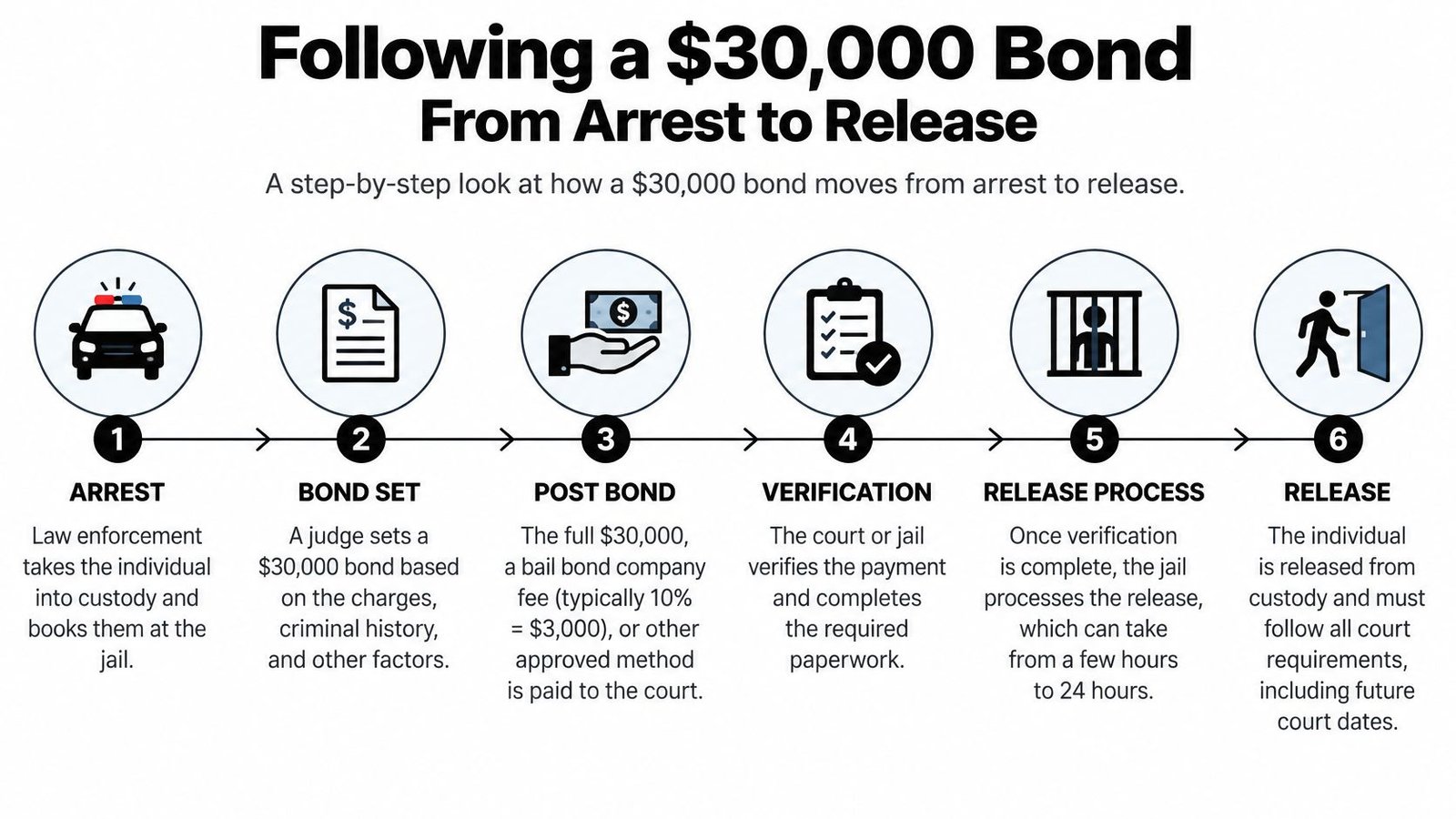
Following a $30,000 Bond From Arrest to Release
A judge sets bail at $30,000. A cosigner with a stable job and a home signs the agreement, the premium is paid, and the defendant is released. The Colorado jail release process starts at booking and moves through bond posting, release, and court dates. The cosigner's job starts after the defendant walks out.
The best case
The defendant attends every hearing. You keep in touch, remind them of dates, and call the agency when a date changes. The case ends, the bond is discharged, and your obligation ends. This is the outcome everyone plans for, and it's common when the defendant has family support and a reason to show up.
The turn
Now the defendant misses a court date and doesn't come back. The bond is forfeited. At that point, the cosigner must pay the full bail amount to the bail bond company. On a $30,000 bond, the cosigner owes the entire $30,000, not a share and not just the premium. If you can't pay, the agency can take possession of the collateral, such as a car title or a property deed, to cover the loss. Collateral is a physical asset pledged to secure the bond, and it's the reason agencies ask for it when the risk is high.
Federal consumer guidance is blunt about this kind of exposure. The Federal Trade Commission's cosigning FAQs state that a creditor may collect from the cosigner without first pursuing the main borrower, depending on applicable law and the contract, and that among cosigned loans entering default, as many as three out of four cosigners were asked to repay the debt. Bail is not an installment loan, but assume the same direction of collection.
The number to remember: On a $30,000 bond, your worst case is $30,000. The premium is a fee. The bond amount is the liability.
Measure the decision against that number. If $30,000 is money you couldn't raise without losing your car or your home, you're not a good cosigner for that bond, even if you love the defendant. If you can cover it and you trust the defendant to appear, your signature may be the difference between release tonight and a cell until trial.
Premiums, Collateral and Paperwork Costs
Costs come in four buckets, and only one of them is the fee people talk about at the jail. The premium is the fee you sign for and pay. Collateral is a separate promise, usually property or a cash deposit, and it may be required in addition to the premium and a qualified cosigner when bail is very high or the defendant looks like a flight risk. Additional costs can follow if the bond terms aren't met. The paperwork is not a formality, because Colorado law requires the fee arrangement in writing.
Cosigner costs and obligations by category
| Cost or obligation | Who carries it | When it applies | What to request in writing |
|---|---|---|---|
| Premium | Cosigner signs and pays | Every bond | Total fee and payment schedule |
| Collateral | Cosigner pledges property or cash deposit | Very high bail or high flight risk | List of pledged assets |
| Additional costs | Cosigner | If bond terms are not met | Itemized list of possible charges |
| Interest on unpaid premium | Cosigner | If payments fall behind | Written statement of permitted charges |
| Signed agreement | Producer and cosigner | Before any payment is accepted | Signed and dated copy |
The written agreement protects you
Colorado Revised Statutes section 10-2-705 requires the bail-bond insurance producer to put the premium, commission, or fee arrangement in writing before accepting consideration. The statute requires the written agreement to be signed and dated by the producer and signed by the defendant or indemnitor, and it must state the payment schedule. It also says the producer's signature on the arrangement is not an obligation to repay a lender, and interest and other financial charges on unpaid premiums must comply with Colorado's Uniform Consumer Credit Code.
Read that agreement before money changes hands. The signed and dated copy is your proof of the total fee, the payment schedule, and who promised what. If a company won't put those terms in writing, walk away. Using a bail bondsman typically requires collateral, which can include property or a cash deposit, and a cosigner with stable income may be needed. Our bail bond collateral guide explains what we accept and how a pledge is documented. Co-signers may also be liable for additional costs if the terms of the bond aren't met, so ask for an itemized list of possible charges rather than a verbal promise that there won't be any.
Three questions to settle before you accept:
- What is the total cost in writing? Get the number and the schedule on the signed agreement.
- Which assets are pledged? Name each one, including a car title or deed, and get a receipt.
- What is the payment schedule? Know the dates before you hand over a card.
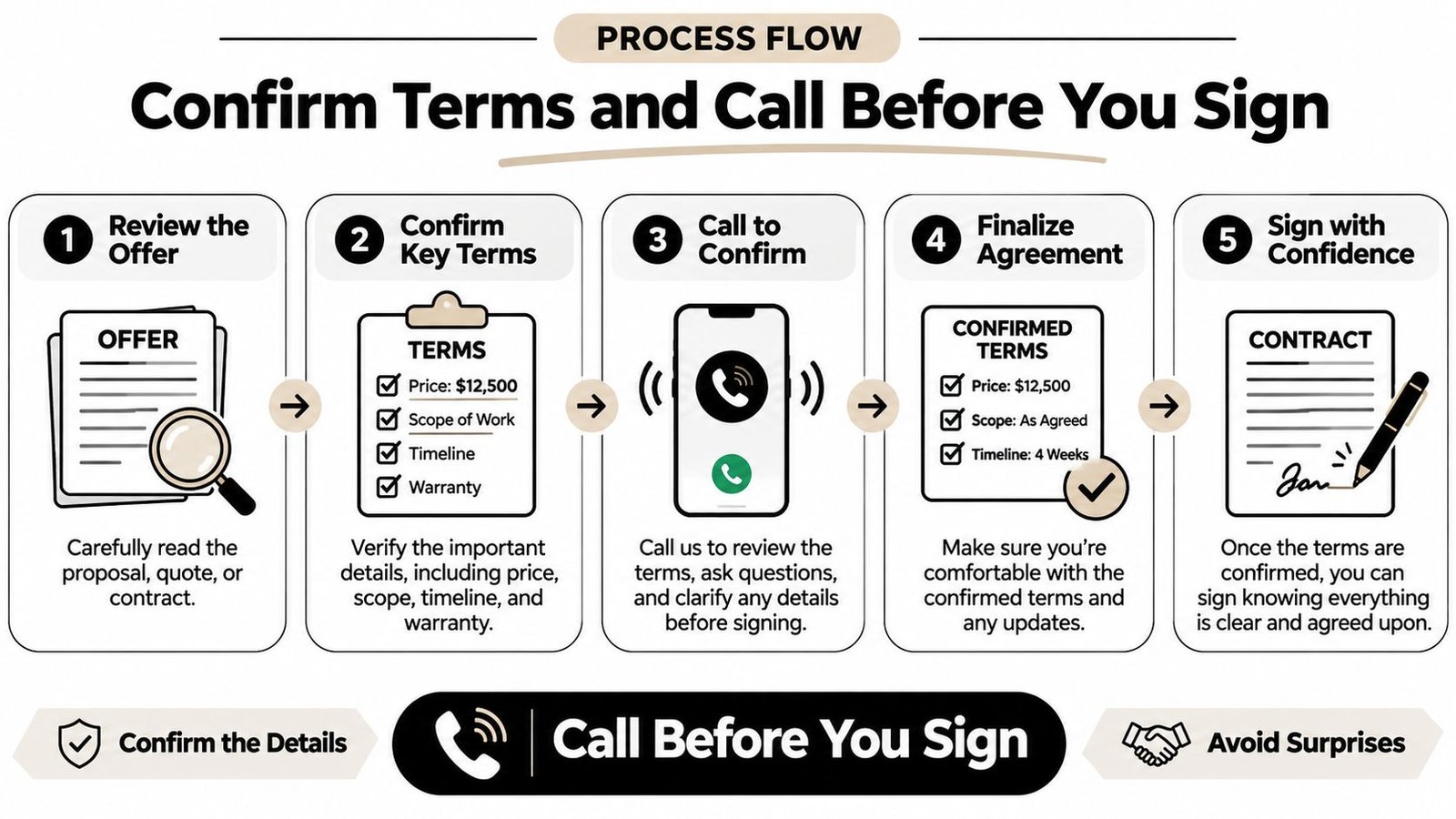
Confirm Terms and Call Before You Sign
Five steps before you sign
- Use the first call to ask everything. The first call with Express Bail Bonds is the chance to ask questions and get answers about costs and what it means to be a cosigner. Write the answers down.
- Confirm the total fee, collateral and payment schedule. Don't pay anything until those terms appear in the signed agreement the producer must provide under Colorado law.
- Review the contract line by line. Read the bail bond contract and check the defendant's court dates, your duties and the fee schedule.
- Build a reminder system. Put every hearing in your phone with an alert, and keep the contact details you gave the agency current during the case.
- Sign only if you could pay the full bond yourself. If the defendant misses court, you're the one who has to cover the amount, not a fraction of it.
If your case is in Golden or Jefferson County, the Jefferson County and Golden bail bond page covers the local courts. For Centennial, use the Centennial bail bond page.
Yes, a cosigner can change the answer on a bad-credit bail application, but only if you can carry the full bond amount if the defendant disappears. Express Bail Bonds answers calls and texts 24/7 at 720-984-2245, sends secure electronic contracts you can sign from anywhere, and can usually post bonds over $5,000 at a 10% fee with an approved cosigner. Call or text before you sign anything, and visit Express Bail Bonds to start the paperwork with an agent who will explain every term first.