
You got the call after midnight. Someone you care about is in custody in Durango, a bond figure is already listed on a public roster, and you're deciding whether to pay before morning. That figure is not a walking-out time. The Durango CO county jail controls booking, housing, and the moment a person leaves. The court controls whether bail is set, what the order says, and when the next appearance is. Paying before those two records match is how families lose a night, and sometimes money that is hard to unwind.
Start with the detention line, not a third-party page. Write the full name, date of birth, booking number, and arrest date on one sheet. Confirm custody, any hold, and whether a bond is even collectible today. That is the order I'd use on a first call.
Durango Jail Contacts and Address at a Glance
The La Plata County Detention Facility is at 283 Girard Street, Durango, Colorado. JailExchange's bail bond instructions list 970-247-1161 as the detention facility's main number, 970-247-1157 as the La Plata County Sheriff's Office number, and 970-385-2900 as non-emergency dispatch. Call the facility before you drive or send money, because booking, visitation, and release instructions change.
| Contact | Number or address | Use it for |
|---|---|---|
| Detention facility address | 283 Girard Street, Durango, CO | Locating the facility |
| Detention facility main line | 970-247-1161 | Custody, booking and visitation questions |
| La Plata County Sheriff's Office | 970-247-1157 | Agency-level questions |
| Non-emergency dispatch | 970-385-2900 | Non-emergency dispatch only, not inmate status |
Which line answers which question. Dial 970-247-1161 for custody, booking, visitation, and release processing. Dial 970-247-1157 for sheriff's office matters that are not an inmate's current housing. 970-385-2900 is non-emergency dispatch only. It will not give you a reliable inmate status.
Third-party listings often print a different number or hours that no longer match the desk. If a webpage and the person who answers disagree, trust the facility line.
Call 911 for any immediate danger. A jail phone is not an emergency line.
Before you dial, write the full legal name, date of birth, booking number, and arrest date. A prepared caller usually gets a status on the first try. For a wider set of Colorado detention lines, use our county jail phone numbers list, then still confirm the Durango line by calling it.
How to Look Up Someone in the Durango Jail
A roster entry confirms that a person is listed, but it does not explain why they remain in custody or whether a bond payment would lead to release. Check the official record first, then confirm the current status with the detention facility.
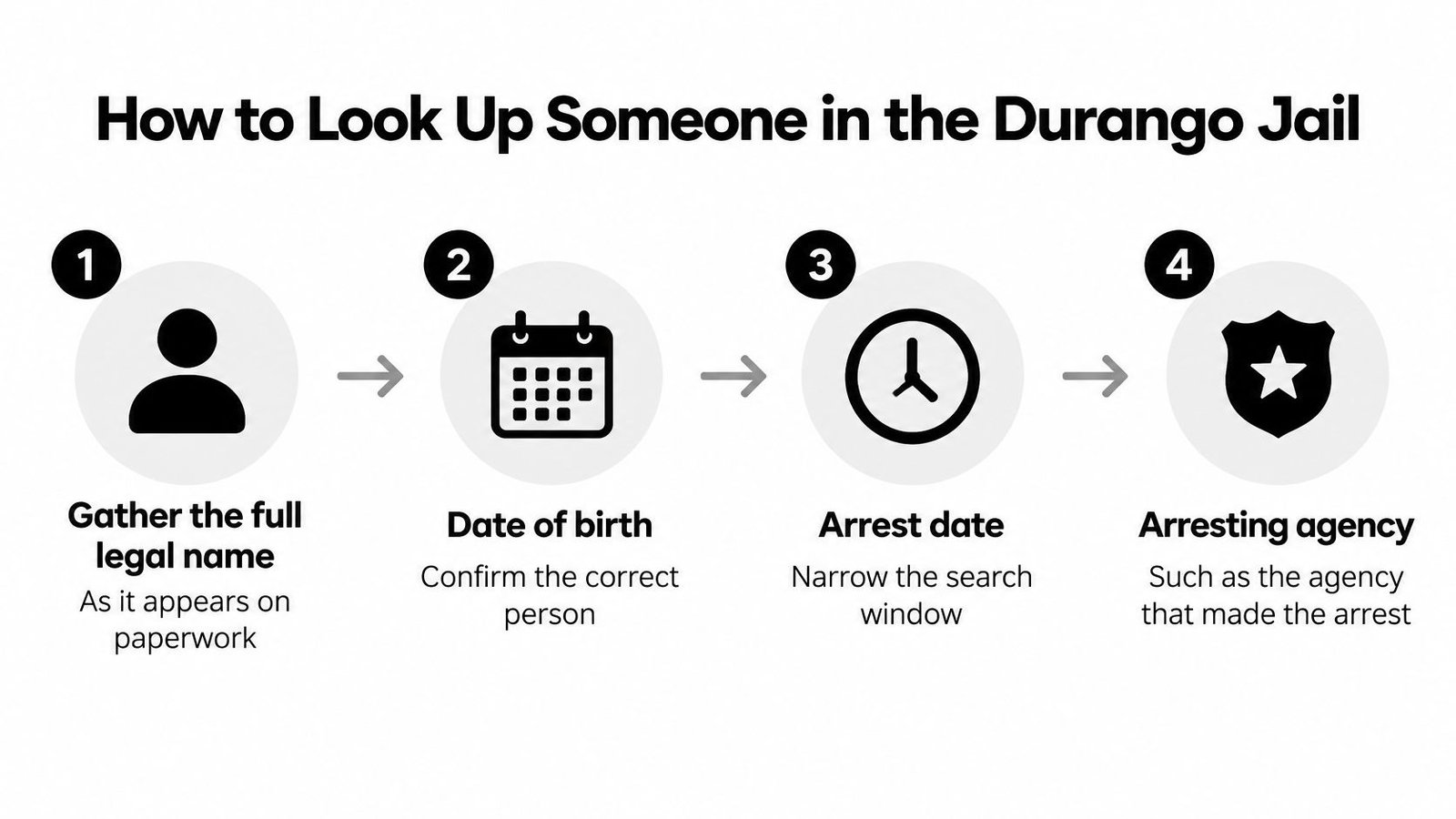
Gather identifying details. Start with the full legal name and date of birth. If available, keep the arrest date and arresting agency handy. A nickname or a different spelling can make a search harder.
Search the official roster. Check the jail's public inmate roster and county inmate search. If a record appears, note the booking number and booking date. Use the Colorado inmate locator tool as another starting point, but confirm the result with the facility.
Try a broader search if needed. Check alternate spellings and dates around the reported arrest. If no record appears, consider whether another agency made the arrest or booked the person elsewhere. An arrest near a county line may not result in custody in Durango.
Treat third-party listings as leads. Commercial sites can help identify a possible match, but their contact details and custody information may be outdated. Confirm the record through an official source before making decisions based on it.
Confirm current custody by phone. Online records can lag behind changes in custody. Call the detention facility, provide the booking number if available, and ask whether the person is still in custody. A roster entry alone does not establish whether a court order or another hold affects release.
If the online record and facility staff give different answers, rely on the facility's current custody information. Keep the person's full legal name, booking number, and arrest date available when you call.
Visitation Rules and How to Book a Visit
You cannot walk up to the La Plata County Detention Facility and expect a visit. JailExchange's visit guide states that visitation requires advance online registration through JailATM. Appointments must be scheduled at least 24 hours before the visit and may be scheduled as far as one week ahead. That window is how you plan around a court date without booking too early or too late.
Visitors must check in 10 minutes before the appointment and present valid photo identification: a driver's license, state identification card, or military ID. Visitors younger than 17 must be listed as additional visitors and accompanied and supervised by an authorized visitor who is at least 18.
| Visit requirement | Rule | Why it matters |
|---|---|---|
| Registration | Online through JailATM | The booking route described for visits |
| Earliest booking | At least 24 hours before the visit | Bookings inside 24 hours do not qualify |
| Latest booking | Up to one week ahead | Lets families plan around court dates |
| Check-in | 10 minutes before the appointment | Arriving late may affect your slot |
| Photo ID | Driver's license, state ID card or military ID | Missing or expired ID can stop the visit |
| Visitors under 17 | Listed as additional visitors and accompanied by an authorized visitor aged 18 or older | A minor cannot visit alone |
When the plan falls apart
An expired license stops the visit even if the appointment is confirmed. A full slot means you pick another time inside the one-week window, not that staff will squeeze you in. If the person has been moved or released, the appointment does not follow them. Call 970-247-1161 and ask whether the visit is still on the schedule. Procedures and open appointments change, so a confirmation email from yesterday is not enough on the day you drive.
Bring the booking number, a current photo ID, the JailATM confirmation, and a note of the arrival time. If you want a plain-language pass at common facility limits before you register, read our jail rules notes, then follow whatever the Durango desk tells you today.
How Long Release Can Take in Durango
Open beds do not set the clock. Processing does.
In August 2024, the Durango Herald described 311 physical beds, of which 30 minimum-security dormitory beds were unsuitable for higher-security prisoners and 21 more were unavailable for operational reasons. That left 260 physically usable beds before classification, gender separation, and security rules. Administrators treated the jail as effectively full at about 75% of physical capacity, about 190 inmates, so new arrests still had a place to go. Operating capacity had earlier been identified as 195, and the population reached 207 in late July 2024. A 2025 report in the same coverage put the average day at about 160 people, against about 190 in 2019. A separate Durango Herald account has also described a total capacity of 293 inmates. Headline beds and daily housing are not the same number.
| Measure | Figure | What it means |
|---|---|---|
| Physical beds reported in August 2024 | 311 | Building count, not what can be used |
| Minimum-security beds unsuitable for higher-security inmates | 30 | Cannot house most higher-security arrests |
| Beds unavailable for operational reasons | 21 | Removed from daily use |
| Physically usable beds before classification rules | 260 | Starting point for housing decisions |
| Effective full point used by administrators | about 190 (75% of physical capacity) | Reserve kept for new arrests |
| Operating capacity previously identified | 195 | Earlier planning figure |
| Population in late July 2024 | 207 | Above the operating figure at that time |
| Average daily population in 2025 | about 160 | Varies by year and policy |
| Average daily population in 2019 | about 190 | Earlier baseline |
| Reported total capacity in prior years | 293 | Headline figure in county reporting |
What actually sets the wait
Ask which stage the person is in. A bed count cannot answer that.
- Booking and medical screening come first. Nobody moves to a housing decision, or to the door, until identity and a health screen are done.
- Classification and housing decide which unit is even legal for that person. Gender separation and security level can leave a "free" bed unusable.
- Court schedules control the first appearance. If a judge has not acted, the jail is waiting on the court.
- Transport between a holding spot and the facility, or to court, adds time the family cannot see on a roster.
- Release paperwork and property return still have to finish after a bond is accepted.
I would ask one question on the call: which of those five stages is this person in right now? For what the door looks like once the legal pieces are done, see our notes on jail release.
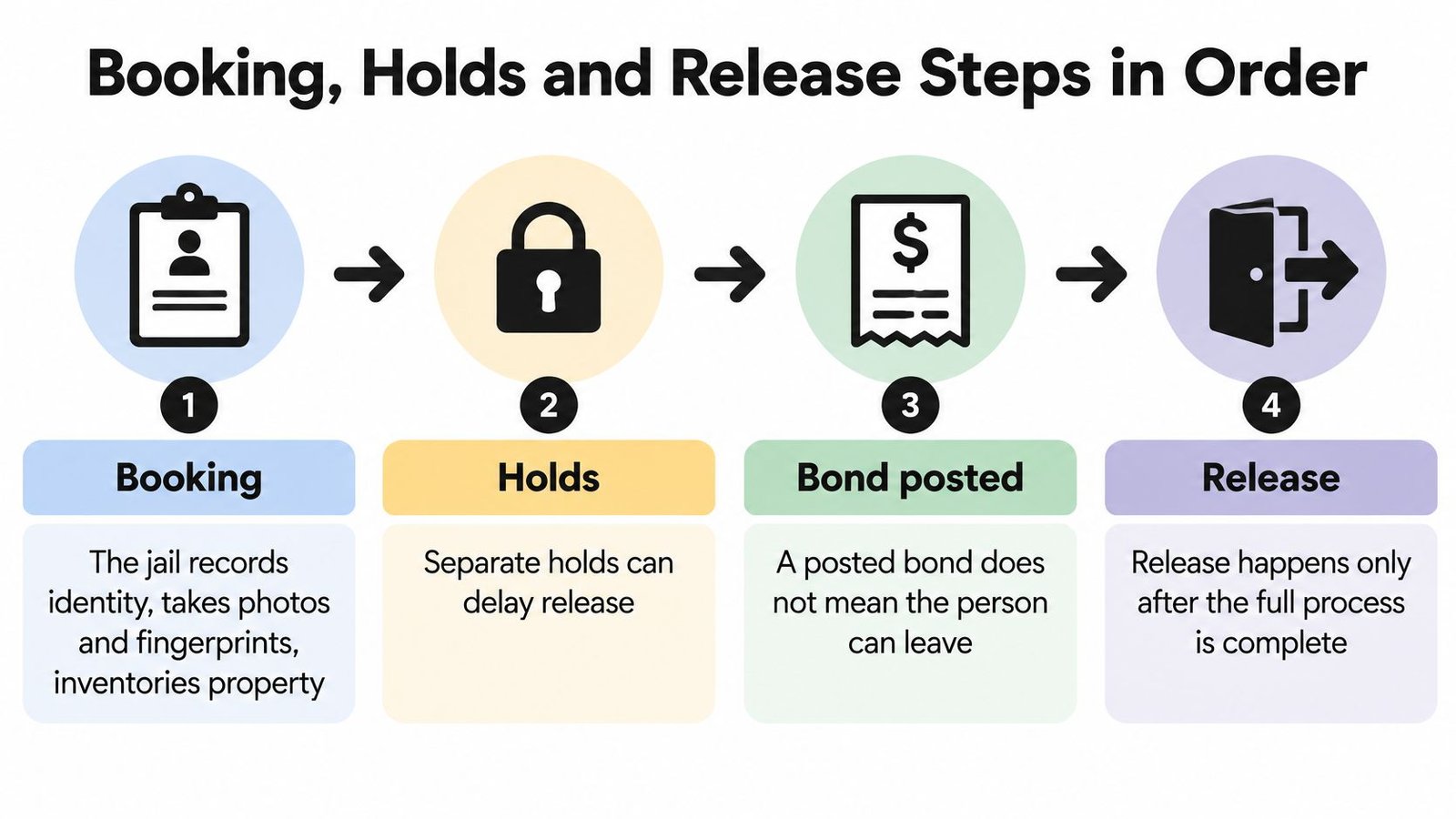
Booking, Holds and Release Steps in Order
Say your brother was arrested on a Tuesday night. By Wednesday morning a roster shows a dollar amount. That is the moment most families decide he is almost out. He usually is not.
JailExchange's facility page is clear on the gap: La Plata County detainees may be released on recognizance, held for court, or released after a bond is paid, and a listed bond amount does not necessarily mean immediate release. The person may still need a first appearance, a judicial order, identity verification, or clearance of another hold. Ordinary jail custody is also not the same thing as a Colorado Department of Corrections record. One lookup can miss the reason someone is still there.
The timeline, and the two false finishes
Booking is the jail's stage. Staff record identity, take photos and fingerprints, inventory property, and run medical and classification screening. Nothing you pay skips that work.
The first court appearance is the court's stage. A judge reviews the charges and sets bail or other release conditions, which can include a dollar amount plus supervision terms. Families often treat the first time a bond amount appears on a roster as proof that release is underway. It is only proof that a number has been written down.
Bond type and amount then have to match. The court record and the jail booking record need to say the same thing. If they don't, the jail will not treat payment as complete.
Holds sit beside the bond. Any one of these can block the door after bail is set: a first appearance that has not happened, a judicial order, identity verification still open, a warrant or hold from another jurisdiction, or a medical or classification review that is not finished. Out-of-state relatives hit this wall most often, because paying feels like the only lever they have.
Release processing is the jail again. Staff complete the accepted bond, finish identity checks, and return property. Payment does not erase that queue. The second false finish is the moment a card is charged or a surety is accepted. Acceptance starts release processing. It is not the walk to the lobby.
After the door, court dates, conditions, and reporting continue. Leaving the building does not close the case.
A posted bond is a court decision on paper. Discharge is a jail action that happens only after holds, identity, and paperwork are clear.
Before you arrange payment, ask the jail or the court one question: is anything blocking this person's release today? A bond agency is useful once a qualifying surety bond is available, not before that answer.
Choosing a Bail Bond Route and Remote Cosigner Steps
The bond amount is set, but the release time is not. A surety or property bond may involve fewer upfront funds than cash bail, yet each route has different costs, paperwork, and approval steps.
A SearchSystems summary of La Plata County jail information reports about 69% utilization, an average daily population of approximately 160 in 2025, and 230 rated beds. Bed space alone does not determine how quickly someone is released. Medical screening, classification, court schedules, transport, and jail paperwork can all affect timing.
Three ways to cover the bond
| Route | Cost to family | Collateral | Paperwork |
|---|---|---|---|
| Cash bail | Full bond amount paid to the court | Cash | Court receipt and case number |
| Surety bond | Non-refundable premium paid to a licensed agent | Often a cosigner, sometimes added collateral | Application, photo ID and agent contract |
| Property bond | Court costs rather than an agent premium | Real property or equity | Title or deed records and court approval |
With cash bail, you pay the full amount up front. It may be returned after the case if the person attends court, minus any lawful fees the court keeps. A surety bond requires a non-refundable premium to a licensed agent, so it can reduce the cash needed at the start but does not come back when the case ends. A property bond uses real estate or equity and requires court approval of the title. That process can take longer, so consider it when cash and a surety bond are not workable options.
If the cosigner is out of state
An out-of-state cosigner may be able to complete paperwork electronically, but that does not set the release time. Confirm with the jail whether it will accept electronic bond paperwork before sending payment or documents. Express Bail Bonds offers online applications, payments, contract documents, and bond posting at most Colorado detention facilities.
Have these details ready:
- Government photo ID for the cosigner.
- Proof of address, such as a utility bill or lease in the cosigner's name.
- Booking details: full name, date of birth, booking number, and the bond amount confirmed by the jail and court.
- A payment method you can use during the call, and a receipt for the transaction.
- A court plan for who will help the defendant track the next appearance and follow the court's conditions.
The guide to cosigning for someone in another state explains what to consider before completing paperwork remotely. If the person is held in Jefferson County, use the Jefferson County bail bonds process. For an arrest in the Centennial area of Arapahoe County, see the Centennial bail bonds information.
Court Dates, Case Numbers and Conditions
Jail custody and the court case are two files. The jail can tell you someone is housed. The court can tell you what the judge ordered. Mixing those calls is how people miss a date that was never on the roster.
Get the case number from the court. Ask the clerk, or read the booking record for the case or charge reference the court uses. A booking number is not a case number. Paying against the wrong one stalls the file.
Confirm the next appearance with the clerk. Get the date, time, and courtroom. A missed appearance can bring a warrant even when bail was posted and the person already went home. Write it down while you're on the phone, then read it back.
Read the bond order, don't just note the dollars. Look for supervision, no-contact terms, travel limits, and reporting. A family that only remembers "$2,000" can walk the defendant into a violation on day one.
Match the court to the arrest. The agency that made the stop and the court that has the case are not always the same. Confirm the court before anyone pays. A city arrest can still sit on a county docket, and the reverse happens too.
Keep a contact log. Case number, judge's name if the clerk gives it, date of each call, and who you spoke with. When the roster changes overnight, that log is what you compare.
Call the detention facility when the question is custody, housing, or whether release processing has started. Call the court when the question is the case number, the next date, or the wording of the order. Use phone numbers from the court and the sheriff, not from a commercial jail directory. Those directories go stale, and a wrong clerk's office will cheerfully give you another county's calendar.
Confirm Custody and Bond Status Before You Pay
Don't send money because a webpage looks complete. Run three checks, in this order, on the day you intend to act.
Call the detention facility at 970-247-1161. Give the full name, date of birth, and booking number. Ask for custody, booking status, bond type, bond amount, and any hold. If staff cannot confirm the person is still there, stop.
Call the court. Ask which case number applies and when the next appearance is set. If the clerk and the jail quote different amounts, do not pay either figure until they match.
Ask the jail about the paperwork path. Will this facility accept electronic bond documents today, and does the cosigner have to appear in person? A yes on a bond amount is not a yes on remote filing.
If bond is set and no hold applies, a licensed agent is the next call, not another refresh of the roster. Express Bail Bonds is a fully licensed Colorado bail bonds agency. We serve all of Colorado with electronic documents at jails that do online bonds. Agents are available 24/7 by call or text at 720-984-2245, and we quote fees and premiums before any commitment. Start the online process at Express Bail Bonds.
Jail and court information changes between a morning call and an afternoon payment. Verify each detail with the office that owns it on the day you act.
If the Durango checks come back clean and a surety bond is the right route, Express Bail Bonds can take the application, payment, and contract online and post at most Colorado detention facilities, including this one when the jail accepts electronic bonds. We walk families through the fee, the court date, and what the jail still has to finish after the bond is in. Visit Express Bail Bonds or call or text 720-984-2245 when you're ready to move.