At 2 a.m., the phone rings and somebody says your brother got picked up somewhere around the 80247 ZIP code. You know the call matters, but you don't know whether the arrest went through Denver, Aurora, or one of the county facilities in between, and that's where families lose time. In that moment, the right move is simple, stay calm, confirm the booking location, gather the basics, and get a bondsman on the line before you start guessing at courthouses.
That's the practical purpose of this guide. 80247 isn't a postcard neighborhood profile, it's a working part of the Denver metro where boundaries, jail intake, and release timing can change fast depending on the address, the arresting agency, and the paperwork. If you need a live human, Express Bail Bonds is available 24/7 at 720-984-2245, by call or text, and the point is to shorten the gap between that first call and release.
A Quick Scenario Before the 80247 Zip Code Explainer
The most common mistake after an arrest in this part of town is wasting the first hour arguing over the ZIP code instead of finding the booking record. A family hears “80247,” assumes that settles everything, then discovers the person could be headed through a Denver, Aurora, or county process depending on where the stop happened and which agency wrote the report.
Start with the booking, not the memory
If the arrest happened near a boundary line, the city on the record matters more than the ZIP on the mail. The same area can sit inside a dense urban grid where one block points toward Denver procedure, another toward Aurora handling, and a third toward county intake. That's why families should ask for the full legal name, date of birth, and the facility name first, then work backward from there.
Practical rule: don't call three jails in a panic. Confirm one booking location, then make one clean plan.
The rest of this article is built for that exact moment. You'll get the geography, the detention-facility logic, the bail steps, and the paperwork that moves a release forward. If the call comes in tonight, the job is not to memorize Denver law, it's to know what to ask, who to call, and how to stop the clock.
Where 80247 Actually Sits and Why the Borders Matter
80247 is not a clean little neighborhood box. It overlaps parts of Denver, Aurora, and county boundary areas, which is exactly why a person arrested there might not end up in the jail someone expects. The city listed on the arrest record often tells you more than the ZIP code printed on a mailing label.
Read the map like a bail agent would
The practical question is simple. Did the stop happen in a Denver-controlled stretch, an Aurora-controlled stretch, or along one of the county edges where the booking path can shift? In a dense metro area, that distinction drives everything that follows, from the first jail search to the court that picks up the case.
That's why 80247 has to be treated as a working ZIP, not a destination. The area is compact, crowded, and tied to commuter movement, so arrests don't funnel through one predictable doorway. When families understand that, they stop asking the wrong question and start asking the one that matters, “Which facility has them right now?”
For a local comparison point, the same boundary logic is why nearby ZIPs can behave differently from one another, and why a separate neighborhood page such as the 80231 ZIP code overview won't tell you where a person from 80247 was booked. The boundary, not the mailing code, is the key.
Population, Demographics, and Safety Profile of 80247
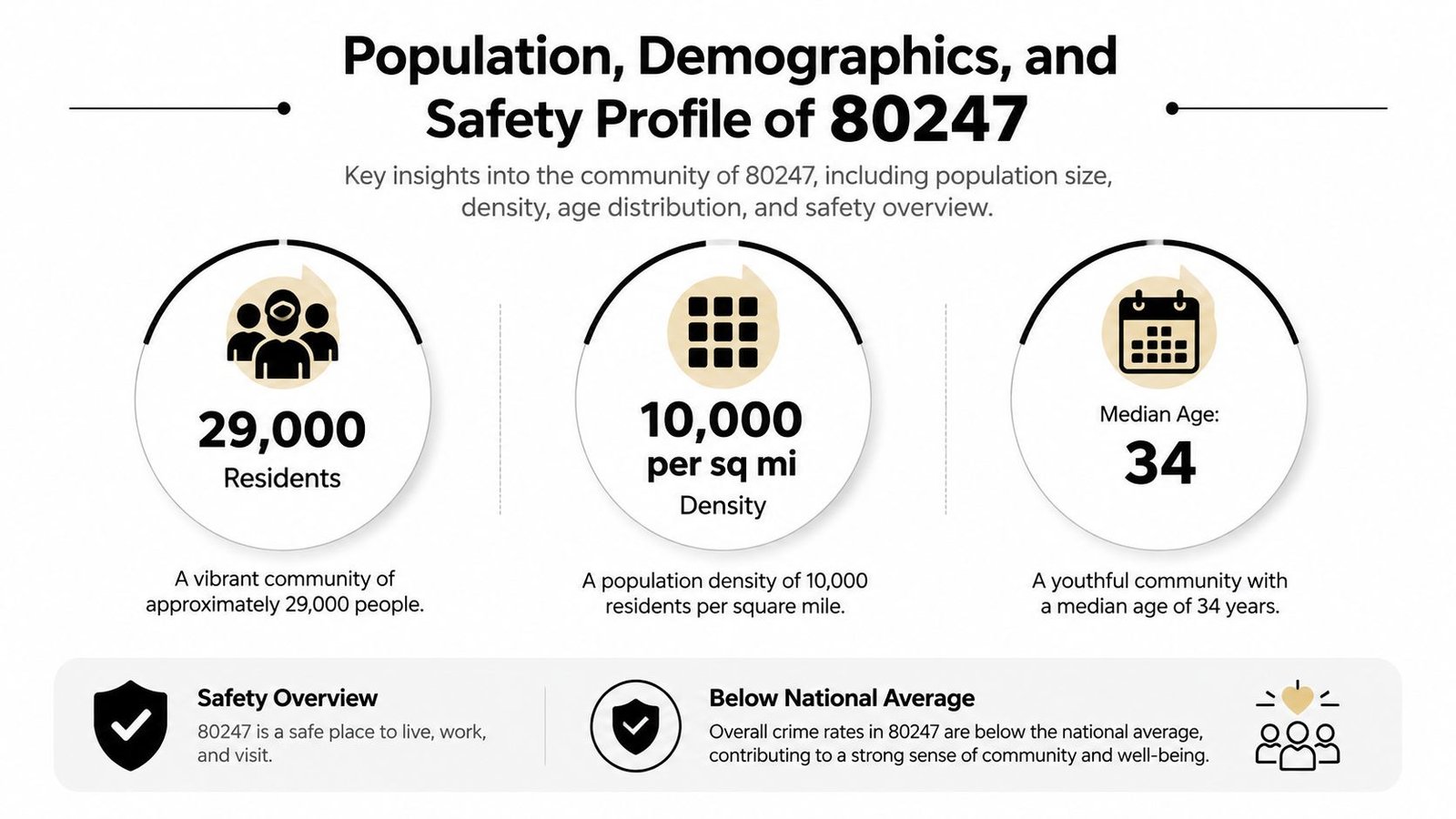
An arrest in 80247 usually starts in a dense, built-out part of town, where apartment turnover, street traffic, and mixed-use blocks make contact details harder to trust than people expect. One profile places the ZIP at about 29,453 residents and roughly 10,115 people per square mile (IncomeByZipCode), while another independent source puts it at 28,580 residents and 8,729 people per square mile (ZipDataMaps). The exact count can shift by source, but the practical picture stays the same. 80247 is crowded enough that a fast jail check matters more than a general neighborhood assumption.
What those numbers mean in practice
The median age is about 35.3 years (IncomeByZipCode), which points to a working-age area where phones change hands, tenants move, and family contact can break down after a booking. One profile shows 41.8% of residents with at least a college degree and a median household income of $63,798 (Simplemaps). Another housing profile lists a median household income of $60,211 and a median home value of $352,783 (HometownLocator). That mix suggests a middle-income ZIP under real housing pressure, with enough turnover to make follow-up slower than families want.
The housing picture points in the same direction. One dataset reports 58.9% renter-occupied units and 34.0% owner-occupied units (IncomeByZipCode), while another lists 9,590 renter-occupied units and 5,534 owner-occupied units out of 16,284 housing units (HometownLocator). In plain English, this is a renter-heavy ZIP, and renter-heavy ZIPs usually mean more address changes, more call-backs, and more work to keep family members connected after an arrest.
Crime context matters here too. CrimeGrade places the overall crime rate at 64.01 per 1,000 residents and says incidents are concentrated in the southeast parts of 80247 (CrimeGrade). That does not mean every block feels the same. It does mean families should treat an arrest in this ZIP as time-sensitive and location-specific, because the booking path and the release path can change block by block.
For a bail agent, those details are not trivia. They explain why a call from 80247 often turns into a search for the exact jail, the exact court, and the exact paperwork before anyone can get traction. If you need the local numbers in one place, county jail phone numbers is the kind of reference sheet that saves time when the clock is already running.
Nearby Detention Facilities and Courts You May Need to Contact
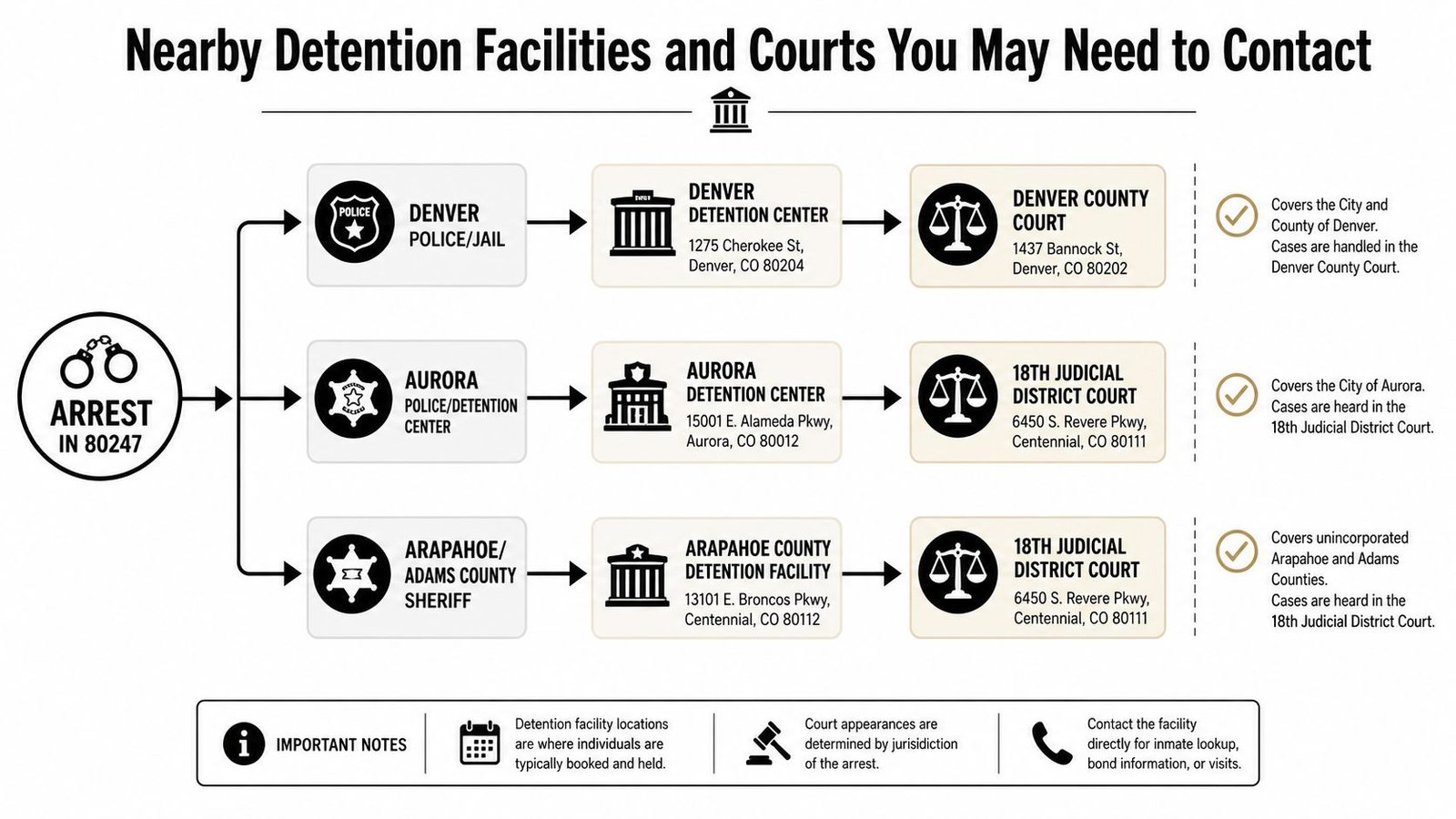
An arrest in the 80247 area can start one way and end somewhere else. A stop near the border may lead to a Denver booking, an Aurora detention hold, or a county facility, depending on which agency made the arrest and how the charge is filed. Families lose time when they guess wrong, so the first job is to identify the exact jail and the court that will handle the case.
The facilities families usually need to check
A Denver arrest can move into the city jail system and later into Denver County Court for the case track. An Aurora arrest may go through Aurora detention and then into Aurora Municipal Court or the county system, depending on the charge. If the matter is handled on the county side, Arapahoe County Court or Adams County Court may be where the next hearing shows up.
The quickest way to find out where someone is held is to work from the booking information, not from the ZIP code alone. Get the arresting agency, the jail intake line, or the jail search portal to confirm the exact facility, then copy the name exactly as it appears in the record. If you need a local reference sheet, county jail phone numbers helps cut down the back-and-forth that slows a release call.
For families comparing how detention and court coverage shifts across metro counties, it helps to look at local examples like Jefferson County Golden Colorado and Centennial bail bonds. Those pages show the practical difference between jurisdictions, because the first step stays the same everywhere, confirm the facility, then move on to the bond.
How the Colorado Bail Process Actually Works
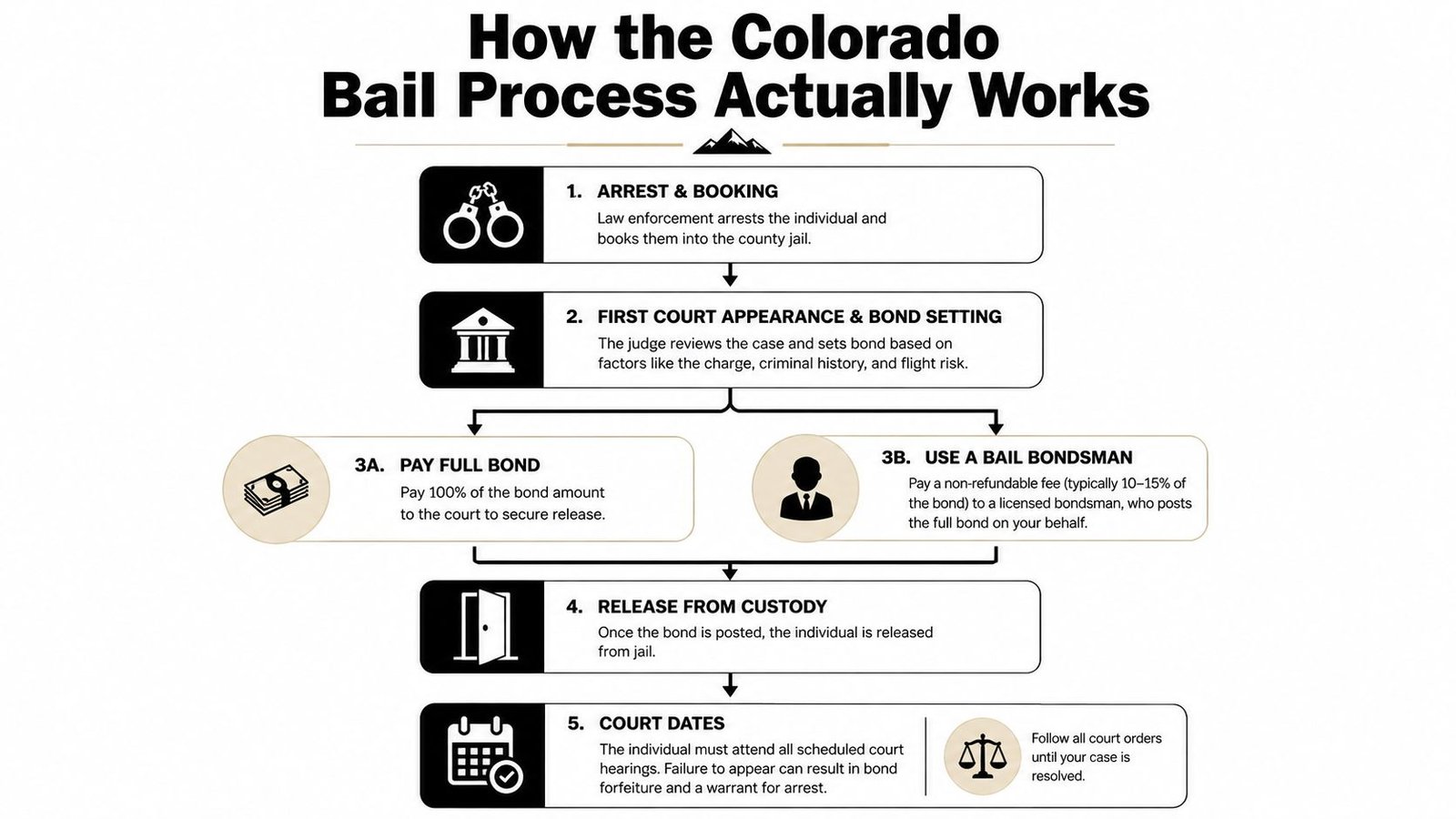
Colorado bail starts with a judge, not a family member, and that detail matters more than many realize. At the first court appearance, the judge sets the bond, then the defendant or the family decides whether to pay cash, use a surety bond, or handle property-based options if they're available. The process becomes much less confusing once you separate the court's job from the bondsman's job.
What usually happens after booking
A licensed bondsman can post a surety bond for a non-refundable premium. Colorado's standard premium is 15%, and for bonds over $5,000 Express Bail Bonds often secures 10% with an approved cosigner. That's the main financial fork in the road, and it's why the cosigner's information matters early.
The bond agent will usually want the defendant's full legal name, date of birth, the booking facility, the charges, and any court date already assigned. If you've got the booking number, bring that too. Those details let the agency verify the case, confirm the amount, and avoid delays caused by bad spelling or mixed-up identities.
A useful way to think about the timeline is this, the call starts the process, the paperwork validates it, and the jail completes it. The speed usually depends on how quickly the family gives accurate information and how fast the facility posts the release after the bond is accepted. That's why clean documents matter as much as cash.
How does bail bonds work is a helpful plain-English explainer if you want the legal mechanics spelled out more slowly. The short version is simple, the judge sets the bond, the bondsman posts the surety, and the defendant gets released once the facility finishes its part.
What Posting Bail Online With Express Bail Bonds Looks Like
A jail call rarely happens at a convenient hour. The practical question is how fast a family can get the bond moving without driving across town, waiting at the wrong desk, or missing a required signature. With an online process, a relative can call 720-984-2245, confirm the facility and bond amount, and finish the application, contract, and payment from a phone or laptop. That keeps the focus on release, not on running errands around the metro.
A realistic same-night workflow
The call usually starts at home, with one person opening the paperwork while someone else checks the booking details. The bondsman verifies the arrest, confirms the release conditions, and posts the bond after the documents are signed and the premium is handled. If the facility is moving at a normal pace, that can cut out extra trips and reduce confusion about who needs to sign and what needs to be sent.
For families who want to skip a longer back-and-forth, the simplest route is to pay bail bond online once the case details are confirmed. That option works best when the booking information is accurate and the cosigner can get the paperwork done without waiting for office hours. It also helps when the defendant is booked in one part of the metro and the family member handling the bond is somewhere else.
The advantage is distance. A bond can get started from home, a workplace, or a car outside the detention facility, which matters when the arrest happens far from where the cosigner lives. Families usually want the same two things, a person who answers the phone and forms that do not create another delay. The online route is built around that problem.
Key Contacts, Documents, and Fees to Keep Handy
If an arrest happens, speed comes from preparation, not panic. Keep the defendant's full legal name, date of birth, the booking facility name, and the case or charge number if you have it. For the cosigner, have a photo ID, proof of address, and employment information ready so the application doesn't stall.
| Item | Detail |
|---|---|
| Core phone line | 720-984-2245, available 24/7 by call or text |
| Standard premium | 15% |
| Larger bond option | 10% on bonds over $5,000 with an approved cosigner |
| Website | expressbailbonds.com |
| Documents for the defendant | Full legal name, date of birth, booking facility, charges, court date |
| Documents for the cosigner | Photo ID, proof of address, employment information |
| Bond type focus | Surety bonds, not cash-only bonds |
Keep the list short and usable
The right checklist is the one you can read under stress. Write the facility name first, because everything else depends on that. Then add the charges, the bond amount, and the best number to reach the family member who can cosign.
For people who want to know exactly what paperwork gets asked for, what documents do I need is worth saving before anything happens. That resource pairs well with the practical rule here, the faster you can verify identity and paperwork, the faster the bond can move.
If you're comparing coverage across Colorado, remember the agency works across Denver, Arapahoe, Jefferson, Douglas, Weld, El Paso, and other counties. That matters in metro cases because the arrest county and the home county are often two different places.
Acting Fast When an Arrest Hits the 80247 Area
An arrest in the 80247 ZIP code moves fast once the booking process starts, and the phone call that follows should be just as focused. The first question is where the person was booked, because that decides who can accept the bond, what paperwork the jail will ask for, and how long the release takes to get moving. Around Denver and Aurora, those details matter more than the zip code itself, especially when the arrest happens near a border and the family has to sort out the right facility under stress.
If the person is already under a restrictive hold, the broader confinement rules can affect what happens next. The pretrial confinement restriction FAQs from Gonzalez & Waddington give useful background on that side of the process. For families dealing with a local arrest, the practical job stays the same, confirm the booking location, gather the paperwork, and get one accurate call to a bondsman who works these facilities every day.
The short version is simple. Keep the defendant's full name, date of birth, and booking location ready, then make sure the cosigner has what the jail and bond office will ask for. That cuts down the back-and-forth that slows release, especially when the arresting agency and the jail are in different parts of the metro area.
If you need the contact saved before anything happens, keep Express Bail Bonds handy and check the county coverage pages ahead of time. In 80247, speed usually comes from knowing who holds the inmate, who can sign, and who can process the bond without wasting a night on guesswork.
If someone you care about gets arrested in the 80247 area, do not spend the night chasing the wrong jail or waiting on bad information. Call Express Bail Bonds at 720-984-2245, use the online process if that gets the bond moving faster, and start release with a Colorado team that handles these cases every day.